How-to guide
How to Calculate ROI on a Small Business Investment
ROI is one subtraction and one division: the value you got back, minus what you put in, divided by what you put in. Spend $4,000 on a second commercial oven and it produces $6,000 in extra gross profit over the year, and your ROI is (6,000 − 4,000) ÷ 4,000 = 50%.
The arithmetic is trivial. Deciding whether 50% is *good* is where most small businesses go wrong, because two adjustments most calculator pages skip are what turn the number into a decision. The first is time: a 50% return earned over four years and a 30% return earned over eight months are not comparable until you convert both to a per-year rate. Fidelity's ROI primer makes the same point about holding periods — a 10% return over ten years is a weaker annual performer than 5% over one — and then lists the other things the basic formula silently ignores: taxes, inflation, and risk.
The second adjustment is the alternative. ROI has no universal pass mark; it only means something next to what else that money could have done — paying down a 24% business credit card, sitting in a savings account, or staying in your pocket. An owner-operator weighing a new delivery van, a website rebuild, or a piece of equipment is really asking a comparison question, and "50% is a good return" answers the wrong one.
This guide covers the formula, the annualization step, how to judge a result against your own alternatives, two worked examples with realistic small-business numbers, and the traps — counting revenue instead of profit, forgetting the cost of the money — that make a mediocre investment look excellent.
Quick answer: the ROI formula
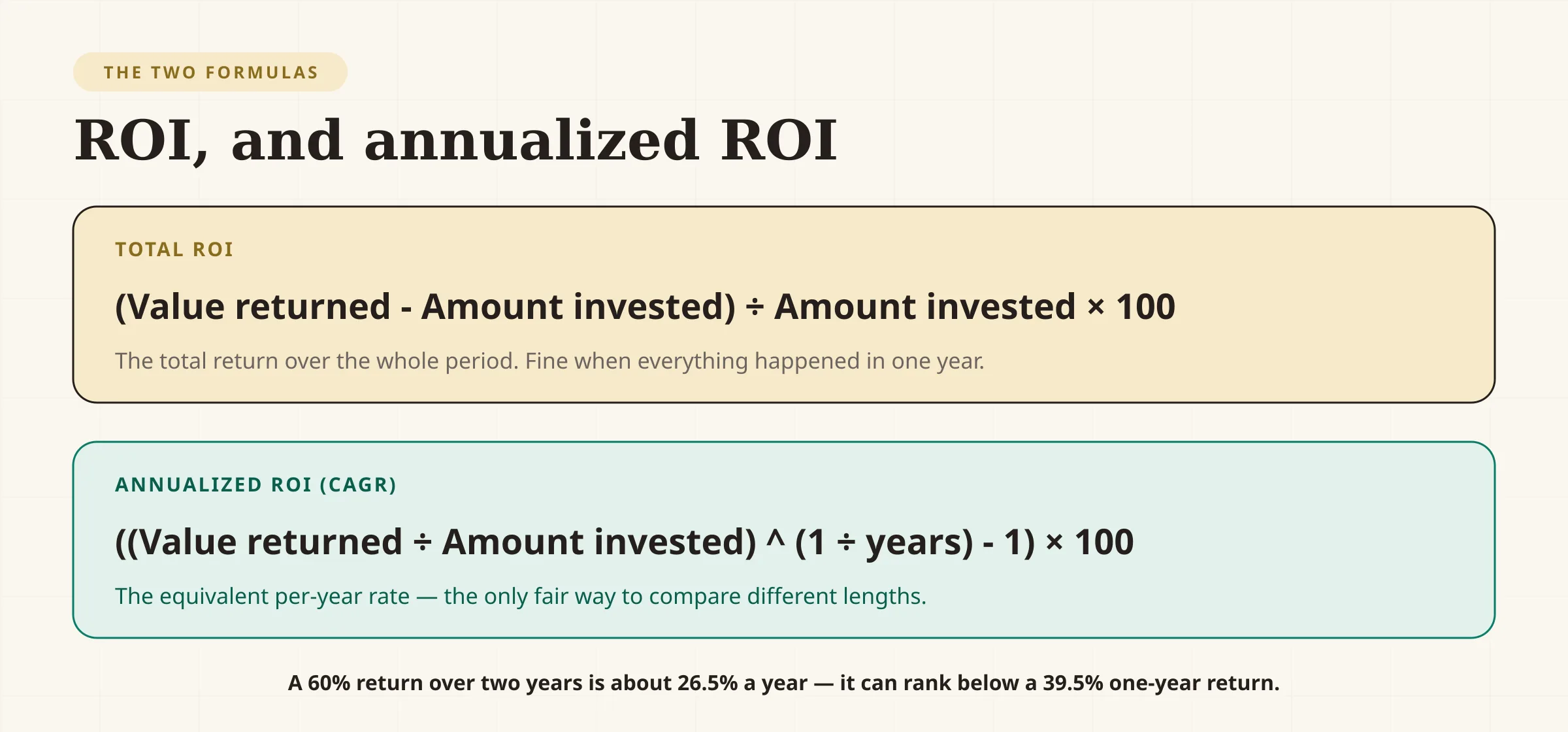
Invest $2,000 in a piece of equipment that returns $2,500, and the ROI is (2,500 − 2,000) ÷ 2,000 × 100 = 25%. Positive ROI means you made money; negative means you lost it. That's the whole formula — everything else in this guide is about getting the two inputs right and then interpreting the output honestly.
If the investment spans more than one year and you want to compare it against something that doesn't, add one more step:
The ROI Calculator does both, and shows the net dollar gain alongside the percentage so a big ratio on a tiny investment doesn't fool you.
How to calculate ROI, step by step
Step 1: Define "amount invested" — and include everything it really cost
The denominator is not just the sticker price. It is the total cash and time the investment requires to start producing a return: purchase price, delivery, installation, setup, any software or training tied to it, and ongoing costs you wouldn't otherwise have. If you finance it, the interest is part of what the investment costs you.
A bakery that buys a $4,000 used oven but pays $300 to have it moved and wired in made a $4,300 investment, not $4,000. That difference drops the ROI from 50% on a $6,000 return to 39.5% — enough to change a close call.
Step 2: Define "value returned" — this is total value, not profit
This is the single most common mistake. The numerator is what you *got back*, not what you gained. Say a $1,000 ad campaign produced $1,500 in gross profit. The value returned is $1,500, and the ROI is (1,500 − 1,000) ÷ 1,000 = 50%. If you enter the $500 gain instead, you'd calculate 500 ÷ 1,000 = 50% too — because in this one case they coincide — but change the numbers and the error compounds. The ROI Calculator is explicit about this: enter the total value received, and let the calculator subtract the investment for you.
For a product business, use gross profit, not revenue, as the value returned. Revenue includes your cost of goods, and counting it as a return double-counts money you never kept. The Profit Margin Calculator and the how to calculate profit margin guide get you to a gross-profit number you can trust.
Step 3: Subtract, divide, and express it as a percentage
(Value returned − Amount invested) ÷ Amount invested, then × 100. Keep the two numbers on the same basis — same time period, same definition of profit — or the ratio is meaningless.
Step 4: Annualize it if the investment isn't a one-year commitment
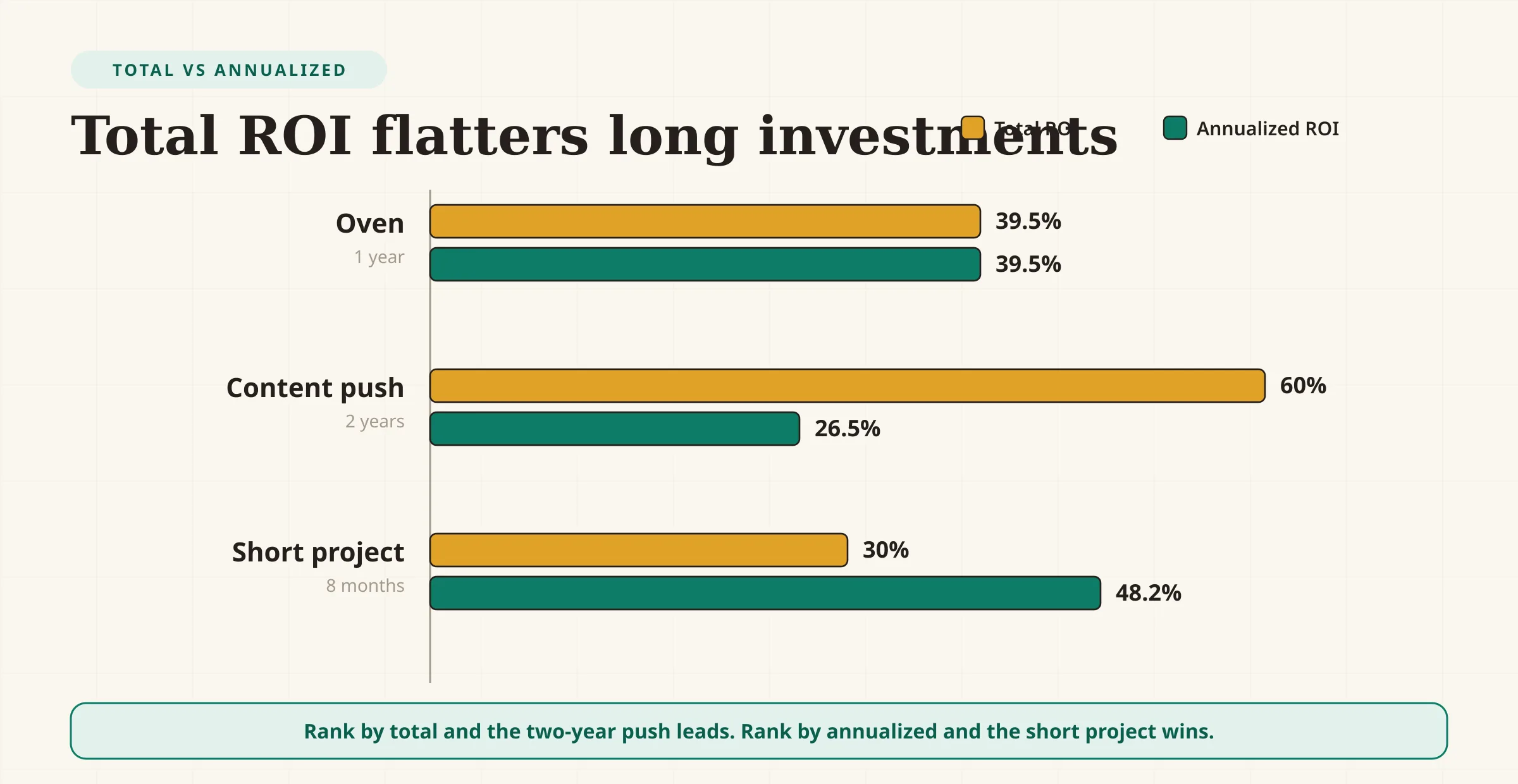
If everything happened inside twelve months, the total ROI and the annualized ROI are the same number. If it took longer, or shorter, annualize so it can be compared. A project that returns 30% over eight months is not a worse investment than one returning 30% over a year — it's a materially better one, and only the annualized figure shows it.
Worked example 1: a one-year equipment purchase
A two-person home bakery buys a second oven for $4,300 all-in and estimates it will add $6,000 in gross profit over the next year from extra orders.
- Amount invested:
$4,300 - Value returned:
$6,000 - ROI:
(6,000 − 4,300) ÷ 4,300 × 100 = 39.5% - Net gain:
$6,000 − $4,300 = $1,700 - Annualized ROI:
39.5%(the period is one year, so it's unchanged)
Every dollar put into the oven returned about $1.40. Nice — but is 39.5% good? That depends entirely on the next section: what else the $4,300 could have done.
Worked example 2: a two-year investment, annualized
An owner invests $10,000 in a content and SEO push and attributes $16,000 in gross profit to it over two years.
- Total ROI:
(16,000 − 10,000) ÷ 10,000 × 100 = 60% - Net gain:
$6,000 - Annualized ROI:
((16,000 ÷ 10,000) ^ (1 ÷ 2) − 1) × 100 = 26.5%
The headline 60% looks better than the oven's 39.5%, but the oven achieved its return in *one* year while this took two. On a per-year basis the oven (39.5%) actually out-earned the content push (26.5%) — the opposite of what the headline numbers suggest. This is why a multi-year investment always gets annualized before it's compared to a one-year one.
What makes an ROI "good": your next-best option
There is no universal good ROI, despite what any single-number benchmark implies. The honest test is comparative. Ask what happens to the same money if you *don't* make this investment:
- Paying down debt is a guaranteed return. If you carry a business credit card at 24% APR, every dollar you put toward that balance earns 24% annualized with zero risk. A project projecting 20% doesn't clear that bar; a project projecting 30% only barely does, and now has to justify the risk.
- The risk-free rate is the floor. Money left in a savings account or Treasury earns the risk-free rate. That's the baseline any risky investment has to beat, not merely exceed zero.
- The stock market is one long-run yardstick. Fidelity notes the S&P 500 has averaged over 10% a year from 1957 through 2024. That's a useful sanity check for a passive alternative, though a small business investment is illiquid and concentrated, so it should demand a higher return, not an equal one.
The practical version: write down your next-best use of the money and its rate. If the investment's annualized ROI doesn't clearly beat it — after accounting for the risk that the projection is wrong — the arithmetic is telling you to do something else.
The two things ROI ignores (and when they matter)
Timing. ROI treats a dollar returned in year one the same as a dollar returned in year five, which is wrong — money sooner is worth more. For a small equipment purchase the distortion is minor. For a multi-year project with big upfront costs, it isn't. The rigorous tools are discounted cash flow, net present value, and internal rate of return, which weight each year's cash by when it arrives. If a decision is large enough to finance, it's large enough to run past an accountant or a spreadsheet built for NPV.
Taxes and inflation. ROI is a pre-tax, nominal number. A 26.5% annualized return taxed at your marginal rate and eroded by inflation is meaningfully smaller in real terms. The Self-Employment Tax Calculator and the small business tax checklist are where that part of the picture lives.
ROI vs ROAS vs CAC: three different questions
Owners often use these interchangeably, but they answer different things:
- ROI asks how much *profit and value* came back per dollar invested, across any kind of investment.
- ROAS asks how much *revenue* came back per dollar of ad spend. It's narrower and revenue-based — see how to calculate ROAS.
- CAC asks what *one new customer* cost you to acquire. See the CAC Calculator and how to calculate CAC.
For a marketing campaign, all three can be useful, but they are not substitutes: a campaign can post a healthy ROAS while losing money once you account for margin, and a strong ROI on equipment says nothing about customer acquisition.
Common mistakes
- Entering profit as "value returned." The numerator is total value received; the calculator handles the subtraction.
- Using revenue instead of gross profit for a product business, which inflates the return with money you never kept.
- Comparing a multi-year ROI to a one-year ROI without annualizing — the mistake that reverses rankings.
- Leaving costs out of the investment — delivery, installation, training, and the interest on financing all belong in the denominator.
- Treating ROI as risk-free certainty. It's a backward-looking result or a projection; a projected number is only as good as its assumptions.
- Ignoring opportunity cost. "It made money" is not the same as "it beat the alternative."
- Forgetting the cost of the money. A financed purchase that returns 15% while costing 12% is a razor-thin spread before risk.
- Judging on one success. Compute ROI across the projects you tried, not just the one that worked, or you'll keep funding your best story instead of your best return.
Checklist
- Amount invested includes purchase, setup, ongoing, and financing costs
- Value returned is total value (gross profit for product businesses), not profit or revenue
- Both figures cover the same period
- Multi-year returns converted to annualized ROI
- Next-best use of the money identified, with its rate
- Annualized ROI compared against that alternative, not a universal benchmark
- Timing, taxes, and inflation considered for large or long projects
- Projection assumptions written down so the actual result can be checked later
FAQs
How do I calculate ROI?+
Subtract the amount invested from the value returned, divide by the amount invested, and multiply by 100. A $2,000 investment that returns $2,500 is `(2,500 − 2,000) ÷ 2,000 × 100 = 25%`. The [ROI Calculator](/tools/roi-calculator) does it instantly, plus annualized ROI.
What is a good ROI for a small business?+
There isn't a universal number. Compare the return to what else you could do with the money — paying down debt at your credit-card APR, the risk-free savings rate, or another project. If it doesn't clearly beat your next-best option after accounting for risk, it isn't good, however large the percentage looks.
What is the difference between ROI and annualized ROI?+
ROI is the total return over the whole period. Annualized ROI (also called CAGR) converts it to an equivalent per-year rate so investments of different lengths can be compared. A 60% return over two years is about 26.5% a year.
Should I use revenue or profit in the ROI formula?+
Use gross profit for a product business, not revenue. Revenue includes your cost of goods — money you never keep — so counting it as a return overstates the investment. Costs, shipping, and fees should be netted out first.
Can ROI be negative?+
Yes. If you get back less than you invested, ROI is negative. A $1,000 investment that returns $800 has an ROI of −20%.
Does ROI account for the time value of money?+
No. Every dollar is treated as equal regardless of when it arrives. For large or multi-year projects, use net present value or internal rate of return, which discount each year's cash flow by when it occurs.
Does this calculator account for taxes and inflation?+
No — it gives the raw, pre-tax, nominal return. Subtract taxes on the gain and account for inflation to see the real return, especially over longer holding periods.
How is ROI different from ROAS?+
ROI measures profit and value returned per dollar invested, for any investment. ROAS measures revenue per dollar of advertising spend. A campaign can have a strong ROAS and still lose money after product and fulfillment costs.
What to do next
Run the numbers on your next investment in three passes. First, get an honest amount invested and total value returned, and compute the basic ROI with the ROI Calculator. Second, annualize it if it isn't a one-year decision so you can compare it fairly. Third, write down the rate on your next-best use of the money — a card balance, a savings account, another project — and only proceed if the annualized return clears it. If the investment is marketing spend, cross-check it against ROAS and CAC so a good headline return doesn't hide an unprofitable campaign.
Free tools to try
ROI Calculator
See your return on investment as a percentage — plus annualized ROI over time.
CAC Calculator
What a new customer costs you — and the LTV:CAC ratio that says if it's worth it.
Profit Margin Calculator
Find your margin, markup, and profit from cost and revenue — instantly.
Break-Even Calculator
Find how many units you need to sell to cover your costs.
Keep reading
Guide
How to Calculate ROAS (Return on Ad Spend)
How to calculate ROAS: the formula, break-even ROAS by margin, platform vs blended numbers, and the attribution traps that inflate reported results.
Guide
How to Calculate Profit Margin (Formula + Examples)
How to calculate profit margin step by step — the formula, the difference between gross, operating, and net margin, and worked examples with real numbers.
Guide
Where to Sell a Small Business: 13 Marketplaces Compared
BizBuySell, Flippa, Acquire, Empire Flippers, brokers and more compared — real listing fees, commissions, and which fits your business type and size.