How-to guide
The Small Business Owner's Tax Checklist
Most "small business tax checklist" PDFs are lists of documents to gather in April. By April, roughly half the deadlines that actually cost a small business money have already passed — the March 15 return date for partnerships and S corps, the January 31 deadline for W-2s and 1099s, and three of the four quarterly estimated-tax dates. A checklist organized around what to *collect* misses the thing the IRS actually penalizes: what's *due*, and when.
The other thing those checklists skip is that there is no single small business tax calendar. As the IRS puts it on its Business taxes page: "The form of business you operate determines what taxes you must pay and how you pay them," with five general types — income tax, estimated taxes, self-employment tax, employment taxes, and excise tax. A sole-proprietor consultant and a 12-employee S-corp bakery share almost nothing on the calendar except April 15.
This checklist is organized the way the year actually runs: deadlines first, then the recordkeeping and deduction rules that make those deadlines survivable. Every figure is verified to irs.gov (or the Social Security Administration) as of September 2026, including the 2026 changes most template checklists still get wrong — the 1099-NEC threshold, the split-year mileage rate, and the new QBI rules.
Quick answer: the whole year on one page
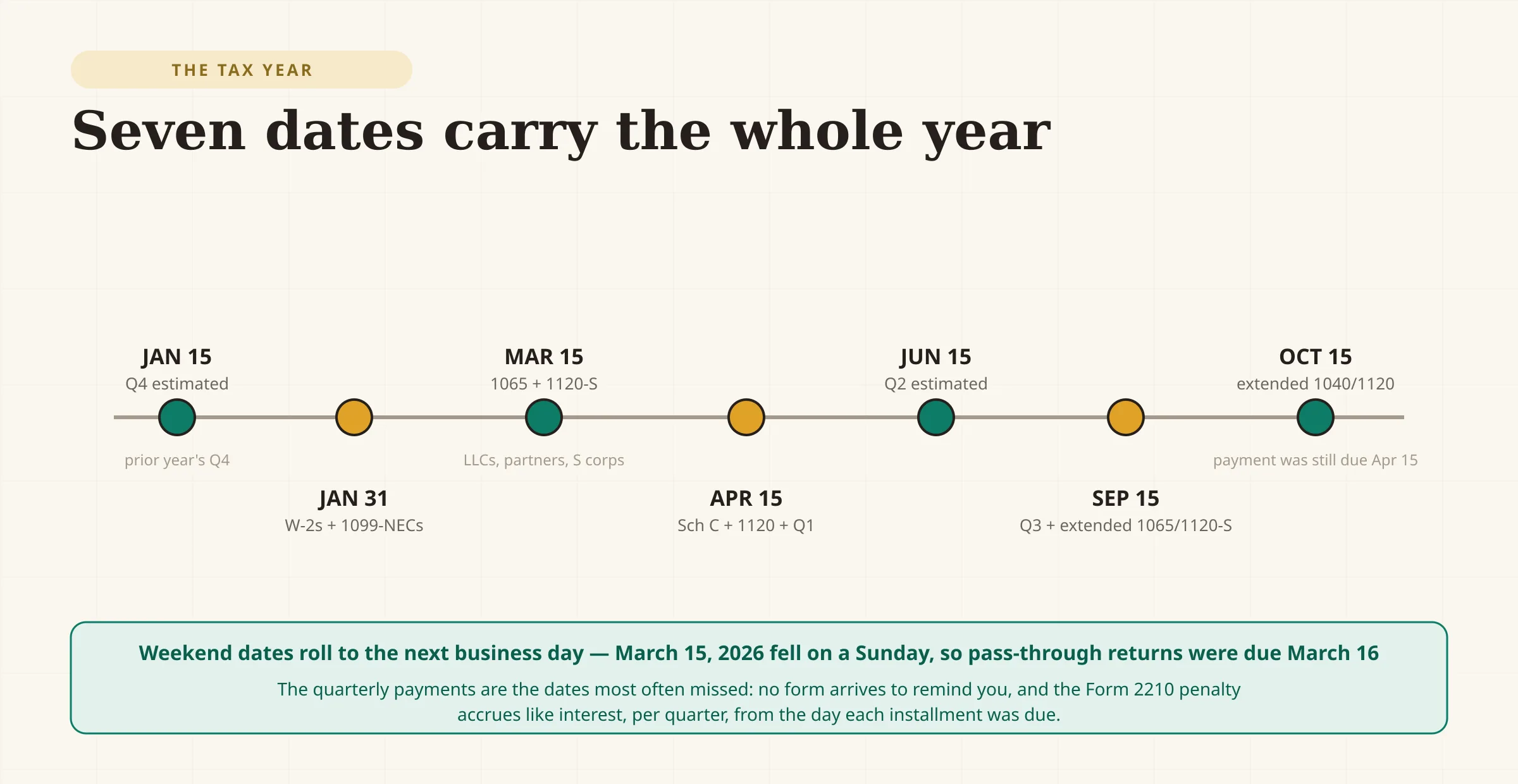
Calendar-year deadlines, in the order they arrive:
| Date | What's due | Who it applies to |
|---|---|---|
| Jan 15 | Q4 estimated tax for the year just ended | Sole proprietors, partners, S-corp shareholders |
| Jan 31 | W-2/W-3 to employees and the SSA; 1099-NEC to contractors and the IRS | Anyone with workers |
| Mar 15 | Partnership (Form 1065) and S-corp (Form 1120-S) returns | Partnerships, multi-member LLCs, S corps |
| Apr 15 | Form 1040 with Schedule C; C-corp (Form 1120) return; Q1 estimated tax | Sole proprietors, C corps, everyone |
| Jun 15 | Q2 estimated tax | Pass-through owners |
| Sep 15 | Q3 estimated tax; extended 1065 and 1120-S returns | Pass-through owners, extended filers |
| Oct 15 | Extended 1040 and 1120 returns | Extended filers |
Two notes on that table: dates that fall on a weekend or holiday roll to the next business day (March 15, 2026 fell on a Sunday, so 2026 pass-through returns were actually due March 16), and extensions extend the *filing* deadline, never the *payment* deadline — tax owed was still due on the original date.
Step 1: Confirm your entity — it determines everything
The same business activity files completely different paperwork depending on its legal form, per IRS Publication 583's entity-to-form mapping:
| Your business | Federal return | Original due date | Extended due date |
|---|---|---|---|
| Sole proprietor / single-member LLC | Schedule C with your Form 1040 | April 15 | October 15 (Form 4868) |
| Partnership / multi-member LLC | Form 1065 | March 15 | September 15 (Form 7004) |
| S corporation (including LLC electing S-corp) | Form 1120-S | March 15 | September 15 (Form 7004) |
| C corporation (including LLC electing C-corp) | Form 1120 | April 15 | October 15 |
The IRS's own Form 1065 and Form 1120-S instructions state the March 15 date for calendar-year filers; the when-to-file page covers April 15 for individual returns. If you formed an LLC and never filed an election (Form 2553 or 8832), you're on the *default* row for your situation — single-member LLCs are disregarded entities filing Schedule C, multi-member LLCs file as partnerships.
Step 2: Quarterly estimated taxes — the four dates nobody reminds you of
Employees have withholding taken from every paycheck. Business owners are their own withholding department, and the IRS expects payment as you go: sole proprietors, partners, and S-corp shareholders who expect to owe $1,000 or more for the year (corporations: $500) must make estimated tax payments on four dates:
- April 15 — income from Jan 1 to Mar 31
- June 15 — April 1 to May 31
- September 15 — June 1 to Aug 31
- January 15 of the following year — Sep 1 to Dec 31
Miss them and the underpayment penalty accrues — it works like interest, computed per quarter on Form 2210. The three ways out of it, per the same IRS page: owe less than $1,000 after credits, pay at least 90% of this year's tax, or pay 100% of last year's tax (110% if your prior-year adjusted gross income exceeded $150,000, or $75,000 married filing separately) — whichever of the last two is smaller.
The practical move for most owners: pay 100% of last year's total tax in four equal installments, which is automatic safe harbor, then true up in April. And note the payments must include self-employment tax, not just income tax — the setting your hourly rate guide shows the divide-by-(1 − rate) correction that keeps freelancers from underpaying on exactly this.
Where the year stands right now: the first three 2026 installments (April 15, June 15, September 15) are done or due, and the Q4 payment for tax year 2026 lands January 15, 2027.
Step 3: Self-employment tax — the 15.3% that surprises first-year owners
Net self-employment earnings of $400 or more trigger self-employment tax: 15.3%, split into 12.4% for Social Security (up to a wage base) and 2.9% for Medicare (no cap). For 2026 the Social Security wage base is $184,500, per the Social Security Administration — above it, only the 2.9% Medicare portion continues.
Two deductions soften it: you deduct the employer-equivalent half of SE tax in arriving at adjusted gross income, and SE tax itself feeds into the QBI deduction's calculation. If you also have a W-2 job, your wages count toward the $184,500 wage base first — so a side business's SE tax may hit the Medicare-only portion, or none at all.
Step 4: If you have workers — employment taxes and the January 31 wall
The "employment taxes" branch of the IRS's five types covers Social Security and Medicare taxes, federal income tax withholding, and federal unemployment (FUTA) tax. The operational rules, from the IRS's employment tax due dates page:
- Deposits, not annual payments. Withheld taxes go on a monthly or semiweekly deposit schedule determined by your lookback period, and any day the undeposited balance hits $100,000, it's due the next business day.
- W-2/W-3 by January 31 — to employees and to the Social Security Administration.
- 1099-NEC by January 31 — to each contractor and to the IRS.
- Filing 10 or more information returns (W-2s plus 1099s combined) requires e-filing.
The 2026 change most checklists still get wrong: the 1099-NEC reporting threshold rose from $600 to $2,000 for tax years beginning after 2025, per the Forms 1099-MISC and 1099-NEC instructions, with inflation indexing from 2027. (The $600 figure survives only for specific 1099-MISC boxes, like gross proceeds paid to an attorney.) If a template tells you to 1099 every $600 contractor for 2026, the template is a year out of date — and paying a contractor $1,500 in 2026 no longer requires a form, though the *deduction* still requires your own records.
Step 5: Recordkeeping — the part that decides audits and deductions
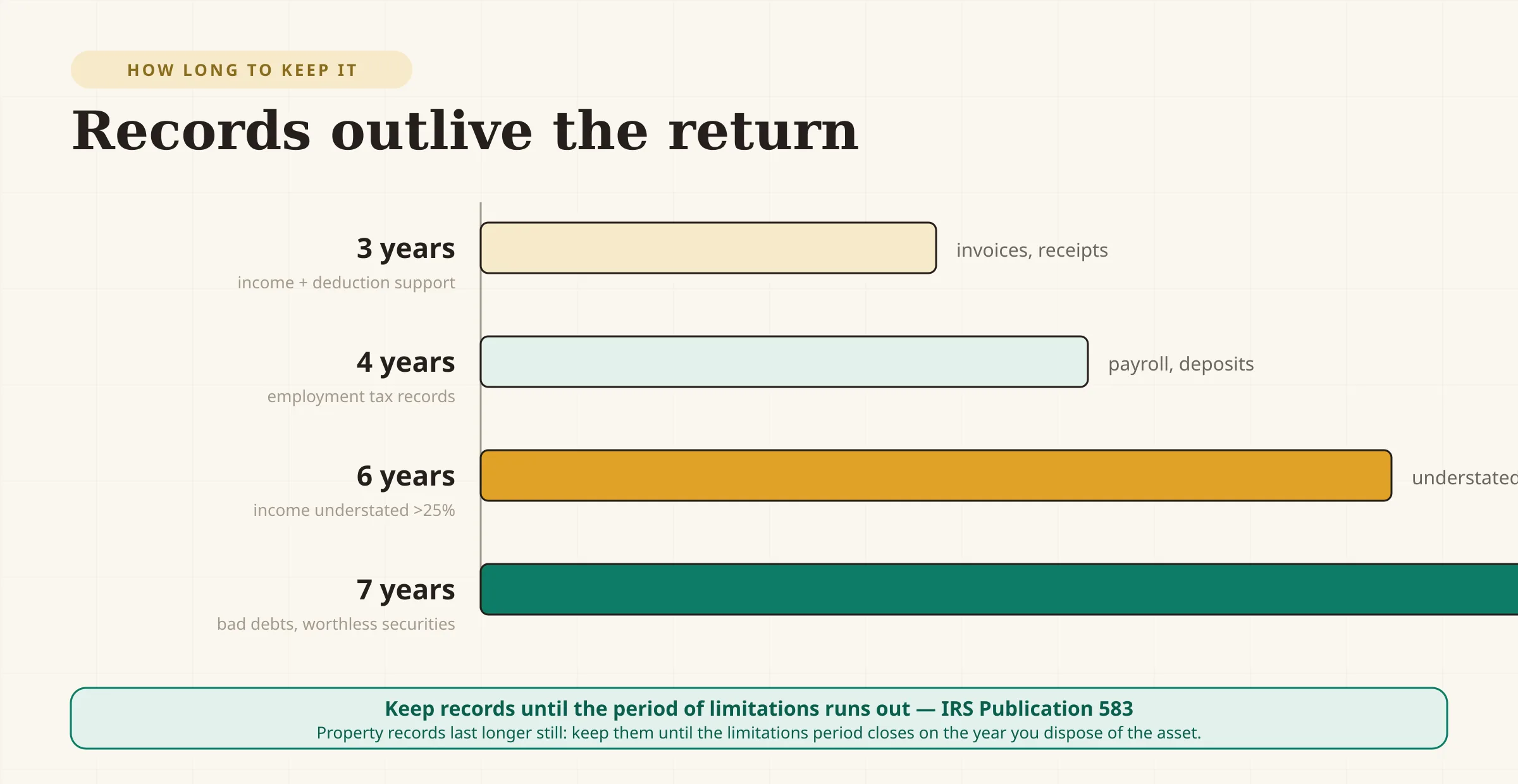
The IRS's recordkeeping rule, from Publication 583: keep records that support each item of income or deduction until the period of limitations for that return runs out. In practice:
| Records | Keep them |
|---|---|
| Income and deduction support (invoices, receipts) | At least 3 years |
| Situations with income understated over 25% | 6 years |
| Employment tax records | At least 4 years after the tax is due or paid |
| Property records (basis for depreciation) | Until the period of limitations expires for the year you dispose of it |
| Records of a bad debt or worthless security | 7 years |
Invoices are gross-receipts records in the IRS's own framing — the how to write an invoice guide covers the ten required elements, and the free Invoice Generator produces them without an accounting subscription. Keep them in a separate business account, keep a mileage log from the first business mile, and keep digital copies of everything — "my accountant has it" is not a records system you control.
Step 6: The deductions worth keeping those records for (2026 figures)
The 2026 numbers, verified to current IRS publications:
- Section 179 expensing: up to $2,560,000 of qualifying equipment placed in service in 2026, phasing out above $4,090,000 of spending, per Publication 946 — which also notes the 100% bonus depreciation allowance was reinstated for qualified property acquired after January 19, 2025.
- Standard mileage rate: a genuinely split year — 72.5¢/mile for January through June 2026, and 76¢/mile from July 1, per the IRS standard mileage rates page. Track the date of every trip, or your log is worth less than the paper.
- Home office, simplified method: $5 per square foot up to 300 square feet (a $1,500 cap), still current per Publication 583.
- Qualified business income (QBI) deduction: permanent from 2026, and up to 20% of qualified business income. The 2026 taxable-income thresholds are $201,750 (single, head of household) and $403,500 (married filing jointly), per Revenue Procedure 2025-32; above them the deduction phases over a widened $75,000/$150,000 range and SSTBs (consulting, law, health, and similar service fields) lose it entirely. New for small incomes: a $400 minimum deduction once you have at least $1,000 of QBI.
Every figure above is tax-year 2026 — reverify against the current year's publications before you file, because these adjust annually.
Step 7: State and local — the layer the IRS doesn't run
There is no federal sales tax return. Sales tax is state-administered, and since the Supreme Court's *South Dakota v. Wayfair* ruling, states can require out-of-state sellers to collect once they cross an economic nexus threshold — thresholds that vary by state, per the Streamlined Sales Tax Governing Board's remote-seller guidance. If you sell into multiple states, nexus is the checklist item; the Sales Tax Calculator and the how to calculate sales tax guide handle the rate math. Most states also levy their own income or franchise tax on businesses, with their own deadlines — your state department of revenue's calendar belongs on the same wall as the federal one.
The copy-paste checklist
EVERY MONTH
[ ] Sales/income records complete and filed (invoices, deposits, receipts)
[ ] Payroll deposits made on schedule (monthly or semiweekly)
[ ] Mileage log current — note 72.5¢ Jan–Jun 2026, 76¢ from Jul 1
[ ] Contractor payments totaled toward the $2,000 1099-NEC threshold
[ ] Estimated-tax set-aside made (a quarter of last year's total tax)

QUARTERLY
[ ] Apr 15 — Q1 estimated tax paid (IRS Direct Pay)
[ ] Jun 15 — Q2 estimated tax paid
[ ] Sep 15 — Q3 estimated tax paid
[ ] Jan 15 — Q4 estimated tax paid for the year just ended

JANUARY
[ ] By Jan 31 — W-2s to employees + W-3 to SSA
[ ] By Jan 31 — 1099-NEC to contractors (over $2,000 for 2026) + IRS copy
[ ] 10+ info returns combined → confirm e-file
[ ] Last year's books closed and reconciled to bank statements

FILING SEASON — KNOW YOUR ROW
[ ] Sole prop / single-member LLC → Schedule C with 1040, Apr 15
[ ] Partnership / multi-member LLC → Form 1065, Mar 15
[ ] S corp (incl. elected LLC) → Form 1120-S, Mar 15
[ ] C corp → Form 1120, Apr 15
[ ] Extension filed if needed (7004 → Sep 15 / 4868 → Oct 15) — payment still due on the original date

BEFORE FILING
[ ] Entity election confirmed (Form 2553/8832 if you switched)
[ ] Section 179 / bonus depreciation decisions made ($2.56M limit)
[ ] QBI checked ($201,750 single / $403,500 MFJ thresholds)
[ ] Half of self-employment tax deducted (wage base $184,500)
[ ] Home office method chosen (simplified $5/sq ft up to 300 sq ft)
[ ] Records retained: 3yr general / 4yr employment / 7yr bad debt
[ ] State income/franchise + sales tax nexus checked
FAQs
What taxes does a small business pay?+
The IRS lists five general types on its Business taxes page: income tax, estimated taxes, self-employment tax, employment taxes, and excise tax. Which apply depends on your entity and whether you have employees — and your entity decides the forms and deadlines for all of it.
When are 2026 quarterly estimated taxes due?+
April 15, June 15, and September 15 of 2026, and January 15, 2027, for the year's four quarters. You generally must pay if you expect to owe $1,000 or more as an individual (including partners and S-corp shareholders).
How do I avoid the estimated-tax penalty?+
Pay at least 90% of this year's tax or 100% of last year's — whichever is smaller — through withholding and timely quarterly payments. If your prior-year AGI was over $150,000 ($75,000 married filing separately), the prior-year figure becomes 110%.
What's the 1099-NEC threshold for 2026?+
$2,000, up from $600 for tax years beginning after 2025, with inflation indexing from 2027. The form is still due to the contractor and the IRS by January 31. Most template checklists still say $600 — they're out of date.
How long do I need to keep business tax records?+
At least 3 years for records supporting income and deductions, 4 years for employment tax records, 6 years if income was understated by more than 25%, and 7 years for bad-debt records. Property records stay until the limitations period closes on the disposal year.
What's the business mileage rate for 2026?+
72.5 cents per mile from January 1 to June 30, 2026, and 76 cents per mile from July 1 through December 31 — a mid-year increase announced by the IRS, so date every log entry.
Does an LLC file its own tax return?+
It depends on the situation. A single-member LLC is a disregarded entity — its activity goes on your Schedule C. A multi-member LLC files Form 1065 as a partnership. An LLC that elected S-corp or C-corp status files 1120-S or 1120 on the corporate calendar.
What happens if I miss a filing deadline?+
Late filing triggers failure-to-file penalties that run per month; late payment adds its own. An extension (Form 7004 or 4868) moves the filing date — September 15 or October 15 — but never the payment date, so pay what you owe by the original deadline and extend the paperwork only.
What to do next
This week: confirm which row of the entity table you're in, put the four estimated-tax dates and January 31 in your calendar with reminders, and make sure your Q3 payment landed. Then set up the recordkeeping habit — every invoice filed, every mile logged — because the deductions in step 6 are only worth what your records can prove. When filing season comes, the best tax software roundup covers what to file with, and the Invoice Generator, Sales Tax Calculator, and Hourly Rate Calculator handle the three calculations that feed the numbers on those forms.
Free tools to try
Keep reading
Guide
Best Tax Software for Small Business (2026)
12 tax software options compared for small businesses — real 2026 prices for TurboTax, TaxAct, FreeTaxUSA and more, plus who files S corps and C corps.
Guide
How to Calculate Sales Tax (With Examples)
How to calculate sales tax: add it to a price, pull it back out of a total, and combine state and local rates — with the formulas and worked examples.
Guide
How to Set Your Hourly Rate (What to Charge)
Work out what to charge per hour: target income, real expenses, self-employment tax, and billable hours — with a formula and a full worked example.