How-to guide
How to Calculate Customer Acquisition Cost (CAC)
Customer acquisition cost (CAC) is one division: everything you spent to win new customers in a period, divided by the number of new customers you won. Spend $3,000 on ads, a booking tool, and a freelancer in a month; win 30 new customers; your CAC is 3,000 ÷ 30 = $100.
The formula is simple enough that it's printed on hundreds of pages. The reason it's still worth a guide is that both halves of that fraction are judgment calls, and the standard write-ups quietly assume you'll make them well. The Corporate Finance Institute's CAC reference defines the numerator as "sales and marketing expenses" and the denominator as customers "acquired" over the "measurement period" — and every one of those terms is a decision. Does the numerator include the CRM subscription and the hour you spent on the proposal? Does a first-time buyer who came back count as new? What if the ad you paid for in January produced a customer who signed in February?
Get those decisions wrong — and the common ones all flatter the number — and a $250 CAC looks like $90. Get them right and CAC becomes one of the two or three numbers that tell an owner-operator whether marketing is working: what a customer costs, against what a customer is worth over time.
This guide covers the formula, what belongs in the numerator and denominator, the period-matching trap, per-channel CAC, the LTV:CAC and payback checks that make the raw number matter, and worked examples with realistic small-business numbers.
Quick answer: the CAC formula
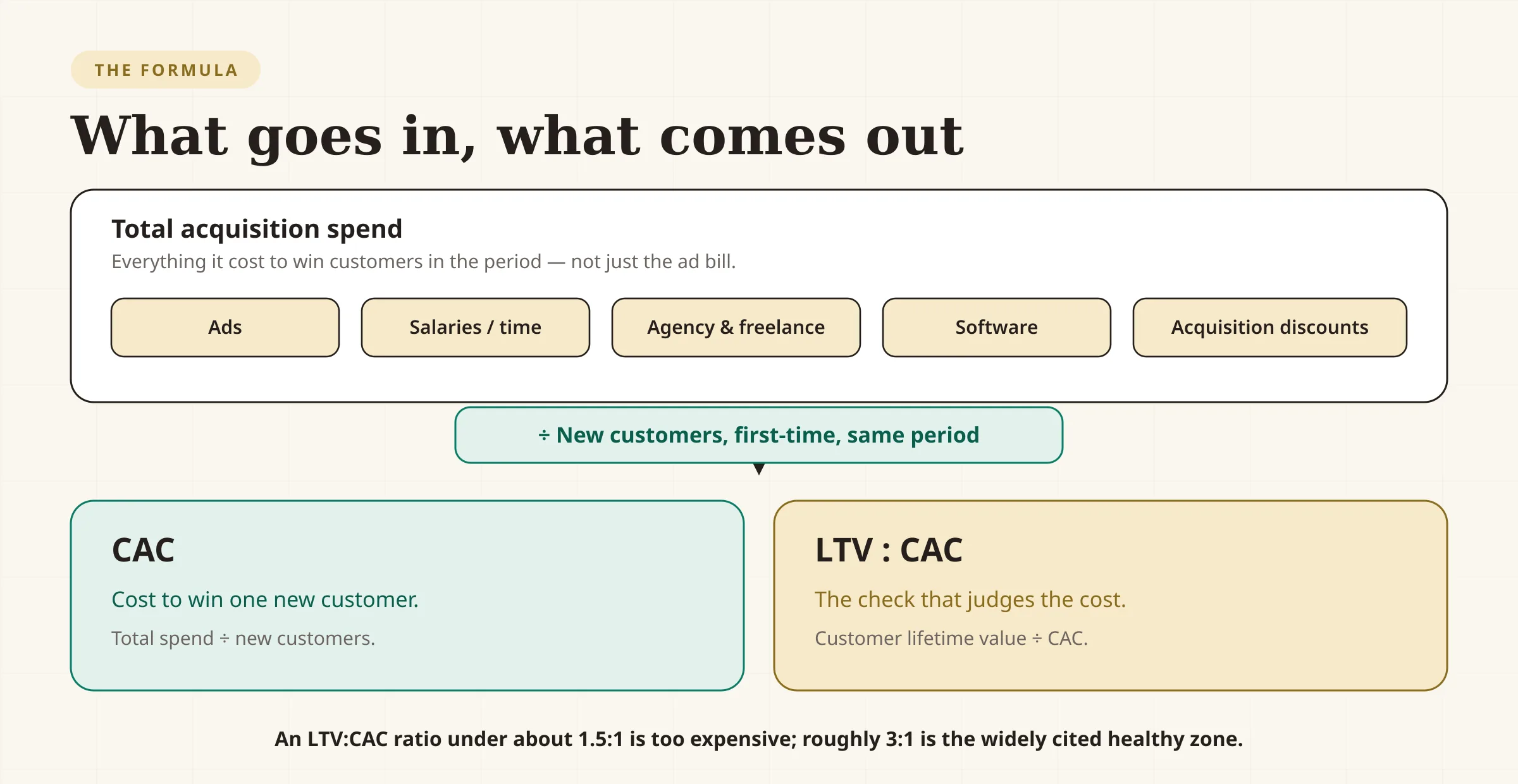
Total acquisition spend is every sales and marketing dollar that went into winning customers in the period. New customers are first-time buyers only — not repeat or retained customers. Both sides must cover the same period. Then, to know whether the number is good, compare it to what a customer is worth:
The CAC Calculator computes CAC and the LTV:CAC ratio together, because a CAC on its own doesn't tell you whether to celebrate or panic.
What actually belongs in acquisition spend
The most common mistake is counting only the ad bill. Advertising is usually the largest line, but it is rarely the only one, and a numerator that omits the rest produces a CAC that is too low to trust. Pull these together for the period:
- Paid media: Google, Meta, TikTok, local radio, print, sponsorships, boosted posts.
- A fair share of time and salaries for anyone whose job touches acquisition — sales calls, quote follow-ups, list building. For a solopreneur, decide an hourly value for your own sales time and include it; if you're spending ten hours a week selling, that has a cost even when no invoice arrives.
- Agency, freelance, and contractor fees for ads, copy, design, and campaign management.
- Marketing software and tools: email platform, CRM, scheduling, landing-page builder, analytics — the portion genuinely used for acquisition.
- Acquisition discounts and offers funded to bring in new customers: intro coupons, free trials, referral rewards, the value of a loss-leading offer.
- Content and creative produced to attract customers, amortized over the period it serves.
Shopify's CAC guide lists the same broad categories, including software, staff, advertising, discounts, and content, which is a useful confirmation that "spend" means more than one line item. Pick a consistent rule, write it down, and apply it every month so the trend is comparable even if the absolute figure is imperfect.
Count new customers only — and match the period
The denominator is first-time customers, not everyone who bought. Repeat and retained customers belong in lifetime value; counting them as acquisitions double-counts your happiest customers and drives CAC artificially low.
The subtler trap is timing. CAC measures a cause-and-effect relationship, but spend and customers don't land in the same bucket: January's ads produce February's sign-ups, and a quote you chase for six weeks closes in the next month. Two rules keep you honest:
- Match the period on both sides. For a monthly CAC, use the month's spend against the customers it produced — not this month's spend against last month's customers, which is the error most spreadsheets make by default.
- Allow for a lag where it exists. For high-consideration purchases — a remodel, a web project, a commercial contract — customers from a given campaign may arrive one to three months later. Track spend by cohort and attribute customers back to the cohort that earned them, or use a longer window (a quarter, not a month) so the timing noise averages out.
Step by step
Step 1: Pick the period and stay in it
A month is fine for high-frequency businesses; a quarter is better when the sales cycle is long. Whatever you choose, use it for both numerator and denominator.
Step 2: Add up the full acquisition spend
Include the lines above, not just ads. Keep a running total in your accounting software with an "acquisition" tag so you're not reconstructing it by hand each time.
Step 3: Count new customers in the same period
New only. If you can, count the ones the tracked spend actually produced, using a CRM, a checkout flag, or a simple question at purchase ("how did you hear about us?").
Step 4: Divide
Total spend ÷ new customers = CAC. Then segment: run the same math per channel — paid search, social, referrals, email, local — so you can see which channel is buying customers cheaply and which is burning money.
Step 5: Compare to LTV or payback
CAC only becomes a verdict once you set it against value. Two ways:
The first compares total lifetime value to acquisition cost; the second asks how many months of gross profit it takes to earn the acquisition cost back. Both are covered below.
Worked example 1: a service business, blended CAC
A two-person cleaning service spends a month like this:
| Line | Amount |
|---|---|
| Google and local ads | $1,800 |
| Booking and email software | $200 |
| Freelancer (ad creative, some admin) | $600 |
| Intro discount for new customers | $400 |
| Total acquisition spend | $3,000 |
It wins 30 new customers in the same month.
- CAC:
3,000 ÷ 30 = $100 - Customer lifetime value (say $450 over the relationship):
450 ÷ 100 = 4.5
A 4.5:1 ratio is comfortably healthy. If anything, this business may be underinvesting in growth — a CAC this far below lifetime value usually means it could spend more to acquire customers and still profit.
Worked example 2: per-channel CAC and the lag trap
The same cleaning service breaks the month down by channel:
| Channel | Spend | New customers | CAC |
|---|---|---|---|
| Google / local ads | $1,200 | 4 | $300 |
| Referral rewards | $150 | 6 | $25 |
| Email to past leads | $0 (software only) | 2 | — |
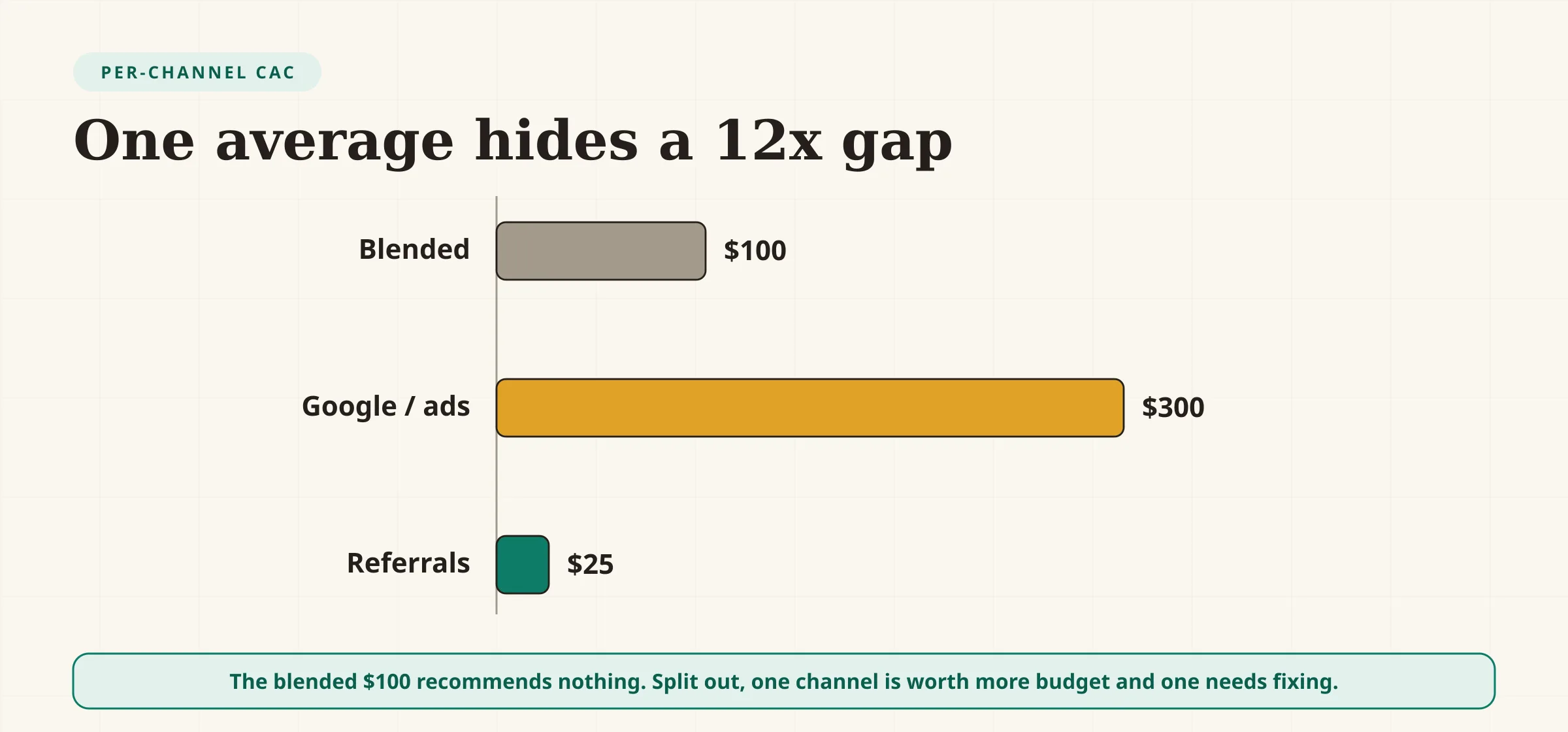
Blended CAC was $100. Split out, Google costs $300 per customer while referrals cost $25 — a 12× difference hiding inside one average. The decision writes itself: fix or pause the ad campaign, and put more into the referral program. This is why a single blended CAC is a starting point, never the end.
The lag trap shows up for a business with a longer cycle. An agency spends $2,000 on ads in January. Only 4 of the 18 customers that campaign eventually produces sign in January; the rest sign in February and March. If the agency divides February's spend by February's customers, it gets a meaningless number. Track the January spend against the full January cohort — 18 customers — for a true CAC of about $111.
The checks that make CAC useful: LTV and payback
A CAC of $100 means nothing by itself. It's excellent for a customer worth $1,000 and ruinous for one worth $90. Two checks turn the cost into a verdict.
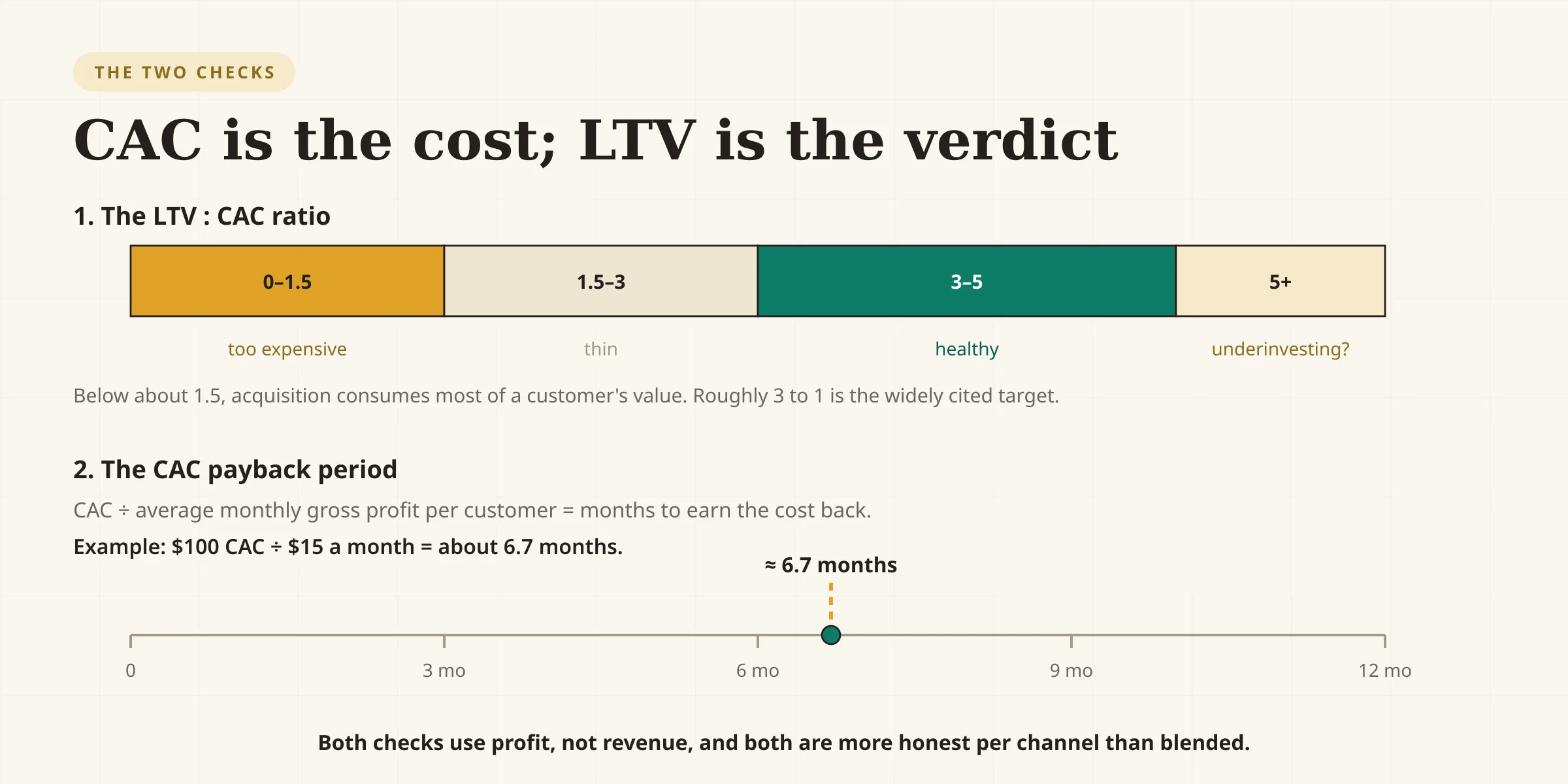
LTV:CAC ratio. Divide customer lifetime value by CAC. A common rule of thumb treats roughly 3:1 as healthy, with 3:1 to 5:1 cited widely (Shopify's guide uses that range), below about 1.5 as too expensive, and far above 5 as possible underinvestment in growth. Treat it as orientation, not law: compute LTV on gross profit, not revenue, or the ratio flatters itself. Revenue-based LTV divides money you never kept.
CAC payback period. Divide CAC by the average monthly gross profit a customer generates. If a customer yields $15 of gross profit a month and CAC is $100, payback is 100 ÷ 15 ≈ 6.7 months. This answers the cash-flow question a ratio doesn't: how long until the customer has paid back what they cost, which is what matters if you're funding growth from a thin bank balance.
CAC vs CPA vs ROAS
These get used interchangeably and shouldn't be:
- CPA (cost per acquisition) is usually tied to one specific conversion — a lead, a trial sign-up, a first purchase — and often counts only ad spend. It's narrower than CAC and typically lower.
- CAC counts *all* acquisition costs against *new customers*. It's the fuller, more honest number.
- ROAS measures revenue per dollar of ad spend and says nothing about whether a customer was won or what they cost. See how to calculate ROAS.
Roughly: CPA tells you whether a campaign is efficient at a step; CAC tells you what a customer costs the business; ROAS tells you how much revenue the ads pulled in.
Common mistakes
- Counting only ad spend. Software, salaries, freelance fees, and acquisition discounts belong in the numerator, or CAC is understated.
- Mixing periods. Last quarter's spend against this quarter's customers produces a number that means nothing.
- Counting repeat buyers as new acquisitions. Repeat purchases are lifetime value, not acquisition.
- Ignoring sales time. For a solopreneur, the hours spent prospecting and following up are a real cost; leaving them out flatters CAC.
- Reporting one blended number. It averages your best and worst channels and hides both.
- Comparing CAC across industries. A $300 CAC is fine for a remodeler and fatal for a café; only LTV and margin decide.
- Using revenue-based LTV. It inflates the ratio by counting money that went to cost of goods.
- Judging a growing business on a down month. Acquisition is lumpy; smooth it over a quarter before changing strategy.
Checklist
- Period chosen and used for both spend and customers
- Numerator includes ads, software, time, fees, and acquisition discounts
- Denominator counts first-time customers only
- Lag between spend and sign-up accounted for (cohort or longer window)
- CAC calculated per channel, not just blended
- LTV computed on gross profit, not revenue
- LTV:CAC ratio and CAC payback period both on hand
- A written, consistent rule for what counts as acquisition spend
FAQs
How do I calculate customer acquisition cost?+
Divide total sales and marketing spend by the number of new customers acquired in the same period. Spend $3,000 and win 30 new customers, and CAC is `3,000 ÷ 30 = $100`. The [CAC Calculator](/tools/cac-calculator) also gives the LTV:CAC ratio.
What should I include in total acquisition spend?+
Everything tied to winning customers in the period: advertising, a fair share of salaries or your own sales time, agency and freelance fees, marketing software, and the value of acquisition discounts and offers. Counting only ads understates CAC.
What is a good LTV:CAC ratio?+
Around 3:1 is the widely cited healthy benchmark, and 3:1 to 5:1 is a common target range. Below about 1.5 means acquisition is too expensive; well above 5 may mean you could grow faster by spending more. Compute LTV on gross profit for an honest ratio.
How do I estimate customer lifetime value?+
A simple version is average order value × purchases per year × years the customer stays, then subtract cost of goods to get profit-based LTV. Use the Conservative figure — if the ratio breaks at a lower LTV, don't proceed.
Should I measure CAC overall or per channel?+
Both, but per-channel is where decisions happen. A blended CAC averages a winning channel with a losing one; the split shows which to scale and which to cut.
Why does my CAC look wrong in months with long sales cycles?+
Because spend and sign-ups land in different months. Match spend to the customers it actually produced, track by cohort, or use a longer period like a quarter so the lag averages out.
Is CAC the same as CPA?+
No. CPA usually measures the cost of a single conversion or lead, often counting only ad spend. CAC counts all acquisition costs per new customer, so it's typically higher and more complete.
How is CAC different from ROAS?+
CAC is a cost per new customer; ROAS is revenue per dollar of ad spend. A campaign can post a strong ROAS and still carry a CAC that exceeds what a customer is worth.
What to do next
Start with one honest number: total acquisition spend over a period, divided by the new customers it produced, with CAC Calculator. Then do the part most people skip — split it by channel. You will almost always find one channel worth more budget and one worth cutting, and that split, not the blended average, is the decision. Finally, set CAC against lifetime value and payback: if the ratio is near or below 1.5, fix the offer, the targeting, or the channel before spending another dollar. Pair this with how to calculate ROAS for campaign-level efficiency, the Marketing Budget Calculator to size spend, and the Best Free CRM roundup if tracking who came from where is the missing piece.
Free tools to try
CAC Calculator
What a new customer costs you — and the LTV:CAC ratio that says if it's worth it.
ROAS Calculator
Return on ad spend — plus the break-even ROAS your margin actually requires.
Marketing Budget Calculator
Turn annual revenue and a percent target into a monthly marketing budget.
Profit Margin Calculator
Find your margin, markup, and profit from cost and revenue — instantly.
Keep reading
Guide
How to Calculate ROAS (Return on Ad Spend)
How to calculate ROAS: the formula, break-even ROAS by margin, platform vs blended numbers, and the attribution traps that inflate reported results.
Guide
How to Calculate ROI on a Small Business Investment
Calculate ROI on a small business investment: the formula, annualized ROI for fair comparisons, what makes a return good, and the traps that inflate it.
Guide
Best Free CRM for Small Business (2026)
12 free CRMs ranked by real limits — Zoho, Freshsales, HubSpot, Bitrix24 and more, with true user caps, contact caps, and upgrade costs as of July 2026.