Comparison
Where to Sell a Small Business: 13 Marketplaces Compared
Selling the business is the one transaction most owners only ever do once — with no do-over if they run it badly. The market is real and liquid: BizBuySell's Insight Report counted 2,345 small businesses changing hands in Q1 2026 alone, at a median sale price of $350,000 and an average cash-flow multiple of 2.7×. And here's the stance this guide takes openly: for most owners, the edge is paying for the process. A run sale — professional packaging, screened buyers, confidential marketing, a negotiator who has closed a hundred of these — is leverage on the biggest invoice of your life. The fee is visible; the price and close-rate you give up going it alone are not.
This guide compares thirteen places to sell — full-service brokers and advisors first, then the DIY marketplaces — with their real fees as of July 2026, who each genuinely fits, and the traps (auto-renewing ad subscriptions, opaque commissions, quarterly-billed extras) that only show up after you've committed. Several of these firms don't publish their fees at all; we say so plainly rather than guessing.
Marketplace, broker, or M&A advisor?
Three different products hide under "sell your business online":
- Brokers and hybrids (Baton, Transworld, Sunbelt, Empire Flippers, Quiet Light) value the business, package it, screen buyers, and run the deal for a success fee — the Main Street norm is about 10% of the sale price. This is the leverage tier: you're buying process, confidentiality, and negotiation.
- M&A advisors (FE International, Website Closers) run competitive processes for larger deals, typically seven figures up, with negotiated fees.
- Marketplaces (BizBuySell, Flippa, BizQuest, BusinessesForSale, DealStream) are advertising platforms. You pay a listing fee, you field the inquiries, you negotiate, you close. Cheapest, most work, and every mistake is yours.
The quick answer by business type: a local service, retail, or food business with $100K+ cash flow starts at Baton (full service at a published 6%) or a Transworld/Sunbelt broker; an established online business fits Empire Flippers or Quiet Light; a SaaS product pushing seven figures fits FE International or Website Closers, with Acquire.com as the self-serve route; the DIY path starts at BizBuySell for Main Street and Flippa for smaller online assets.
Quick comparison
| Platform | Type | Best for | Cost to list | Success fee |
|---|---|---|---|---|
| Baton | Hybrid broker | Main Street, $100K+ SDE | $1,000/mo (credited at close) | 6% to $5M |
| Empire Flippers | Vetted marketplace | Online, $2K+/mo profit | Free | 15% band to $700K |
| Quiet Light | Broker | Online, $500K–$5M | Free | Not published (~10% reported) |
| Transworld | Broker network | Main Street, full service | Free | ~10% typical |
| Sunbelt | Broker network | Main Street, full service | Free | ~10%, ~$15K min |
| Website Closers | Tech brokerage | Tech/ecommerce $1M+ | Free | Not published |
| FE International | M&A advisor | Tech, 7–8 figures | Free | Not published |
| Acquire.com | Marketplace | SaaS and online startups | $25–$100/mo | 6–8% |
| BizBuySell | Marketplace | Main Street, DIY | From ~$66–$75/mo | None |
| Flippa | Marketplace | Online assets under $100K | $29–$129+ | ~10%, sliding down |
| BizQuest | Marketplace | Budget second listing | ~$60/mo (6-mo min) | None |
| BusinessesForSale | Marketplace | One-off fee, international | From $199 one-off | None |
| DealStream | Network | Anything, incl. assets | Free basic | None |
How we compared these
- Leverage per dollar — what the fee actually buys: valuation, packaging, screened buyers, escrow, migration, negotiation, confidentiality. A run process protects price in ways a DIY listing can't, so full-service options lead this list.
- Real, published cost — listing fees, success fees, and minimums, with unpublished commissions flagged rather than guessed.
- Fit by business type and size — the same platform can be the best choice at $80K and the wrong one at $2M.
- Track record and reviews — linked and dated; several big names here have surprisingly thin or poor public review footprints, and we say so.
Where to sell a small business
1. Baton — full service at a published 6%
Baton is where we'd start a Main Street sale: a real brokered process — valuation, financial cleanup, buyer outreach, diligence support — at a 6% success fee on the first $5M, roughly half the ~10% broker norm, with the industry's rarest feature: the price is published. The $1,000/month retainer is credited back at closing, and Baton publishes performance claims most brokers won't — a 68% close rate and 5.5-month average time to close. The bar to entry: about $100K in annual cash flow (SDE).
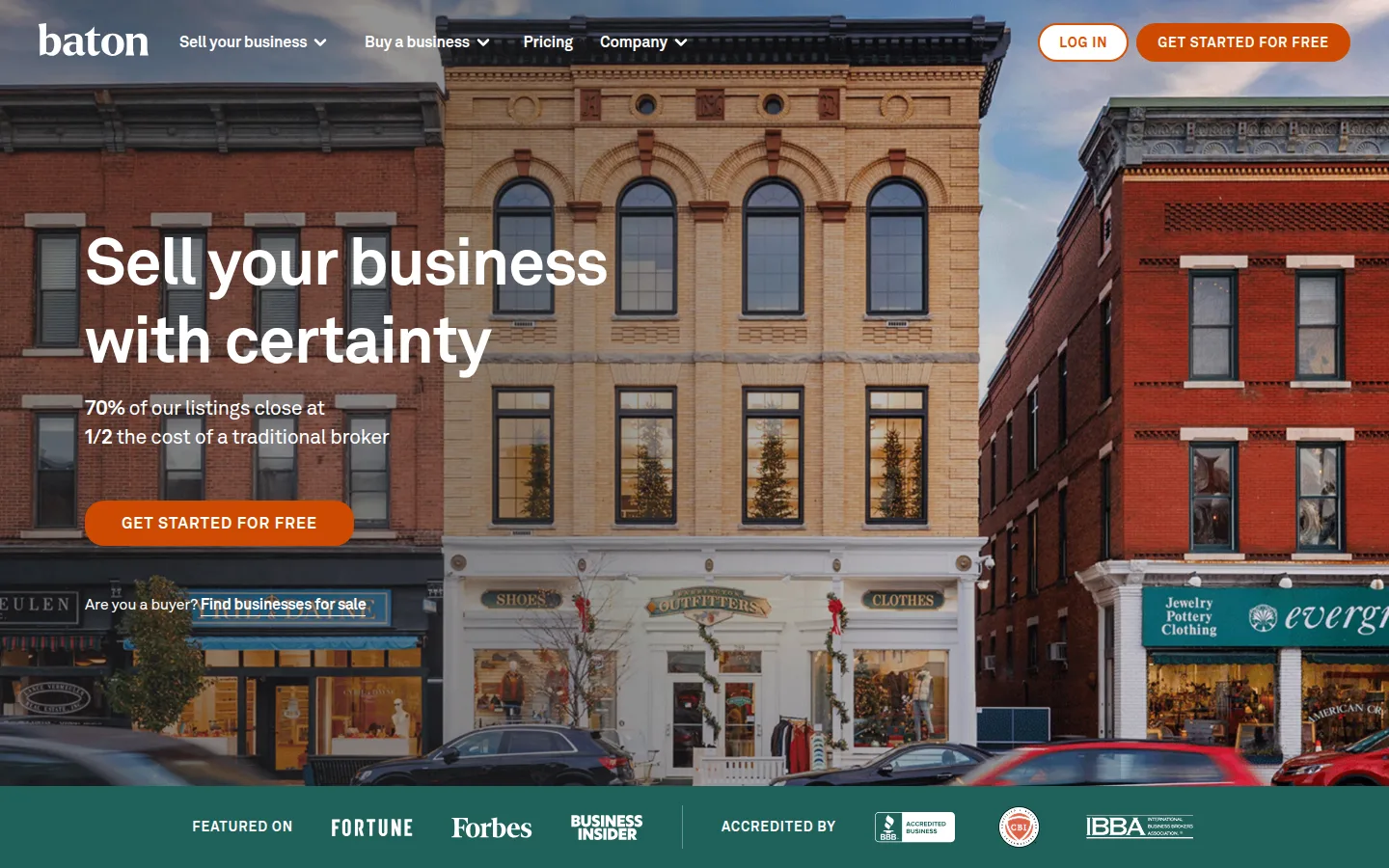
- Fees: $1,000/month (3-month minimum, credited at close; non-refundable if it never sells) + 6% of the sale to $5M (2% above; 3% if your own buyer signs an LOI within 60 days).
- Best for: Main Street owners with $100K+ SDE who want the sale run for them without paying 10%.
- Pros: published, honest pricing in a fee-opaque industry; free valuation to start; full-service prep, buyer outreach, and diligence support.
- Cons: the retainer is real money if the business doesn't sell; the SDE minimum excludes smaller businesses; young firm with a modest review base (4.0/5, ~75 Trustpilot reviews as of July 2026).
2. Empire Flippers — the vetted, done-for-you route for online businesses
Empire Flippers manually vets every listing (requiring roughly $2,000/month average net profit and 12 months of history), hides your URL until buyers unlock it, and handles migration end-to-end. You pay nothing unless it sells — and what the commission buys is a marketplace where every buyer is serious and the operational handoff is done for you.
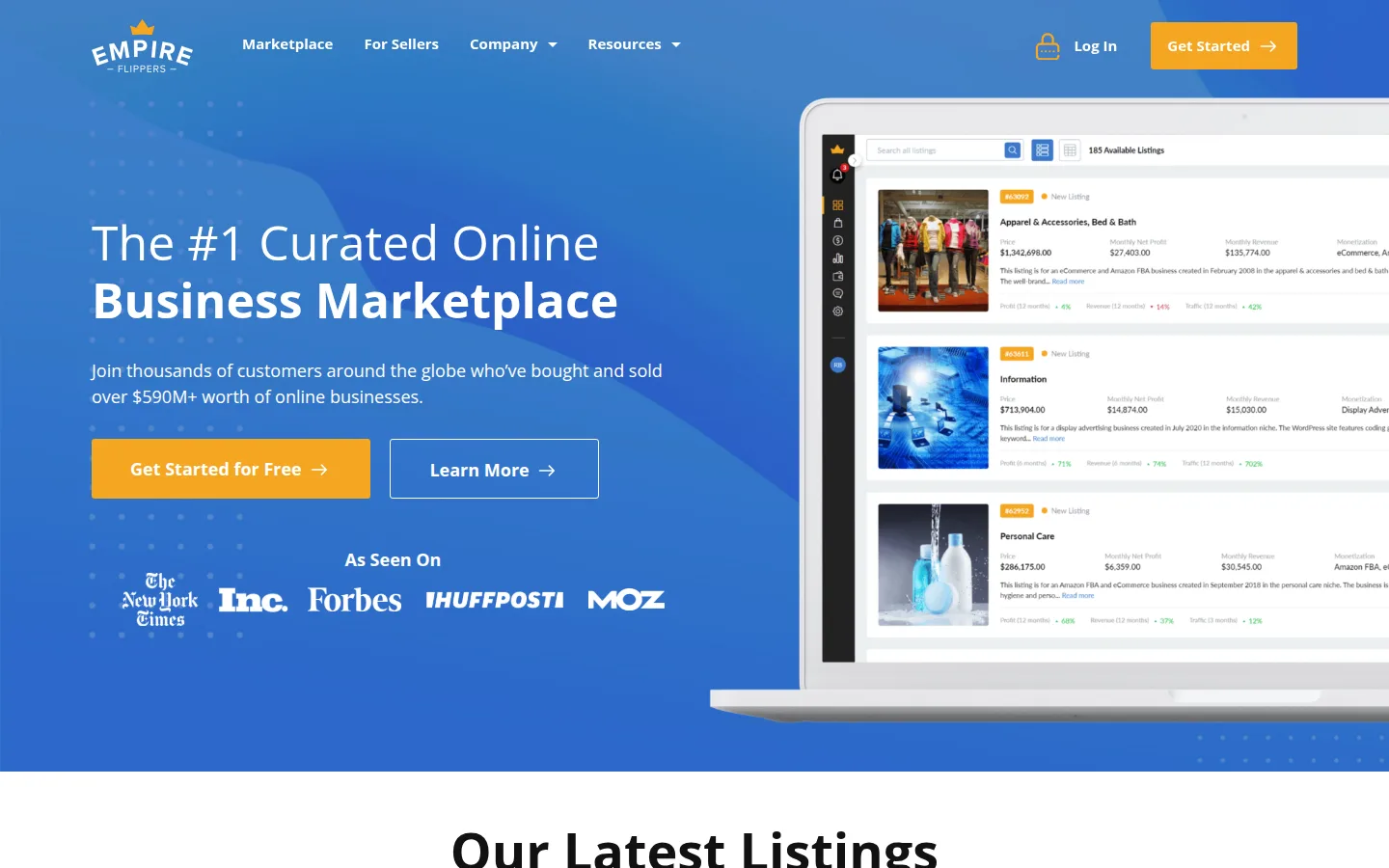
- Fees: no listing fee. Commission: flat $10,000 under ~$67K; 15% from there to $700K; 8% on the portion to $5M; 2.5% above — a $900K sale works out to ~13.4% effective.
- Best for: content, ecommerce/FBA, and SaaS businesses making $2K+/month that want serious, pre-qualified buyers and a managed close.
- Pros: zero cost if it doesn't sell; vetting keeps buyer quality high (it claims 2,600+ deals and a 119-day average sale); migration and escrow handled.
- Cons: the 15% band (and $10K flat minimum) is the highest published headline rate here for typical sub-$700K deals; strict vetting excludes young businesses and adds lead time; two-month exclusivity. Trustpilot 4/5 (~115 reviews) as of July 2026.
3. Quiet Light — advisors who've been operators
Quiet Light sells online businesses with advisors who have built and sold their own — a genuine difference in how your deal gets packaged and negotiated, and exactly the kind of leverage worth paying a commission for. Its sweet spot is $500K–$5M exits (ecommerce, FBA, SaaS, content), with free valuations and no upfront fees.

- Fees: not published — no upfront cost; third-party reports put commissions around 10% on deals to $1M, sliding down on larger ones. Get the number in writing before you engage.
- Best for: online businesses in the $500K–$5M range that want an advisor-led process rather than a marketplace listing.
- Pros: advisors with real operating experience; free, data-driven valuation; strong reputation across the online-business world.
- Cons: fee opacity; too selective for small or young businesses; effectively no third-party review footprint to check claims against — as of July 2026 we found no meaningful Trustpilot presence, so diligence rests on references.
4. Transworld Business Advisors — the biggest full-service broker network
Transworld is the largest business-brokerage franchise — 250+ offices, 1,000+ brokers — which means a local broker who knows your market, meets you in person, and runs everything from valuation to closing. Its own material notes ~10% commission is the common arrangement, with no upfront fee.

- Fees: negotiated per office — typically ~10% of the sale price, success-only.
- Best for: Main Street owners who want a hands-off, in-person, fully brokered sale.
- Pros: a physical office near almost any US business; complete deal management with confidential marketing; listings syndicate to the big marketplaces anyway — so a brokered sale includes the marketplace exposure DIY sellers pay for separately.
- Cons: the priciest standard rate on a typical deal; quality varies office to office (it's a franchise); no central published pricing or reviews — vet your specific local broker, not the brand.
5. Sunbelt Business Brokers — the other giant network
Sunbelt is Transworld's closest peer: roughly 250 offices and 1,400+ brokers coordinating thousands of transactions a year. Its Texas offices publish the numbers most owners can expect network-wide: 10% commission, ~$15,000 minimum fee, no upfront cost.

- Fees: negotiated per office; ~10% with ~$15K minimums is the published norm at network offices.
- Best for: the same fully brokered Main Street sale — get proposals from both Sunbelt and Transworld offices and compare the individuals.
- Pros: enormous network and deal flow; success-fee-only; nearly five decades in the business.
- Cons: franchise variability; the $15K minimum stings on very small businesses; essentially no central review footprint — evaluate the local office.
6. Website Closers — success-fee tech brokerage at scale
Website Closers brokers tech and internet companies — ecommerce, Amazon businesses, SaaS, agencies — claiming a $1M–$1B deal range, 2,300+ businesses sold, and a 92% close rate, all on a pure success-fee basis with free valuations.
- Fees: not published — 100% success-based, structured per deal (flat, Lehman, or reverse-Lehman formulas). Ask for the exact schedule in the engagement letter.
- Best for: tech/ecommerce businesses from ~$1M up that want a brokered process and buyer financing help.
- Pros: no cost unless it closes; SBA-lender relationships widen the buyer pool; BBB A+ accredited.
- Cons: zero published pricing makes comparison-shopping a phone call; a small review base (Trustpilot 4/5, ~58 reviews) for its claimed scale; experiences vary by assigned broker.
7. FE International — the mid-market M&A advisor
FE International runs true M&A processes for technology companies — SaaS, ecommerce, content — claiming 1,500+ transactions, ~$50B in exit value, and a 94.1% close rate. It has moved firmly upmarket: think seven and eight figures, in-house CPAs preparing your financials, and competitive buyer outreach. At that scale, process quality moves the price far more than the fee costs.

- Fees: not published — success-fee only, no retainer, free initial valuation; third-party reports suggest commissions start around 15% for its smallest deals and slide down. Confirm in writing.
- Best for: tech businesses in the seven figures and up that want a structured, competitive sale process.
- Pros: genuine M&A rigor (CIM prep, qualified-buyer outreach, structured diligence); no upfront cost; sector-specialist teams.
- Cons: opaque fees; not for Main Street or small online businesses; almost no consumer-review footprint to check the claims against.
8. Acquire.com — the self-serve route for SaaS
Acquire.com (formerly MicroAcquire) built the standard playbook for startup sales: publish clean pricing, verify buyers (it claims 500K+ registered and $2B+ in verified funds), and throw in free escrow and legal document builders. It's lighter-touch than the brokers above — a "Guided" advisory tier (requiring $100K+ trailing revenue) is the closest it gets to full service.
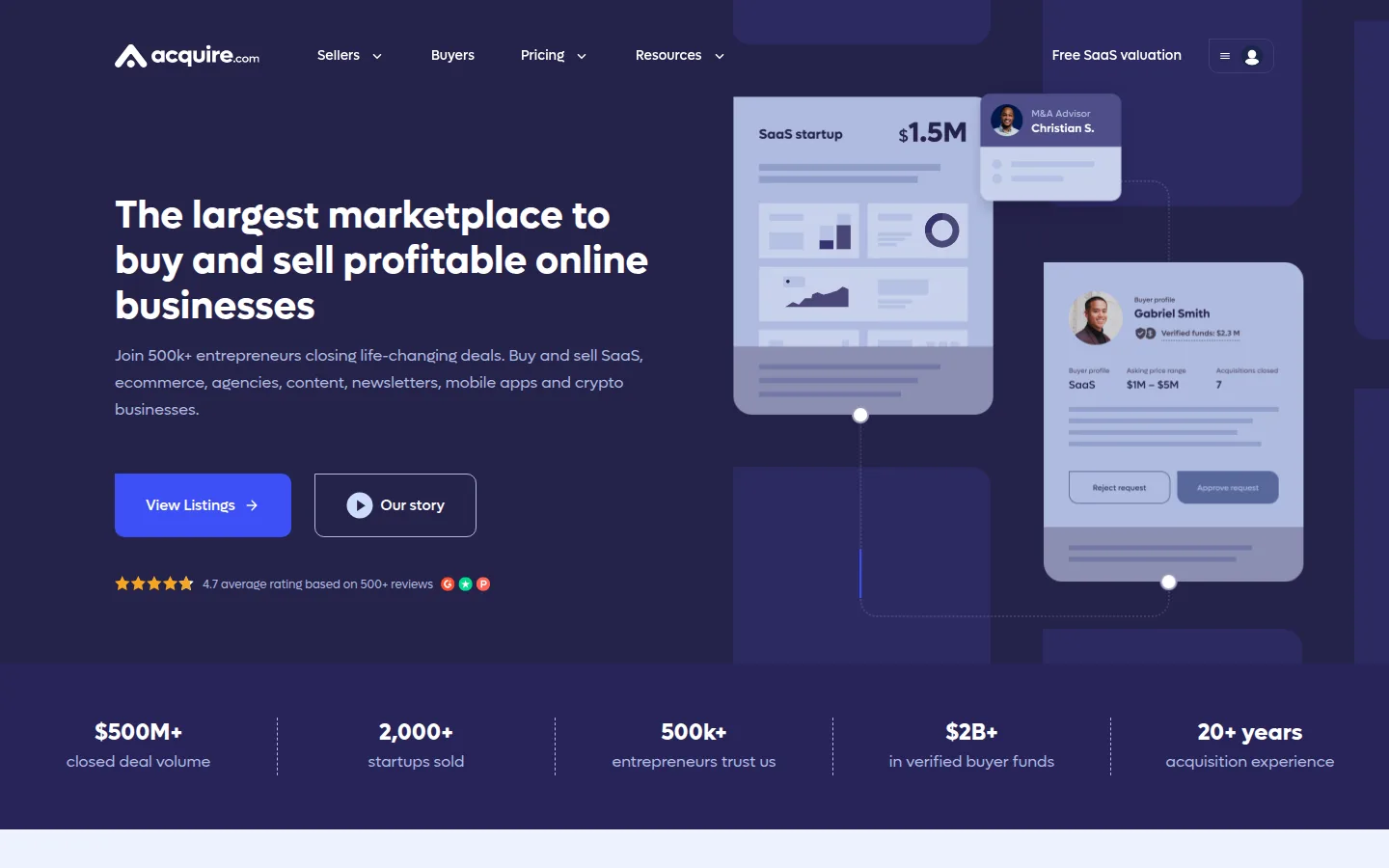
- Fees (published, by asking price): under $250K — 8% closing fee + $25/month listing; $250K–$1M — 7% + $50/month; over $1M — 6% + $100/month. Closing fee only if you sell; escrow free.
- Best for: SaaS first, plus agencies, newsletters, ecommerce, and other online startups whose founders are comfortable driving the deal.
- Pros: the clearest pricing of any full-service-adjacent option; free escrow and legal tooling cut closing costs; a big, SaaS-literate buyer pool.
- Cons: the monthly listing fee accrues regardless of outcome; online businesses only; you're still running much of the process yourself unless you qualify for Guided. Trustpilot 4/5 (~225 reviews) as of July 2026.
9. BizBuySell — the biggest DIY audience for Main Street
If you do go it alone, BizBuySell is where the buyers are: it claims over 4 million visits a month, 120,000+ businesses listed annually, and its listings syndicate across the CoStar network (BizQuest, LoopNet, WSJ). It's an ad platform, not a broker — by its own FAQ, "we are not a brokerage firm" — so you run the sale, field every inquiry, and negotiate yourself; you keep 100% of the price.
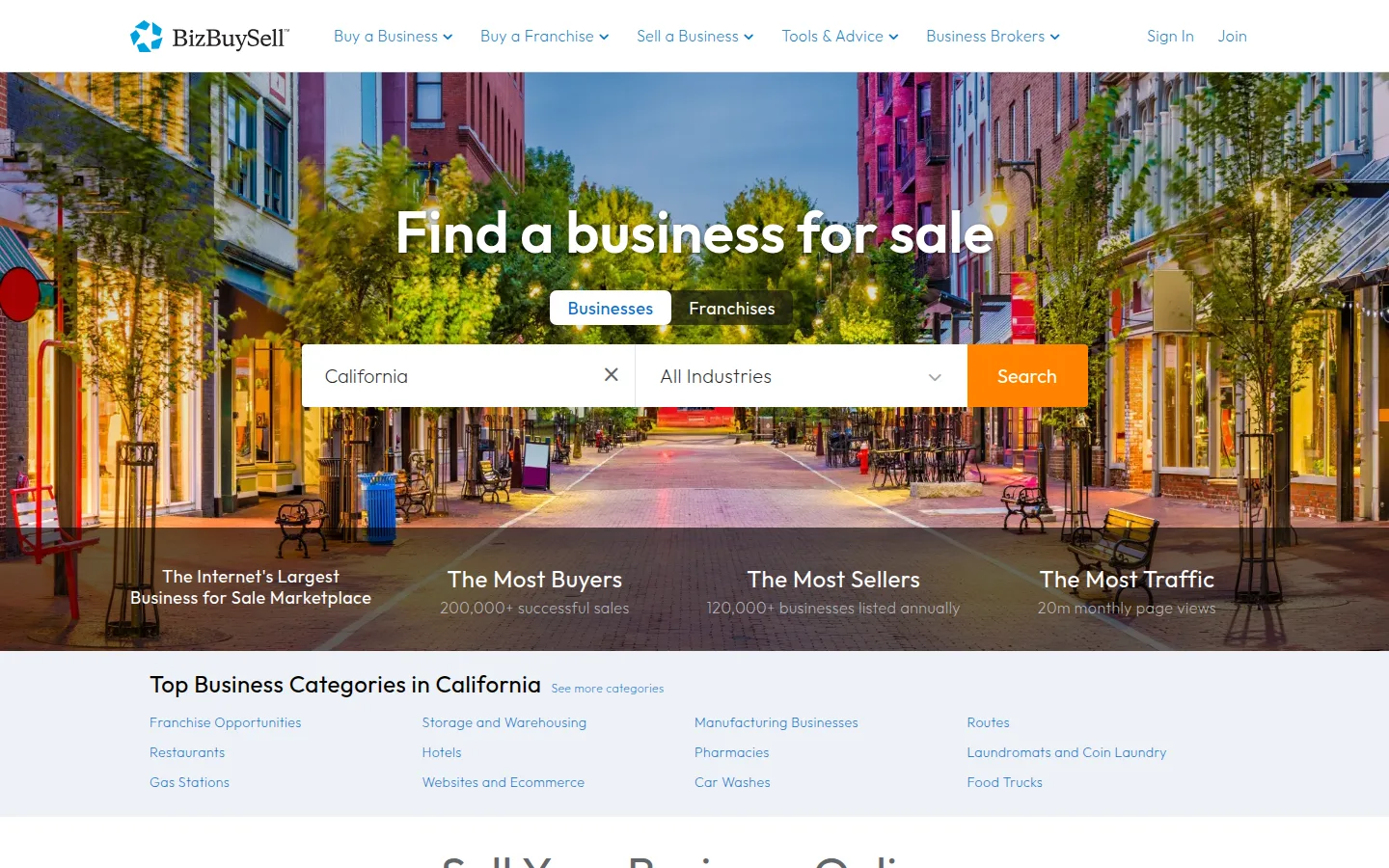
- Fees: plans from roughly $66–$75/month (Basic $74.95, Showcase $99.95, Diamond $199.95 on 6-month terms per its listing FAQ; the sell page advertises "from $65.95/mo"). No success fee. A valuation report is bundled with paid listings.
- Best for: owners committed to the DIY route who want maximum buyer exposure; also worth knowing that brokered listings usually end up syndicated here anyway.
- Pros: the largest claimed buyer pool in the category; flat fee with no commission; the industry's benchmark market data (its quarterly Insight Report).
- Cons: entirely DIY — no vetting, escrow, or negotiation help, which is precisely where sales fall apart; fees accrue whether or not it sells (six months runs ~$450–$1,200); its Trustpilot page sits at just 1.9/5 (~50 reviews, as of July 2026), heavy on billing/auto-renewal complaints — read your plan terms before entering a card.
10. Flippa — the volume marketplace for smaller online assets
Flippa is where sub-$100K websites, ecommerce stores, apps, and content businesses actually trade — it claims 12,000+ deals a year and by far the most listings. It's self-serve with light vetting, which cuts both ways: fast and liquid, but buyer-beware. Below the vetted platforms' minimums, it's often the only liquid market.

- Fees: upfront listing fee by asset size — $29–$199 under $10K, $49–$599 to $50K, $129–$699 above — plus a success fee around 10% on typical small deals, sliding down (published tiers reach ~3% on very large deals; Flippa's fee ladder varies by asking price, so confirm yours before listing). Listing fees are non-refundable even if it never sells. An optional broker package exists for $100K+ assets.
- Best for: online businesses and digital assets under ~$100K, or anything too small for the vetted platforms.
- Pros: unmatched deal volume and buyer traffic for small digital assets; low cost of entry; integrated escrow.
- Cons: fees stack (listing + success + upgrades); minimal vetting means tire-kickers and lowballs; quality varies widely. Trustpilot ~4.2/5 (~3,000 reviews) as of July 2026.
11. BizQuest — budget second exposure
BizQuest shares a parent (CoStar) with BizBuySell and runs the same flat-fee model at a lower price — reported around $60/month with a 6-month minimum. Think of it as additional exposure in the same network rather than an alternative to it.
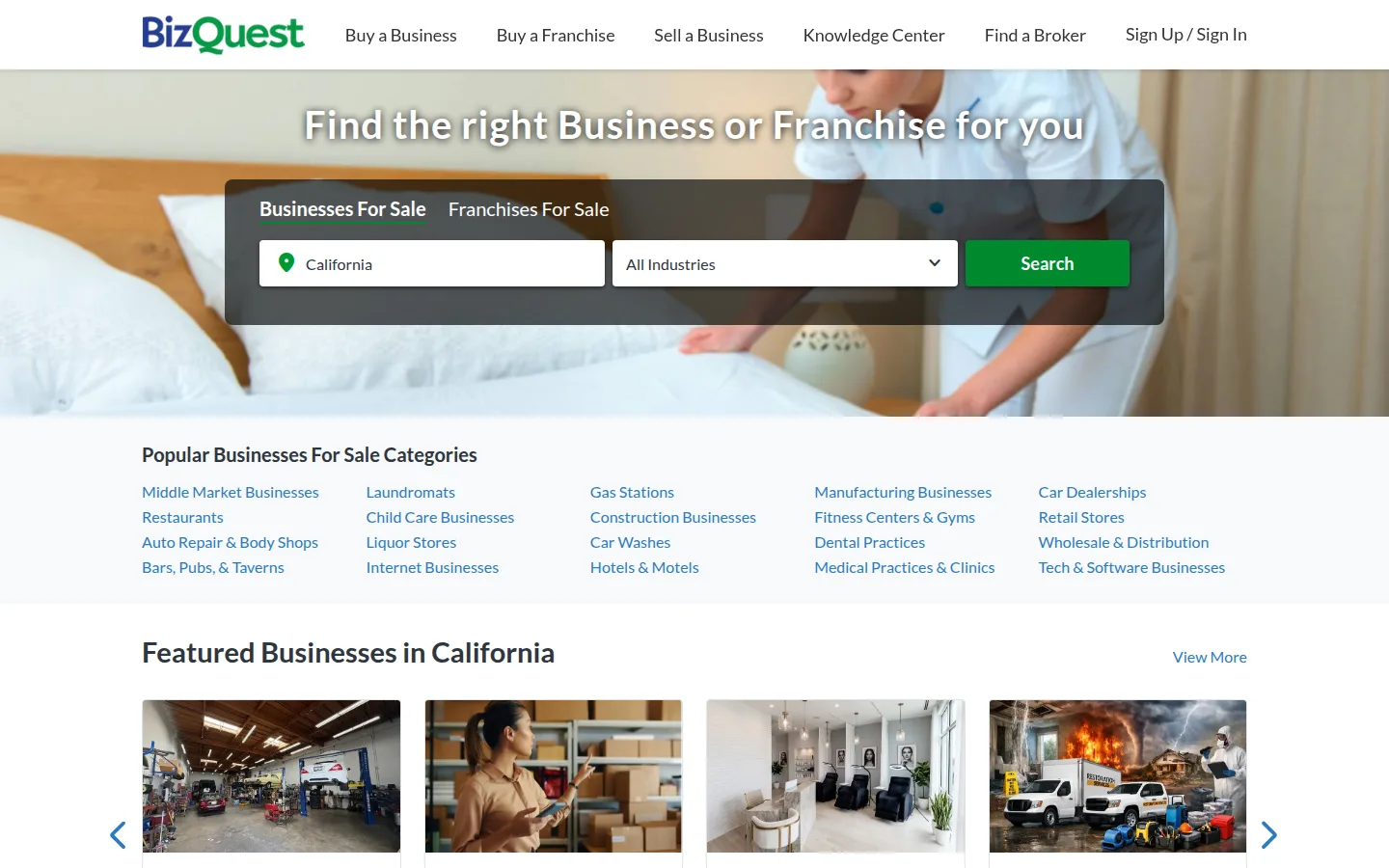
- Fees: vendor doesn't publish openly; third-party reviews report ~$59.95/month basic with a 6-month minimum, no commission.
- Best for: stretching a DIY listing budget across a second Main Street marketplace.
- Pros: cheaper than BizBuySell; long-established (1994); commission-free.
- Cons: smaller audience than its sibling; 6-month lock-in; a tiny, poor Trustpilot sample (2.2/5 from 8 reviews — too few to mean much, but nothing offsetting it).
12. BusinessesForSale.com — one-off fee, international buyers
BusinessesForSale.com has run since 1996 and does two things differently: pricing is a one-off package (from ~$199 for a short listing, ~$299/month-length) rather than an auto-renewing subscription, and its audience is genuinely international — useful for businesses that might attract an overseas or relocating buyer.
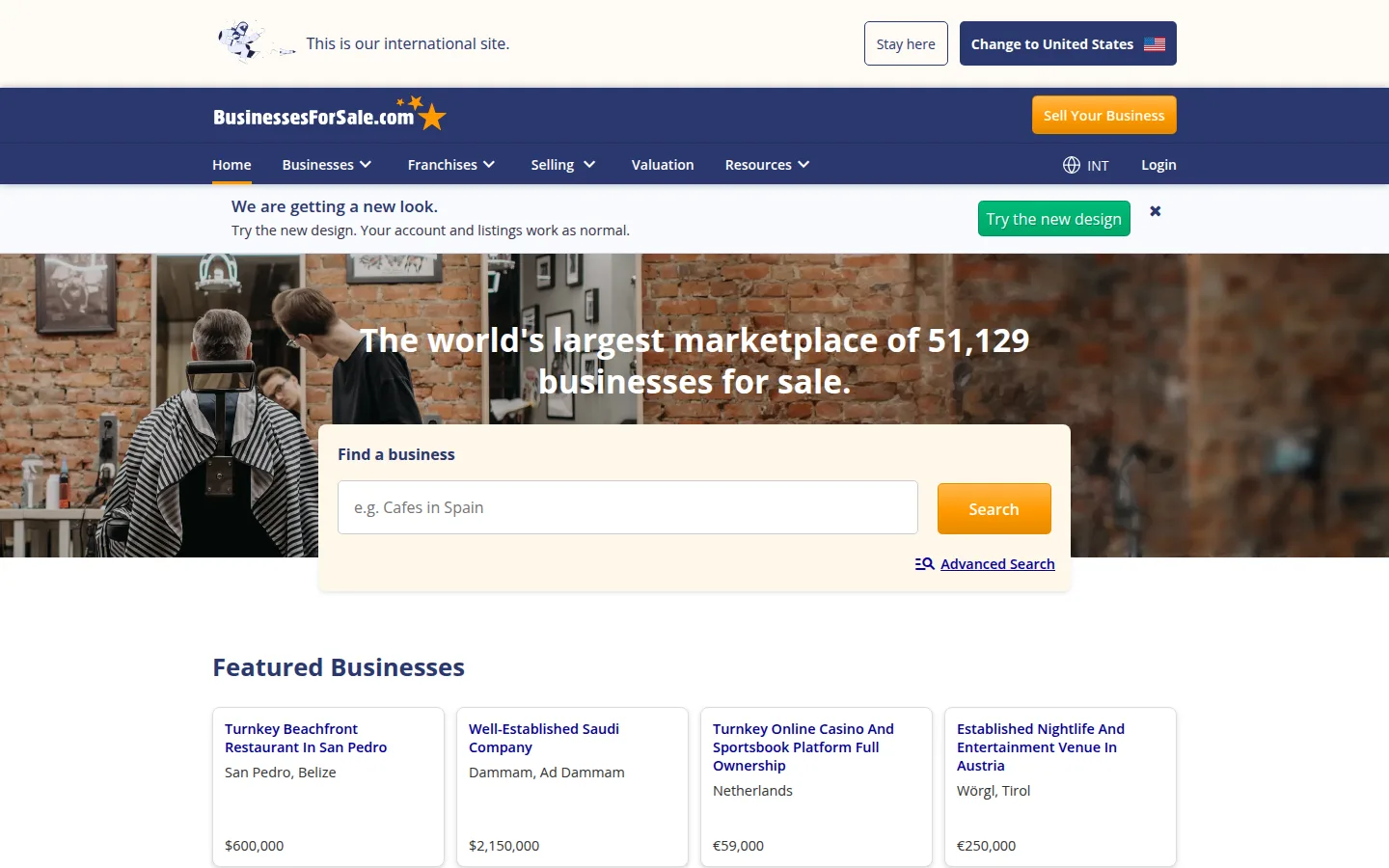
- Fees: one-off listing packages, from ~$199; commission-free. (Package tiers shift — confirm the current grid at purchase.)
- Best for: DIY sellers who hate subscriptions; businesses with international buyer appeal.
- Pros: pay once, no auto-renewal; 16,000+ live US listings; the healthiest marketplace Trustpilot score here (4/5 from ~550 reviews as of July 2026).
- Cons: smaller US buyer pool than BizBuySell; DIY like all marketplaces; reviewers grumble about unqualified inquiries.
13. DealStream — free listing, broadest categories
DealStream (formerly MergerNetwork, since 1995) is a deal-sourcing network more than a curated marketplace: basic business listings are free, members are identity-verified, and the categories run beyond businesses to real estate, oil & gas, and financing.

- Fees: free basic listing, no success fee; promoted-seller upgrades reported around $45/month. Note that buyers pay for membership to contact sellers, which filters but also shrinks responses.
- Best for: a zero-cost supplemental listing, asset-heavy or unusual deals, and reaching professional deal-sourcers.
- Pros: costs nothing to try; 30-year-old network with verified members; covers deal types others don't.
- Cons: no escrow, vetting, or valuation infrastructure; response volume is gated by buyers' willingness to pay; treat it as a supplement, not a primary channel. Trustpilot ~4.3/5 (~80–90 reviews) as of July 2026.
What selling actually costs
Run the numbers before choosing a path — and read them as what the fee *buys*, not just what it costs. On the Q1 2026 median sale of $350,000:
- Baton: 6% = $21,000, minus the credited retainer — a full process at the price transparency the industry lacks.
- Traditional broker: ~10% = $35,000 (with $15K minimums making sub-$150K sales disproportionately expensive) — buys local, in-person deal management end to end.
- Vetted online marketplace (for an online business): Empire Flippers' 15% band = $52,500 with migration handled; Acquire.com's 7% band = $24,500 plus small monthly fees, with you doing more of the work.
- DIY marketplace: ~$450–$1,200 in listing fees over six months (BizBuySell) — and every screening call, negotiation, and diligence request is yours.
The commission case in one line: a broker who gets you 2.9× instead of 2.7× on that median business added ~$26K of price — before counting the deals that close because someone ran the process properly. The Percentage Calculator makes quick work of fee scenarios, and it's worth an hour with the Profit Margin Calculator well before listing: buyers price Main Street businesses on SDE multiples (2.7× on average in Q1 2026), so every dollar of cleaned-up, documented profit is worth roughly three at closing. The ROI Calculator shows your deal the way a buyer will run it.
Which should you choose?
- Local service, retail, or food business with $100K+ SDE: Baton first for the published 6%, with proposals from local Transworld/Sunbelt brokers to compare.
- Online business earning $2K+/month: Empire Flippers for the vetted, managed sale; Quiet Light as it grows toward seven figures.
- SaaS or tech pushing $1M+: FE International or Website Closers for a run M&A process; Acquire.com if you'd rather drive it yourself on published fees.
- Too small for the brokers' minimums: Flippa (online) or a BizBuySell listing (Main Street) — the DIY tier exists for exactly this case.
- Stretching a DIY budget: add BizQuest, BusinessesForSale.com (one-off fee), or a free DealStream listing as supplements.
FAQs
How long does it take to sell a small business?+
Plan on six to twelve months. BizBuySell's market data puts the median around 200 days from listing to close, and even Baton — which advertises faster-than-industry sales — averages 5.5 months. Businesses with clean books, sensible pricing, and someone running the process sell from the fast end of that range.
What does a business broker charge?+
About 10% of the sale price is the Main Street standard — Sunbelt's and Transworld's own materials both point to it — usually success-only with no upfront fee, and minimum commissions around $15,000 are common. Larger deals negotiate sliding scales (Lehman-style formulas). Baton's published 6% and Acquire.com's 6–8% are the notable undercuts.
Is a broker worth the commission?+
For most owners with a business big enough to qualify, yes — that's the position this guide takes. The commission buys confidential marketing, screened buyers, professional packaging, and a negotiator, and those protect price and close-rate in ways that usually outrun the fee. The honest exceptions: businesses under the brokers' minimums, and owners with a qualified buyer already in hand (where even Baton drops to 3%).
What is SDE and why does everyone quote it?+
Seller's Discretionary Earnings: pre-tax profit plus interest, depreciation, amortization, one owner's salary and benefits, and genuinely discretionary expenses. It's the standard measure of what an owner-operator actually takes home, and it's the number your multiple gets applied to. Document every add-back — undocumented SDE is worth nothing to a buyer.
What multiple is my business worth?+
The average across businesses sold in Q1 2026 was 2.7× cash flow (SDE), per BizBuySell's Insight Report, with most Main Street businesses landing between roughly 2× and 3.2× depending on industry, growth, and how owner-dependent the operation is. Online and SaaS businesses trade on different (often higher) multiples through the specialist platforms.
Do I need to tell my employees I'm selling?+
Every platform here supports confidential listings — blind ads, NDAs before details, and (on Empire Flippers) hidden URLs. Confidentiality is one of the strongest practical arguments for the brokered route, since a broker fields all inquiries at arm's length.
Final take
Pay for the process if your business qualifies: Baton at a published 6% for Main Street, Empire Flippers or Quiet Light for established online businesses, and FE International or Website Closers once you're into seven figures. The marketplaces — BizBuySell, Flippa and the rest — are the right tool below the brokers' minimums or for owners who genuinely want to run their own deal. Either way, the highest-ROI work happens before anything goes live: clean, documented, margin-honest financials — start with the Profit Margin Calculator — because at a 2.7× multiple, every dollar of provable profit is three dollars in your pocket at close.
Free tools to try
Keep reading
Guide
New SBA Rules for Buying a Business (SOP 50 10 8.1, Oct 2026)
SBA SOP 50 10 8.1 raises the cash-flow bar for 7(a) business acquisitions to 1.25x, drops projections, adds QoE reports, and caps debt at the valuation.
Guide
Most Profitable Small Business Niches (And the Math Behind Them)
The most profitable small business niches for solopreneurs and small teams — ranked by real margin, not revenue. Plus how to check the profitability of any idea.
Guide
Best LLC Formation Services (2026)
11 LLC services ranked honestly for leverage — real prices, registered-agent renewal traps decoded, and the $0 DIY baseline for the simplest cases.
Guide
Free Small Business Tools (No Signup): The Complete List
A directory of free small business tools — pricing calculators, invoicing, marketing, SEO, and writing. No signup, no paywall, and they explain the math.
Guide
How to Calculate ROI on a Small Business Investment
Calculate ROI on a small business investment: the formula, annualized ROI for fair comparisons, what makes a return good, and the traps that inflate it.