Guide
Best Small Business Loans and Financing (2026)
Small-business credit in 2026 runs the full range: a fixed 25-year SBA 504 debenture in the mid-single digits on one end, and a merchant cash advance quoted as a "1.30 factor" on the other — which, annualized, is a triple-digit APR. The same borrower can be offered both on the same afternoon. The Federal Reserve Banks' 2026 Report on Employer Firms — the 2025 Small Business Credit Survey — found that 60% of firms that borrowed from an online lender said their actual borrowing costs came in higher than they expected, against 37% at small banks and 32% at large banks, and that 22% of applicants got none of the financing they sought. The gap is rarely about creditworthiness. It is about how the price is quoted.
This guide ranks fifteen ways to fund a small business — SBA 7(a) and 504 loans, microloans, online term loans, lines of credit, revenue-based advances, equipment financing, invoice factoring, and a matching marketplace — on the terms that decide the real cost. Every figure is as of October 2026, read from the lender's own page where reachable, with a named third-party source where it wasn't. The most useful part is not the ranking: it is the decoder below. If a lender quotes you a "factor rate," a "flat fee," or a daily remittance instead of an APR, that is the number to convert first — it is the one the Fed survey says borrowers misjudge most.
Quick comparison
| Product | Best for | Amount | Cost signal (as of Oct 2026) | Speed |
|---|---|---|---|---|
| Live Oak Bank (SBA 7(a)) | Best all-round SBA lender | $10K–$350K Express; 7(a) to $5M | Risk-based over prime; 3% SBA guaranty fee at $150,001–$700K | 30–45 days |
| Huntington Bank (SBA 7(a)) | Branch-bank SBA, Midwest | 7(a) to $5M | ~9.75% avg 7(a) rate (2025 SBA data) | Weeks to months |
| TMC Financing (SBA 504) | Owner-occupied real estate | 504 to $5.5M | 6.97% fixed 25-yr standard (6.74% qualifying); 0.50% + 0.203% FY27 fees | Weeks to months |
| Accion Opportunity Fund | CDFI for underbanked firms | $5K–$250K | 9.99%–28.99% APR | ~5–15 days (3rd-party) |
| Kiva US | 0% crowdfunded microloan | $1K–$15K | 0% interest, $0 fees | Weeks (crowdfunded) |
| OnDeck | Fast online term loan | $5K–$400K | 53.2% avg APR (term), 59.8% (LOC) | Same or next day |
| Bluevine Line of Credit | Revolving line, online | to $250K | "as low as 7.8%" | 24 hours |
| Fundbox Line of Credit | Invoice-based businesses | Not published | Quoted; no origination fee | 1–2 days |
| Amex Business Line of Credit | Amex customers, fair credit | $2K–$250K | 0.55%–1.55%/mo fee (≈12%–33% APR) | Same or next day |
| PayPal Business Loan | PayPal sellers | $5K–$200K ($300K repeat) | One flat fee (not published) | Next business day |
| Square Loans | Square sellers | $100–$500K | No interest, one flat fee | Instant–next day |
| Shopify Capital | Shopify merchants | to $2M | One flat fee/remittance | ~2 business days |
| Balboa Capital (Ameris) | Equipment financing | to $500K | Quoted; not published | Days |
| FundThrough | Invoice factoring | Against A/R | One flat fee per invoice | 1 day |
| Lendio | One application, many lenders | $5K–$2M (third-party) | Free to apply; lender sets terms | 1–7 days |
How we ranked these
Loan marketing leads with the monthly payment and hides the number that matters — the total cost of borrowing. We weighed six things:
- The all-in cost of capital — interest, the SBA guaranty fee, origination fees, and any flat fee, converted to a comparable form (APR where possible) rather than taken at the headline.
- Speed to funds — days to close, not hours to apply, because a loan that arrives after the opportunity isn't leverage.
- Fit for a real small business — amounts and terms a 1–50 person company can actually use, and how forgiving the eligibility rules are.
- Structural honesty — whether the lender publishes a rate, and whether the repayment moves with your cash flow or against it.
- What happens if it goes wrong — prepayment terms, personal guarantees, collateral, and daily versus monthly remittance.
- Track record — SBA lending data, review bases, and how the lender behaved in the last two years of rate changes.
Ratings below are real and linked, shown only where a public rating base is big enough to mean something. Where there is no reliable rating, we say "left unrated" rather than print a shaky number. Two sources that disagree on a figure are flagged, not smoothed over.
The loan-cost decoder
This is the part the affiliate sites skip. Three conversions turn almost any loan pitch into a number you can compare.
1. A factor rate is not an interest rate
An MCA or "revenue-based" advance is quoted as a factor rate: you borrow $50,000 at a 1.30 factor and repay $65,000 — a $15,000 cost. The "30%" is the total cost for the term, not an annual rate, and the honest annualization is worse than 30% × (12 ÷ term months), because you repay the principal throughout, so your average balance is closer to half the loan. Converting a factor rate into an effective APR also requires the remittance schedule; here is the math on equal daily remittances:
| Factor rate | Term | Flat cost | Effective APR (our calc.) |
|---|---|---|---|
| 1.20 | 6 months | 20% | ~76% |
| 1.30 | 6 months | 30% | ~111% |
| 1.30 | 12 months | 30% | ~55% |
| 1.40 | 6 months | 40% | ~144% |
The pattern is what matters: the *shorter* the term, the *higher* the APR for the same factor, because the principal comes back faster. A 1.30 factor sounds like "30%." On a six-month advance it is closer to a 111% APR — and a 12-month loan at the same factor is "only" ~55%. If you want the simple version: a flat cost of X% over a six-month daily-remittance advance is roughly 3.5–3.8×X in APR terms. Ask any advance lender for the APR, in writing. If they won't give it, use the table.
2. Daily and weekly remittance is the hidden multiplier
A monthly-payment loan lets you keep the borrowed money for most of the month. A daily remittance takes it out every business day, so you hold less of it, on average, and pay the same flat cost. That is why two products with the same "cost" can have APRs that differ by a factor of two. When you compare a weekly-pay product (OnDeck, Bluevine, PayPal, Amex, Fundbox) to a monthly-pay SBA loan, compare the APR, not the "fee."
3. The SBA guaranty fee, by loan size
SBA 7(a) loans carry an upfront guaranty fee charged on the *guaranteed* portion, with the tier selected by the *gross* loan amount. For FY2027 (approvals on or after October 1, 2026), the schedule is:
| Gross loan amount (maturity over 12 months) | Upfront guaranty fee |
|---|---|
| $150,000 or less | 2% of the guaranteed portion |
| $150,001 – $700,000 | 3% of the guaranteed portion |
| $700,001 – $5,000,000 | 3.5% of the guaranteed portion up to $1M, plus 3.75% above $1M |
| Maturity of 12 months or less | 0.25% |
Two things to hold straight. First, the fee is charged on the *guaranteed* portion (85% of loans up to $150,000; 75% above), so a $500,000 loan at the 3% tier pays 3% of $375,000 = $11,250 — not 3% of $500,000. Second, there is a cliff at $700,000: a $700,000 loan pays 3% of $525,000 = $15,750, while a $700,001 loan pays 3.5% of the guaranteed portion and jumps by thousands. You can finance the fee, but you still pay interest on it.
There is also a lender's annual service fee of 0.55% of the outstanding guaranteed balance — paid by the *lender*, and the notice says it may not be passed to the borrower; it is priced into your rate. And there is a real FY2027 sweet spot: for loans of $700,000 or less, the upfront fee is 0% for manufacturers (NAICS 31–33), named food-supply-chain businesses, and businesses located in a rural area. On the 504 side, the same three categories get *both* the 0.50% upfront and 0.203% annual fees waived; everyone else pays them. OnDeck, Bluevine, Amex, PayPal, and Square are *not* SBA products, so none of this applies to them — their costs live in origination and flat fees instead.
4. Origination fees, and the worked example
Online term loans commonly add an origination fee of 1%–4%+ of the principal. OnDeck charges one (0% only for customers who have already renewed a term loan); Amex charges none. An origination fee is the online-lender equivalent of the SBA guaranty fee: it raises your effective APR above the quoted rate. Here is the reconciliation, using the loan payment calculator:
- An SBA 7(a) loan of $500,000 at 10.00% over 10 years. Enter it into the calculator: the monthly payment is about $6,607, and total interest over the life of the loan is about $292,900 — total repaid ≈ $792,900.
- Add the FY2027 guaranty fee. A $500,000 loan sits in the 3% tier; at a 75% guaranty that is 3% × $375,000 = $11,250.
- Re-annualize. If you pay the fee up front, you effectively borrowed $488,750 and repaid the same $792,900 at the same $6,607/month — an effective rate of roughly 10.5%–10.6%, not 10.00%. The fee costs you about half a percentage point of APR.
That half-point is the difference between the rate a lender quotes and the rate you pay. Run it on your own offer: put the amount, the APR, and the term into the loan payment calculator, add every fee to the total, then compare that total to a competing offer's total. The lowest *payment* is usually the longest term, not the cheapest money.
The best small business loans and financing
1. Live Oak Bank — best all-round SBA 7(a) lender
Live Oak Bank is the SBA specialist to beat: a national, branchless SBA Preferred Lender that has ranked among the largest 7(a) lenders in the country, with industry-specialist teams for dental, veterinary, healthcare, self-storage, restaurants, and more. The 7(a) program it sells is the best-value business credit in the country for a profitable operator who can qualify — a fully amortizing, no-balloon loan that can run 10 years for working capital and 25 years for real estate.
- Key features: SBA 7(a) up to $5 million; SBA 504 for owner-occupied real estate; Live Oak Express SBA-style term loans of $10,000–$350,000 with terms up to 10 years; industry-specialist bankers; Live Oak says it is an SBA Preferred Lender, which can approve without going to SBA first.
- Pricing: read from Live Oak's own SBA page, October 2026: 7(a) pricing is risk-based over the prime rate (SBA caps variable 7(a) at prime +3.0% for loans over $350,000, +4.5% for $250,001–$350,000, +6.0% for $50,001–$250,000, +6.5% for $50,000 or less); Live Oak publishes no rate table and requires a minimum FICO of 680. Live Oak Express runs $10,000–$350,000 with no prepayment penalties. Add SBA's FY2027 upfront guaranty fee — 3% of the guaranteed portion at Live Oak's typical $150,001–$700,000 deal size, 2% at $150,000 or less.
- The catch: no published rates, and a 680 FICO floor that is stricter than SBA's own minimum; a full SBA package (guaranty fee, packaging, closing, and third-party reports) adds roughly 3%–5% of the loan; and closing takes weeks — Live Oak's own page puts SBA approval and closing at 30–45 days after underwriting. It is banker-led, not self-serve.
- Pros: the lowest-risk, cheapest money on this list for a qualifying business; long fixed terms and no balloons; deep industry underwriting; chartered bank (Member FDIC).
- Cons: slow and document-heavy; no published pricing to comparison-shop; 680 FICO and strong cash flow required.
- Reviews: rated "Excellent" on Trustpilot — the badge is reproduced on Live Oak's own site (October 2026); the Trustpilot profile page blocked our automated check, so we can't reprint the exact score or review count. Third-party SBA FOIA data ranks Live Oak #1 in 7(a) volume for 2025.
2. Huntington Bank — best branch-bank SBA lender
Huntington National Bank is the bank-branch counterpoint to Live Oak: a top-2 national SBA 7(a) lender with a physical footprint across the Midwest and Sun Belt, and a borrower-friendly appetite for startups and business acquisitions. If you want a local banker you can sit across from, Huntington is the strongest traditional bank on this list.
- Key features: SBA 7(a) up to $5 million; SBA 504 for real estate; business acquisition and partner-buyout financing; franchise lending; 34% of its 2025 7(a) volume went to startups (per SBA FOIA data) and 30% to changes of ownership; branches concentrated in Ohio, Texas, Michigan, Florida, Illinois, and 10 more states.
- Pricing: Huntington publishes no rate card (its site blocked our automated check). Based on SBA FOIA records for calendar 2025 and reported by GoSBA Loans (February 2026), Huntington approved $2.09 billion across 6,998 7(a) loans at an average 9.75% rate, versus a 10.32% national average, with an average loan size of $298,000. Treat that as third-party-reported and historical. SBA caps the variable rate at prime +3.0% for loans over $350,000.
- The catch: the average rate is an *average*, not a promise, and it applies only to the deals SBA records; the footprint is 15 states, so you need a business (or branch) in one of them — heavy concentration in Ohio, Michigan, and Texas; GoSBA also notes complaints about reaching support. Note one conflict: GoSBA's page headline says "$1.86B across 6,071 loans at 9.63%" while its own body says $2.09B / 6,998 / 9.75% for 2025 — we report the body figures and flag the discrepancy rather than pick one.
- Pros: real branches and a local banker; genuinely startup- and acquisition-friendly; below-average SBA rates on its book; a top-2 7(a) lender by count.
- Cons: regional; no published pricing; service reputation is mixed; slower than online lenders.
- Reviews: 2.5/5 on Trustpilot across ~1,770 reviews (third-party-reported by GoSBA Loans, February 2026, which notes most reviews cover Huntington's general banking rather than SBA deals specifically) — a weak base, so weigh it as directional only.
3. TMC Financing — best SBA 504 lender for owner-occupied real estate
TMC Financing is one of the largest Certified Development Companies (CDCs) in the country, and the 504 program is the best long-term real-estate financing most small businesses will ever see: a fixed rate locked for 25 years with only 10% down. If you're buying the building your business occupies, this beats a conventional commercial mortgage on both rate and down payment.
- Key features: SBA 504 structure — a senior lender covers ~50% of the project, the CDC debenture covers ~40% (fully SBA-guaranteed), and the borrower puts in ~10%; fixed rates for 25 years on real estate and 10 years on long-life equipment; funds purchase, construction, renovation, and qualifying refinance; equipment with a useful life of 10+ years is eligible.
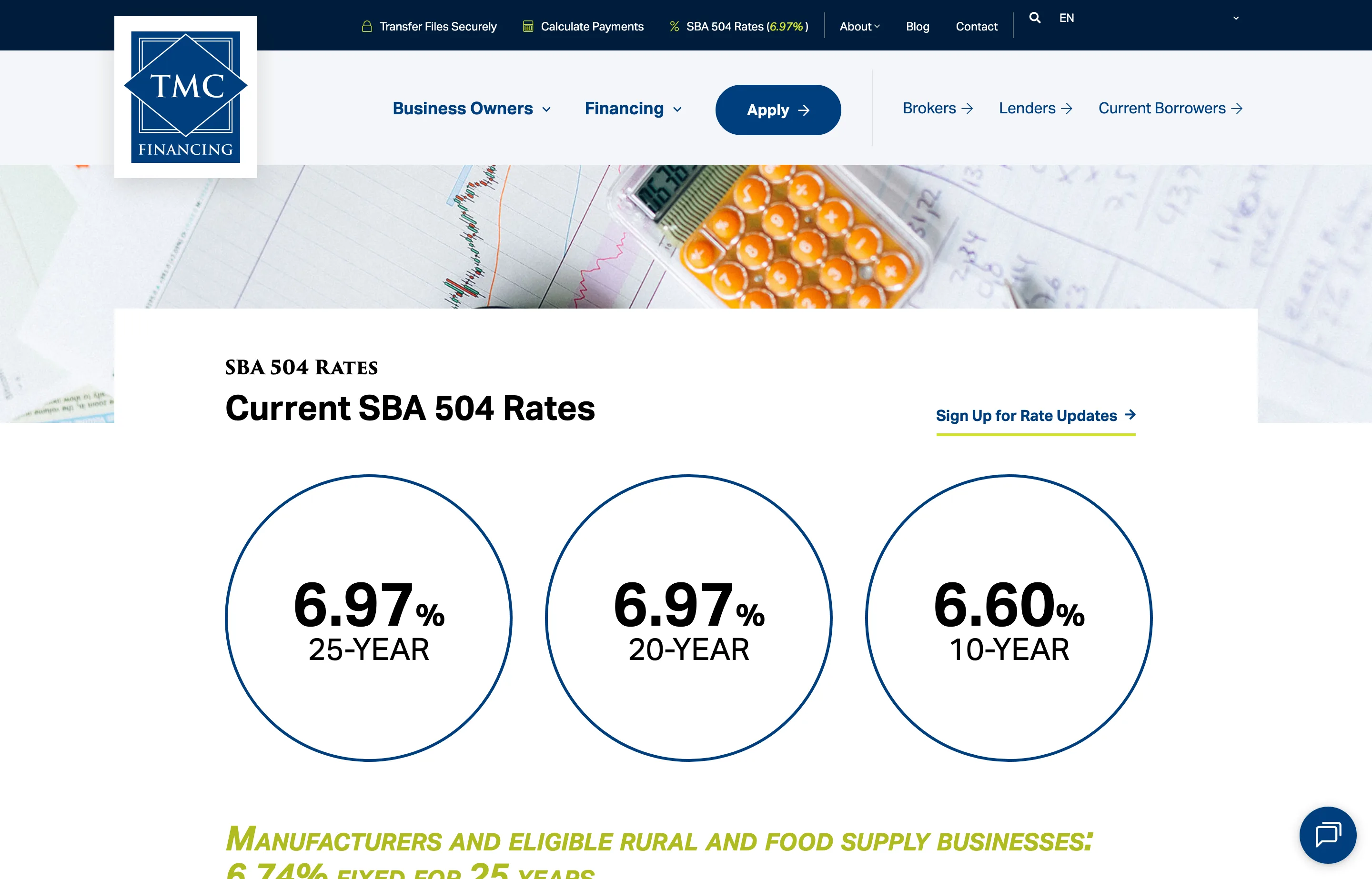
- Pricing: read from TMC's own rates page, October 2026: 6.74% fixed for 25 years for manufacturers and eligible rural and food-supply businesses, and the standard table printed in October 2026 shows 6.97% fixed for 25 years, 6.97% for 20 years, and 6.60% for 10 years (a third-party source had quoted ~6.1%–6.3% for the standard debenture — treat the table as the live figure and re-check it before you commit, since the 504 rate resets at SBA's monthly debenture sale). SBA FY2027 504 fees: 0.50% upfront guaranty fee + 0.203% annual service fee, both *waived* for qualifying manufacturers, food-supply-chain, and rural businesses (per SBA Information Notice 5000-881796). Maximum 504 debenture loan: $5.5 million.
- The catch: 504 is not working capital — it funds fixed assets only, and the *senior* (bank) half of the deal is priced separately and usually floats, so your blended cost is higher than the CDC rate alone; you must occupy at least 51% of the property and create or retain jobs; the 10% down and CDC/bank paperwork make it slower than a 7(a). Prepayment on the debenture carries a fee in the early years.
- Pros: the lowest long-term fixed rate available to a small business, locked for 25 years; only 10% down; the fee waiver is real money on a $2M project.
- Cons: real asset only; two lenders to manage; job and occupancy requirements; slower to close.
- Reviews: left unrated — no reliable public rating base (TMC publishes client testimonials, not an aggregated rating).
4. Accion Opportunity Fund — best nonprofit/CDFI lender for underbanked businesses
Accion Opportunity Fund is a nonprofit CDFI focused on women, entrepreneurs of color, and low-to-moderate-income business owners — the businesses traditional banks tend to turn away — and it pairs the money with free one-on-one business advising. It is the best answer on this list for a business with thin credit or no collateral but real cash flow.
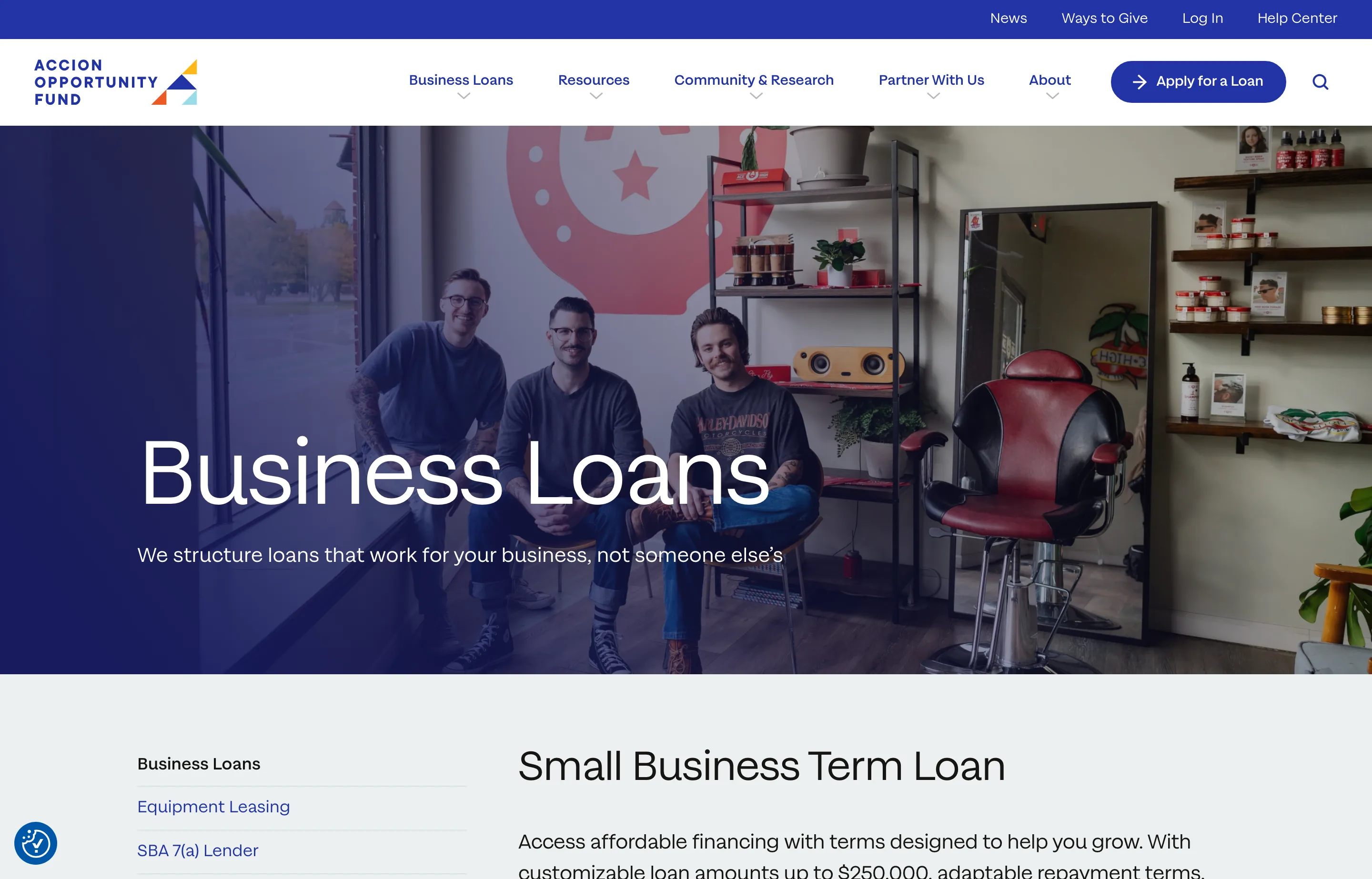
- Key features: small-business term loans of $5,000–$250,000; SBA 7(a) loans of $100,000–$350,000 on a 10-year term as a Community Advantage-style lender; equipment leasing; commercial truck and food-truck financing; free business advising and courses; lending decisions that weigh cash flow and tax returns, not just a credit score.
- Pricing: read from Accion Opportunity Fund's own help center (updated January 13, 2026): term-loan interest rates "range anywhere from 9.99%–28.99%." Available in 45 states — loans are not available in DC, MT, ND, SD, TN, or VT (per its own site).
- The catch: the top of the rate range (28.99%) is expensive money; the process is relationship-led, not instant — third-party reviews put funding at roughly 5–15 business days; amounts are capped at $250,000 for term loans; and it is unavailable in six states/DC. You also generally need to demonstrate ability to repay from documented cash flow.
- Pros: a genuine second-chance lender; a nonprofit mission with real borrower support; a fair, published rate range; SBA 7(a) access through a mission lender.
- Cons: higher rates at the top end; slower and more hands-on; geographic gaps; smaller amounts than a bank.
- Reviews: left unrated — no aggregated Trustpilot/G2 star rating we could verify (Candid lists it at a Platinum transparency level, which is a charity signal, not a borrower review base).
5. Kiva US — best 0% crowdfunded microloan
Kiva US is the one product on this list with no interest and no fees at all. Kiva is a 501(c)(3) nonprofit that crowdfunds business loans of up to $15,000 from its network of 1.5 million lenders — for an entrepreneur who can tell a story and rally a network, it is the cheapest capital in existence.
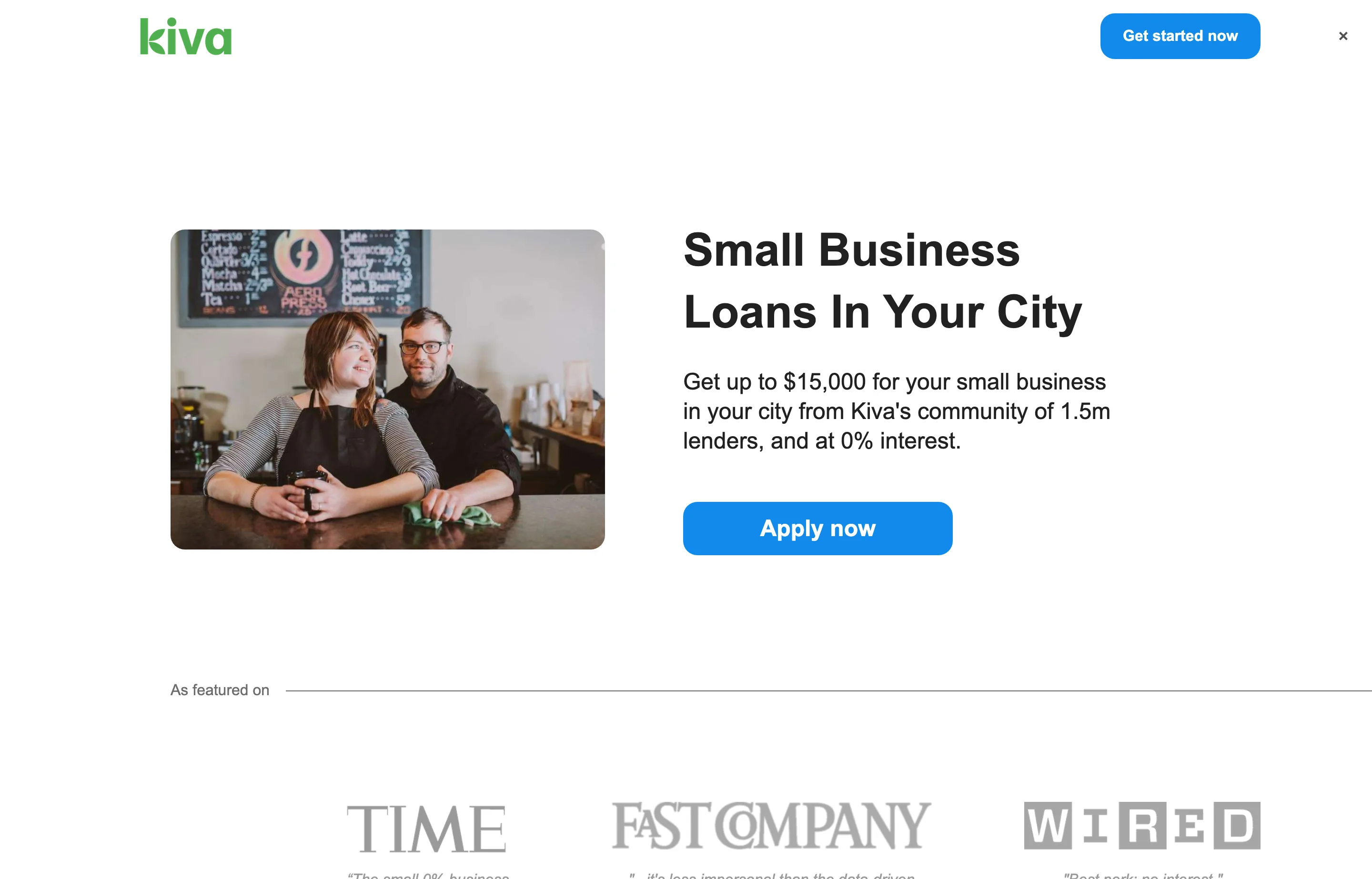
- Key features: up to $15,000 at 0% interest and $0 fees; no minimum credit score and no collateral requirement (per Kiva's own borrower pages); funds raised from a public 15-day crowdfunding window, with your friends and family "invited" to lend first; borrowers report Kiva can help build credit; Kiva is a nonprofit, not a bank.
- Pricing: 0% APR plus $0 fees — read from Kiva's own small-business lending and borrower pages, October 2026. Repayment is typically over 12–36 months (third-party-reported; Kiva's public borrower pages describe "several months to a few years").
- The catch: the loan isn't guaranteed — you have to fundraise it. You invite your own network to lend first, then go public for a crowdfunding window, so approval depends on effort and reach, not just credit. Amounts are small ($15,000 ceiling), and it takes time (weeks) from application to funds.
- Pros: genuinely 0% interest and $0 fees; no minimum credit score or collateral; nonprofit mission; free marketing to 1.5M lenders.
- Cons: you must recruit lenders; slow; small amounts; not designed for larger capital needs.
- Reviews: left unrated — no reliable public rating base for the US loan program that we could verify.
6. OnDeck — best online term loan for speed
OnDeck is the established name in fast online term loans — funding as soon as the same day, no hard credit pull to check rates, and amounts up to $400,000. It earns a place on speed and transparency about a very important number; it is *not* cheap money, and OnDeck is unusually honest about that.
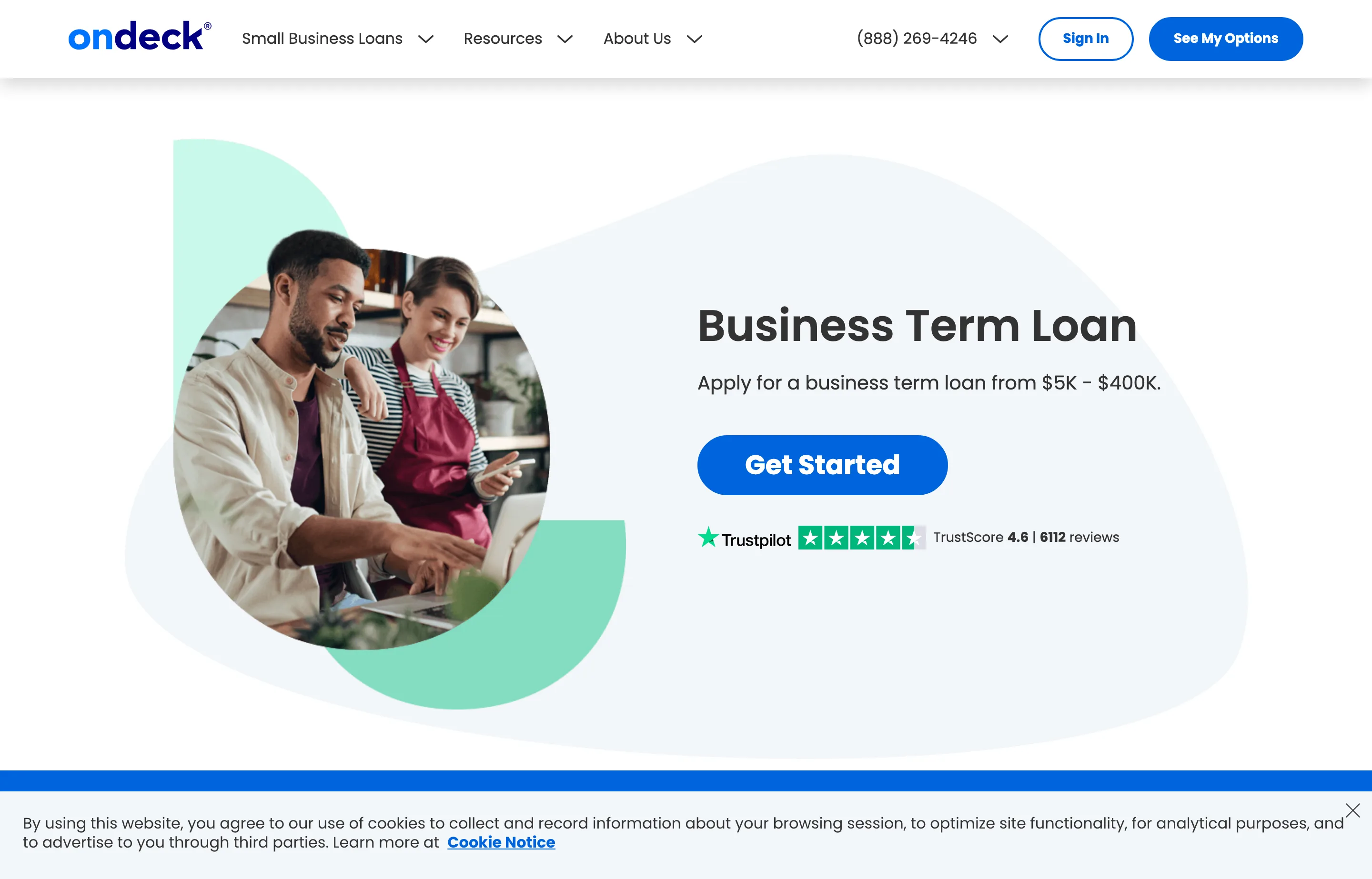
- Key features: term loans $5,000–$400,000 with repayment terms up to 24 months and fixed daily or weekly payments; a companion line of credit of $6,000–$200,000 (12/18/24-month terms); same-day funding on weekday approvals before 10:30 a.m. ET; funds issued by OnDeck family companies or Celtic Bank.
- Pricing: read from OnDeck's own disclosure, October 2026: "the average rate for term loans is 53.2% APR and the average rate for lines of credit is 59.8% APR," based on loans originated in the half-year ending June 30, 2026. An origination fee applies (0% only for customers who have already renewed a term loan). Minimums: 1 year in business, $100,000 annual revenue, 625 personal FICO, and a business checking account. Prepaying a term loan normally costs 75% of remaining interest unless you hold its "100% prepayment benefit" option.
- The catch: the average 53.2% APR is the headline you must internalize — OnDeck is a fast, expensive bridge, not cheap capital. Eligibility for the *lowest* rates is "very limited," per OnDeck's own note; prepayment is penalized unless you qualify for the benefit option; OnDeck does not lend in North Dakota.
- Pros: genuinely fast (same-day possible); transparent about its average APR; no hard pull to check rates; builds business credit with on-time payments; higher limits than most short-term lenders.
- Cons: very high average APR; origination fee; daily/weekly payments; prepayment penalty; state restriction.
- Reviews: TrustScore 4.6/5 on Trustpilot (4,674 reviews) per OnDeck's own site widget (October 2026); also an A+ Better Business Bureau rating.
7. Bluevine Line of Credit — best revolving line of credit
Bluevine is best known for business checking, and its line of credit is the revolving counterpart: credit up to $250,000, no maintenance fees, and a rate that can be as low as 7.8% for the strongest applicants. For a business that wants a buffer it can draw and repay, this is the cleanest online option.
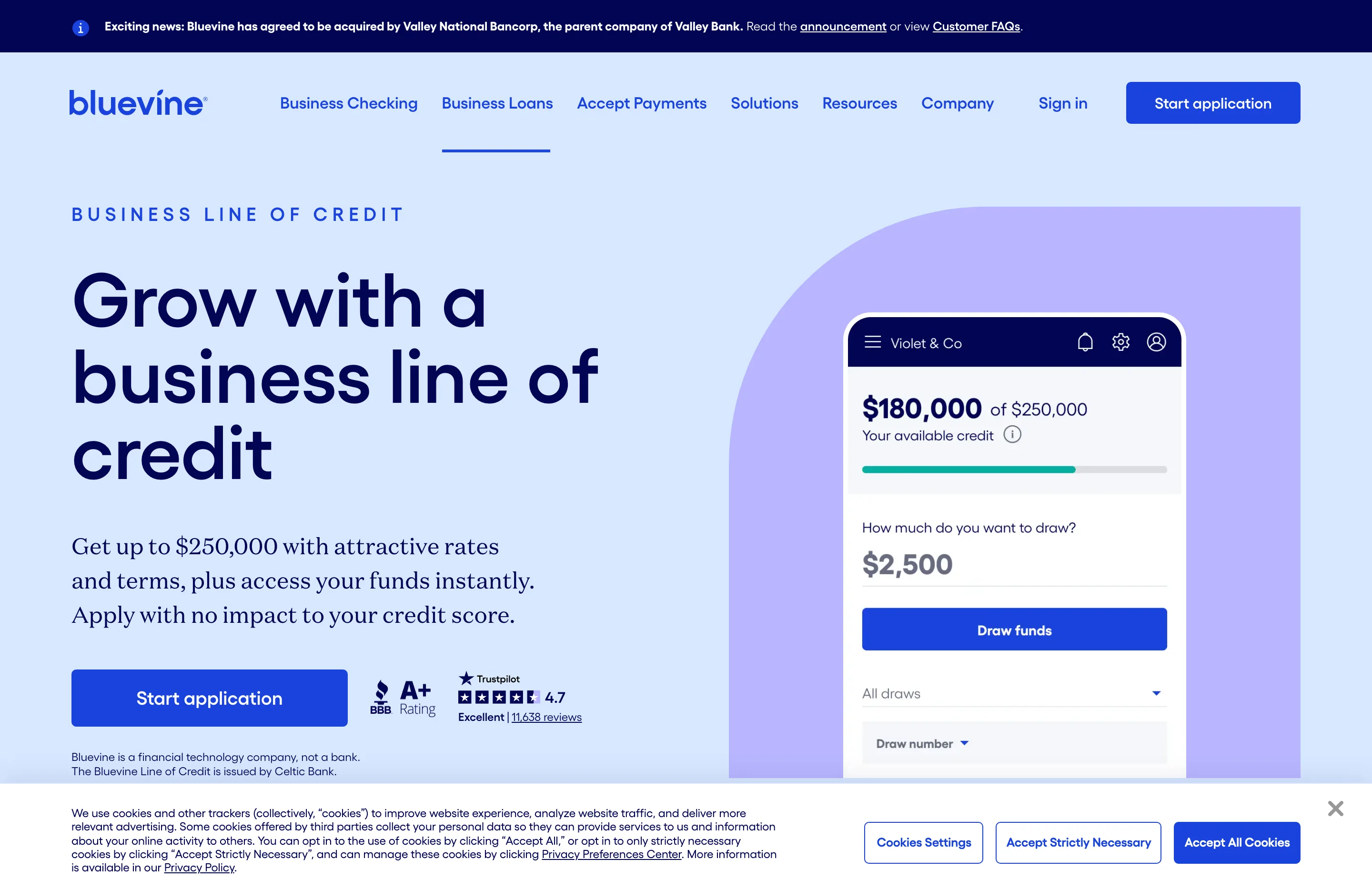
- Key features: revolving credit lines up to $250,000; no maintenance fees; rates "as low as 7.8%" for top qualifying customers; instant access to approved draws with a Bluevine Business Checking account; automatic weekly or monthly repayment; repayment reported to Experian for business credit.
- Pricing: read from Bluevine's own line-of-credit page, October 2026: "rates as low as 7.8% for top qualifying customers and no maintenance fees." Draws by wire cost $15; ACH draws are fee-free. Minimum qualifications: $10,000/month revenue, 625+ FICO, 12+ months in business, and a corporation or LLC (sole proprietors can't apply directly). Ineligible states: Nevada, North Dakota, South Dakota, and US territories.
- The catch: "as low as 7.8%" is the best case, available only to "top qualifying customers" — your offer will depend on your profile; accepting an offer triggers a hard credit inquiry; repayment is a fixed weekly or monthly schedule (not interest-only like a bank line); and if Bluevine can't fund you, your application is passed to a network of lending partners whose terms you don't control.
- Pros: one of the lowest advertised online rates; no maintenance fee; fast draws; revolving and replenishing; pairs with free Bluevine checking.
- Cons: the best rate is selective; hard inquiry on acceptance; fixed amortizing repayment; not for sole proprietors; state exclusions.
- Reviews: Bluevine's consumer rating is 4.7/5 on Trustpilot (~11,400 reviews, September 2026) — a company-wide figure, not specific to the line of credit.
8. Fundbox — best line of credit for invoice-based businesses
Fundbox built its name on the "draw against open invoices" model, and its line of credit is designed for the business that gets paid on terms: each draw becomes its own short-term installment, and paying early costs less. It is now heavily embedded inside accounting and invoicing platforms — QuickBooks, FreshBooks, Invoice Simple, and more — which is exactly where an invoice-driven business lives.
- Key features: a line of credit where each draw carries its own fixed payment schedule; repayment terms of 3, 6, 12, 18, or 24 months per draw (some terms are available only through embedded partners); the line replenishes as you repay; no origination fees, and remaining fees are waived on early payoff; also offers term loans, invoice financing, and revenue-based financing.
- Pricing: read from Fundbox's own line-of-credit page, October 2026: no origination fees, and the page states "remaining fees are waived on early payoff." Fundbox does not publish a rate or fee percentage on its public pages — the cost is quoted at underwriting — so treat the price as third-party-unverifiable until you have an offer. Financing is originated by First Electronic Bank or Lead Bank.
- The catch: the price is the black box — you cannot comparison-shop Fundbox without applying, and the site has pivoted much of its messaging to embedded "capital for platforms"; the direct product's line size isn't published either. It's best used when it's already inside your accounting software.
- Pros: no origination fee and no early-payoff penalty (fees waived); terms fit invoice cycles; deep accounting-platform integrations; fast draws.
- Cons: rates unpublished; line size unpublished; now oriented toward platform partners; the quoted cost can be high for a short draw.
- Reviews: Trustpilot 4.7/5 per the Trustpilot badge reproduced on Fundbox's own site (October 2026), linking to its Trustpilot profile.
9. American Express Business Line of Credit — best for Amex customers and fair credit
American Express Business Line of Credit (built on the platform Amex acquired from Kabbage) is more accessible than a bank line — a year in business, a 660 FICO, and $3,000/month in revenue — and it prices as a monthly fee rather than an APR. It is the clearest example on this list of why you must decode the quote.
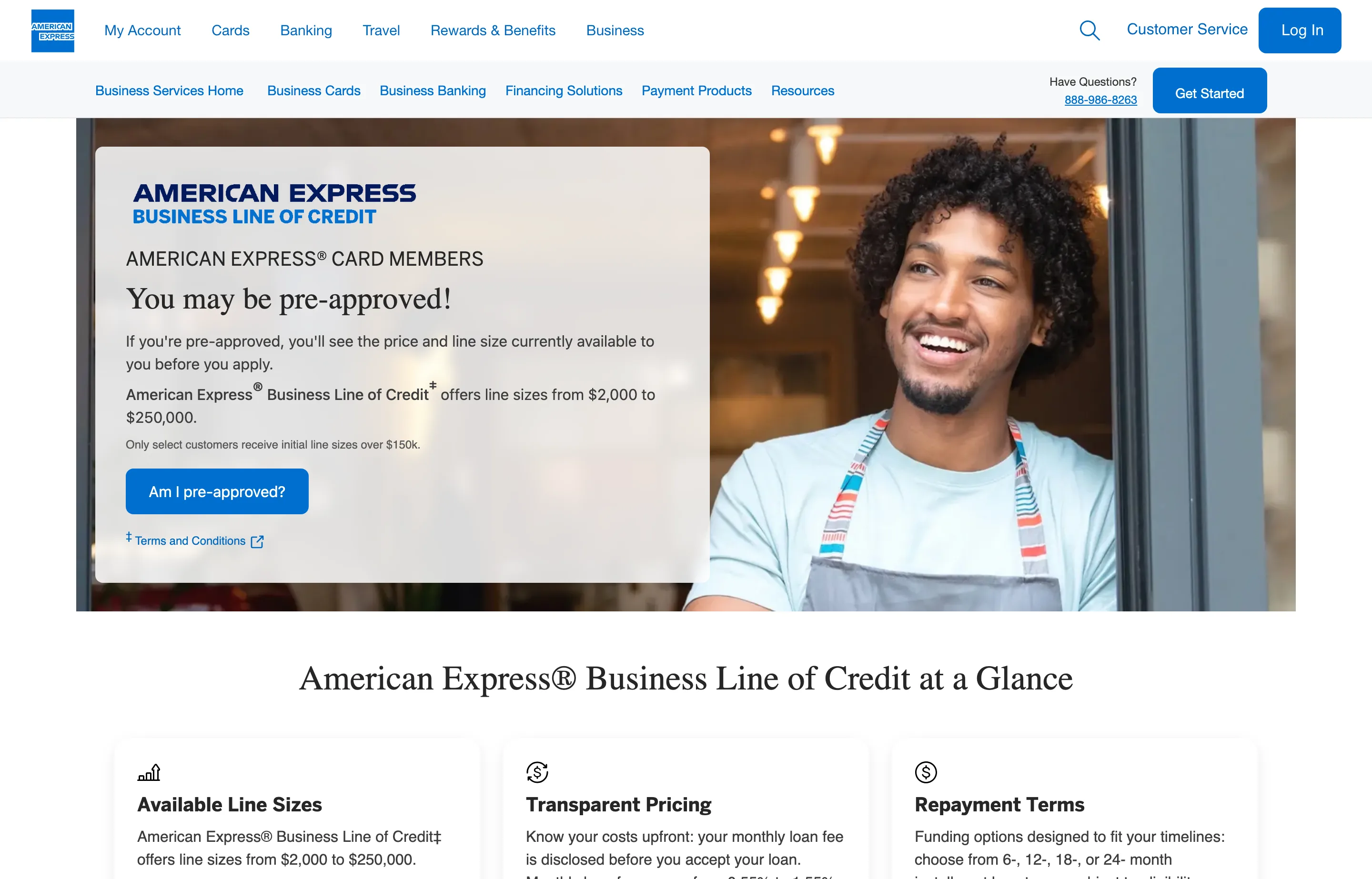
- Key features: lines from $2,000 to $250,000 (only select customers see initial lines above $150,000); 6-, 12-, 18-, or 24-month installment terms; each draw becomes its own installment loan; no origination, annual, application, or prepayment fees; fast online application with real-time review of linked bank accounts.
- Pricing: read from Amex's own page, October 2026: a monthly loan fee of 0.55%–1.55% of principal, spread equally across the term — and no origination, annual, application, or prepayment fees. Eligibility: 18+, business at least 1 year old, FICO 660+, average monthly revenue of at least $3,000.
- The catch: Amex does not quote an APR, so you must annualize the fee yourself: a 1.55%/month fee on a 12-month term is 18.6% of principal in total, which works out to roughly a 33% APR; the 0.55% end is closer to 12% APR (our conversion). Note the two mechanics that bite: fees are calculated on the *original* principal even as you pay it down, and short terms (6 months) raise the APR. There's also a personal guarantee.
- Pros: no origination or prepayment fees at all; accessible credit bar; fast funding; a genuinely low monthly fee at the 0.55% end; Amex brand and support.
- Cons: priced as a fee, not an APR, which obscures the real cost; fee charged on original principal; shorter 6-month option is expensive annualized; personal guarantee.
- Reviews: left unrated — no product-specific rating base we could verify.
10. PayPal Business Loan — best financing for PayPal sellers
PayPal Business Loan (Lender: WebBank) is a flat-fee, weekly-payment term loan of $5,000–$200,000 (up to $300,000 for repeat borrowers) that requires no collateral and funds as soon as the next business day. For a business already running sales through PayPal, it is the lowest-friction option here.
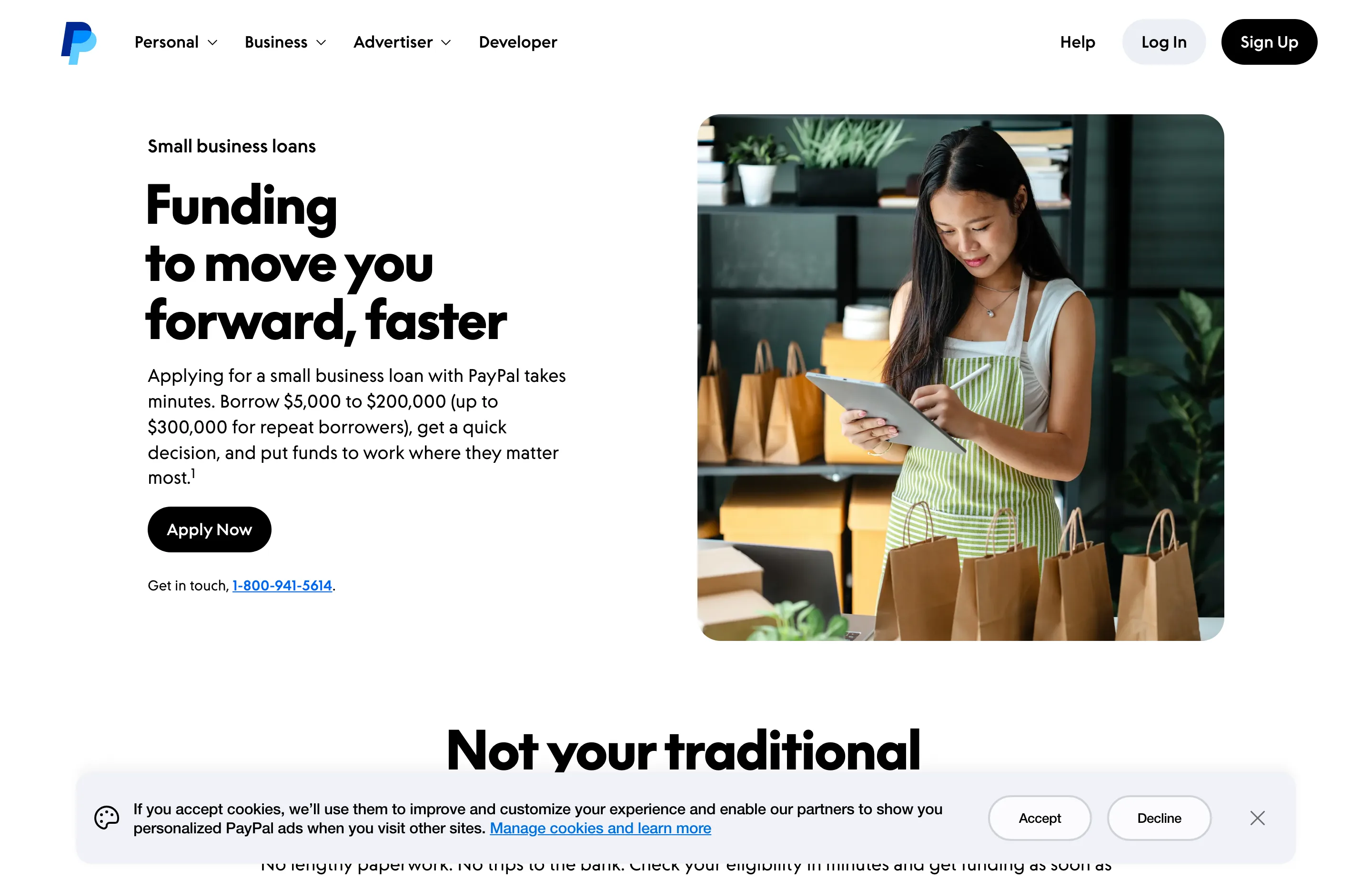
- Key features: loans of $5,000–$200,000 (up to $300,000 for repeat borrowers); terms of 17–52 weeks; one fixed fee paid over the life of the loan, with the only other cost a $20 returned-item fee if a payment bounces; no collateral; automatic weekly payments on a day you choose; funds as soon as the next business day; builds business credit with on-time payments.
- Pricing: read from PayPal's own small-business-loan page, October 2026: the loan carries "one fixed fee that's paid over the life of the loan" — but PayPal does not publish the fee percentage on the page, so you can't compare it without an offer. Minimum eligibility: annual revenue of at least $33,300 and a business at least nine months old, with a PayPal business account required. Funds are issued by WebBank; unavailable in North Dakota and South Dakota. PayPal's separate Working Capital product runs $1,000–$250,000 (up to $400,000 repeat) and repays as a share of PayPal sales.
- The catch: the flat fee is the whole cost *and* the whole mystery — because it isn't published, you must annualize the quoted fee (see the decoder) to compare it to an SBA rate; terms as short as 17 weeks push the effective APR high; a hard credit check is run only if you accept the offer.
- Pros: no collateral and a low barrier ($33,300 revenue, nine months); next-business-day funding; a single flat fee with no hidden charges beyond the $20 returned-item fee; integrates with your existing PayPal cash flow.
- Cons: fee unpublished; short terms can mean a high annualized cost; requires a PayPal business account; two states excluded.
- Reviews: left unrated for the loan product — no product-specific rating we could verify (PayPal's broader merchant business draws a 4.6/5 on Capterra with ~26,500 reviews, July 2026, but that measures payments, not this loan).
11. Square Loans — best for Square sellers
Square Loans turns your Square processing history into an offer: $100 to $500,000, no interest, a single flat fee, and repayment taken automatically as a percentage of your daily sales. For a café, salon, or shop already on Square, it is the least-effort money there is.
- Key features: offers from $100 to $500,000 based on your Square history; no interest — one flat fee; repayment is automatic from a percentage of daily Square sales, so slow days cost less; no long forms and no hard inquiry to check eligibility; funds instant with Square Checking, else next business day; loans issued by Square Financial Services, Inc.; Square reports $26.5B+ funds extended and 900K+ businesses funded as of internal 2025 data.
- Pricing: read from Square's own Loans page, October 2026: "No interest, just one flat fee." Square does not publish the fee — it depends on your processing history, offer amount, and repayment rate — so annualize your quoted fee (decoder above) before comparing.
- The catch: Square Loans exist only for Square sellers, and the "flat fee" is unpublished, so the effective APR depends on how fast you sell — repay faster and the annualized cost rises for the same fee. There is a required minimum payment, and Square may hold a portion of daily sales.
- Pros: no interest and no separate monthly fee; instant or next-day funding; repayment flexes with sales; no separate application if you're eligible; effectively free to check.
- Cons: Square sellers only; fee unpublished; sales-based repayment can slow your cash flow on busy days; minimum payment required.
- Reviews: left unrated for the Loans product — no product-specific rating base we could verify.
12. Shopify Capital — best funding for Shopify merchants
Shopify Capital is the built-in funding arm for Shopify stores: merchant cash advances and loans of up to $2 million, repaid as a share of daily sales, with no credit checks and no personal guarantee. For an inventory-heavy Shopify merchant, it is the most native option available.
- Key features: funding up to $2 million; both merchant cash advances and loans; repayment as a percentage of daily sales (slower sales, smaller payments); funds in as quick as 2 business days if approved; no credit checks and no personal liability or compounding interest, per Shopify; early renewal top-ups; issued by WebBank in the US.
- Pricing: read from Shopify's own Capital pages, October 2026: funding is repaid "based on a percentage of daily sales," the maximum repayment term is 18 months, and two minimum payments apply. Shopify does not publish a fee or factor rate — it is offered by invitation and priced per merchant.
- The catch: it is a cash advance/loan with a fixed fee, not an APR product, so you must annualize the offered fee; it is only for eligible Shopify merchants and is offered by invitation based on your store history; and repayment skims daily sales, which can pinch a tight margin if the remittance rate is set too high.
- Pros: up to $2M with no personal guarantee and no credit check; repays as you sell; fast; native to your Shopify admin; keeps inventory and marketing funded.
- Cons: Shopify merchants only, by invitation; fee/factor unpublished; 18-month cap; daily-sales remittance.
- Reviews: left unrated for Capital — no product-specific rating base we could verify.
13. Balboa Capital (Ameris Bank Equipment Finance) — best for equipment and vehicles
Balboa Capital — now operating within Ameris Bank — is one of the longest-running equipment finance companies in the country (founded 1988, acquired by Ameris Bancorp in 2020, third-party-reported), financing purchases up to $500,000 with fast, mostly online decisioning. When you need the truck, machine, or kitchen build-out financed rather than a lump of cash, equipment financing prices better than an unsecured term loan because the asset secures it.
- Key features: equipment financing and leasing up to $500,000 (per the official Ameris equipment-finance page); covers vehicles, machinery, technology, and franchise build-outs; equipment serves as collateral, which lowers the rate versus unsecured credit; fast online application with specialist follow-up; SBA 7(a) and 504 options available through the wider Ameris relationship (third-party-reported).
- Pricing: Balboa/Ameris publishes "competitive rates" but no rate table; the equipment-finance page timed out on our automated check, and rates are quoted per application. Treat equipment rates as quoted, not published — ask for the APR and the term, not the monthly payment.
- The catch: the rate is quoted, so you cannot compare without applying, and equipment financing only funds the specific asset (you can't take the cash for payroll); longer terms on used or "soft" equipment are harder to get; and the site's bot protection meant we could not read the current rate/term page (we relied on the official page title and named third-party reviews).
- Pros: asset-backed pricing is cheaper than unsecured credit; up to $500K; decades of equipment expertise; fast decisioning.
- Cons: quoted-only pricing; asset-restricted use; newer to the Ameris brand after the Balboa rebrand; we could not fully verify the current page.
- Reviews: left unrated — no reliable public rating base we could verify for the equipment-finance entity.
14. FundThrough — best invoice factoring for B2B and government receivables
FundThrough advances cash against your unpaid invoices within a day, taking 100% of the invoice *less one flat fee*, and waits for your customer to pay on your net terms. If your problem is slow-paying business or government clients rather than a one-time expense, factoring often fits better than a loan.
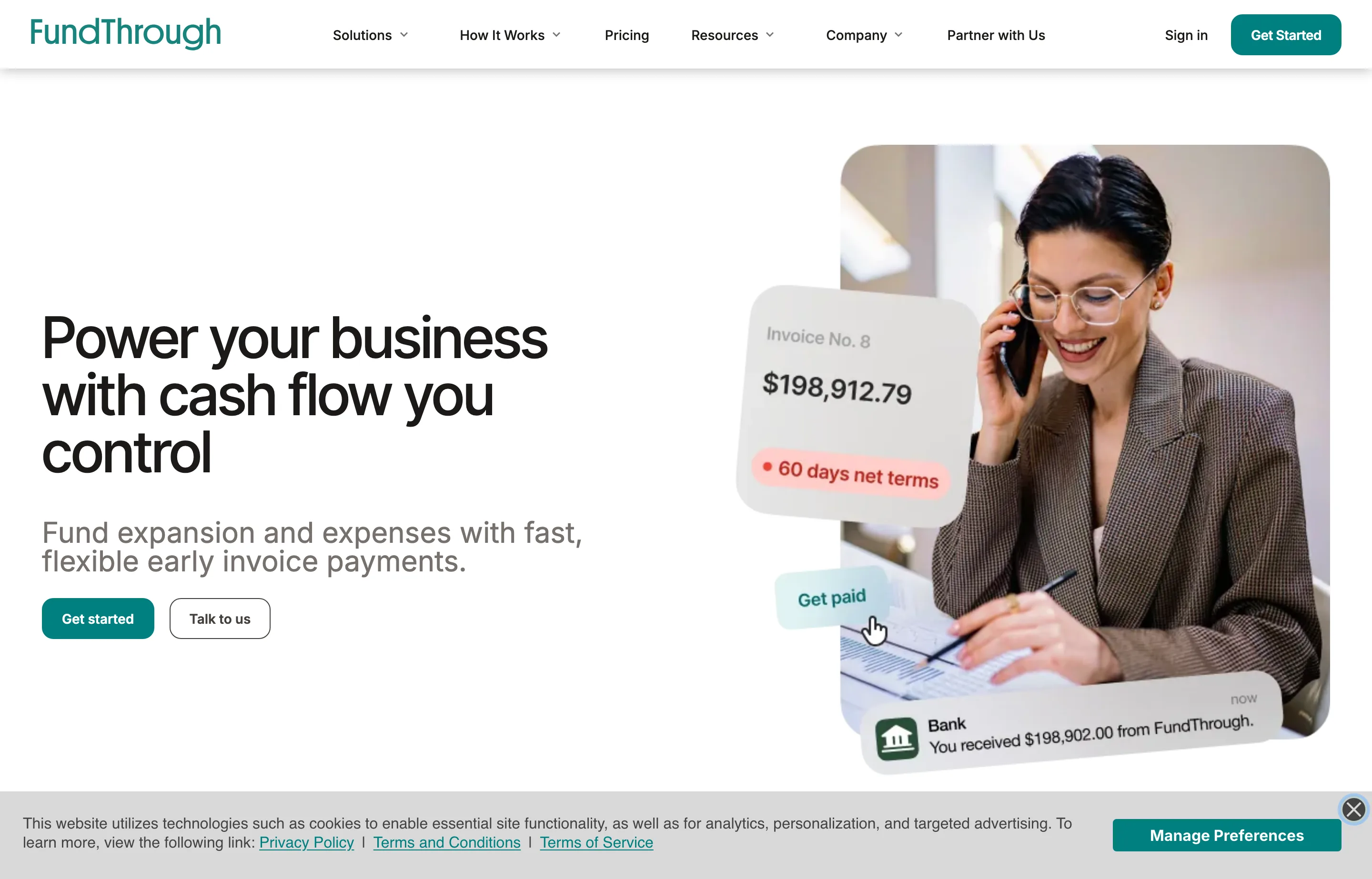
- Key features: advances 100% of an invoice minus one flat fee, usually within 24 hours after your first funding; spot factoring — choose which customers' invoices to factor; no required minimum funding after the first invoice; integrates with QuickBooks, Xero, Sage, and Enverus OpenInvoice; $3B+ in invoices factored and an average 52 days faster to payment, per FundThrough.
- Pricing: read from FundThrough's own site, October 2026: "Get 100% of your invoice value up front, less one flat fee" with "No required minimum funding after your first invoice funding." FundThrough does not publish the fee percentage — it is quoted per invoice — so ask for the discount rate on a specific invoice before you commit. For context, invoice factoring is usually priced as a discount of ~1%–5% of the invoice per 30 days, which annualizes to a double-digit-plus APR; treat that band as a general market range, not a FundThrough quote.
- The catch: factoring is not a loan — you sell the receivable, and factoring works only if you invoice creditworthy business or government customers; your customer may be notified and asked to pay FundThrough instead of you; the fee is unpublished; and factoring the same invoice you've also financed elsewhere is fraud.
- Pros: turns 60–90-day terms into near-immediate cash; non-dilutive and debt-free; choose which invoices to fund; strong accounting integrations; high customer rating.
- Cons: fee unpublished; only works with creditworthy invoices; customer-facing; can be expensive annualized; not for B2C businesses.
- Reviews: 4.6 average across Google, Trustpilot, and G2, per the rating published on FundThrough's own site (October 2026).
15. Lendio — best marketplace to compare many lenders at once
Lendio is not a lender — it is a marketplace that submits one application to a network of lenders (its own site says over 100 lenders and financial partners; third-party coverage says 75+) and returns the offers you qualify for. It is free to the borrower, which makes it the fastest way to see several term sheets without applying to each lender separately.
- Key features: a single application matched against 75–100+ lending partners; covers term loans, lines of credit, SBA loans, equipment financing, and more (11+ product types); a free "funding manager" to help compare offers; free to the borrower — Lendio is paid by its lending partners; embedded financing available inside other software platforms.
- Pricing: read from Lendio's own pages, October 2026: applying is free to the borrower, because Lendio is compensated by the lenders in its network. The rates and terms are set by whichever lender accepts you — Lendio does not control them. Third-party coverage puts the marketplace's term loans at roughly $5,000–$2 million with rates from about 8% APR; treat the rate range as third-party-reported.
- The catch: you trade control for convenience — your application data goes to many lenders, and the offers that come back can include high-cost products you'd never have chosen; the marketplace doesn't set the rate, so the comparison work is still yours; Lendio's own site blocked our automated check, so two of its figures rely on a named third party.
- Pros: one application, many offers; free to the borrower; a wide product menu including SBA; a funding manager to help you compare; faster than applying lender-by-lender.
- Cons: you don't set the rate; your data is shared broadly; high-cost offers can surface; no published rate table (it depends on partners).
- Reviews: left unrated — no reliable public rating base we could verify.
The paperwork around the money: free Small Business Tools
A loan gives you capital; it doesn't tell you whether the deal makes sense. These free tools do the arithmetic before you sign:
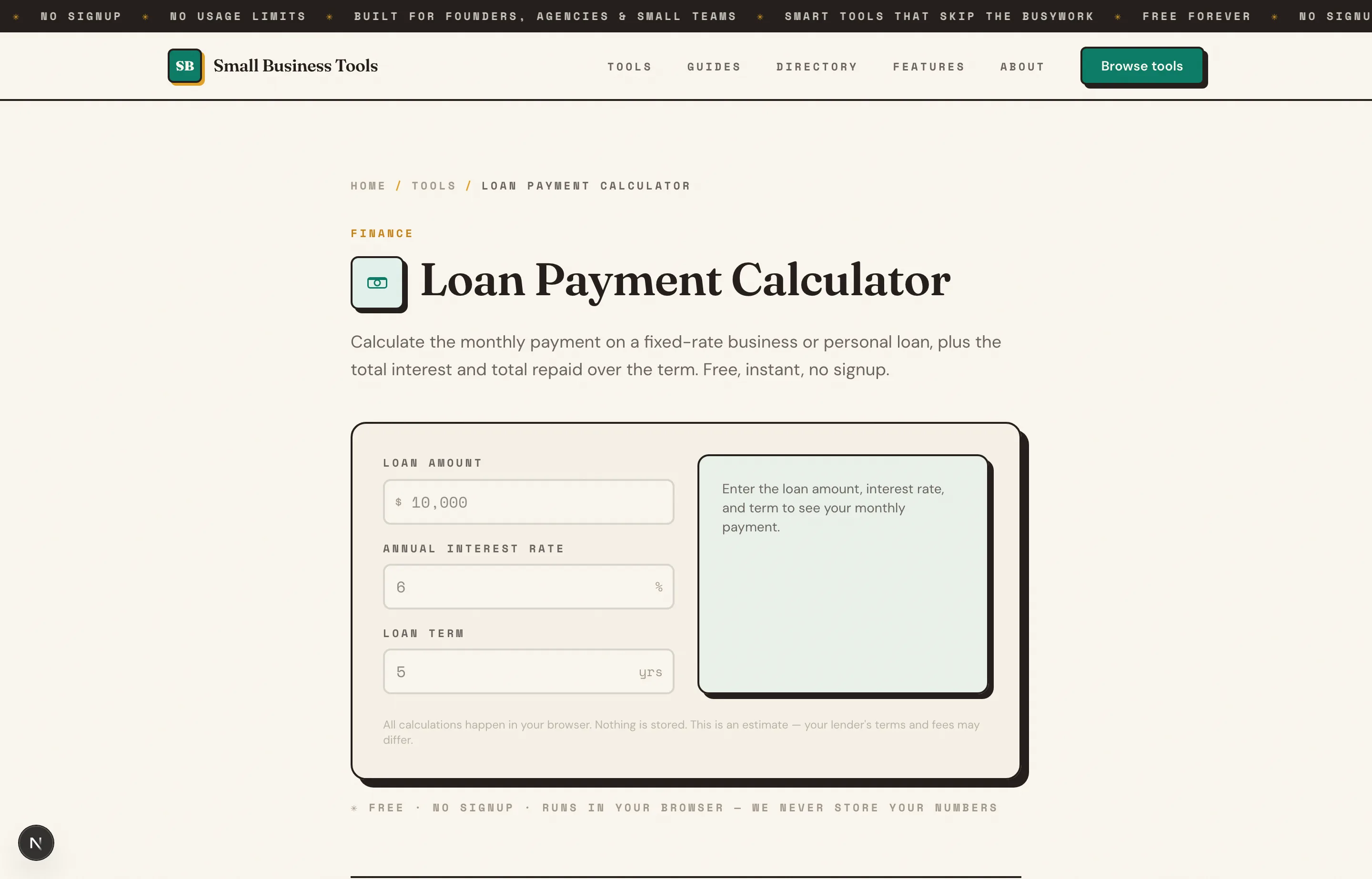
- Loan Payment Calculator — the decoder's best friend: enter the amount, APR, and term to get the monthly payment, total interest, and total repaid. Use it to reconcile a quoted rate against the real cost, exactly as in the worked example above.
- ROI Calculator — the only reason to borrow is a return higher than the cost of capital. Compare the return on the equipment, inventory, or marketing the loan funds against the APR you're being charged.
- Percentage Calculator — the fastest way to annualize a flat fee or "factor rate": multiply the flat cost by the number of terms in a year, then adjust for the amortizing schedule (see the decoder table).
- Profit Margin Calculator — check that the payments your loan requires fit inside your existing margin before you commit to daily or weekly remittances.
The free small business tools hub lists the rest by job. The loan sits inside a larger money picture: run the repayment through the SBA guide if you're buying a business, size the return with How to calculate ROI, confirm what card acceptance costs in the payment processors guide, and park the proceeds in the right account with the business bank accounts guide.
Which should you choose?
- You're a profitable business that can wait a few weeks: Live Oak Bank for SBA 7(a) — the cheapest money here, if you clear its 680 FICO floor and documentation.
- You want a local banker and you're in the Midwest/Sun Belt: Huntington Bank — startup- and acquisition-friendly, with below-average SBA rates on its book.
- You're buying the building your business occupies: TMC Financing for an SBA 504 — a fixed 25-year rate with 10% down, and 0% SBA fees if you qualify for the FY2027 waiver.
- You have thin credit or no collateral but real cash flow: Accion Opportunity Fund (published 9.99%–28.99% range, nonprofit) or Kiva US (0%, if you can fundraise it).
- You need money this week and can repay it fast: OnDeck — same-day possible, but budget for a ~53% average APR and an origination fee. Compare it to Bluevine (~7.8%-and-up line) or Amex (12%–33% annualized) first.
- You process on Square, Shopify, or PayPal: the platform loan is the fastest to get — but annualize the flat fee before you accept, because none of the three publishes a rate.
- You're financing a specific machine, truck, or build-out: Balboa Capital/Ameris equipment financing — asset-backed pricing beats unsecured credit; get the APR in writing.
- Your problem is slow-paying B2B or government customers: FundThrough factoring — get paid in a day, at the cost of a per-invoice fee.
- You want several offers without applying five times: Lendio — free to you, but read every offer's annualized cost, not its payment.
- You just need to compare offers you already have: put each one into the loan payment calculator, add every fee, and compare totals.
The one habit that matters: convert every quote to an APR before comparing. A "1.30 factor," a "1.5% monthly fee," and "2.9% + $15,000 guaranty fee" are not the same units, and the Fed's own survey says 60% of online-lender borrowers got this wrong.
FAQs
What is the best small business loan in 2026?+
For a business that can qualify, an SBA 7(a) loan (through Live Oak Bank or Huntington) or an SBA 504 loan (through a CDC like TMC Financing) offers the cheapest capital on this list — long fixed terms and the lowest rates. For speed, online term loans (OnDeck), lines of credit (Bluevine, Fundbox, Amex), and platform advances (Square, Shopify, PayPal) fund in a day but cost far more annualized. The "best" loan is the cheapest one you can actually qualify for that the business can repay.
What is an SBA guaranty fee, and how much is it in 2026?+
It is SBA's upfront fee on a 7(a) loan, charged on the guaranteed portion. For FY2027 approvals (on or after October 1, 2026): **2%** for loans of $150,000 or less, **3%** for $150,001–$700,000, and **3.5%** up to the first $1 million of the guaranteed portion plus **3.75%** above that for larger loans. There is also a lender's annual service fee of 0.55% of the outstanding guaranteed balance, which the lender pays and may not pass to you. Loans of $700,000 or less to manufacturers, food-supply-chain businesses, and rural businesses pay a **0%** upfront fee.
How do I convert a factor rate to an APR?+
Multiply the flat cost by the number of terms in a year, then adjust upward because you repay principal throughout. On equal daily remittances, a 1.30 factor over six months is roughly a **111% APR**; the same 1.30 factor over 12 months is roughly **55%**; and a 1.20 factor over six months is about **76%**. The shorter the term, the higher the APR. Always ask the lender for the APR in writing, and use the [loan payment calculator](/tools/loan-payment-calculator) to check the total.
Are online business loans a bad idea?+
Not automatically — they fund in hours, which a bank cannot, and for a short-term, high-return need that speed is worth the cost. They become a bad idea when a borrower compares a 53% APR term loan to a 10% SBA loan on the *monthly payment* rather than the total cost. The Federal Reserve's 2025 survey found 60% of online-lender borrowers said the cost came in higher than they expected; that is the failure mode to avoid.
What's the difference between a line of credit and a term loan?+
A **term loan** gives you a lump sum repaid on a fixed schedule; a **line of credit** gives you revolving access up to a limit, and you pay interest or fees only on what you draw. Use a term loan for a one-time investment (equipment, an acquisition, a build-out) and a line of credit for working capital and cash-flow gaps. Amex, Bluevine, and Fundbox are lines; OnDeck, PayPal, and the SBA products are term loans.
Can I get a small business loan with bad credit?+
Yes, but cheaper options narrow. Kiva US has **no minimum credit score** and 0% interest (up to $15,000, crowdfunded); Accion Opportunity Fund weighs cash flow and tax returns, not just a score, with rates from 9.99%; and Amex's line goes down to a **660 FICO**. SBA 7(a) lenders like Live Oak typically want **680+**, and OnDeck requires **625**. Expect the rate to rise as your credit falls — and convert every offer to an APR before deciding.
Final take
Match the product to the job, not the sales pitch. Buying a building or refinancing one? SBA 504 through a CDC. A long-term working-capital or acquisition need, and you can wait? SBA 7(a) through a bank or a preferred lender. Thin credit or no collateral? Accion Opportunity Fund or Kiva. A same-week gap you'll clear in a month or two? An online term loan or line of credit — as long as you've annualized the cost first.
Then do the one thing the marketing counts on you skipping: convert the quote to an APR. Put the amount, the real APR (not the factor rate), and the term into the free loan payment calculator, add every fee to the total, and compare that against the return the money will earn with the ROI calculator. Cheapest quote, best deal — free, no signup, nothing stored.
Free tools to try
Loan Payment Calculator
See the monthly payment, total interest, and total cost of any fixed-rate loan.
ROI Calculator
See your return on investment as a percentage — plus annualized ROI over time.
Percentage Calculator
What is X% of Y, X is what % of Y, and percent change — answered in plain words.
Profit Margin Calculator
Find your margin, markup, and profit from cost and revenue — instantly.
Keep reading
Guide
New SBA Rules for Buying a Business (SOP 50 10 8.1, Oct 2026)
SBA SOP 50 10 8.1 raises the cash-flow bar for 7(a) business acquisitions to 1.25x, drops projections, adds QoE reports, and caps debt at the valuation.
Guide
Best Business Bank Accounts for Small Business (2026)
12 business bank accounts compared — real 2026 fees for Bluevine, Novo, Relay, Chase and more, plus the fintech-vs-bank FDIC decoder.
Guide
How to Calculate ROI on a Small Business Investment
Calculate ROI on a small business investment: the formula, annualized ROI for fair comparisons, what makes a return good, and the traps that inflate it.
Guide
Best Payment Processors for Small Business (2026)
11 payment processors compared for small businesses — real 2026 fees for Square, Stripe, PayPal, Helcim and more, plus when interchange-plus saves money.