Guide
Claude Haiku 5.5: Cheaper High-Volume AI for Small Business
On 7 October 2026 Anthropic released Claude Haiku 5.5, describing it as its cheapest, fastest and most capable small model — around 75% cheaper to run on average than the model it replaces. For a small business, the benchmark scores matter less than the economics: the repetitive AI work you previously rationed — summarising, classifying, tagging, drafting first replies — now costs pennies instead of dollars.
This guide covers what actually changed, what it costs at published rates, which small-business jobs it makes affordable, and how to test it before you build anything on top of it. Every figure is dated, because model pricing moves fast.
Quick answer
- Anthropic launched Claude Haiku 5.5 on 7 October 2026. It is the cheap, fast tier of the Claude family, built for high-volume, cost-sensitive work rather than hard reasoning.
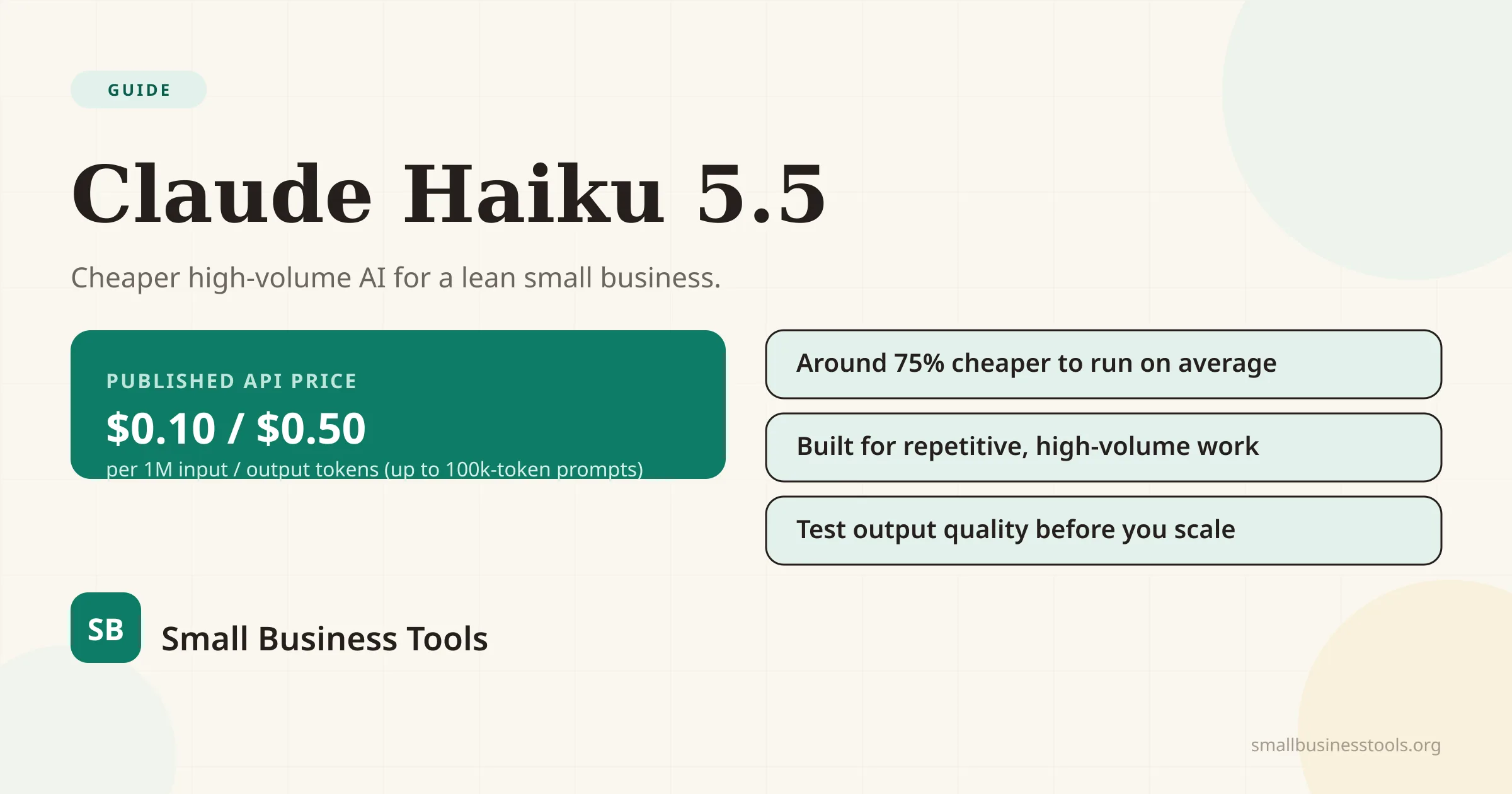
- Published API pricing is $0.10 per million input tokens and $0.50 per million output tokens for prompts up to 100,000 tokens — about 90% below Haiku 4.5 in that band, and roughly 75% lower on average across typical use.
- If you only *chat* with Claude in the app, little changes — Haiku already powers the cheaper experience and is included on the Free, Pro and Max plans. The price cut matters when you run AI at volume through the API or through a tool built on it.
- Alongside the launch, Anthropic halved Sonnet 5.5 cache-read pricing and added monthly API credits for Max and Team subscribers.
- The practical move: pick one repetitive task, compare the old and new cost at your real volume, and only scale it if output quality holds up on your own examples.
What changed on 7 October 2026
Anthropic shipped Claude Haiku 5.5 worldwide — on the Claude Platform and on Amazon Web Services, Google Cloud and Microsoft Azure — under the model ID claude-haiku-5-5. It is available now, not a waitlist or a pilot. The announcement frames it plainly: this is the model for "quick and repetitive workloads" like summaries, compaction, database queries and classification, and for speed-sensitive jobs like live customer support.
The headline is price. Here is the published API pricing per million tokens, for prompts up to 100,000 tokens versus over that threshold:
| Per 1 million tokens | Haiku 5.5 (≤100k) | Haiku 5.5 (>100k) | Haiku 4.5 | Sonnet 5.5 (for reference) |
|---|---|---|---|---|
| Input | $0.10 | $0.50 | $1.00 | $2.00 |
| Output | $0.50 | $2.50 | $5.00 | $10.00 |
| Cache reads | $0.01 | $0.05 | $0.10 | $0.10 |
| Cache writes | $0.125 | $0.625 | $1.25 | $2.50 |
Anthropic notes that 90% of requests to the previous Haiku model fell under 100,000 tokens, so most workloads land in the cheapest band. It prices Haiku 5.5 90% below Haiku 4.5 for prompts up to 100k tokens and 50% below for prompts over that. Once you account for a slightly heavier tokenizer, the company puts average running costs about 75% lower.
Two supporting changes came with it:
- Sonnet 5.5 cache reads halved, from $0.20 to $0.10 per million tokens, which Anthropic says makes Sonnet 5.5 around 20% cheaper on most agentic work.
- New monthly API credits for Claude Max and Team subscribers — $100/month for Max 5x, $200/month for Max 20x, and up to $500/month pooled across Team users — for building on the Claude Platform.
On Anthropic's own benchmarks, Haiku 5.5 also jumps sharply over Haiku 4.5 on computer use (72.4% vs 15.7% on OSWorld 2.1) and knowledge-work tasks. Those are vendor-published numbers, useful as direction, not as your own quality proof.
Who this actually helps — and who it doesn't
The story is easy to misread, so separate two very different users.
If you run AI at volume or use tools built on the API, this is a real cost change. Any workflow that calls a model thousands of times a month — support triage, review summarising, list classification, first-draft generation — just got dramatically cheaper to run. That is what turns "too expensive to automate" into something a one- or two-person team can wire up.
If you only chat with Claude in the app, not much changes. Haiku is already part of the free and paid Claude experience. The app plans are Free ($0), Pro at $17/month billed annually ($20 monthly), and Max from $100/month. The 5.5 price cut applies to the API, not to your subscription.
The distinction matters because it decides whether you should do anything at all. If you're a solo owner who occasionally asks Claude to rewrite an email, the answer is: nothing to change. If you're paying for a tool — or a freelancer built you an automation — that runs on a Claude model in the background, this is worth checking.
The jobs it makes affordable
Haiku 5.5 is a small model. Match it to small-model work: high volume, repetitive, and low stakes if a single output is imperfect.
| Job | What it looks like | Why volume was the blocker before |
|---|---|---|
| Support triage | Read incoming tickets, tag category, urgency and sentiment | Manual tagging doesn't scale; larger models cost too much per ticket |
| Summarising | Condense long emails, reviews, threads or documents | Doing it across every item added up fast |
| First-draft replies | Draft a starter response for support, sales or enquiries | Volume made per-reply cost the deciding factor |
| Classification and routing | Sort leads, expenses, listings or feedback into buckets | Thousands of rows make cheap per-call pricing essential |
| Content repurposing | Turn one blog post into social posts, an email and an FAQ | Repetitive, low-judgment transformation at scale |
| Data cleanup | Normalise messy names, addresses or categories | High item counts, low per-item value |
The pattern is the same everywhere: the work is repetitive and cheap per item, and the old cost made doing it at all uneconomical.
What it costs: a worked example
Numbers make the change concrete. Both examples use published API rates and ignore cache discounts, which would only lower the Haiku 5.5 figure further.
Example 1 — a small support workflow. Say you route 5,000 enquiries a month, and each call averages 2,000 input tokens and 500 output tokens. That is 10 million input tokens and 2.5 million output tokens a month.
- Haiku 5.5: (10 × $0.10) + (2.5 × $0.50) = $1.00 + $1.25 = $2.25/month
- Haiku 4.5: (10 × $1.00) + (2.5 × $5.00) = $10.00 + $12.50 = $22.50/month
Same work, roughly 90% less.
Example 2 — a classification job at scale. Say you tag 50,000 records a month, each averaging 500 input tokens and 100 output tokens. That is 25 million input and 5 million output tokens.
- Haiku 5.5: (25 × $0.10) + (5 × $0.50) = $2.50 + $2.50 = $5.00/month
- Haiku 4.5: (25 × $1.00) + (5 × $5.00) = $25.00 + $25.00 = $50.00/month
At these volumes the difference is the line between "not worth automating" and "run it every day." Your own token counts will differ, but the ratio holds: Haiku 5.5 is roughly a tenth of the old rate in the cheap band.
One caveat on the arithmetic: if a single prompt exceeds 100,000 tokens, the rate rises fivefold on input and output. Keep prompts short and the work surgical, and you stay in the cheap band.
How to try it without overpaying
A short checklist, in order:
- Pick one repetitive task. Not a project — one recurring job you already do by hand or skip entirely.
- Measure the real volume. Count how many times a month it runs, and estimate the input and output tokens per run from a few examples.
- Run a small quality test first. Take 20–50 real examples and compare Haiku 5.5's output against what you use today. Cheaper only counts if the output still passes.
- Keep prompts short. Aim to stay under the 100k-token threshold, where pricing is a tenth of the old rate.
- Use it for sub-steps, not judgment. The most cost-effective pattern is a cheap model for the repetitive middle and a stronger model only for the few calls that need real reasoning.
- Set a spend alert. In the Claude console, set a monthly budget so a runaway script can't surprise you.
- If you only use the Claude app, do nothing. You already have Haiku; the change is on the API side.
If you want to work through the output quality by hand first, the free AI Email Writer and AI Humanizer let you draft and tighten text without wiring anything up, and the Word Counter keeps responses within the limits a given channel imposes.
Risks and caveats
- The benchmarks are Anthropic's own. Independent testing of Haiku 5.5 was still thin at publication. Treat capability claims as directional until you've tested your own cases.
- Prices change. Everything here is dated as of October 2026. Model pricing and plan tiers move often — re-check before you commit a budget.
- Cheaper is not automatically right. For anything high-stakes — legal, medical, financial, tax, or a claim a customer will rely on — a small model still needs human review. The saving is in volume work, not in judgment calls.
- Watch the threshold. The fivefold jump above 100,000 tokens per prompt is the most likely way to accidentally raise your bill.
- The tokenizer changed. Haiku 5.5 uses a slightly heavier tokenizer, so a given task may consume marginally more tokens. Anthropic says the ~75% average figure already accounts for this.
- The API credits are plan-specific. Max and Team credit allocations are not a general discount and don't apply to Free or Pro.
Sources
- Anthropic — Claude Haiku 5.5 (launch, pricing, benchmarks, API credits)
- Claude plans and pricing (Free, Pro, Max tiers)
- Anthropic Newsroom (release timeline)
FAQs
Is Claude Haiku 5.5 free to use?+
Haiku is available in the free Claude app tier and on paid plans, where it's included alongside larger models. The API is always usage-priced, and the 75%-cheaper pricing applies to that API usage — not to a subscription.
How much cheaper is Claude Haiku 5.5 than Haiku 4.5?+
Anthropic prices it 90% lower for prompts up to 100,000 tokens and 50% lower over that threshold. Counting a slightly heavier tokenizer, the company says average running costs are about 75% lower.
Do I need to be a developer to benefit?+
Not necessarily. If you use a tool or automation that runs on Claude's API, you benefit indirectly through lower costs. If you only chat with Claude in the app, the change is minor and you don't need to do anything.
Which small-business tasks suit Haiku 5.5?+
High-volume, repetitive, low-stakes-per-item work: summarising, classifying, tagging, routing, rewording, and first-draft replies. Reserve larger models for complex reasoning or anything that needs careful judgment.
Will using a cheaper model lower my content quality?+
Only if you skip review. Haiku 5.5 is more capable than Haiku 4.5 on Anthropic's benchmarks, but it is still a small model. Keep human editing on anything a customer sees, and test it on your own examples before scaling.
Final take
The value of Claude Haiku 5.5 for a small business isn't the model itself — it's that the cost floor for running AI at volume just dropped roughly tenfold in the band most workloads sit in. Pick one repetitive job you currently do by hand, put the old and new costs side by side, and run a small quality test before you scale anything. If the output holds up, you've added a capability that was previously priced out.
From there, the small business AI stack guide is the natural next read — it maps the recurring jobs worth automating, and the best AI writing tools covers the drafting layer on top.
Free tools to try
Keep reading
Guide
The Small Business AI Stack: Tools for Every Job in 2026
A practical AI stack for small businesses — the tools that actually save time on marketing, content, SEO, and admin, organized by the job they do. Free where it counts.
Guide
Best Free AI Writing Tools for Small Businesses
12 AI writing tools ranked for small businesses — pricing, pros, cons, and features. From ChatGPT and Claude to free, no-signup generators for repeat jobs.
Guide
How to Get Recommended by ChatGPT & AI Search
What makes AI assistants recommend your business: which crawlers to allow, what the evidence says about schema and llms.txt, and how to measure it.