Guide
The Small Business AI Stack: Tools for Every Job in 2026
Most "best AI tools" lists are just a pile of logos. What a small business actually needs is a stack — the right tool for each recurring job, so nothing sits blank and nothing gets overthought. You don't need forty AI subscriptions. You need one dependable option for each of the handful of tasks that eat your week: writing, marketing, social, SEO, and admin. The shift is real and fast — Stanford's AI Index documents how sharply AI adoption and everyday business use have climbed.
This guide organizes an AI stack by job, not by brand. For every job below there's a free tool on this site you can use right now — no signup, no credit card — plus notes on when a paid, general-purpose model is worth reaching for instead.
How to think about an AI stack
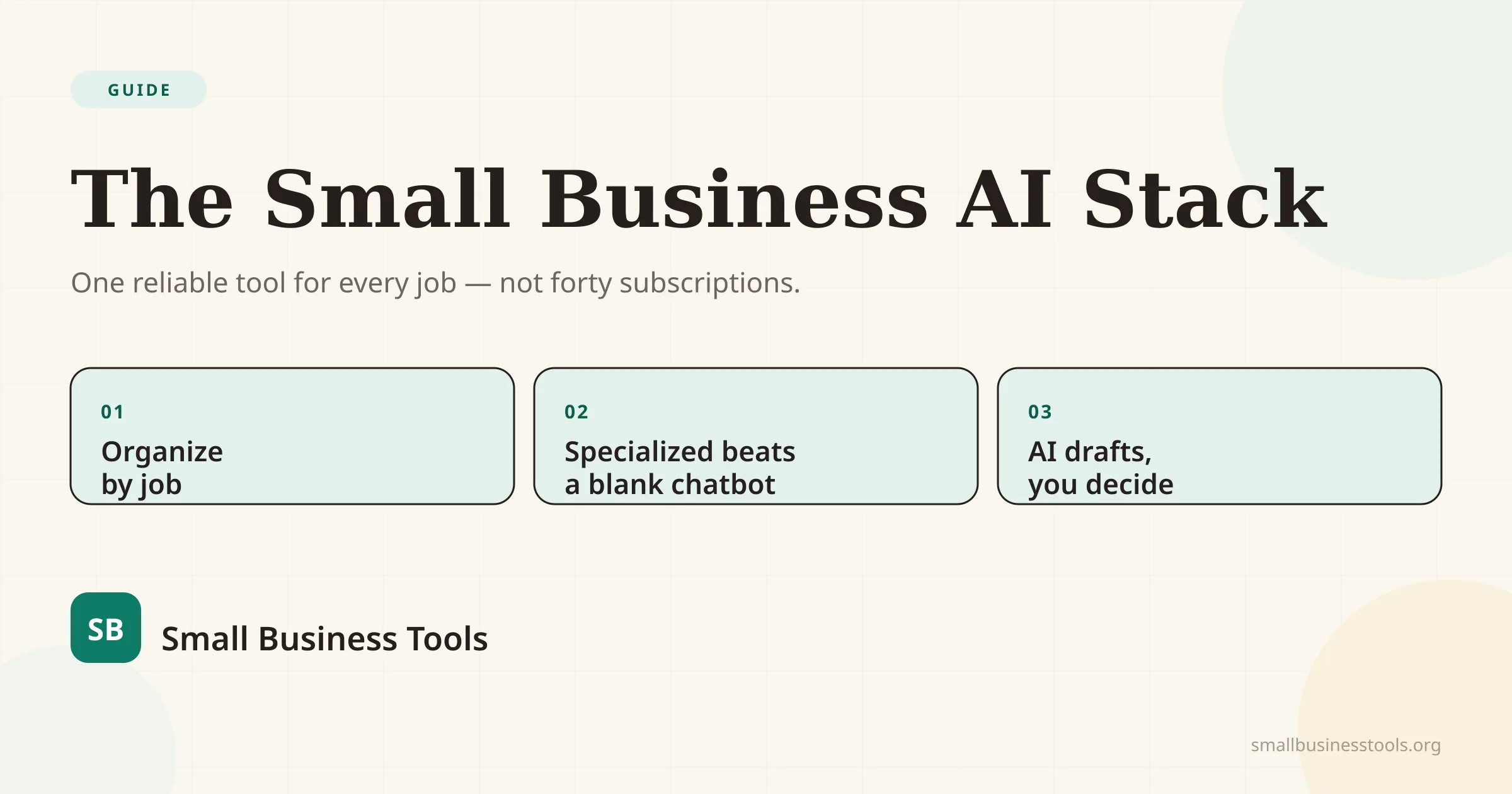
Three principles keep an AI stack useful instead of overwhelming:
- Organize by job, not by tool. "I need to write a product description" is a job. Pick the tool that does that job in one step, and you skip the blank page and the prompt-engineering.
- Specialized tools beat a blank chatbot for repeat tasks. A general model can do anything, but a purpose-built generator already knows the format, the character limits, and the structure. For work you do weekly, the specialized tool is faster and more consistent.
- AI drafts; you decide. Every output is a first draft to edit, not a final answer to publish. The time saved is in getting past blank — the judgment stays yours.
With that framing, here's the stack by job.
Content & writing
The largest time sink for most small businesses is turning a blank page into words — blog posts, emails, descriptions, rewrites. This is where AI earns its keep first.
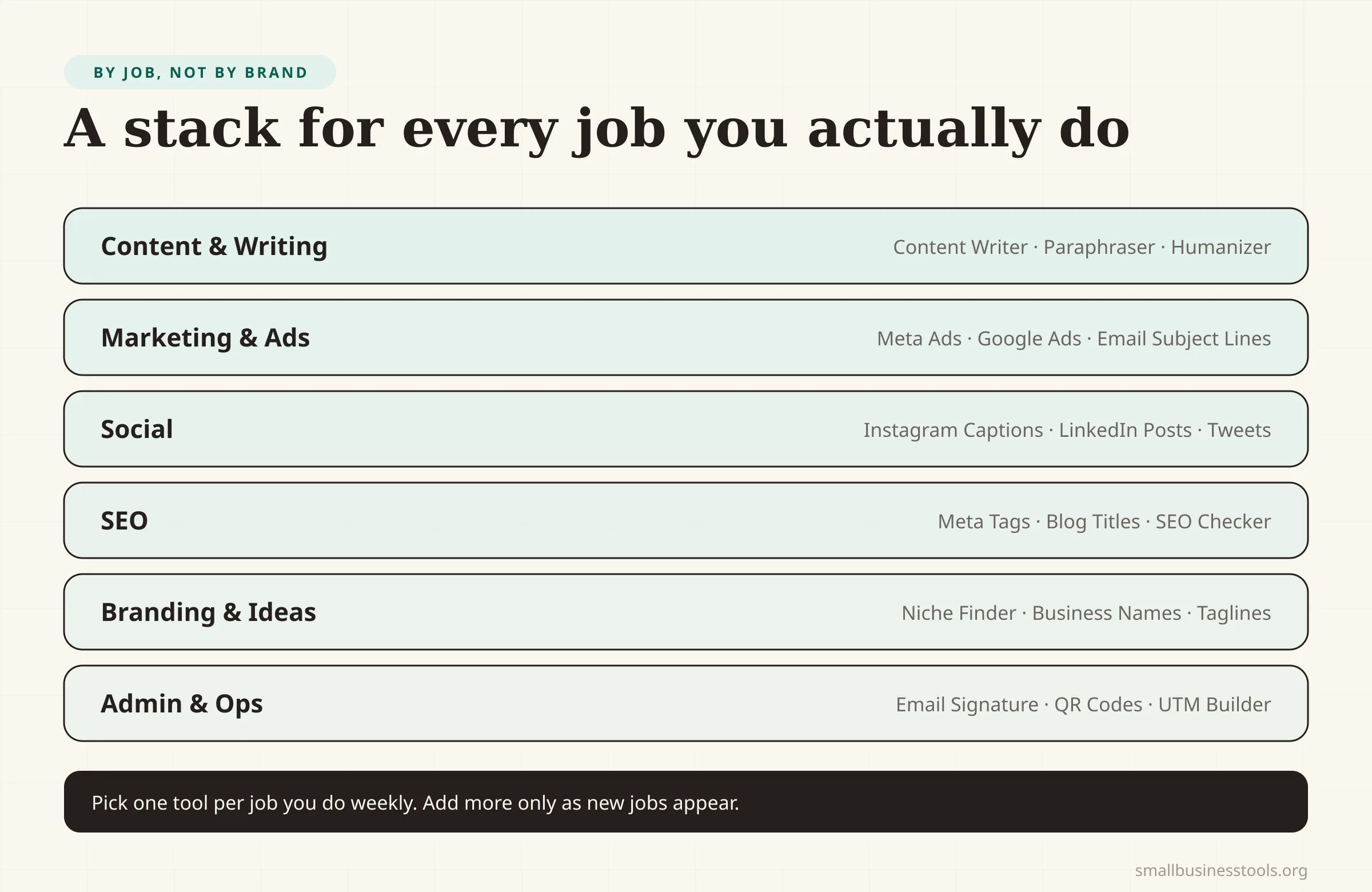
| Job | Free tool | Reach for a paid model when… |
|---|---|---|
| Draft a blog post or article | AI Content Writer | You need long-form with heavy research |
| Rewrite or reword text | Paraphrasing Tool | Rarely — the tool handles most cases |
| Make AI text sound human | AI Humanizer | — |
| Write a customer or sales email | AI Email Writer | You need a long multi-touch sequence |
| Write product descriptions | Product Description Generator | — |
| Generate an FAQ section | FAQ Generator | — |
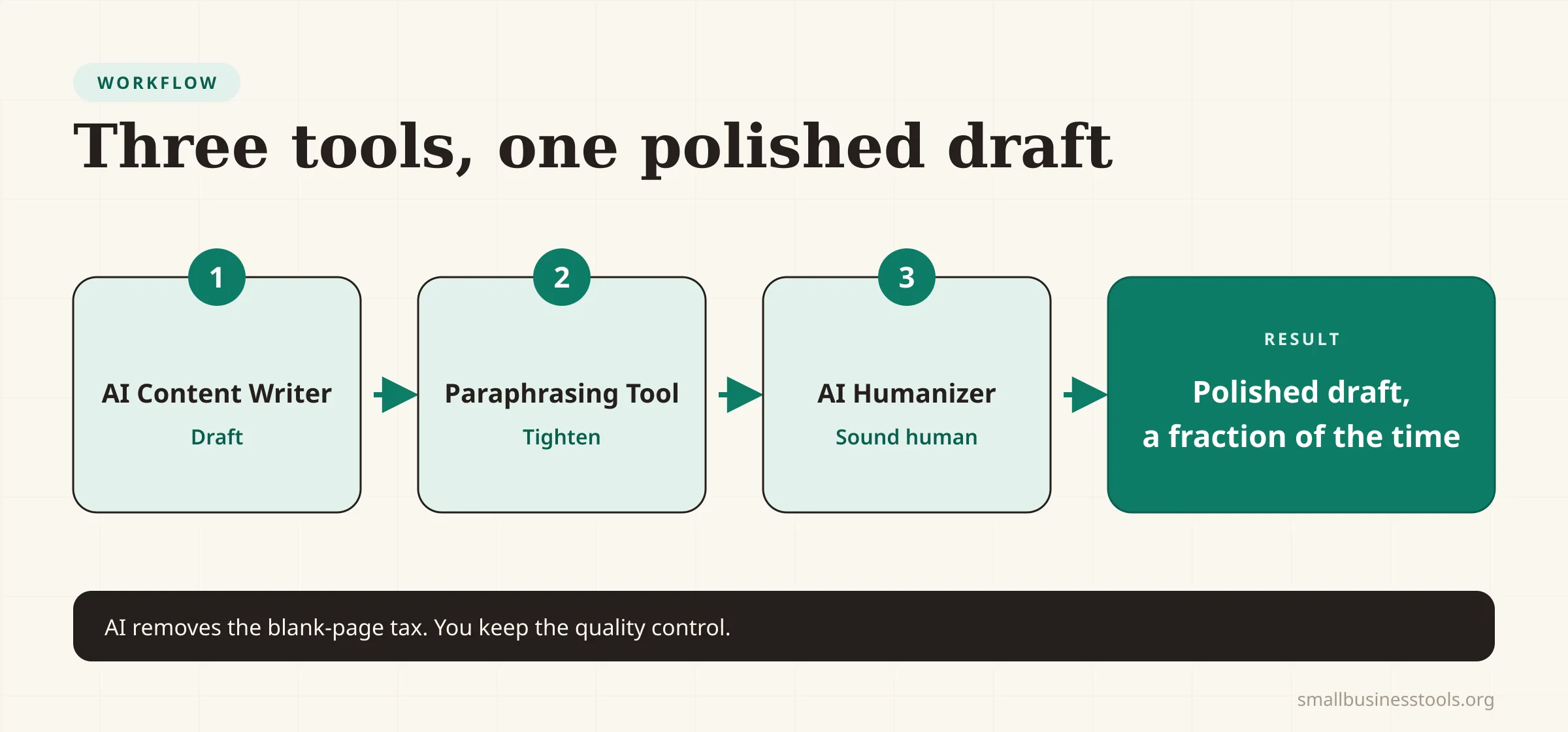
The workflow that saves the most time: generate a draft with the Content Writer, tighten it with the Paraphrasing Tool, and run it through the AI Humanizer so it doesn't read like a robot wrote it. Three tools, one polished draft, a fraction of the time.
Marketing & ads
Ad copy has rules — character limits, headline counts, platform policies — that a general chatbot ignores unless you spell them out. Purpose-built ad tools bake those constraints in.
- Facebook and Instagram ads — the Meta Ads Copy Generator writes policy-aware primary text, headlines, and descriptions.
- Google Search ads — the Google Ads Copy Generator respects the 30-character headline and 90-character description limits so nothing gets truncated.
- Email subject lines — the Email Subject Line Generator gives you options built to get opened, not ignored.
- Budgeting — plan the spend before you write the ad with the Marketing Budget Calculator, then measure the return on ad spend with the ROAS Calculator and the true cost per customer with the CAC Calculator.
The generators handle the words; the calculators handle the money. Use both — clever ad copy that loses money on every click is worse than no ad at all.
SEO & getting found
Search is still where high-intent customers look for a business like yours. AI won't rank you on its own, but it removes the friction from the on-page basics that used to eat hours.
- Blog titles that get clicks — Blog Title Generator
- Keyword ideas to target — Keyword Ideas Generator (ideas to validate, not invented volumes)
- Meta descriptions — Meta Description Generator
- All your meta tags at once — Meta Tags Generator
- Preview your Google snippet — SERP Snippet Preview
- Structured data — Schema Markup Generator
- Audit a page — Website SEO Checker and Image Alt Text Checker
A note on honesty: no free tool can give you real, precise search volumes without a paid data source, and any tool that pretends to is guessing. Use AI keyword tools for *ideas*, then validate the ones that matter against a real SERP before you write. For local businesses especially, on-page structured data and an accurate meta setup do more than any amount of AI-generated fluff.
Branding & ideas
Starting something new, or naming it? AI is a genuinely good brainstorming partner because the cost of a bad suggestion is zero and the good ones spark better ones.
- Find a niche — Business Niche Finder
- Generate business ideas — Business Ideas Generator
- Name the business — Business Name Generator
- Write a tagline — Tagline Generator
If you're at the "what should I even start" stage, pair these with our guides on the best small business ideas for solopreneurs and the most profitable niches to go from a raw idea to a validated, sellable one.
Admin & operations
The unglamorous jobs that still have to happen — and where AI and simple tools quietly reclaim hours.
- Professional email signature — Email Signature Generator
- QR codes for menus, booking links, reviews — QR Code Generator
- Word and character counts for anywhere with limits — Word Counter
- Track campaigns properly — UTM Link Builder
Building your own stack: a starter kit
If you're overwhelmed, don't adopt everything. Start with one tool per job you actually do weekly:
- Writing → Content Writer + AI Humanizer
- Social → whichever platform you post on most
- One ad channel → Meta Ads or Google Ads, plus the ROAS Calculator to keep it honest
- SEO basics → Meta Tags Generator + Website SEO Checker
Add tools only as new recurring jobs appear. A stack of four tools you use every week beats forty you opened once.
Common mistakes with AI tools
- Publishing the first draft. AI gets you to a draft fast; shipping it unedited is how you end up sounding like everyone else. Always edit into your own voice.
- Collecting tools instead of using them. The value is in the repeated job, not the login count. Pick one tool per job and go deep.
- Trusting AI with facts and numbers. Models make things up confidently. Verify claims, prices, and especially anything a customer will rely on.
- Ignoring the money math. AI can write a brilliant ad that still loses money. Pair every marketing generator with the ROAS and CAC calculators so you know a campaign actually pays.
FAQs
What are the best AI tools for a small business?+
The best AI tools are the ones matched to the jobs you do weekly — content writing, ad copy, social posts, SEO basics, and admin. Rather than chase brands, build a small stack with one reliable tool per job. Every job in this guide has a free tool on this site to start with.
Do I need to pay for AI tools?+
Not to get started. Free, purpose-built generators cover most recurring small-business tasks. A paid general-purpose model is worth it for heavy long-form work, complex research, or high volume — but most owners over-buy before they've used the free options.
Will AI-written content hurt my SEO?+
Not inherently — search engines reward helpful, accurate content regardless of how it was drafted. It hurts you when you publish thin, generic, unedited output. Use AI for the draft, then add real expertise, examples, and your own voice before publishing.
Can AI replace a marketer or writer for a small business?+
It replaces the blank page and the busywork, not the judgment. AI drafts fast; deciding what's on-brand, accurate, and worth publishing is still a human job. Treat it as a very fast junior assistant that needs review.
How do I start without getting overwhelmed?+
Pick one job you do every week, use one tool for it, and build the habit before adding a second. A four-tool stack you use consistently beats a giant collection you opened once. See the starter kit above.
Final take
A good AI stack for a small business isn't a long list of subscriptions — it's one dependable tool for each recurring job, used consistently, with your judgment on top. Start with writing and one marketing channel, keep the money math honest with the ROAS and CAC calculators, and add tools only as new weekly jobs appear. Every tool linked in this guide is free to try right now, so you can assemble your stack one job at a time.
One job this guide doesn't cover: being found *by* AI rather than using it. If customers are asking assistants for recommendations in your category, our guide on getting recommended by ChatGPT and AI search covers which crawlers to allow and what the evidence actually supports.
Free tools to try
AI Content Writer
Draft blog posts, captions, and marketing copy in your brand voice.
Meta Ads Copy Generator
Get 3 Facebook & Instagram ad variants — primary text, headline, description.
Business Niche Finder
5 specific niches matched to your skills — with the first offer and a cheap way to validate each.
Keep reading
Guide
Best Free AI Writing Tools for Small Businesses
12 AI writing tools ranked for small businesses — pricing, pros, cons, and features. From ChatGPT and Claude to free, no-signup generators for repeat jobs.
Guide
14 Best Social Media Scheduling Tools for Small Business (2026)
14 social media schedulers ranked for small businesses — real 2026 pricing, free-plan caps, and X support for PosterMyWall, Buffer, Statusbrew, Metricool and more.
Guide
Best AI SEO Tools for Small Businesses in 2026
The SEO tools that give small businesses a real edge in AI search — paid data suites, AI audits like CrawlRaven, PikaSEO's free suite, and the free essentials.
Social media
Social is a volume game, and volume is exactly what AI is good at. Draft a week of posts in the time it used to take to write one.
Batch it: pick one afternoon, generate a month of captions and posts, edit them into your voice, and schedule. The AI removes the blank-page tax; you keep the quality control.