Guide
How to Get Recommended by ChatGPT & AI Search
Customers have started asking assistants the questions they used to type into Google — "best bookkeeper near me," "who should I hire to re-tile a bathroom," "what's a good CRM for a two-person business." Pew Research Center's February 2026 survey of 5,119 US adults found 49% now use AI chatbots and 44% use ChatGPT, up from 33% and 34% a year earlier, with 42% using them for information searching. For local businesses specifically, BrightLocal's 2026 consumer survey found the share using AI tools to find a local business went from 6% to 45% in a single year.
So the question is fair. The answers you'll find, unfortunately, are mostly wrong — recycled from each other, citing no primary sources, and recommending at least one tactic that stopped working in May 2026.
This guide is built entirely from vendor documentation and controlled studies, with links to every source. Where something genuinely isn't publicly documented, it says so rather than guessing. That happens more often than you'd like.
Quick answer
Three things decide whether an assistant can name you, in this order:
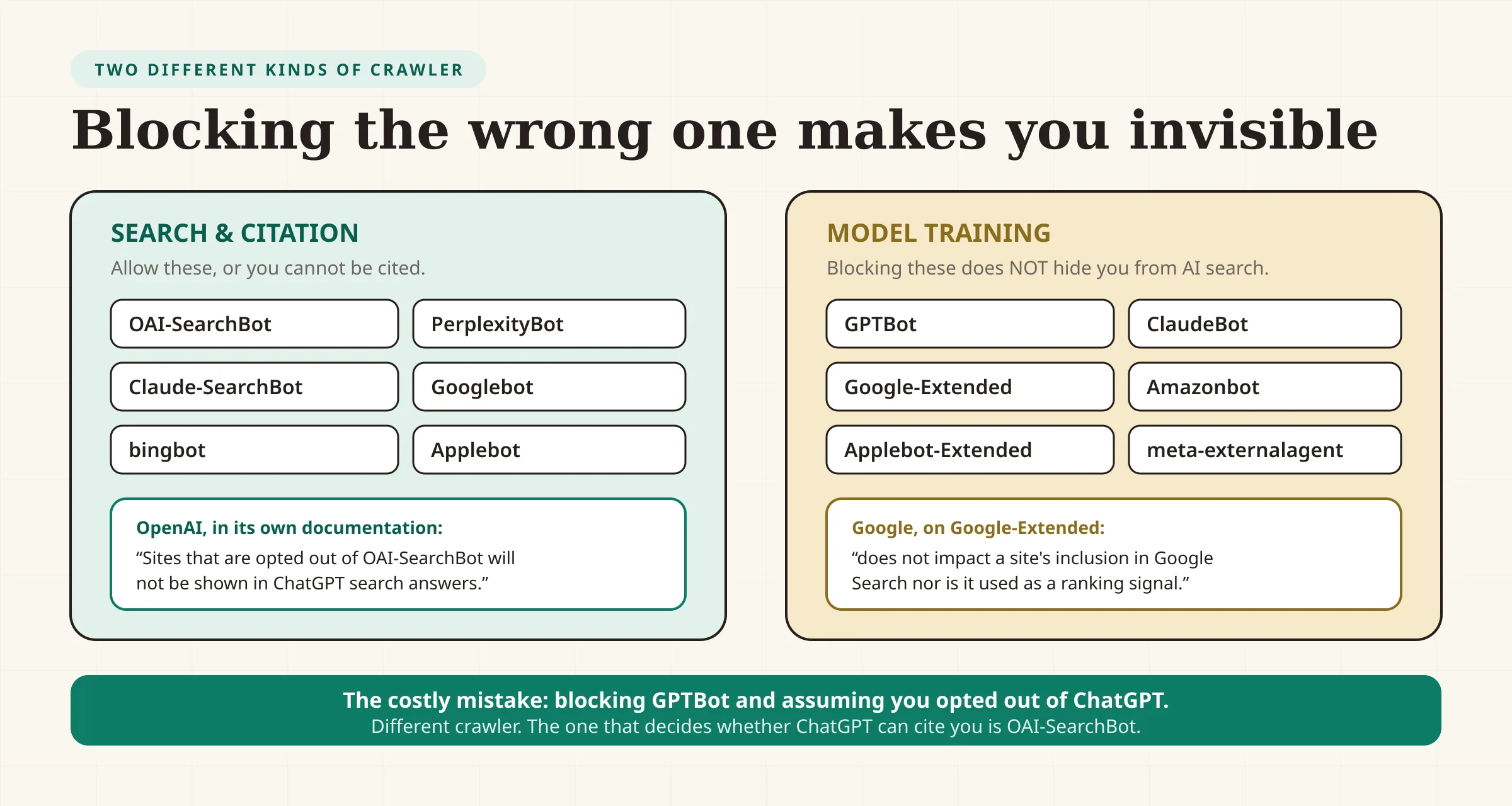
- You let the right crawlers in. There are separate crawlers for search and for model training, and blocking the wrong one makes you invisible. This is the single most common self-inflicted wound.
- You're findable through whatever index the assistant queries. AI answers are assembled from live retrieval, so ordinary discoverability still matters — but far less directly than it did a year ago.
- The facts are stated in plain, visible text. Not in a JSON blob, not implied, not in an image. The best available evidence says assistants read what a human would read.
Everything else — llms.txt files, FAQ schema, "AI rank tracking" subscriptions — is either unproven, deprecated, or actively sold on a misunderstanding.
How each system actually finds you
Worth being precise about, because most guides aren't.
ChatGPT
OpenAI documents four crawlers. The distinction between them is the most actionable thing in this guide:
| Token | What it does |
|---|---|
OAI-SearchBot | Surfaces websites in ChatGPT's search features |
GPTBot | Collects content for training foundation models |
ChatGPT-User | Fetches pages when a user's request requires it |
OAI-AdsBot | Validates safety of pages submitted as ChatGPT ads |
The sentence to internalize, from OpenAI's own crawler documentation: *"Sites that are opted out of OAI-SearchBot will not be shown in ChatGPT search answers."*
OpenAI also explicitly blesses the split: *"a webmaster can allow OAI-SearchBot in order to appear in search results while disallowing GPTBot."* You can be cited without contributing to training. And robots.txt changes take about 24 hours to register for search.
Does ChatGPT run on Bing's index? Nobody outside OpenAI knows, and OpenAI won't say. Its publisher FAQ states only that ChatGPT search *"leverages third-party search providers, as well as content provided directly by our partners"* — plural, unnamed. The "ChatGPT uses Bing" claim traces to a single February 2025 study by Seer Interactive covering roughly 500 citations, which found 87% overlap with Bing's top organic results — and which Seer themselves labelled directional rather than conclusive. Treat it as a reasonable guess, not a fact, and don't build a strategy on it.
Google AI Overviews and AI Mode
Google is the most explicit of any provider, and its message is deflating: there is no special trick.
From Google's AI features documentation: *"There are no additional requirements to appear in AI Overviews or AI Mode, nor other special optimizations necessary."* To be eligible, *"a page must be indexed and eligible to be shown in Google Search with a snippet."*
Google's newer optimization guide, updated 10 July 2026, goes further and lists what you don't need: no AI text files, no special markup, no chunking your content into fragments, no writing in a particular style for machines. What it does recommend is ordinary: a unique point of view, people-first content, clear headings, semantic HTML, good page experience — and, specifically for local businesses, using Google Business Profile.
One mechanic worth knowing: AI Mode uses query fan-out, issuing multiple related searches across subtopics simultaneously rather than reading one results page. That's why ranking for the exact phrase matters less than it used to.
Perplexity, Claude, and Copilot
Perplexity documents PerplexityBot (search and citation; *"not used to crawl content for AI foundation models"*) and Perplexity-User for user-initiated fetches, which *"generally ignores robots.txt rules."* How it selects or ranks sources is not publicly documented.
Claude documents Claude-SearchBot (search quality), Claude-User (user-initiated), and ClaudeBot (training). Anthropic doesn't publish anything about how sources are chosen for citation. Note that the legacy tokens anthropic-ai and Claude-Web that appear in many blog posts are not in the current documentation.
Microsoft has published more publisher-facing material on this than anyone else, and almost nobody covers it. Its framing, from a May 2026 engineering post: *"Traditional search asks: which pages should a user visit? Grounding asks: what information can an AI system responsibly use to construct a response?"* Microsoft names five signals it optimizes for — factual fidelity, source attribution quality, freshness, conflict detection, and coverage of high-value facts — and recommends site owners strengthen depth, *"improve structure with headings, tables, and FAQ sections,"* support claims with evidence, keep content current, and register with Bing Places if they're a local business.
Note the honest contradiction there: Microsoft recommends FAQ sections and tables; Google says no special formatting is needed. Both are official. Neither is lying. They're different systems.
The robots.txt block
This is the part with the highest ratio of impact to effort, and the part no competing article publishes. Every token below comes from the vendor's own documentation.
# ---- AI SEARCH: allow, so you can be found and cited ----

# OpenAI — ChatGPT search. Block this and you cannot appear in ChatGPT answers.
User-agent: OAI-SearchBot
Allow: /

User-agent: ChatGPT-User
Allow: /

# Perplexity
User-agent: PerplexityBot
Allow: /

User-agent: Perplexity-User
Allow: /

# Anthropic (Claude)
User-agent: Claude-SearchBot
Allow: /

User-agent: Claude-User
Allow: /

# The search indexes that also feed AI answers
User-agent: Googlebot
Allow: /

User-agent: bingbot
Allow: /

User-agent: Applebot
Allow: /


# ---- MODEL TRAINING: your call. Blocking these does NOT ----
# ---- remove you from AI search answers. Delete to allow. ----

User-agent: GPTBot
Disallow: /

User-agent: ClaudeBot
Disallow: /

User-agent: Google-Extended
Disallow: /

User-agent: Applebot-Extended
Disallow: /

User-agent: meta-externalagent
Disallow: /

User-agent: Amazonbot
Disallow: /
For most small businesses, delete the second half and allow everything. A local plumber has essentially nothing to lose from model training and everything to lose from being invisible. The training block is there because some publishers want it, not because you should.
Two caveats: user-initiated fetchers may ignore your file entirely — OpenAI says robots.txt "may not apply" to ChatGPT-User, and Perplexity says its user agent "generally ignores robots.txt rules." And if you write a bingbot-specific section, bingbot reads only that section and ignores your wildcard rules.
The two misconceptions that cost the most
Blocking GPTBot does not hide you from ChatGPT search. They're different crawlers. Plenty of sites have blocked GPTBot for training reasons, believing they opted out of AI generally, while remaining perfectly visible in ChatGPT search — and plenty of others have blocked OAI-SearchBot by accident and vanished from it.
Blocking Google-Extended does not hide you from AI Overviews. Google's documentation is explicit that Google-Extended governs training for Gemini models and *"does not impact a site's inclusion in Google Search nor is it used as a ranking signal."* AI Overviews and AI Mode are Search surfaces, governed by noindex and nosnippet. The same applies to Apple: *"Webpages that disallow Applebot-Extended can still be included in search results."*
If you want out of Google's AI features specifically, there's now a Search Console setting for it — the Search generative AI control — which Google says *"isn't used as a ranking or inclusion signal affecting other parts of Search."* It's rolling out to a subset of site owners, so you may not have it yet.
llms.txt: the honest answer is no
You will be told to add an /llms.txt file. The evidence says don't bother — and there is now a direct denial from Google.
From Google's generative AI optimization guide, updated 10 July 2026:
Google's John Mueller was blunter in April 2025, noting that no AI service had said it used llms.txt and that server logs show they don't even check for it — comparing it to the keywords meta tag: *"this is what a site-owner claims their site is about… Is the site really like that? well, you can check it. At that point, why not just check the site directly?"*
OpenAI, Anthropic, Perplexity, and Microsoft don't mention llms.txt in any crawler or publisher documentation. The format was proposed in September 2024 by an independent developer and makes no claim that providers consume it.
One point of fairness: some AI companies publish an llms.txt on their own documentation sites. That's them acting as publishers for developer convenience — not evidence that their crawlers read yours.
It costs almost nothing to publish one if you want to hedge. Just don't let anyone sell it to you as a ranking factor, and don't let it displace work that's actually evidenced.
Schema: useful, but not for this
Here the honest answer will disappoint anyone selling structured data as an AI play.
The best-controlled study found no effect. Ahrefs tracked 1,885 pages that added JSON-LD between August 2025 and March 2026, matched against 4,000 control pages using a difference-in-differences design. Results: AI Overview citations −4.6%, AI Mode +2.4%, ChatGPT +2.2% — the last two statistically indistinguishable from zero. Their conclusion: *"Adding schema produced no major uplift in citations on any platform."*
A retrieval experiment suggests why. searchVIU built a test page in October 2025 placing the same facts in eight different locations and queried five AI systems. Its headline finding was that JSON-LD markup was not extracted by *any* system during direct page fetch. Gemini found facts in 4 of 8 locations, ChatGPT 3, Google AI Mode 2, Perplexity 1, Claude 0 — and the ones they found were in visible HTML. It's a small experiment, and it only covers live retrieval rather than indexing, but it points the same direction as the Ahrefs data.
The practical rule: if you want an assistant to know a fact about your business, put the fact in visible text on the page. Your hours, your service area, your pricing, what you do and don't do. Not only in a markup block a human never sees.
Schema still earns its place for other reasons. Google documents that Organization structured data *"can help Google better understand your organization's administrative details and disambiguate your organization in search results"* — that's entity hygiene and it's worth doing. LocalBusiness markup is not deprecated and still governs rich result eligibility. Our Schema Markup Generator produces both. Just don't expect it to move AI citations.
FAQ schema is now deprecated — and that's fine
If you have FAQPage markup, or a plugin adding it, here is the current state: Google fully deprecated FAQ rich results on 7 May 2026. Documentation was removed in June 2026, along with the Search Console reporting and Rich Results Test support, and API support was removed in August 2026. Google had already restricted the feature to government and health sites back in August 2023; this finished the job.
What that does and doesn't mean:
- FAQPage markup is not harmful and remains valid schema.org. Google's standing position on unused structured data is that it causes no problems but has no visible effect.
- It will not produce rich results in Google. Any guide showing you FAQ schema for that purpose is stale.
- The visible Q&A content still matters. Microsoft explicitly recommends FAQ sections for AI grounding, and question-and-answer text is exactly the plain-language format the retrieval evidence favours.
That is why our FAQ Generator is worth using for the questions and answers themselves — the ones your customers actually ask about price, timing, and guarantees — rather than for the JSON-LD it also produces.
What does correlate with getting cited
Since the technical levers are mostly myths, what actually moves? Ahrefs analysed 75,000 brands across ChatGPT, AI Mode, and AI Overviews in December 2025. The correlations, strongest first:
| Factor | ChatGPT | AI Mode | AI Overviews |
|---|---|---|---|
| YouTube mentions | 0.737 | 0.737 | 0.737 |
| Branded web mentions | 0.664 | 0.709 | 0.656 |
| Branded anchors | 0.511 | 0.628 | 0.527 |
| Branded search volume | 0.352 | 0.466 | 0.392 |
| Domain Rating | 0.266 | 0.285 | 0.326 |
| Branded organic traffic | 0.235 | 0.357 | 0.274 |
Their own disclaimer applies and should be repeated: correlation isn't causation, and improving these numbers won't automatically boost visibility.
But the shape is informative. Being mentioned by name, in places that aren't your website, correlates far more strongly than any measure of your own site's authority. Domain Rating — the metric most SEO services sell — sits near the bottom. A related Ahrefs finding: brands in the top quartile for web mentions get up to ten times more AI Overview mentions than the next quartile down, while backlinks correlated at just 0.218.
For a small business, that translates into unglamorous work: getting listed in genuine local and industry roundups, being quoted in trade press, having customers discuss you in forums and communities, appearing on supplier and partner pages, being on YouTube at all. Our local SEO guide covers the same shift from the local angle, where unstructured mentions now rank among the top AI visibility factors.
The genuinely good news
Semrush analysed more than 50,000 brands across 1,094 US categories between January and June 2026 and found that only 15.2% of categories had a clear owner. Roughly 85% remain competitive, and 98% of AI search volume sits in topics with no established leader. Domain-level metrics predicted category ownership only about half the time — barely better than a coin flip.
That is the opposite of the traditional search story, where entrenched domains own the head terms. Deep, specific coverage of a narrow topic beats general domain strength. A two-person bookkeeping firm that genuinely owns "bookkeeping for food trucks in Oregon" has a real shot at being the answer.
Don't buy "AI rank tracking"
Before anyone sells you a position report: SparkToro ran 2,961 tests across 12 prompts and roughly 600 volunteers in late 2025, covering ChatGPT, Claude, and Google's AI Overviews and AI Mode. The finding:
Getting the same list *in the same order* was roughly 1 in 1,000. Rand Fishkin's summary was that any tool claiming to give you a ranking position in AI is "full of baloney."
The same study found something useful, though: across roughly a thousand responses, top brands in narrow categories appeared 55–77% of the time. So *appearance rate across many prompts* is measurable even though *rank* is noise. The goal isn't to be number one. It's to show up often.
How to measure it, free
Two first-party tools launched in 2026 and neither is widely known.
Google Search Console generative AI performance reports, announced 3 June 2026, show impressions, pages, countries, devices, and dates for AI Overviews and AI Mode. There's no click data, but it's the first free, first-party way to see whether Google's AI surfaces are showing your pages at all.
Bing Webmaster Tools AI Performance, in public preview since 10 February 2026, reports total citations, average cited pages, grounding queries, and page-level citation activity across Microsoft Copilot and Bing's AI summaries. Bing Webmaster Tools is far easier to get into than most people assume, and this report has no equivalent anywhere else. Microsoft added citation share and topic breakdowns in June 2026, with the honest caveat that citation share is *"an observational metric – not a ranking system."*
Both are free. Between them they cover the two largest AI surfaces, which is more than any paid "AI visibility" subscription can honestly claim.
The checklist
robots.txtallowsOAI-SearchBot,PerplexityBot,Claude-SearchBot,Googlebot,bingbot, andApplebot- You've confirmed you are not blocking a search crawler by accident
- Key facts — hours, service area, pricing, what you do — are in visible page text, not only in markup
- Organization schema on the homepage for entity disambiguation
- LocalBusiness schema if you serve a geographic area
- A real FAQ section answering the questions customers actually ask
- Google Business Profile complete and current
- Bing Places for Business claimed — Microsoft's own recommendation, and almost nobody does it
- Search Console generative AI report checked for a baseline
- Bing Webmaster Tools AI Performance report checked
- A plan for getting mentioned somewhere that isn't your own website
- No money spent on llms.txt, "GEO audits," or AI rank tracking
FAQs
Can I pay to be recommended by ChatGPT?+
Not for organic recommendations. OpenAI runs an ads product with its own crawler for validating ad pages, but that's advertising, distinct from the answers assistants generate. If someone offers to guarantee you a spot in ChatGPT's recommendations, they cannot deliver it — and the SparkToro consistency data shows there isn't a stable "spot" to sell.
Does blocking GPTBot remove me from ChatGPT?+
No, and this is the most expensive misunderstanding in the field. `GPTBot` is the training crawler; `OAI-SearchBot` is the one that decides whether you appear in ChatGPT search answers. You can block the first and keep the second — OpenAI explicitly documents that combination.
Do I need an llms.txt file?+
No. Google states plainly that Google Search doesn't use them, and no major provider has confirmed reading them. Publish one if you like the idea of hedging, but nothing should depend on it.
Will adding schema get me cited more often?+
The best available evidence says no. A controlled study of 1,885 pages found no meaningful lift on any platform, and a retrieval experiment found AI systems didn't extract JSON-LD when fetching a page live. Add Organization and LocalBusiness schema for entity clarity and rich result eligibility — but put the facts you want quoted into visible text.
Is FAQ schema still worth adding?+
The markup no longer produces rich results — Google deprecated FAQ rich results on 7 May 2026. The FAQ *content* is still worth having: Microsoft recommends FAQ sections for AI grounding, and plain question-and-answer text is the format retrieval evidence favours. Write the FAQs for readers; treat the markup as harmless leftover.
How is this different from normal SEO?+
Less than vendors would like you to think, and more than it was a year ago. Being indexed and discoverable is still the foundation. But Ahrefs found the share of AI Overview citations coming from Google's top 10 fell from 76% to 38% between mid-2025 and March 2026, which they attribute to heavier query fan-out. Ranking well helps; it is neither necessary nor sufficient.
What's the single highest-value thing I can do?+
Check your robots.txt today. Being accidentally blocked is the only failure mode on this list that takes you to zero, and it takes five minutes to rule out.
What to do next
Most of what's sold as AI optimization is either unproven or was deprecated this year. The work that survives contact with the evidence is short:
- Open your robots.txt and confirm the search crawlers are allowed. If you have no robots.txt at all, everything is allowed — that's fine.
- Put your facts in visible text. Use the FAQ Generator to draft the questions customers actually ask, and publish the answers on the page.
- Add Organization schema with the Schema Markup Generator, and get your titles and descriptions right with the Meta Tags Generator.
- Claim Bing Places alongside Google Business Profile, and check both free AI reports for a baseline.
Then go and get mentioned somewhere that isn't your own website. On the evidence, that's the thing that actually correlates — and it's the one part nobody can sell you a shortcut to.
Free tools to try
Keep reading
Guide
Local SEO for Small Business: Guide + Best Tools
How Google ranks local businesses, the Business Profile rules that get you suspended, and which local SEO tools are worth paying for in 2026.
Guide
Small Business SEO Audit Template (Free, Copy-Paste)
A free SEO audit template where every check cites Google's own documentation — no signup, no download, and honest limits on every free tool it uses.
Guide
Best AI SEO Tools for Small Businesses in 2026
The SEO tools that give small businesses a real edge in AI search — paid data suites, AI audits like CrawlRaven, PikaSEO's free suite, and the free essentials.