Guide
New SBA Rules for Buying a Business (SOP 50 10 8.1, Oct 2026)
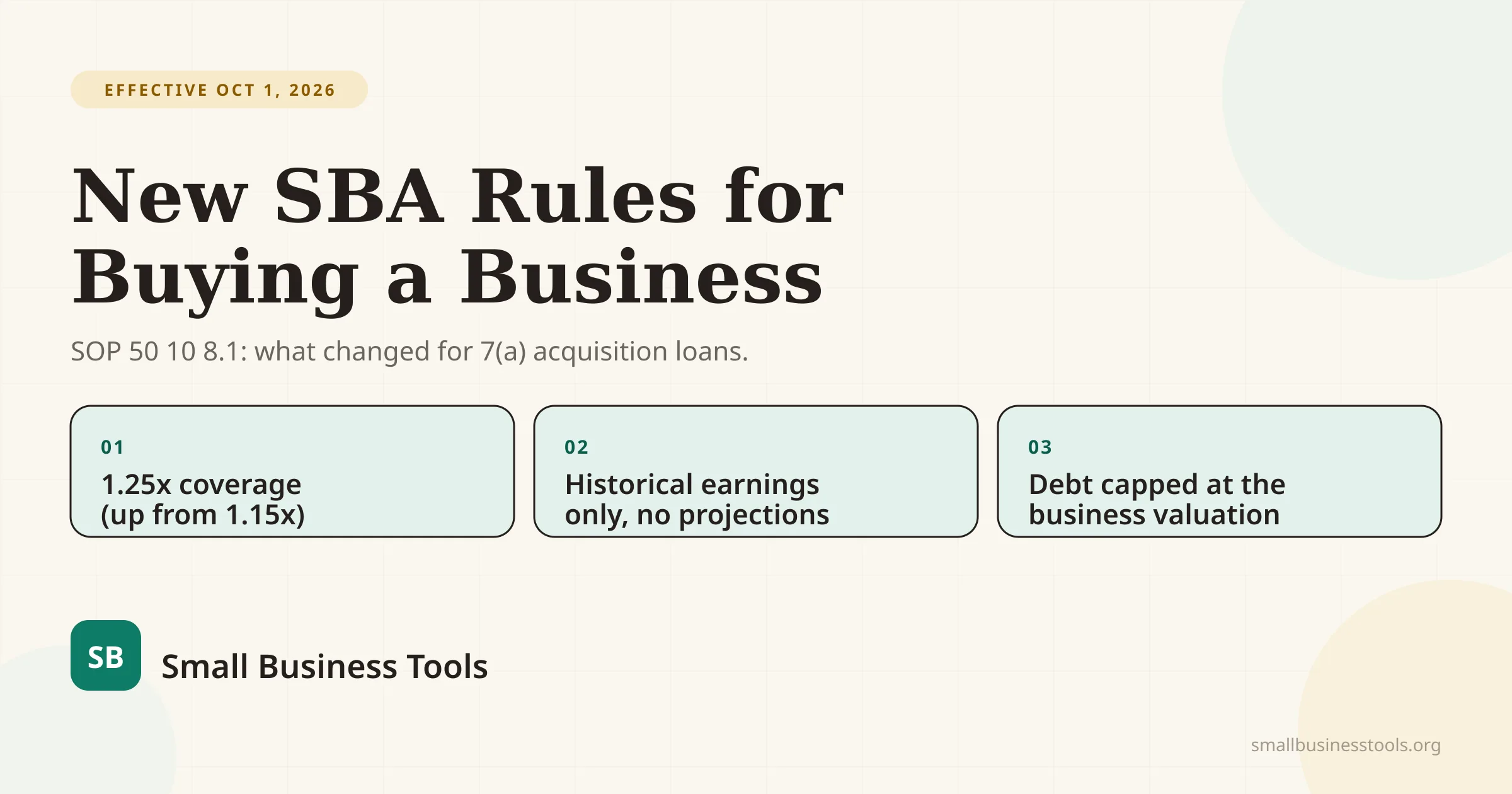
If you are buying a small business with an SBA 7(a) loan, the deal got harder to finance on October 1, 2026. That is the effective date of SBA SOP 50 10 8.1, the U.S. Small Business Administration's official rulebook for 7(a) and 504 lenders, and its rewritten change-of-ownership appendix raises the cash-flow test for most acquisitions from 1.15x to 1.25x, stops lenders from counting projections toward it, and caps total acquisition debt at the independently supported business value.
Per SBA Information Notice 5000-882227, the new SOP applies to applications SBA receives on or after October 1 — which, in SBA's terms, is the date a loan is approved and assigned an SBA loan number. A deal numbered on September 30 still runs under the old SOP 50 10 8, even if it closes later. If you are a seller, this matters just as much: the rules decide how much a buyer can borrow against your business, and therefore what price actually closes.
Key takeaways
- The cash-flow bar went up. First-time buyers, owner buyouts, and ESOP/co-op deals now need 1.25x debt service coverage. Existing businesses buying a competitor in the same industry stay at 1.15x.
- Projections no longer count. Coverage must be met on the last fiscal year or a two-year average of *historical* earnings (with documented adjustments). The lender still reviews your post-closing plan; it just can't approve the loan on it.
- Debt is capped at the valuation. All acquisition debt — including seller notes that get paid — cannot exceed the business valuation. Anything you pay above the valuation must be equity.
- Deals of $3 million or more need a Quality of Earnings report, including a cash proof that ties bank deposits to the income statement and tax returns.
- Sellers can stay on longer. A seller can now consult for the buyer for up to 24 months, up from 12.
What changed in SOP 50 10 8.1
The biggest structural change is that SBA now sorts every 7(a) change of ownership into one of four categories, and the underwriting rules follow the category:
- Initial Acquisition — the default. A new majority (or largest) owner who wasn't already an owner, or who has worked in the business for less than 24 months.
- Business Expansion — an existing business that has operated for at least two full fiscal years under current ownership buys 100% of another business in the same four-digit NAICS industry group.
- Owner Buyout — existing owners or long-tenured employees (24+ consecutive months) buy out a partner, or a partial change of ownership where an original owner stays.
- ESOP & Cooperative — an employee stock ownership plan or co-op buys a controlling (51%+) stake.
Here is how the rules that matter most moved:
| Rule | Before (SOP 50 10 8) | From October 1, 2026 (SOP 50 10 8.1) |
|---|---|---|
| Minimum debt service coverage | 1.15x, on historical and/or projected cash flow | 1.25x for Initial Acquisition, Owner Buyout, and ESOP/co-op; 1.15x for Business Expansion — historical or adjusted historical only |
| Projections | Could support coverage for changes of ownership | Reviewed, but cannot be used to meet coverage (narrow exception for special-purpose property like hotels and self-storage) |
| Lender can value the business itself | When the amount financed minus real estate and equipment was $250,000 or less | When the Business Purchase Price is $350,000 or less and buyer and seller aren't closely related |
| Independent valuation | Above $250,000, from a Qualified Source | Above $350,000, from an accredited appraiser (ASA, CBA, ABV, CVA, or BCA) ordered by the lender — a buyer's or seller's valuation can't be used |
| Quality of Earnings (QoE) report | Not required | Required for Initial Acquisitions and Business Expansions with a Business Purchase Price of $3 million or more |
| Debt ceiling | The 7(a) loan was capped at the valuation; financing for a shortfall had to be subordinate | Total debt (including seller debt not on full standby) is capped at the valuation; any price above it must be equity |
| Minimum equity injection | 10% of total project cost | 10%; cannot be reduced for Initial Acquisitions; lender may reduce or waive it for Business Expansions and Owner Buyouts with enough liquidity and no negative net worth |
| Seller transition | Consultant for up to 12 months | Consultant for up to 24 months in aggregate |
| Seller rebates to buyer | Applied to the loan up to the subsidy-recoupment threshold; any remainder could stay in the business | All rebate proceeds must pay down the 7(a) loan principal |
A few other changes are worth knowing:
- Seller notes on full standby still count toward equity — but only up to half. Seller debt, other standby debt, and non-controlling minority investor equity (under 20% ownership, no control) together can supply no more than half of the required injection. Full standby means no principal *or* interest payments for the life of the SBA loan.
- Interest-only side debt gets amortized on paper. If any acquisition debt that isn't on standby is interest-only, the lender must underwrite it as if it amortized over no more than 10 years.
- Seller-carry can be refinanced after three years. A seller note can be refinanced into SBA debt only after it has been in place and current — not on standby — for 36 months.
- Earnouts are still banned. Payments to the seller that depend on future performance remain prohibited. Buyer rebates are allowed.
- Smaller loans don't get a lighter cash-flow test. 7(a) Small and SBA Express loans can still fund an acquisition, but the same coverage minimums apply.
- Every deal gets a site visit, though lenders may verify e-commerce and other non-physical businesses virtually.
- Ownership eligibility is narrower. SBA financing is limited to businesses whose owners and required guarantors are all U.S. citizens or U.S. nationals with their principal residence in the U.S. That restriction took effect earlier in 2026 and is now written into the SOP.
Who is affected
Affected:
- First-time buyers using an SBA 7(a) loan to purchase an existing business — the largest group, and the one facing the 1.25x bar and the non-reducible 10% equity.
- Sellers whose likely buyers need SBA financing — common for main-street businesses where buyers rarely pay all cash.
- Partners buying each other out, and employees buying the business they work for — especially employees with less than 24 months' tenure, who are now underwritten like outside buyers if they take 50% or more or become the largest owner.
- Brokers and advisors pricing listings around what an SBA lender will finance.
Not directly affected:
- Deals that already had an SBA loan number before October 1, 2026.
- Conventional bank loans, seller-financed-only deals, and other non-SBA acquisition financing.
- SBA loans that aren't for a change of ownership — equipment, working capital, or real estate for a business you already own.
- Existing operators buying a same-industry business, at least on the coverage ratio, which stays at 1.15x (they still face the valuation cap, and QoE at $3 million+).
Example: the same deal before and after October 1
Take a buyer purchasing an HVAC service company — no real estate — for $1,200,000, plus $100,000 for working capital and closing costs. Total project cost: $1,300,000.
- Required equity: 10% = $130,000. The seller agrees to carry up to $65,000 on full standby (the most that can count), so the buyer brings at least $65,000 in cash.
- SBA loan: $1,170,000 over 10 years. At an illustrative 10.00% variable rate — prime at 7.00% plus the 3.00% maximum spread SBA allows on loans over $350,000 — the payment is about $15,462 a month, or $185,540 a year.
- The business's verified historical EBITDA: $215,000.
That works out to a debt service coverage ratio of about 1.16x.
| Under SOP 50 10 8 | Under SOP 50 10 8.1 | |
|---|---|---|
| Required coverage | 1.15x | 1.25x |
| Maximum annual debt service at $215,000 EBITDA | ~$186,960 | $172,000 |
| Maximum 10-year loan at 10.00% | ~$1,178,900 | ~$1,084,600 |
| The $1,170,000 loan | Passes | Fails by ~$85,400 |
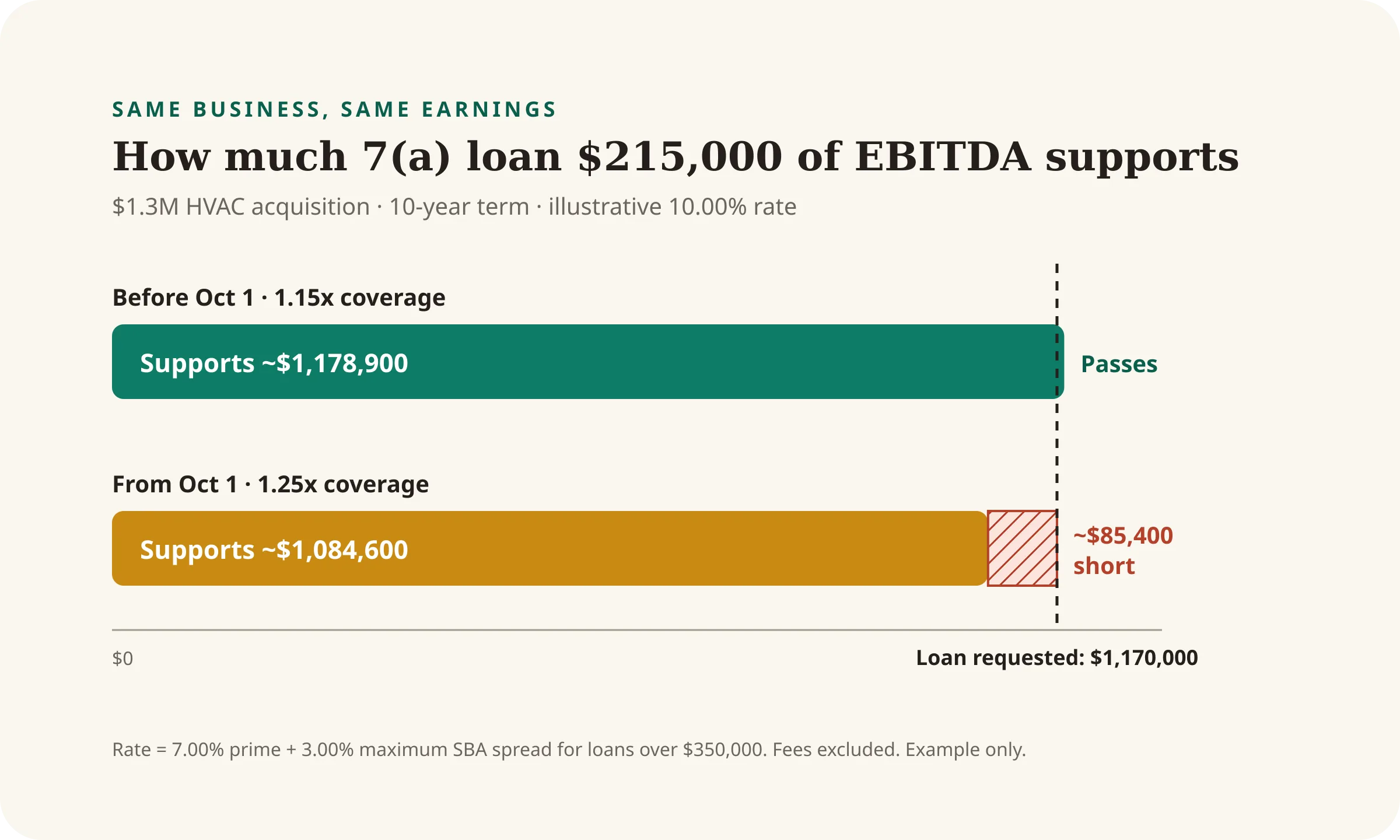
Under the old rules, a lender could also have leaned on the buyer's post-closing projections — say, a plan to raise service-agreement prices. Under the new rules, those projections go in the credit memo but can't close the gap.
To get this deal approved, the roughly $85,000 has to come from somewhere other than the 7(a) loan:
- More buyer cash. The simplest fix if the buyer has it.
- A bigger seller note on full standby. SOP 50 10 8.1 lets the buyer add extra equity — including limited sources such as standby seller debt — to shrink the loan until coverage works. The seller waits for that money until the SBA loan is repaid.
- A lower price. Often the honest answer, because it's the same earnings supporting less debt.
- A lower rate or different structure. Some lenders price below the maximum spread; each quarter-point matters. If prime rose another 0.25%, the same loan would cost about $15,624 a month and coverage would slip further.
Run your own numbers with the loan payment calculator: enter the loan amount, the rate your lender quotes, and a 10-year term, multiply the monthly payment by 12, then divide the business's verified EBITDA by that annual figure. If the answer is under 1.25, you know before the lender does.
What to do now
If you're buying:
- Identify your category early. Initial Acquisition is the default. If you think you're a Business Expansion (1.15x) or Owner Buyout, confirm your lender agrees — they have to document why in the credit memo.
- Test coverage at 1.25x on historical numbers only. Use the last fiscal year or the two-year average. Ignore your growth plan for this step.
- Plan for the valuation to set the ceiling. If you've agreed a price above what a lender-ordered appraiser is likely to support, the gap is your cash (or full-standby money), not the bank's.
- Line up 10% that will survive scrutiny. For a first-time acquisition, no lender can waive it, and at least half has to come from unlimited sources — mainly your own unborrowed cash, a gift, or a grant with no clawback.
- Budget for diligence. Lender-ordered valuations and, at $3 million+, a QoE report can be passed through to you — and what you spend on them counts toward your equity injection.
If you're selling:
- Get your earnings documented before you list. Every add-back you claim needs support the lender can verify against your IRS transcripts. An add-back you can't document will reduce what a buyer can borrow.
- Price to what 1.25x supports. Divide your verified EBITDA by 1.25 to get the maximum annual debt service a first-time buyer can carry, and work backward to a financeable price.
- Decide how much you'll carry on full standby. Under the new rules, standby seller debt is often what bridges a coverage gap — but you receive nothing on it until the SBA loan is paid off.
- Use the longer transition. Offering up to 24 months of consulting can make an owner-dependent business more financeable. Earnouts are still off the table.
Risks and caveats
- SBA minimums are floors. Many lenders already required more than 1.15x; some will now require more than 1.25x. Ask your lender for its own policy, not just SBA's.
- The example rate is illustrative. It uses SBA's maximum variable spread over the prime rate. Your rate may be lower, and fees (including SBA's guaranty fee) aren't included.
- Category mistakes are expensive. Misreading whether your deal is an expansion or an initial acquisition changes the coverage ratio, the equity rules, and whether a QoE is required.
- 504 loans have their own rules. This guide covers the 7(a) change-of-ownership appendix, where the acquisition changes live.
- Rules change. SBA first issued SOP 50 10 8.1 in August 2026 and republished it with technical updates on September 25. Check the current version on SBA's site before relying on any threshold.
The bottom line
The most useful number in any acquisition right now is the verified EBITDA divided by 1.25. If you're a buyer or seller mid-deal, run it before your next lender call, then decide which lever — cash, standby seller note, or price — you're actually willing to pull.
Sources
- SBA SOP 50 10 — Lender and Development Company Loan Programs (version 8.1 with technical updates, effective October 1, 2026), Appendix 15: 7(a) Changes of Ownership
- SBA Information Notice 5000-882227 — Issuance of Technical Updates to SOP 50 10 8.1
- SBA SOP 50 10 8 (effective June 1, 2025) — prior version, used for the before-and-after comparison
- Federal Reserve FOMC statement, September 16, 2026 — federal funds target raised to 3.75%–4.00%
- Reuters via Kitco: US banks raise prime rate after Fed decision — prime rate to 7.00% effective September 17, 2026
FAQs
When do the new SBA acquisition rules take effect?+
SOP 50 10 8.1 applies to 7(a) and 504 loans that receive an SBA loan number on or after October 1, 2026. Applications numbered on or before September 30, 2026 stay under SOP 50 10 8, even if they close later.
What debt service coverage ratio does SBA require to buy a business now?+
1.25x for Initial Acquisitions, Owner Buyouts, and ESOP or cooperative purchases, and 1.15x for Business Expansions, where an established business buys another in the same industry group. Coverage is measured on the last fiscal year or a two-year average of historical or adjusted earnings.
Can projections still be used to qualify for an SBA acquisition loan?+
The lender must review your post-closing projections but can't rely on them to meet the coverage minimum. The only exception is the purchase of an owner-occupied special-purpose property, such as a hotel or self-storage facility, where the appraised real estate fully secures the loan.
How much down payment do I need to buy a business with an SBA loan?+
At least 10% of total project cost for a first-time acquisition, and that minimum cannot be reduced. Up to half of it can come from seller debt on full standby, other standby debt, or a non-controlling minority investor; the rest must be your own unborrowed cash, a gift, or a qualifying grant. Lenders may ask for more.
Does a seller note count toward the SBA equity injection?+
Only if it is subordinated and on full standby — no principal or interest payments for the entire life of the SBA loan — and only up to half of the required injection, combined with other limited sources. A seller note that receives payments doesn't count as equity and adds to the debt service the business must cover.
When is a Quality of Earnings report required for an SBA loan?+
For Initial Acquisitions and Business Expansions where the Business Purchase Price, excluding owner-occupied real estate, is $3 million or more. The lender must order or review it, it must include a cash proof for the trailing 12 months and the last two fiscal years, and its earnings figure must be used in the coverage calculation.
How long can a seller stay on after an SBA-financed sale?+
In an Initial Acquisition or Business Expansion, the seller can't remain an owner, officer, or employee, but can work as a consultant for up to 24 months in total, including extensions. In a partial Owner Buyout, the selling owner can stay on.
Free tools to try
Keep reading
Guide
Where to Sell a Small Business: 13 Marketplaces Compared
BizBuySell, Flippa, Acquire, Empire Flippers, brokers and more compared — real listing fees, commissions, and which fits your business type and size.
Guide
Break-Even Analysis: A Step-by-Step Guide
Break-even analysis explained step by step: the formula, fixed vs variable costs, contribution margin, and a worked example that finds the break-even point.
Guide
Most Profitable Small Business Niches (And the Math Behind Them)
The most profitable small business niches for solopreneurs and small teams — ranked by real margin, not revenue. Plus how to check the profitability of any idea.