Guide
Best Business Credit Cards for Small Business (2026)
A business credit card is sold on two numbers — the welcome bonus and the cash-back rate — and the money is decided by two others: the annual fee you pay to hold it and the APR you pay the moment you carry a balance. Strip away the marketing and a business card is a short-term, unsecured loan with a rewards program bolted on. That matters because borrowing to smooth cash flow is the norm, not the exception: in the Federal Reserve Banks' 2025 Small Business Credit Survey report on employer firms, 59% of firms sought new financing in the prior year and the most common reason was simply meeting operating expenses (56%). A card is often the fastest approval a small business can get — which is exactly why the cost of carrying one deserves more attention than the sign-up bonus.
This guide ranks twelve business cards — cash-back and points, charge and revolving, no-fee and premium, small-business and corporate — as of October 2026. Every annual fee, earn rate, welcome offer, APR and foreign-transaction fee below was read from the issuer's own product or pricing page where it was reachable; anything we couldn't confirm on an issuer page is flagged as third-party-reported or left out. The single rule that outranks every ranking: rewards are worthless if you carry a balance. At roughly 24% APR, one month of revolving costs about 2% of the balance — which wipes out an entire year of a 2% reward earned on the same money. A 2% earn against a ~28% APR is a losing trade, so the picks below assume you pay in full.
The list splits three ways. The no-fee cash-back and points cards (Chase Ink Cash, Amex Blue Business Plus and Cash, Capital One Spark Cash Select, U.S. Bank Triple Cash) are the right default for most owner-operators. The fee cards (Chase Ink Business Preferred, Capital One Spark Cash Plus, Amex Business Platinum) only earn their keep above a spend threshold — the math is worked out below. The corporate cards (Brex, Ramp, BILL Spend & Expense/Divvy, and Shopify Credit for merchants) trade personal liability for business underwriting and built-in controls. Rank honestly: if you'll carry a balance, skip the rewards rows and find the lowest APR instead.
Quick comparison
| Card | Type | Annual fee | Rewards headline | APR (variable) |
|---|---|---|---|---|
| Chase Ink Business Cash | Revolving | $0 | 5% office/internet/phone, 2% gas/dining, 1% rest | 0% intro 12 mo, then 16.99%–24.99% |
| Amex Blue Business Plus | Revolving | $0 | 2X points on first $50K/yr, 1X after | 0% intro 12 mo, then 16.99%–28.74% |
| Amex Blue Business Cash | Revolving | $0 | 2% on first $50K/yr, 1% after | 0% intro 12 mo, then 16.99%–28.74% |
| Capital One Spark Cash Select | Revolving | $0 | 1.5% flat, 5% via Capital One Business Travel | 0% intro 9 mo, then 16.99%–26.99% |
| U.S. Bank Triple Cash Rewards | Revolving | $0 | 3% gas/office/cell/dining, 1% rest | 0% intro 12 cycles, then variable (rate not published) |
| Chase Ink Business Preferred | Revolving | $95 | 3X shipping/ads/travel/internet on first $150K | 17.99%–26.99% |
| Capital One Spark Cash Plus | Charge | $150 (refunded at $150K spend) | 2% flat, 5% via Capital One Business Travel | Pay in full; carry option, rate not published |
| Amex Business Platinum | Charge | $895 | 5X Amex Travel flights/hotels, 2X key categories | Pay Over Time 17.99%–28.74% |
| Brex | Corporate charge | $0 card; $0–$12/user/mo software | Up to 7X (rideshare/travel/restaurants/software) | Charge card (pay in full) |
| Ramp | Corporate charge | $0 | Cash back on every swipe | Charge card (pay in full, 30-day) |
| BILL Spend & Expense (Divvy) | Corporate | $0 software | Rewards (rate not published) | Charge card |
| Shopify Credit | Revolving/pay-in-full | $0 | Up to 3% on top category, 1% elsewhere | Pay in full or fee-based installments |
All figures as of October 2026, read from each issuer's own page where reachable; APRs are variable and will change — verify current terms before applying.
How we ranked these
Business-card marketing shows you the bonus and hides the four numbers that decide the real cost. We weighed:
- The full annual cost — the fee minus the statement credits you'd actually use, and the spend needed to break even against a $0-fee alternative.
- The earn rate on your real categories — the headline percentage isn't the effective rate when 5% is capped at $25,000 or 2X drops to 1X after $50,000.
- APR and the pay-over-time question — whether the card is revolving (carry a balance) or a charge card (pay in full), and the cost of revolving if you do.
- Liability — personal guarantee (Chase and Amex small-business cards state cardholder and company are "jointly and severally liable") versus corporate cards underwritten on business financials.
- Foreign transaction fees — 0%, 2.7%, or 3%, which quietly decides the cost of any cross-border spend.
- Operational fit — spend controls, accounting integrations, employee cards, and travel coverage.
Ratings below are real and sourced only where a genuine, dated rating base exists (linked); otherwise we say so rather than picking a flattering number.
The best business credit cards
1. Chase Ink Business Cash — best no-fee cash back for everyday business spend
Chase Ink Business Cash is the highest-earning no-fee card on this list for the expenses a typical small business actually has. Internet, cable and phone bills are a monthly line item for nearly everyone, and at 5% back on the first $25,000 a year in that category plus office-supply stores, most owner-operators clear more cash here than on any flat-rate card at the same $0 fee.
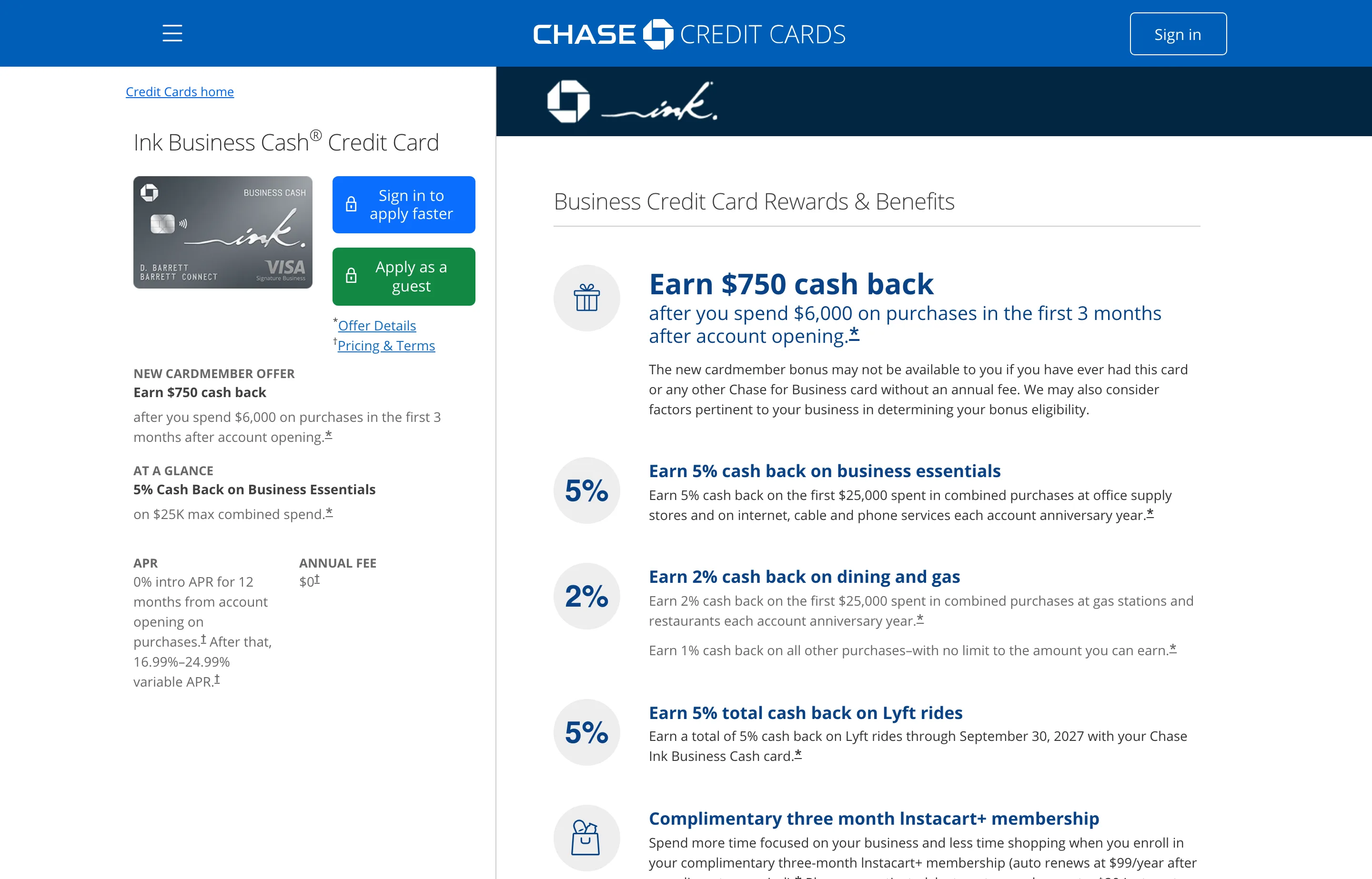
- Key features: 5% cash back on the first $25,000 combined at office supply stores and on internet, cable, and phone services each account anniversary year; 2% on the first $25,000 combined at gas stations and restaurants; 1% on everything else with no cap; free employee cards; 5% total cash back on Lyft rides through September 30, 2027; a complimentary 3-month Instacart+ membership (auto-renews at $99/year).
- Pricing (read from Chase's own product and pricing pages, as of October 2026): $0 annual fee. Welcome offer: $750 cash back after $6,000 in purchases in the first 3 months. 0% intro APR for 12 months on purchases, then 16.99%–24.99% variable. Foreign transaction fee: 3% of each transaction in U.S. dollars. Cash-advance APR 28.74%; late fee $40.
- The catch: the 3% foreign transaction fee is the highest on this list, so it's the wrong card for cross-border spend. Rewards are tracked as points (each $1 in cash back = 100 points), the 5% and 2% tiers reset every account anniversary year, and the welcome bonus may not be available if you've had this card or another no-annual-fee Chase for Business card.
- Pros: a genuinely useful 5% category with a high $25,000 cap; $0 fee; no cap on the 1% base; free employee cards.
- Cons: 3% foreign transaction fee; narrow bonus categories; rewards redeem as statement credit, not a transferable travel currency.
- Reviews: left unrated — no reliable public rating base.
2. American Express Blue Business Plus — best no-fee flat-rate rewards card
Amex Blue Business Plus is the best "set it and forget it" earner: 2X Membership Rewards points on the first $50,000 of purchases each calendar year, which at the common 1-cent valuation beats the 1.5% flat-rate card below and can be worth considerably more if you transfer points to airline and hotel partners.
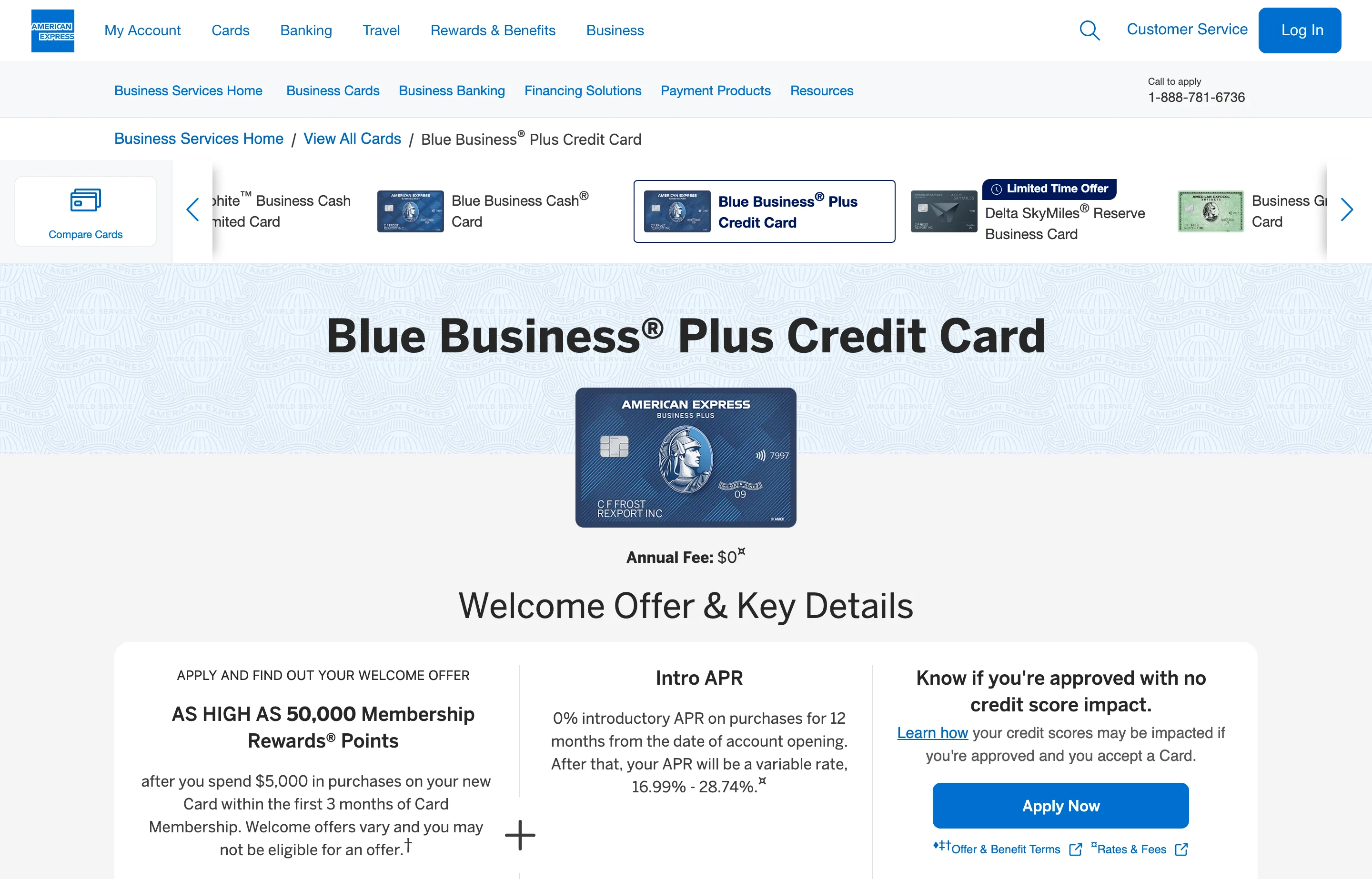
- Key features: 2X Membership Rewards points on the first $50,000 in eligible purchases each calendar year, then 1X; Expanded Buying Power (spend above your credit limit, subject to terms); up to 99 employee cards; Amex Offers; QuickBooks connection.
- Pricing (read from Amex's own rates-and-fees page, as of October 2026): $0 annual fee. Welcome offer: 15,000 Membership Rewards points after $5,000 in the first 3 months (POID K6CD:9932, accurate as of 10/13/2026). 0% intro APR for 12 months, then 16.99%–28.74% variable. Foreign transaction fee: 2.7%. Penalty APR 29.99%; late fee up to $39.
- The catch: the 2X rate collapses to 1X after $50,000 a year, so a high-volume business ends up on a mediocre flat rate. The 2.7% foreign transaction fee is high, Membership Rewards points must be redeemed or transferred well to beat plain cash back, and Amex states the cardholder and company are jointly and severally liable for the balance.
- Pros: 2X on all spend for the first $50K; $0 fee; flexible points with strong transfer partners; Amex Offers.
- Cons: the $50K cap; 2.7% foreign transaction fee; point value varies; personal liability.
- Reviews: left unrated — no reliable public rating base.
3. American Express Blue Business Cash — best no-fee flat 2% cash back
Amex Blue Business Cash is the cash sibling of Blue Business Plus: the same $0 fee and the same $50,000 a year cap, but it pays 2% as an automatic statement credit instead of points — simpler if you'd rather not manage a rewards balance.
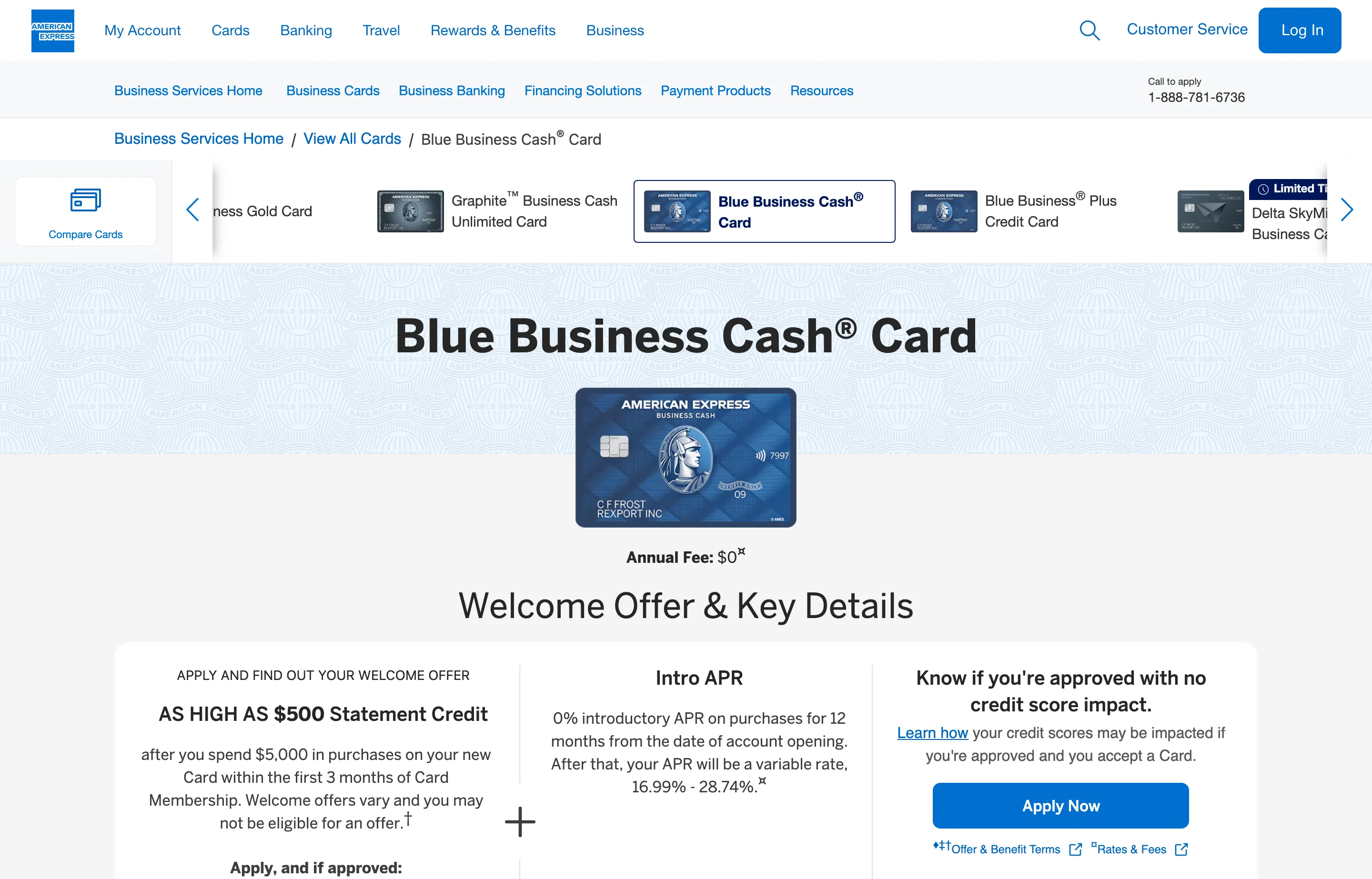
- Key features: 2% cash back on the first $50,000 in eligible purchases each calendar year, then 1%; cash back is automatically credited to your statement; Expanded Buying Power; up to 99 employee cards.
- Pricing (read from Amex's own rates-and-fees page, as of October 2026): $0 annual fee. Welcome offer: $150 statement credit after $5,000 in the first 3 months (POID KC28:9990). 0% intro APR for 12 months, then 16.99%–28.74% variable. Foreign transaction fee: 2.7%. Late fee up to $39.
- The catch: it shares the Plus card's $50K cap and 2.7% foreign transaction fee, and its $150 welcome offer is far smaller than the $750 cash bonuses on the Chase and Capital One cards. Cash back arrives as a statement credit, so you can't redirect it to a bank deposit.
- Pros: a true 2% cash back up to $50,000 at $0 annual fee; no points to track or value.
- Cons: the small welcome offer; 2.7% foreign transaction fee; reward drops to 1% after $50K.
- Reviews: left unrated — no reliable public rating base.
4. Capital One Spark Cash Select — best no-fee card with a 0% intro APR
Capital One Spark Cash Select pairs a 1.5% flat rate with 5% on hotels and rental cars booked through Capital One Business Travel and an introductory 0% APR for 9 months — a solid low-friction pick if you want a card that also carries a balance interest-free for a while.
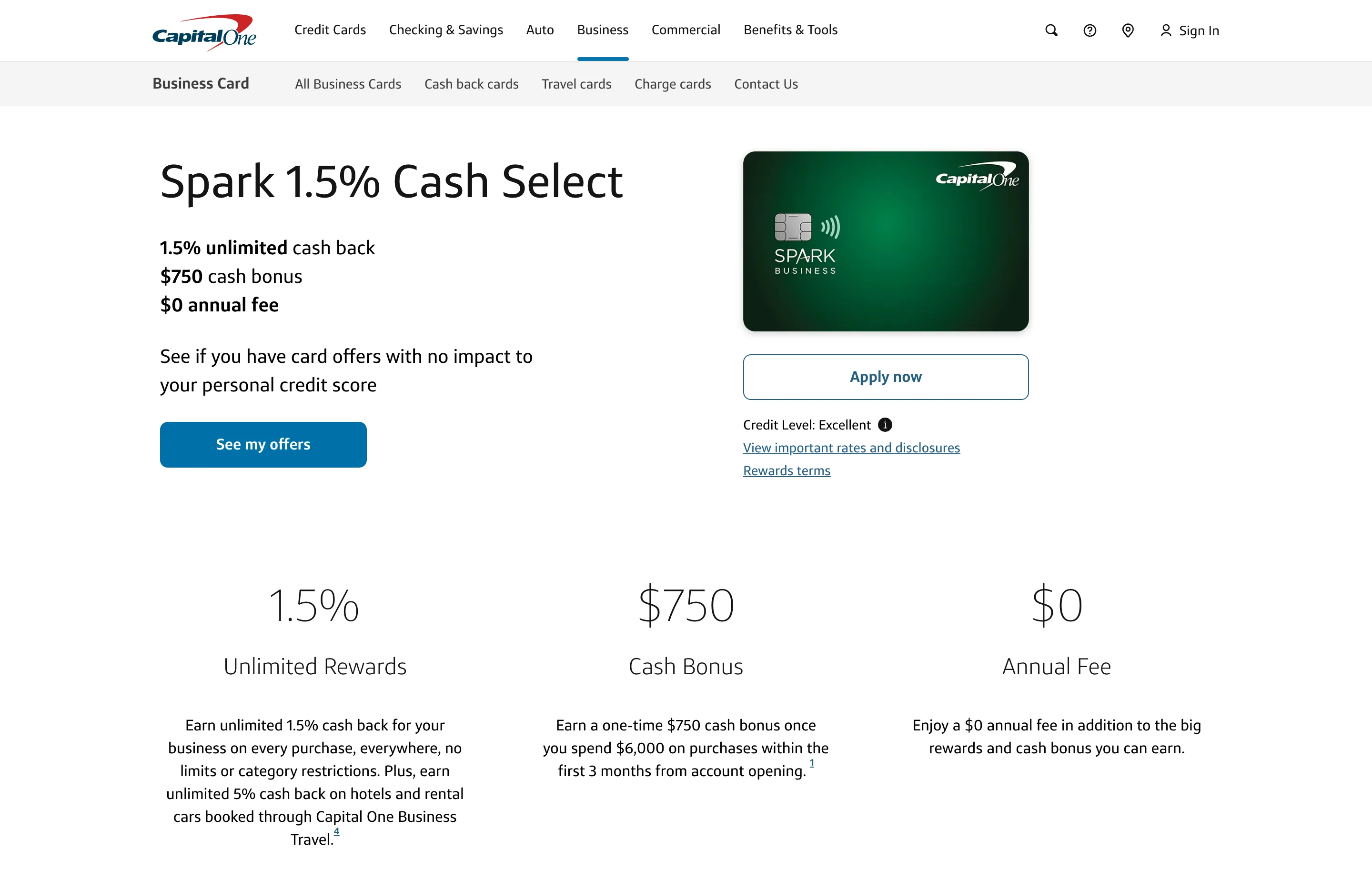
- Key features: 1.5% unlimited cash back on every purchase; 5% on hotels and rental cars booked through Capital One Business Travel; free employee and virtual cards; year-end summaries; assignable account managers.
- Pricing (read from Capital One's own product page, as of October 2026): $0 annual fee. Welcome offer: $750 cash back after $6,000 in the first 3 months. 0% intro APR for 9 months, then 16.99%–26.99% variable. Rewards don't expire for the life of the account. Capital One lists the card as requiring Excellent credit.
- The catch: the 1.5% base rate is below the 2% you can get on the first $50,000 from the Amex cards, and the 5% rate only applies inside Capital One's own travel portal. The 0% intro period is shorter than the 12 months on the Chase and Amex cards.
- Pros: 0% intro APR; a travel-portal bonus rate; $0 fee; a large, current review base.
- Cons: 1.5% base rate; portal-gated 5%; shorter intro APR.
- Reviews: 4.3/5 from 1,102 reviews (Bazaarvoice customer reviews on Capital One's own Spark Cash Select page, 83% would recommend) — as of October 2026.
5. U.S. Bank Triple Cash Rewards — best no-fee card for gas, dining, phone and software
U.S. Bank Triple Cash Rewards earns 3% on a bundle of very common business costs — gas and EV charging, office supplies, cell phone service, and restaurants — and throws in a $100 annual credit for software subscriptions that offsets part of a QuickBooks or FreshBooks bill.
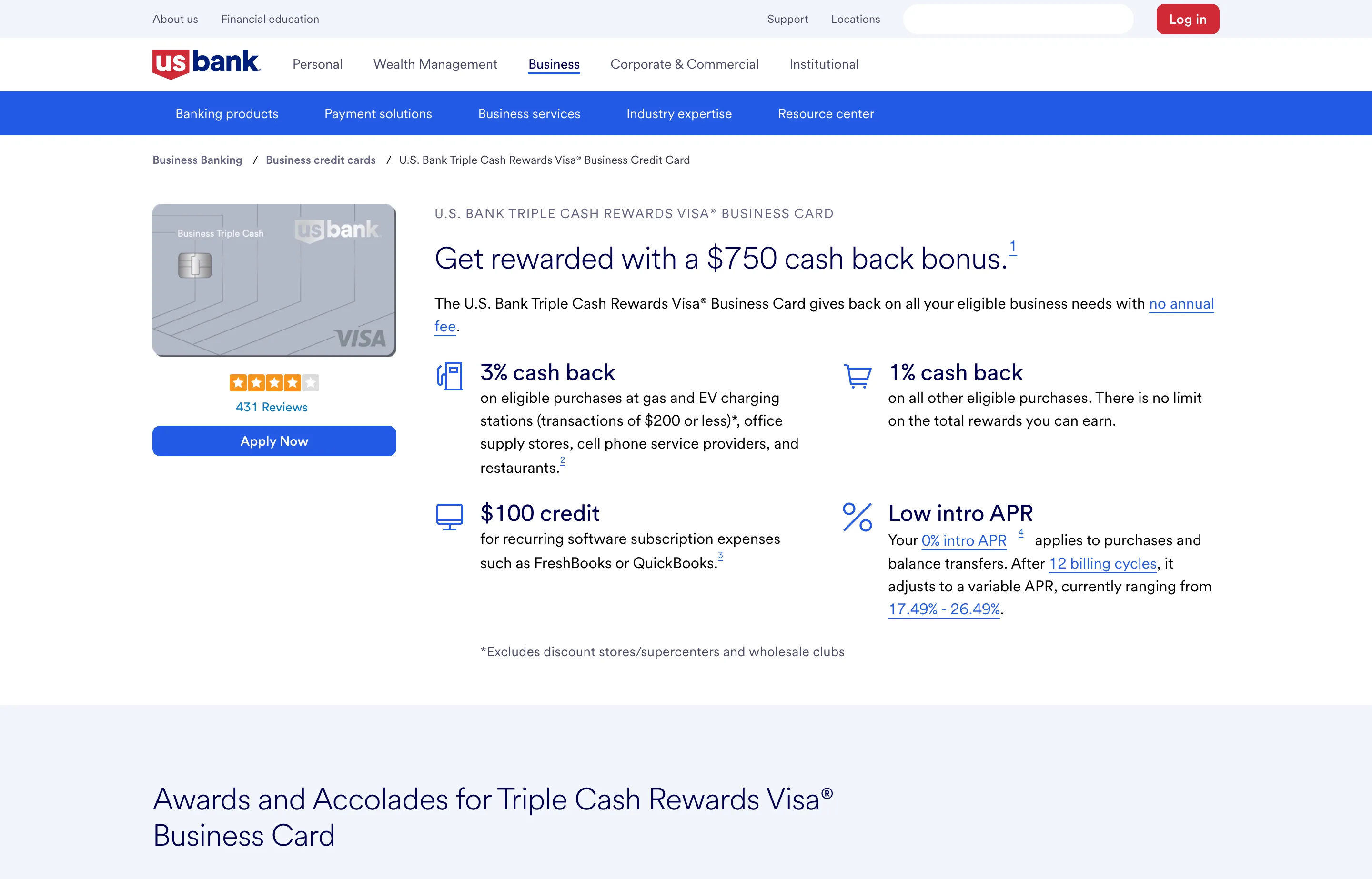
- Key features: 3% cash back on gas and EV charging (transactions of $200 or less), office supply stores, cell phone service providers, and restaurants; 1% on all other purchases with no cap; a $100 statement credit per 12-month period after 11 consecutive months of eligible software subscription purchases (e.g., FreshBooks or QuickBooks); 5% on prepaid hotel and car rentals booked in the Travel Center.
- Pricing (read from U.S. Bank's own product page, as of October 2026): $0 annual fee. Welcome offer: $750 cash back after $6,000 on the Account Owner's card within the first 180 days. 0% intro APR for 12 billing cycles on purchases and balance transfers, then a variable APR — U.S. Bank's page does not publish the ongoing rate, so confirm it in the pricing disclosure before applying. Free employee cards.
- The catch: the 3% categories are narrower than they look — gas only counts on transactions of $200 or less, and the $100 software credit requires 11 straight months of qualifying purchases. The ongoing APR isn't published on the product page we read.
- Pros: high rates on everyday categories; a recurring software credit; $0 fee; a 0% intro APR on purchases and balance transfers.
- Cons: category rules and caps; unresolved ongoing APR; U.S. Bank's regional footprint.
- Reviews: left unrated — no reliable public rating base (the card carries Forbes Advisor 2025 "best cash-back business card" accolades, shown on U.S. Bank's page).
6. Chase Ink Business Preferred — best mid-fee card for shipping, ads and travel
Chase Ink Business Preferred is the fee card that earns its keep fastest. For an e-commerce or agency business spending on shipping, social and search advertising, and internet/cable/phone, the 3X categories — plus no foreign transaction fees — repay the $95 fee after roughly $4,200 of category spend a year if you value points at 1.25 cents.
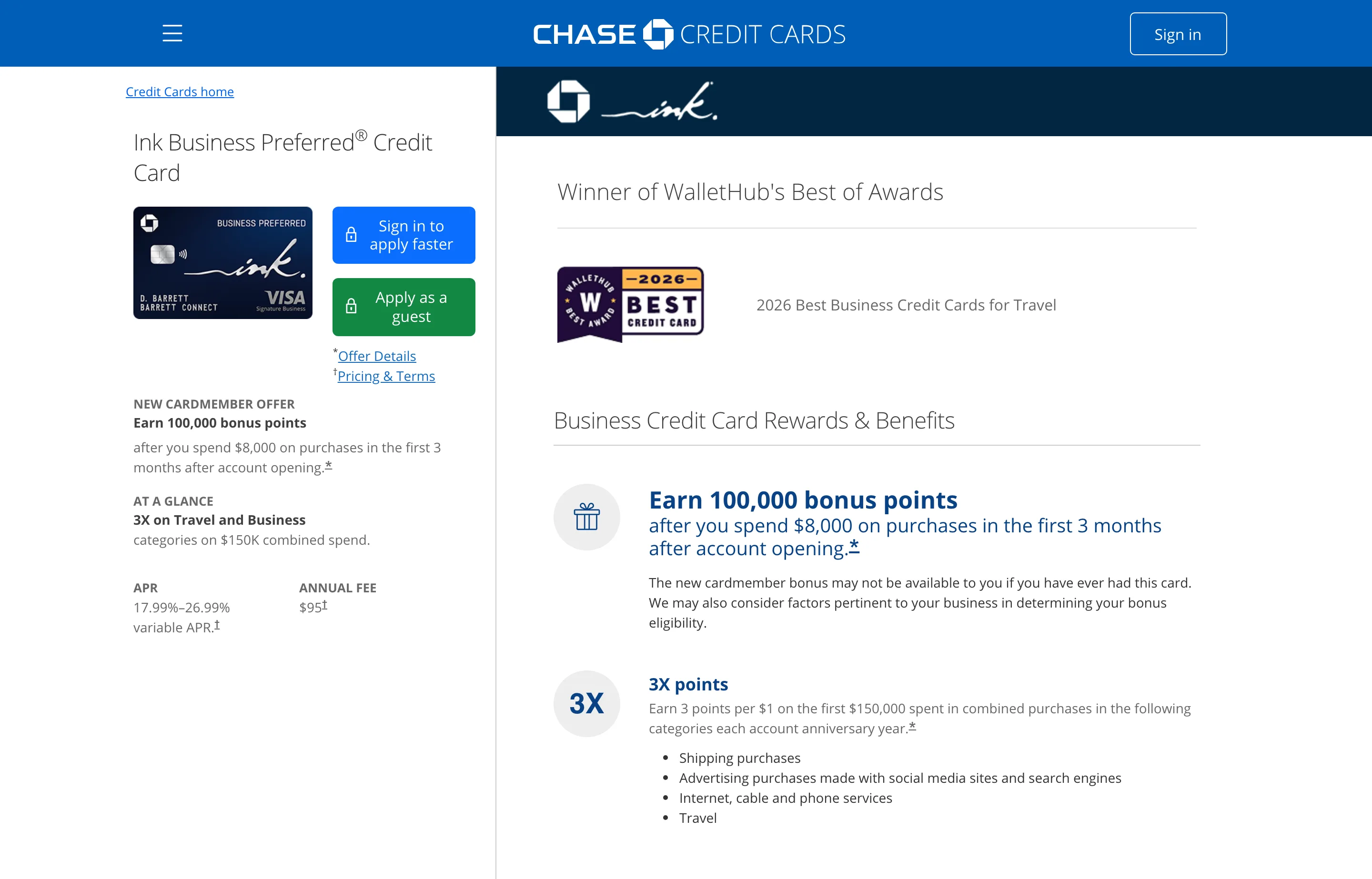
- Key features: 3X points on shipping, advertising purchased from social media sites and search engines, internet/cable/phone services, and travel on the first $150,000 combined each account anniversary year; 1X on everything else; 5X total on Lyft rides through September 30, 2027; free employee cards; trip cancellation/interruption insurance, primary auto rental coverage, cell phone protection, purchase protection and extended warranty; complimentary DashPass.
- Pricing (read from Chase's own product and pricing pages, as of October 2026): $95 annual fee. Welcome offer: 100,000 bonus points after $8,000 in the first 3 months. 17.99%–26.99% variable APR. No foreign transaction fees. 1 point per $1 on non-bonus purchases; points transfer to airline and hotel partners.
- The catch: the 3X rate applies only to the first $150,000 a year combined, it's a points card whose value depends on redemption, and the $95 fee is real money if your spend is low or doesn't fall into the bonus categories.
- Pros: no foreign transaction fees; strong, broadly useful 3X categories; transferable points; valuable travel and purchase insurance.
- Cons: the $95 fee; point-valuation sensitivity; the $150K cap.
- Reviews: left unrated — no reliable public rating base (the card carries a WalletHub 2026 "best business cards for travel" accolade, shown on Chase's page).
7. Capital One Spark Cash Plus — best charge card that pays you back
Capital One Spark Cash Plus is a 2% unlimited charge card with no preset spending limit, a large welcome offer, and an annual fee that's refunded once you spend $150,000 in a year. It only suits a business that clears its balance — it's designed to be paid in full.
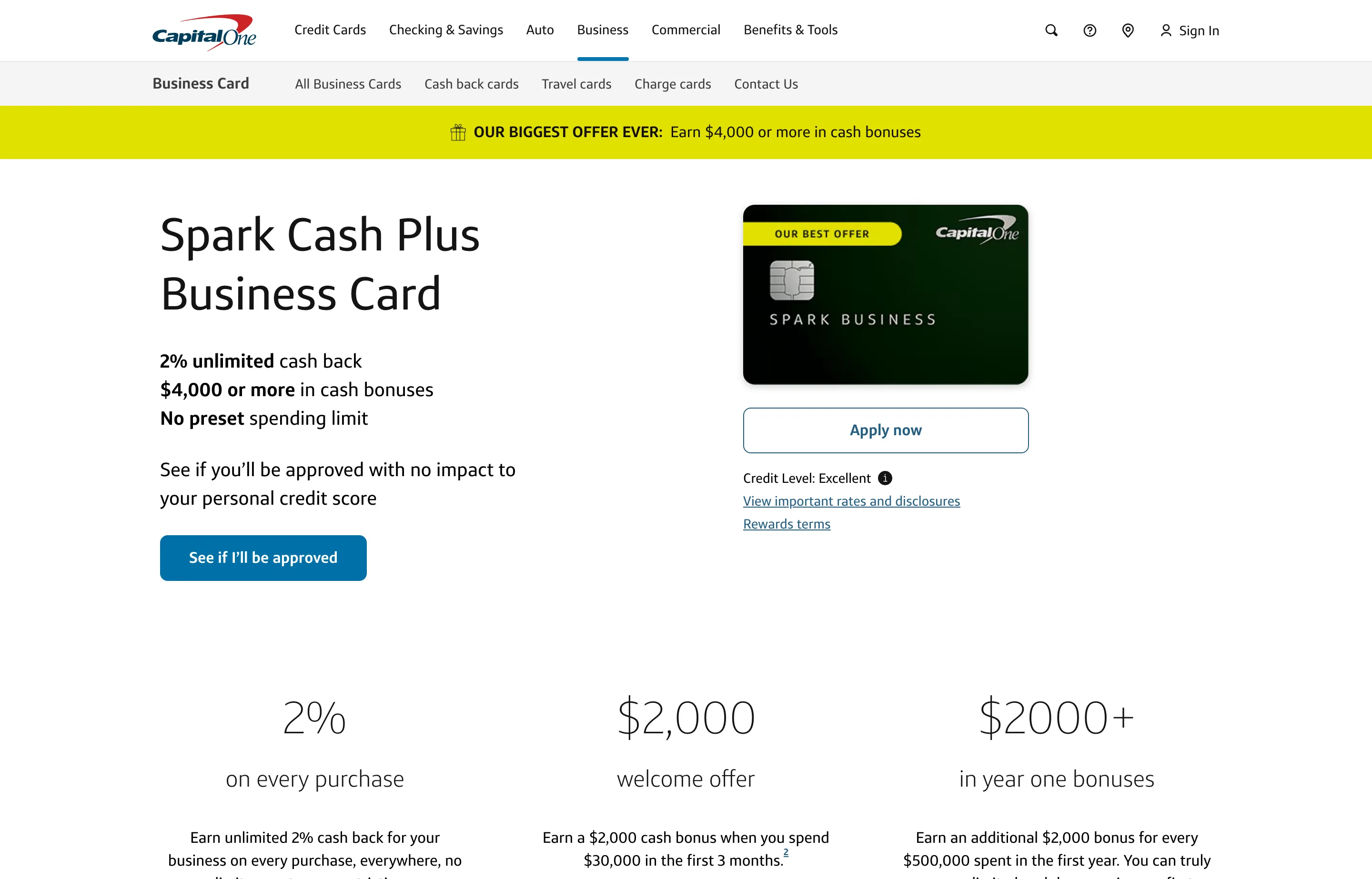
- Key features: 2% unlimited cash back on every purchase; 5% on hotels, vacation rentals and rental cars booked through Capital One Business Travel; no preset spending limit; free employee and virtual cards; account managers.
- Pricing (read from Capital One's own product page, as of October 2026): $150 annual fee, refunded each year you spend at least $150,000. Welcome offer: $2,000 after $30,000 in the first 3 months, plus $2,000 for every $500,000 spent in the first year. It's a charge card designed to be paid in full, with the option to carry a balance with interest (the ongoing rate is not published on the product page — check the pricing schedule). Late fee 2.99%. Capital One lists the card as requiring Excellent credit.
- The catch: carrying a balance is discouraged by design and the APR isn't published on the page we read. The fee isn't refunded until $150,000 of spend. The foreign transaction fee also isn't stated on the product page.
- Pros: 2% unlimited; a very large bonus ceiling; the fee refunds at $150K; no preset spending limit.
- Cons: the $150 fee below $150K; the discipline of a pay-in-full card; some terms are off-page.
- Reviews: left unrated — no reliable public rating base for this specific card.
8. American Express Business Platinum — best premium charge card for travel-heavy businesses
Amex Business Platinum is an $895-a-year travel machine whose value is in the statement credits, not the earn rate. Stack the hotel, airline, Dell, Adobe, Indeed, wireless, CLEAR and ChatGPT credits and it can pay for itself — but only if you'd have spent that money anyway.
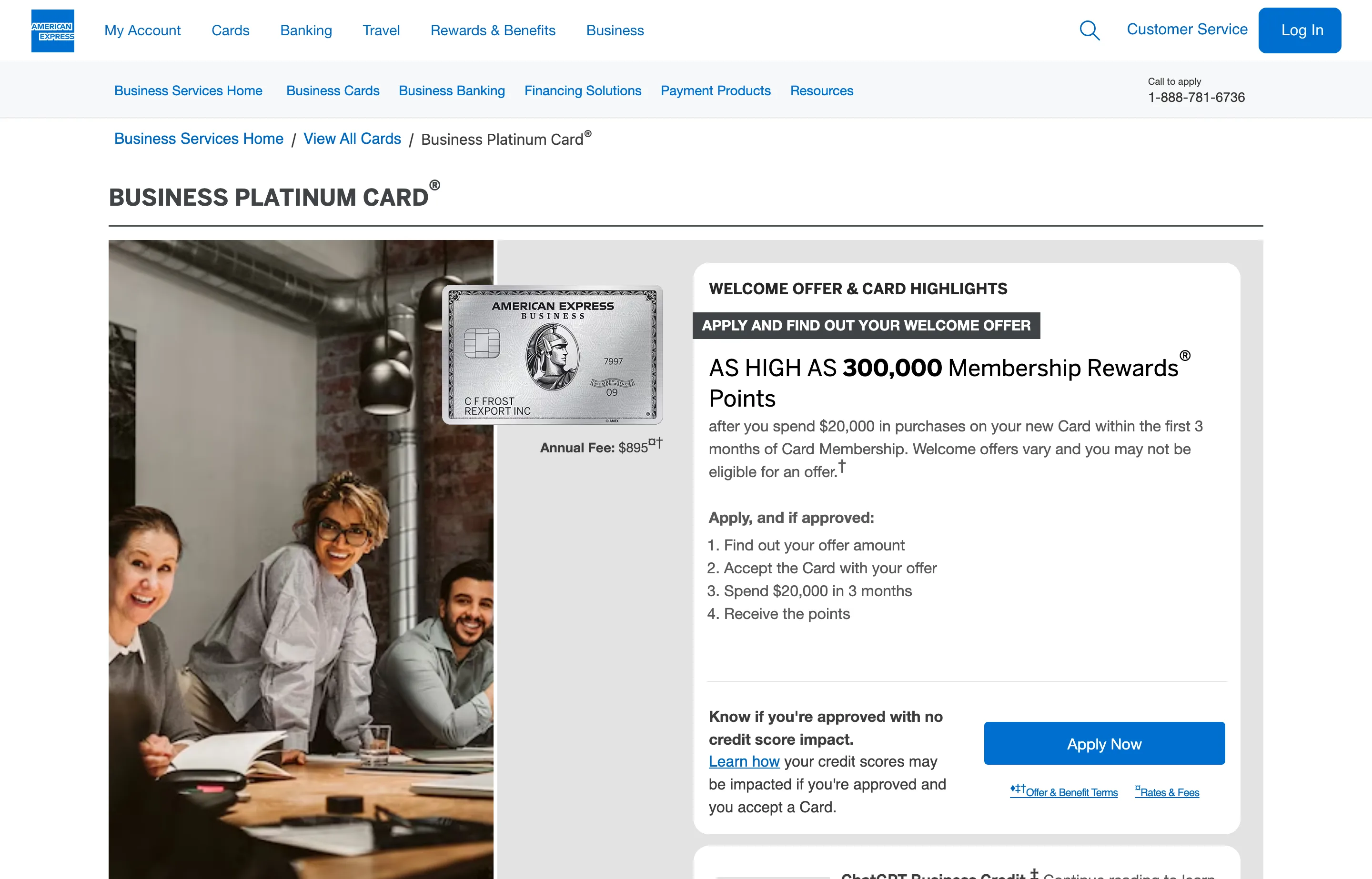
- Key features: 5X Membership Rewards points on flights and prepaid hotels booked at AmexTravel.com; 2X on key business categories (U.S. construction material and hardware suppliers; U.S. electronic goods retailers and software and cloud providers; U.S. shipping providers; and eligible purchases of $5,000 or more) on up to $2 million a year; 1X on everything else; lounge access (Centurion Lounges, Priority Pass Select, and 10 Delta Sky Club visits); and a long list of credits — up to $600 hotel ($300 semi-annually), $200 airline fee, $200 Hilton, $219 CLEAR Plus, up to $1,150 Dell, $300 ChatGPT Business, $250 Adobe, up to $360 Indeed, up to $120 wireless, and a $120 Global Entry/TSA credit.
- Pricing (read from Amex's own product and rates-and-fees pages, as of October 2026): $895 annual fee ($400 per Employee Business Platinum Card; Employee Business Expense Cards are free). Welcome offer: "as high as" 300,000 Membership Rewards points after $20,000 in the first 3 months — Amex tells you your exact offer before you accept. Pay Over Time APR 17.99%–28.74% variable. No foreign transaction fees. Late fee $39 or 2.99% of the past-due amount.
- The catch: $895 is the highest fee on this list by a wide margin, and the rewards alone won't earn it back — the card only works if you actually use the credits. The welcome offer is a variable "as high as" figure, not a fixed number, and it's a charge card whose carried balances are priced as Pay Over Time.
- Pros: unmatched credits and lounge access; 5X on travel; no foreign transaction fees; premium travel and purchase insurance.
- Cons: the $895 fee; credit-driven value; a points currency; charge-card economics.
- Reviews: left unrated — no reliable public rating base for this product.
9. Brex — best corporate card with no personal guarantee
Brex is a corporate charge card underwritten on your company's finances — revenue, amount raised, or cash balance — rather than your personal credit, so it's the right call for a funded startup or any company that wants spend controls without a founder's personal guarantee.
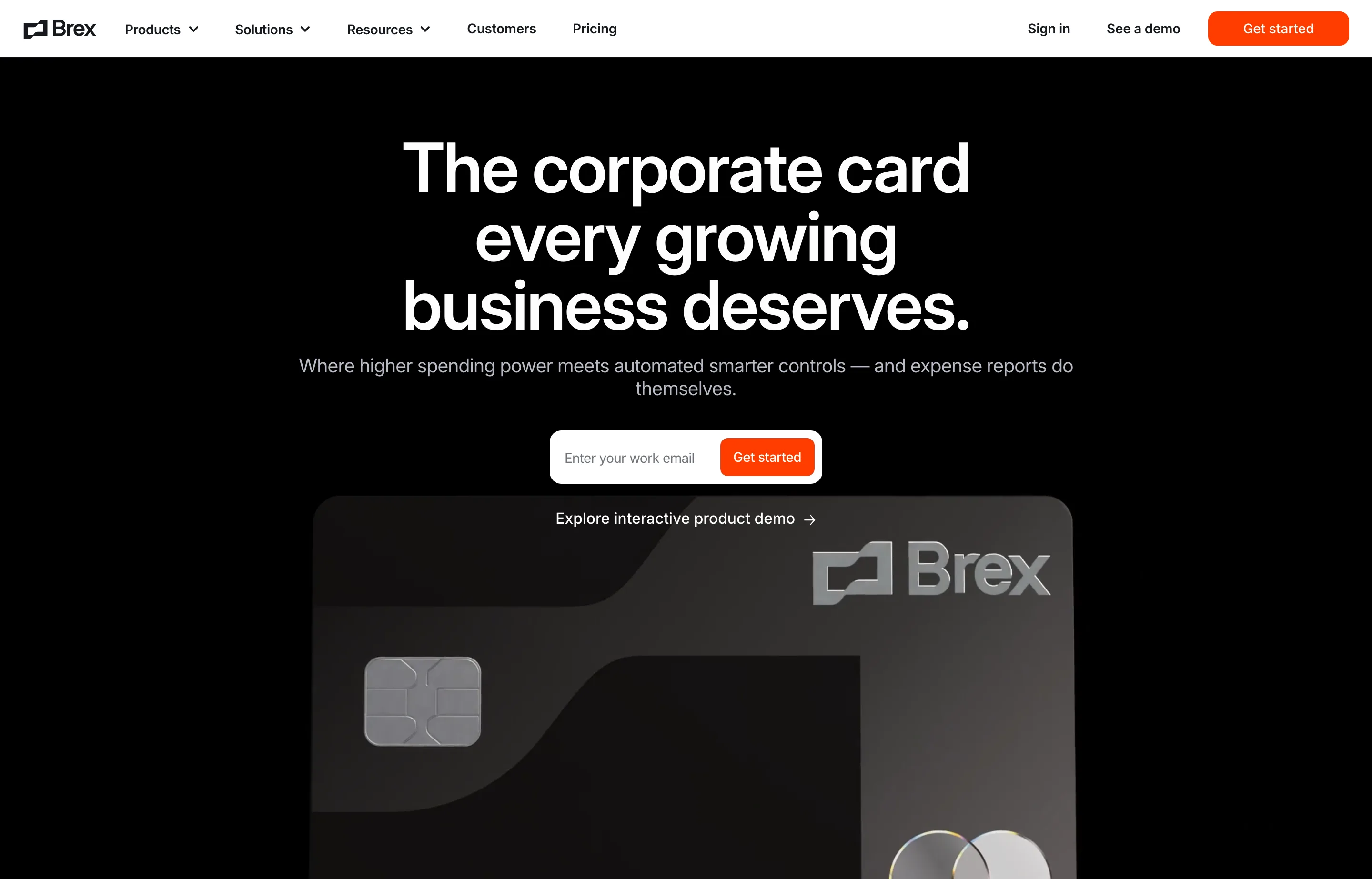
- Key features: no personal guarantee and no personal credit check; business-based limits that Brex says can run up to 30x higher than traditional business cards; unlimited virtual and physical cards; category-, merchant- and amount-level spend controls; automated receipt collection; up to 7X rewards (7X rideshare, 4X Brex prepaid travel, 3X restaurants, 2X software, 1X everything else); Mastercard, accepted in 210+ countries.
- Pricing (read from Brex's own product and pricing pages, as of October 2026): no card annual fee; the Brex Essentials platform plan is $0/user/month and Premium is $12/user/month. No foreign transaction fees, though Brex may apply an FX markup of up to 3% when currency conversion is required.
- The catch: eligibility favors U.S.-incorporated companies and, in practice, venture-backed startups with traction rather than a corner store. The rewards skew toward rideshare and travel, not the general spend a local operation has, and it's a pay-in-full corporate card.
- Pros: no personal guarantee; business-based limits; strong built-in controls; global acceptance; a free entry plan.
- Cons: startup-oriented eligibility; rewards that skew to travel; corporate charge model.
- Reviews: left unrated — no reliable public rating base.
10. Ramp — best free corporate card for spend controls and cash back
Ramp is a no-fee corporate charge card with a 30-day payback, no personal guarantee, and cash back on every swipe — the pick for a growing team that wants controls and accounting automation in one place.
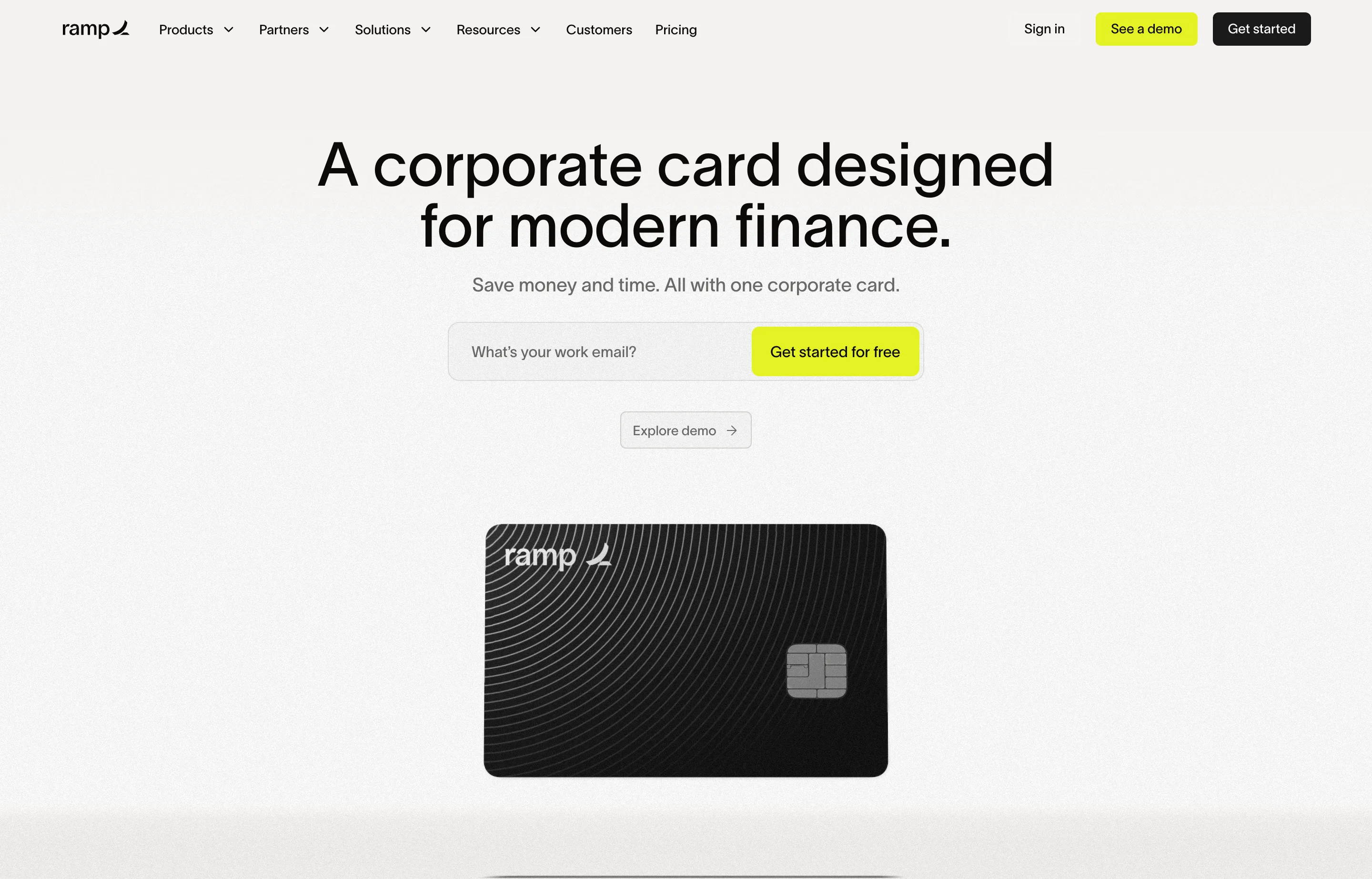
- Key features: no personal guarantee and no personal credit check; a corporate charge card with a 30-day payback; custom virtual cards with vendor- and category-level restrictions; automated receipts, memos and accounting sync; cash back on every swipe, redeemable as a statement credit, bank deposit, travel or gift cards; Visa; 200+ integrations.
- Pricing (read from Ramp's own product page, as of October 2026): no annual fee and no interest charges (it's a corporate charge card); the platform is free to start. Ramp markets "up to 5%" savings that blend cash back with non-card savings — that figure is an illustrative estimate, not a rewards rate.
- The catch: it's a corporate charge card, not a revolving line, so it's a poor fit for a business that needs to finance purchases over months. The rewards aren't a single clean percentage, and its best features assume a finance function to configure.
- Pros: $0 fee and no interest; cash back on every swipe; best-in-class spend controls; a free software layer.
- Cons: corporate charge model; a blended (not headline) rewards figure; designed for teams rather than solo operators.
- Reviews: left unrated — no reliable public rating base.
11. BILL Spend & Expense (Divvy Card) — best free card bundled with expense software
BILL Spend & Expense (formerly Divvy) is the strongest "card plus software" bundle here: $0 per user per month gets you corporate cards, budgets and expense automation, with access to credit lines from $1,000 to $5M, subject to approval.
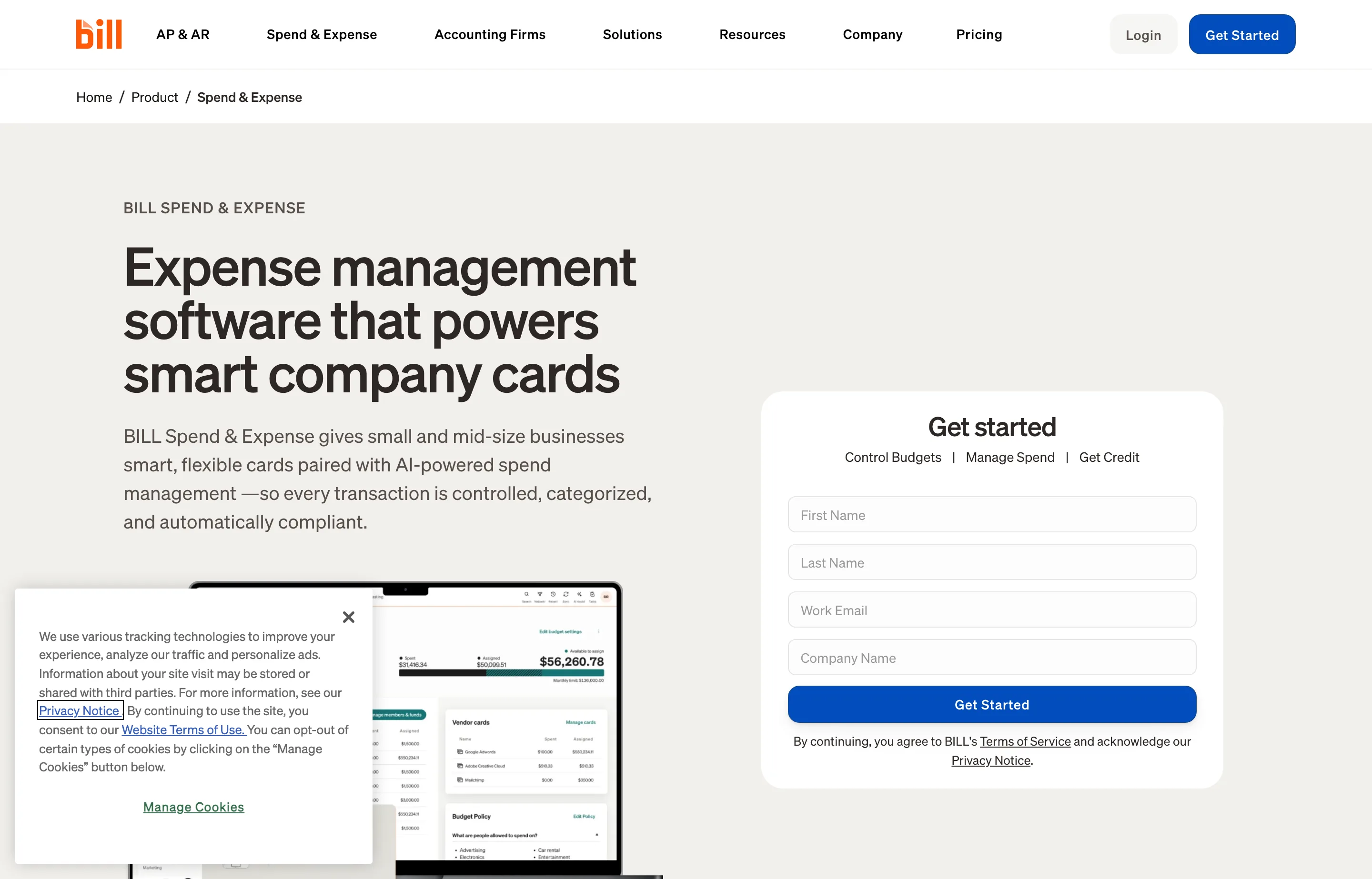
- Key features: physical and virtual cards; budgets with real-time controls and limits; AI receipt capture, matching and transaction coding; two-way sync with QuickBooks, Xero, NetSuite and more; rewards; a mobile app.
- Pricing (read from BILL's own Spend & Expense and pricing pages, as of October 2026): BILL Spend & Expense is $0 per user/month, including corporate cards, budgets and expense tracking. The BILL Divvy Card is issued by bank partners (listed at bill.com/legal/bank-partners) and is not a deposit product. Credit lines of $1,000–$5M are advertised but, per BILL, "are not guaranteed and will be determined upon application approval."
- The catch: BILL's public pages don't publish the card's specific reward rate or any cardholder APR — you apply to see the terms. It's a business spend card rather than a consumer-style rewards card, so the value is in the software, not the earn rate.
- Pros: $0 software; genuine budgets and controls; access to credit lines; strong accounting integrations.
- Cons: the reward rate is unpublished; credit lines aren't guaranteed; a spend-management tool rather than a simple rewards card.
- Reviews: left unrated — no reliable public rating base.
12. Shopify Credit — best no-fee card for Shopify merchants
Shopify Credit is the only card here built for a specific platform: if you sell on Shopify, it pays up to 3% cashback on your top spend category, runs no credit check, and requires no personal guarantee.
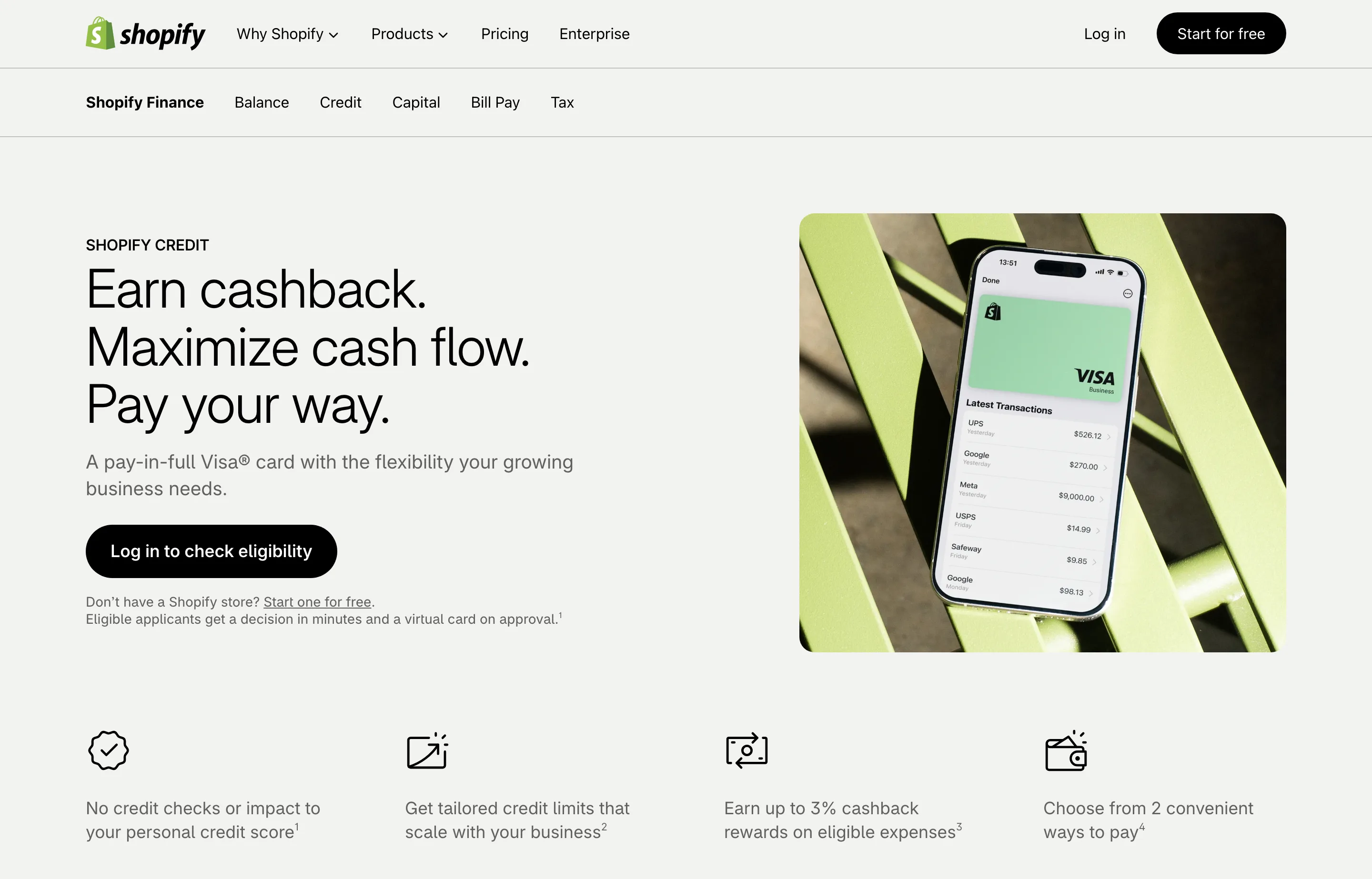
- Key features: up to 3% cashback on up to $250,000 of annual eligible purchases in your monthly top spend category (marketing, fulfillment, or wholesale), then 1%; 1% on the other two categories; no credit checks and no impact to your personal credit score; no guarantor; performance-based credit limits that scale with the business; Visa, issued by Celtic Bank and powered by Stripe.
- Pricing (read from Shopify's own product page, as of October 2026): no annual fee; no foreign transaction fees; no card replacement fees. It's a pay-in-full card: by default your full statement balance is auto-debited within a 1-month grace period, or you can pay over time from daily sales (up to 10 months) for a fee, with a 2% monthly late fee on any balance unpaid after 10 months.
- The catch: it's pay-in-full (or fee-based installments), and it's only available to Shopify merchants. The 3% rate only applies to your single top category, so it's worth little unless your spend concentrates in marketing, fulfillment or wholesale.
- Pros: up to 3% cashback; no credit check and no personal guarantee; no foreign transaction fees; free.
- Cons: Shopify-only; pay-in-full design; category-based rewards.
- Reviews: left unrated — no reliable public rating base.
The math the application assumes: free Small Business Tools
A card application is a cost decision, and these free tools do the arithmetic the issuer's marketing skips:
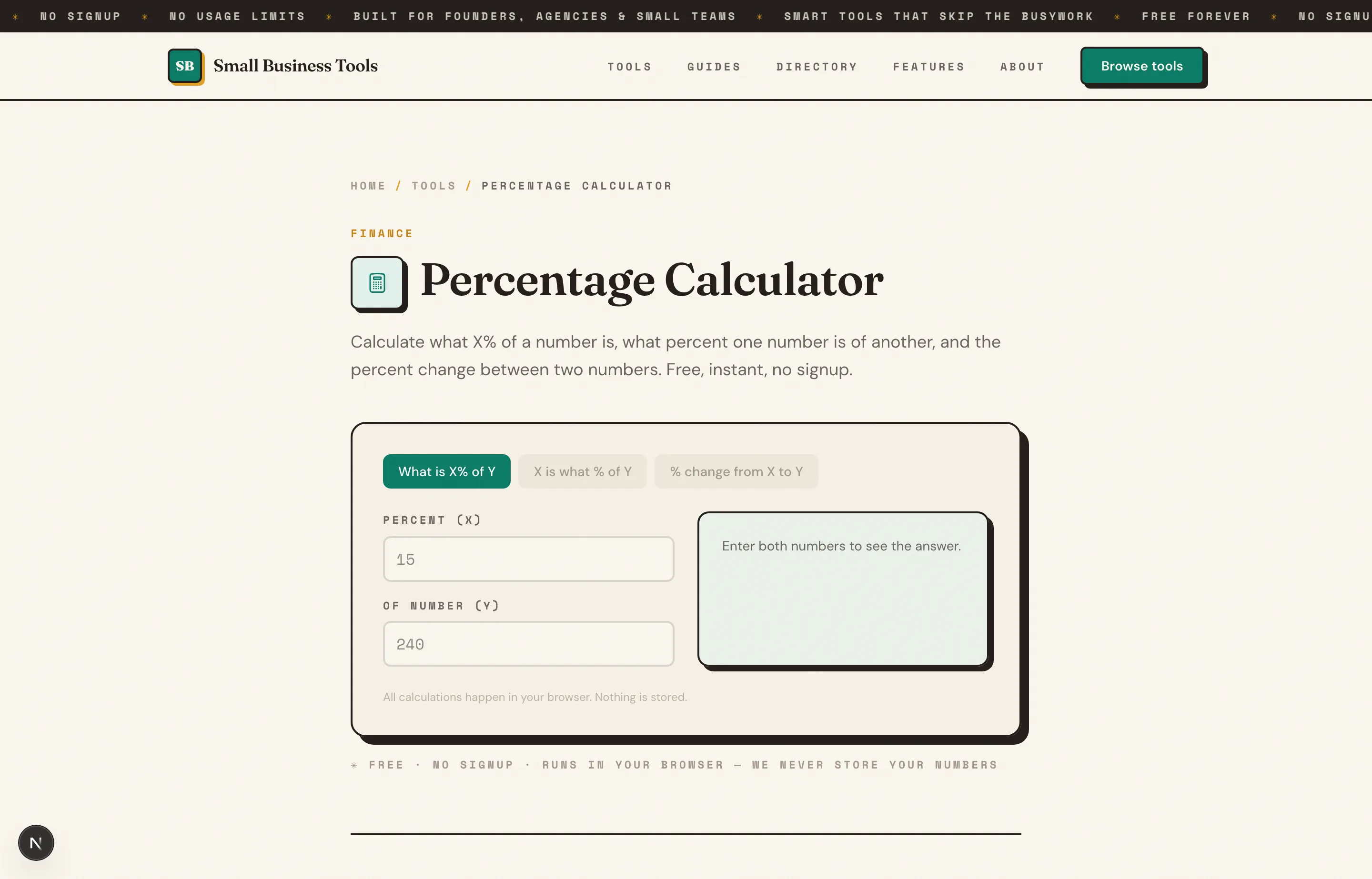
- Percentage Calculator — the rewards-versus-interest decoder: what 2% earns on your monthly spend, what 24% APR costs on a carried balance, and whether a 5% category capped at $25,000 is really better than a flat 2%.
- ROI Calculator — treat the annual fee as an investment: return (rewards plus used credits) against cost (the fee), so an $895 Business Platinum or a $95 Ink Preferred is judged on the numbers, not the perks.
- Break-Even Calculator — the annual-fee break-even in spend terms: how much category spend a fee card needs before it beats the identical $0-fee card.
- Invoice Generator — clean, numbered invoices so the revenue that pays the statement actually arrives on time (a card you clear in full every month only works if customers pay in full, too).
The free small business tools hub lists the rest by job. Pair this guide with the business bank accounts guide for where the money sits, the accounting software guide for the books every card statement posts into, and the payment processors guide for what it costs to accept the cards your customers hand you.
Which should you choose?
- You pay in full and want the best no-fee earn on everyday spend: Chase Ink Business Cash (5% on office/internet/phone) if your spend fits those categories; Amex Blue Business Plus (2X points) or Blue Business Cash (2% cash back) if you want a flat rate on the first $50,000 a year.
- You want a simple 0% intro APR: Capital One Spark Cash Select (9 months) or the 12-month intro on the Chase Ink Cash and Amex Blue Business cards.
- You run a shop that drives, eats, and buys office supplies: U.S. Bank Triple Cash Rewards — 3% on those categories plus a recurring software credit.
- You spend heavily on shipping, advertising, or travel: Chase Ink Business Preferred — the $95 fee clears at roughly $4,200 of category spend, and there's no foreign transaction fee.
- Your annual spend is north of $150,000 and you clear your balance: Capital One Spark Cash Plus — 2% unlimited and the fee refunds itself at $150K.
- You want a premium travel card and the credits to justify it: Amex Business Platinum — only if you'll actually use the credits.
- You want a corporate card with no personal guarantee: Brex for funded startups, Ramp for teams that want controls and cash back, BILL Spend & Expense for the cards-plus-software bundle.
- You sell on Shopify: Shopify Credit — up to 3% cashback with no credit check and no personal guarantee.
A worked example of the break-even, using the Break-Even Calculator: Chase Ink Business Preferred earns 3X on its bonus categories versus roughly 1.5% on a $0-fee flat card. If you value a Chase point at 1.25 cents, 3X is worth about 3.75% — a 2.25-point advantage over the flat card. The $95 fee divided by that 0.0225 advantage gives a break-even of about $4,222 of category spend a year, or roughly $352 a month on shipping, advertising, internet and travel. Below that, the $0-fee card wins.
And the number that overrides all of it, using the Percentage Calculator: on an $8,000 monthly balance carried at 24.99% APR, you'd pay about $2,000 a year in interest — against roughly $1,920 in rewards earned by a 2% card on the same spend, before you've earned a cent. At roughly 24% APR, one month of revolving costs about 2% of the balance, which is exactly the annual reward on a 2% card. Carry a balance at 28% and you're paying the reward back with interest on top.
FAQs
What is the best business credit card for a small business?+
For most owner-operators who pay in full, the best card is a no-fee earner matched to spend: **Chase Ink Business Cash** for office supply, internet and phone bills (5% back), **Amex Blue Business Plus** or **Cash** for a flat 2X/2% on the first $50,000 a year, or **Capital One Spark Cash Select** if you want a 0% intro APR. Businesses with heavy shipping, advertising or travel spend should run the break-even on **Chase Ink Business Preferred**, and Shopify merchants should look at **Shopify Credit**. The right answer depends on your categories and whether you can clear the balance.
Are business credit cards worth it if I carry a balance?+
No — not for the rewards. Rewards are a percentage of spend; interest is a percentage of the balance, and interest is the bigger number. At a ~24% APR you pay about 2% of the balance in interest every month, so a single month of revolving erases a full year of a 2% reward. If you expect to carry a balance, ignore the earn rates and the welcome bonus and compare APRs — or use a 0% intro period deliberately and pay it off before it ends.
Do I need a business credit card, or can I use a personal card?+
You're not required to have a business card, but there are three real reasons to get one: separating business and personal expenses makes your books and Schedule C far cleaner, a business card builds a business credit profile (which helps later financing), and corporate cards let you issue employee cards with controls. The trade-off: most small-business cards — including Chase Ink and Amex's business cards — put the cardholder and the company on the hook as "jointly and severally liable," so you personally guarantee the debt. Corporate cards from Brex, Ramp and Shopify Credit, by contrast, don't require a personal guarantee. Note too that the CARD Act's consumer protections generally don't cover business cards.
What's the difference between a charge card and a credit card?+
A credit card (revolving) gives you a credit limit and lets you carry a balance month to month at an APR — Chase Ink, Amex Blue Business Plus/Cash, Capital One Spark Cash Select and U.S. Bank Triple Cash are all revolving cards. A charge card is designed to be paid in full each month: **Amex Business Platinum** and **Capital One Spark Cash Plus** are charge cards, and **Brex** and **Ramp** are corporate charge cards. Some charge cards offer a "pay over time" feature (Business Platinum's carries 17.99%–28.74% variable) but the model assumes you clear the balance — which is precisely what keeps the rewards math in your favor.
Do business credit cards build business credit?+
Yes, if the issuer reports to the commercial bureaus (Dun & Bradstreet, Experian Business, Equifax Business). Cards underwritten on your business and EIN — rather than your personal credit — are the clearest way to build a separate business file, and corporate cards like Brex and Ramp go furthest by underwriting on business financials. Keep in mind that most small-business cards also report activity to your personal credit, and missed payments hurt both profiles.
What credit score do you need for a business credit card?+
Issuers rarely publish a score cutoff. Where a page states one, it's high: Capital One lists both **Spark Cash Select** and **Spark Cash Plus** as requiring **Excellent** credit. In practice, traditional small-business cards underwrite partly on your personal credit, so a strong personal score helps, while corporate cards (Brex, Ramp, Shopify Credit) look at business performance or revenue instead and may not check personal credit at all. Amex's business cards tell you if you're approved with no credit-score impact before you accept.
Final take
Pick by how you pay, not by how big the bonus looks. If you clear your balance every month — which the numbers above say you must — the best card for most small businesses is a $0-fee earner matched to your actual spend: Chase Ink Business Cash for office and phone bills, Amex Blue Business Plus or Cash for a flat 2% on the first $50,000 a year, Capital One Spark Cash Select when you want a 0% intro APR. If your spend concentrates in shipping, advertising or travel, Chase Ink Business Preferred earns its $95 fee back at roughly $4,200 of category spend; if you run north of $150,000 a year and pay in full, Capital One Spark Cash Plus refunds its own fee. Only reach for Amex Business Platinum if you'll genuinely use its credits, and only choose a corporate card (Brex, Ramp, BILL, or Shopify Credit) if you want to keep the debt off your personal name.
Then keep both sides of the ledger honest: run the annual-fee break-even with the Break-Even Calculator, check the rewards-versus-interest trade with the Percentage Calculator, and bill with the free Invoice Generator — free, no signup, nothing stored.
Free tools to try
Percentage Calculator
What is X% of Y, X is what % of Y, and percent change — answered in plain words.
ROI Calculator
See your return on investment as a percentage — plus annualized ROI over time.
Invoice Generator
Create a professional invoice and download it as a PDF in 30 seconds.
Break-Even Calculator
Find how many units you need to sell to cover your costs.
Keep reading
Guide
Best Business Bank Accounts for Small Business (2026)
12 business bank accounts compared — real 2026 fees for Bluevine, Novo, Relay, Chase and more, plus the fintech-vs-bank FDIC decoder.
Guide
Best Free Accounting Software for Small Business (2026)
12 accounting tools ranked for small businesses — real free-tier caps, current pricing, pros and cons for Wave, Zoho Books, GnuCash, QuickBooks, Xero and more.
Guide
Best Payment Processors for Small Business (2026)
11 payment processors compared for small businesses — real 2026 fees for Square, Stripe, PayPal, Helcim and more, plus when interchange-plus saves money.
Guide
How to Calculate ROI on a Small Business Investment
Calculate ROI on a small business investment: the formula, annualized ROI for fair comparisons, what makes a return good, and the traps that inflate it.