Guide
Best Business Bank Accounts for Small Business (2026)
Business checking is sold on "$0 monthly fee" — and the money is made in everything the sticker doesn't say: the balance you must keep to waive the fee you don't have, the $0.30 per $100 you pay on cash deposits above the cap, the 25 free teller transactions, and whether your money is actually at a bank at all. Half of the most-advertised business accounts are fintechs: your deposit sits at a partner bank, and FDIC coverage is either direct $250K or "pass-through" via a sweep network — a structure the FDIC itself has proposed tightening, with its custodial-account recordkeeping rulemaking spelling out that pass-through insurance applies only when its requirements are satisfied.
This guide compares twelve business bank accounts — six fintechs, two chartered online banks, and the four big branch banks — across the terms that decide the real cost. Every figure is as of September 2026, read from the bank's own fee schedule or pricing page where reachable, with named third-party sources where it wasn't. The single most important decoder in the piece is the last one: if you deposit cash every week, skip to the branch-bank section — no fintech on this list takes a true branch cash deposit.
Quick comparison
| Account | Type | Monthly fee | Cash deposits | FDIC structure |
|---|---|---|---|---|
| Bluevine | Fintech | $0 (Plus $30, Premier $95) | Green Dot/ATM, fees + caps | $3M via sweep, Coastal Community Bank |
| Relay | Fintech | $0 (Grow $30, Scale $90) | None | $3M via sweep, Thread Bank |
| Novo | Fintech | $0 | None | $250K, Middlesex Federal Savings |
| Mercury | Fintech | $0 (Plus $29.90, Pro $299) | None | Choice Financial Group + Column N.A. |
| Found | Fintech | $0 (Plus $35, Pro $80) | Retail, fee per deposit | $250K, Lead Bank |
| Lili | Fintech | $0 (Pro $15–Premium $55) | Retail partners, fees | $3M via sweep, Sunrise Banks |
| Grasshopper | Chartered digital bank | $0 | MoneyPass ATMs only | Direct $250K; ICS to $125M |
| Axos | Chartered online bank | $10 (waived at $5K) | MoneyPass/Allpoint ATMs | Direct $250K; IntraFi to $265M |
| U.S. Bank Essentials | Branch bank | $0 | $2,500/mo free, then $0.30/$100 | Direct $250K |
| Chase Business Complete | Branch bank | $15 (easily waived) | $5,000/mo free | Direct $250K |
| Bank of America Fundamentals | Branch bank | $16 (12-mo holiday, then waivable) | $5,000/mo free ($20K at Relationship tier) | Direct $250K |
| Wells Fargo Initiate | Branch bank | $15 (waivers hardened in 2026) | $5,000/mo free | Direct $250K |
How we ranked these
Business checking marketing shows you the monthly fee and hides the four numbers that matter more. We weighed:
- The full fee structure — the waiver conditions (balance minimums, debit-spend requirements, qualifying deposits), the free-transaction counts and what counts as a "transaction," and the cash-deposit allowance with its per-item overage.
- Insurance structure — direct chartered-bank FDIC versus fintech pass-through, and how much of the sweep-network coverage is published and verifiable.
- Yield and where it sits — checking APY versus savings APY versus "Treasury" products, and the activity conditions attached.
- Operations fit — integrations, sub-accounts, user roles, invoicing, and whether the account assumes you'll never walk into a branch.
- Track record — 2025–26 repricing, support reputation, and the app-store-versus-Trustpilot splits that reveal who a product actually serves.
Ratings below are real, sourced from Trustpilot, G2, and app stores (linked and dated). Consumer-bank ratings skew low everywhere (people review banks when angry), so we show the splits honestly rather than picking the flattering number.
The best business bank accounts
1. Bluevine Business Checking — best free online business checking
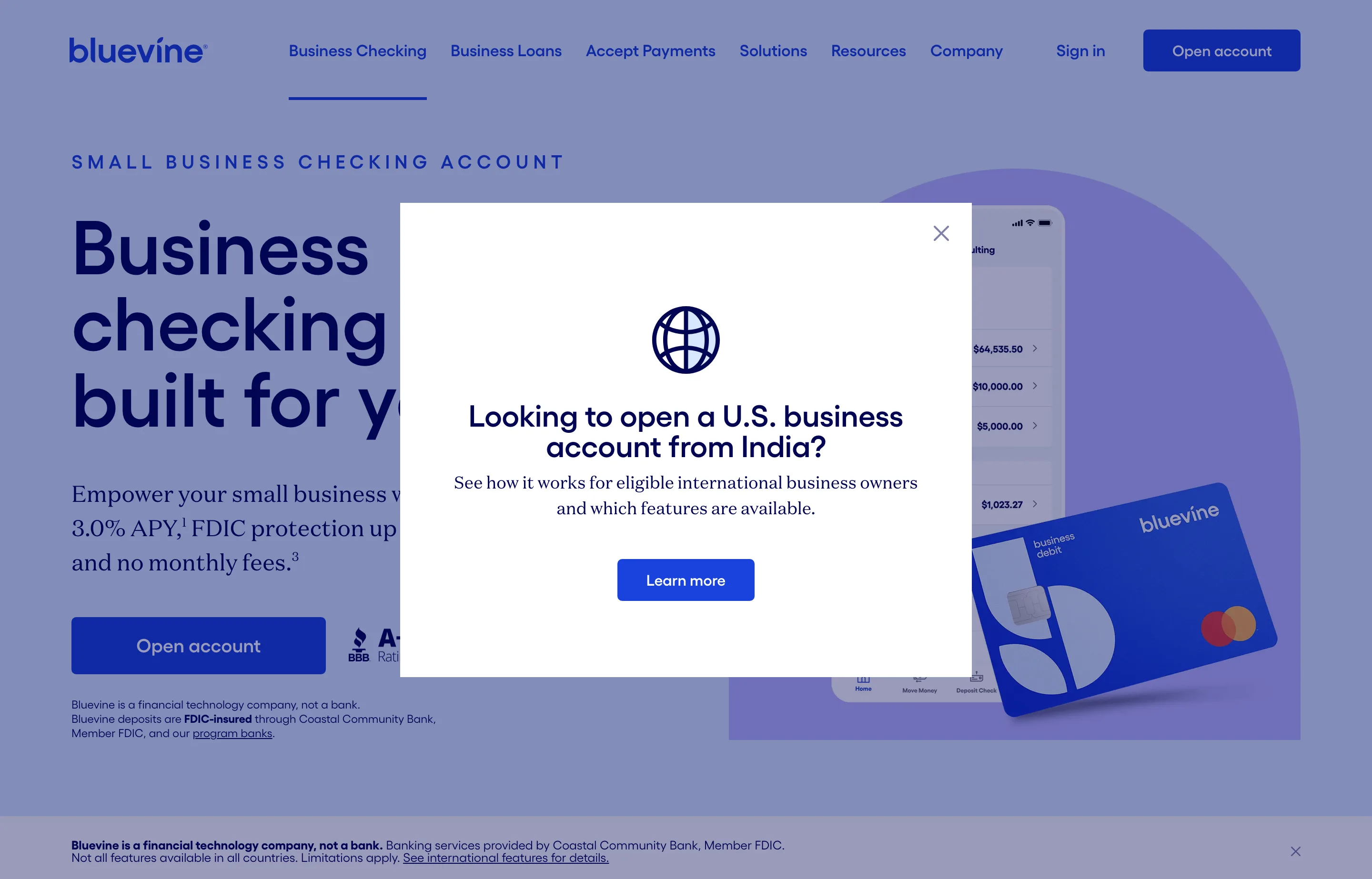
Bluevine is the biggest small-business banking platform in the country (over a million businesses, $2B+ on deposit per its own site) and the best all-round free account: $0 monthly fee, unlimited transactions, no overdraft fees, and a checking APY that most branch banks can't touch. The 2025 additions — paid Plus and Premier tiers — pushed the best yield behind a $95/month plan, but the free tier remains the strongest default on this list.
- Key features: sub-accounts with auto-transfer rules (5/10/20 by plan); virtual and physical debit cards with limits; team logins; AP automation; invoicing; Tap to Pay; treasury services via its SEC-registered affiliate.
- Pricing: read from Bluevine's own product page, as of September 2026: Standard $0/month, no minimum balance, unlimited transactions. APY 1.3% on balances up to $250,000 — but only if you spend $500/month on the Bluevine debit card or receive $2,500/month in customer payments; miss the activity goal and you earn nothing that month. Plus $30/month at 1.75% with no activity requirement; Premier $95/month at 3.0%. Wires up to $15 out; MoneyPass ATMs free, $2.50 outside.
- The catch: the activity-conditioned APY is the fine print most miss; cash deposits run through ~90,000 Green Dot retail locations and Allpoint+ ATMs with service fees and roughly $7,500/month caps (per CreditDonkey, June 2025 — Bluevine doesn't publish the limits); and the paid tiers are pricier than Relay's or Mercury's equivalents.
- Insurance: FDIC up to $3M per depositor via Coastal Community Bank, Member FDIC, plus named program banks — the sweep list is published on Bluevine's support site.
- Pros: genuinely free with unlimited transactions; real yield on operating cash; the largest platform and best review base of the fintechs.
- Cons: interest requires monthly activity; retail-network cash deposits with fees and caps; paid tiers pricey.
- Reviews: 4.7/5 on Trustpilot (~11,400 reviews) — as of September 2026.
2. Relay — best for cash-flow organization
Relay is the Profit First account: up to 20 checking accounts on the free tier with automatic transfer rules, so profit, tax, payroll, and operating cash live in labeled buckets instead of one soup. For a 5–50 person shop with a bookkeeper, it's the best structure in the category.
- Key features: up to 20 checking accounts (50 on Scale); up to 50 debit and 5 credit cards per cardholder; QuickBooks and Xero sync; bill pay with approval rules; invoicing; unlimited users; term loans.
- Pricing: read from Relay's own pricing page, as of September 2026: Starter $0/month with 1.11% savings APY and 1% card cash back; Grow $30/month (1.75% savings, 1.25% cash back, bookkeeping automations); Scale $90/month promo (regularly $120; 3.0% savings, 1.5% cash back). No minimum balance, no overdraft fees. Wire and same-day-ACH fees are plan-dependent and live in the deposit agreement rather than the pricing page.
- The catch: the best APY and automations moved behind the paid tiers in 2025; no cash-deposit network at all; and the public rating base is thin — we left consumer ratings off rather than citing a handful of app-store reviews.
- Insurance: banking via Thread Bank, Member FDIC; deposits sweep to program banks for up to $3M — the program-bank list is published at thread.bank.
- Pros: the multi-account architecture nothing else matches at $0; transparent sweep disclosure; built for teams.
- Cons: paid tiers for the best rates; no cash acceptance anywhere; thin public review base.
- Reviews: left unrated — no high-volume Trustpilot/G2 base exists (the Canada App Store shows 4.8/5 on 39 ratings; not a meaningful sample).
3. Novo — best free checking for integration-heavy businesses
Novo is the simplest honest deal here: $0 monthly fee, no transaction limits, no minimum balance, and 40+ integrations (Stripe, Shopify, QuickBooks, Square, Xero) that make it the natural companion account for an e-commerce or app-based business.
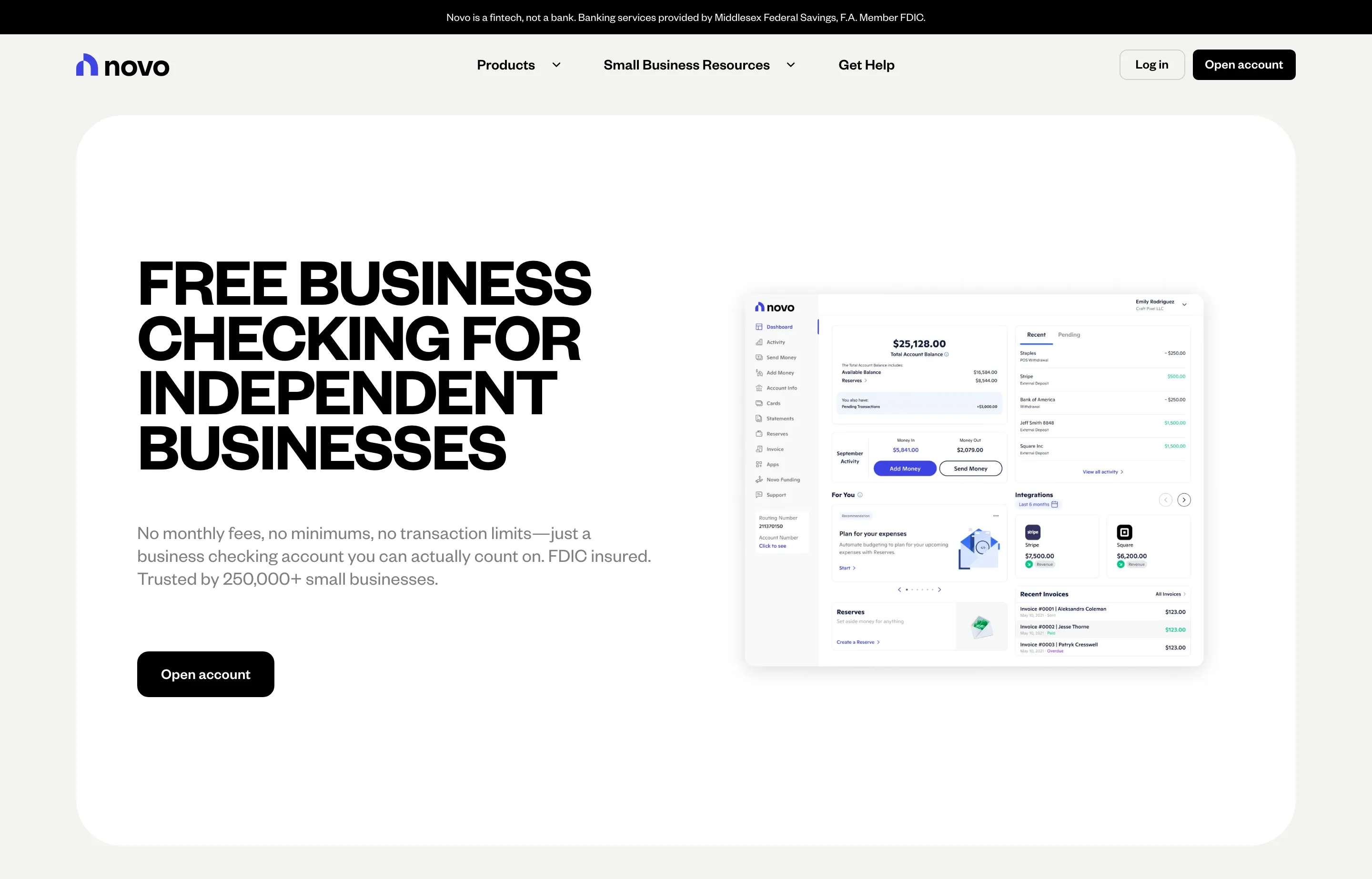
- Key features: Novo Reserves (up to 20 sub-buckets inside checking with auto-allocation); virtual and physical cards; built-in invoicing; FedNow instant payments; a business credit card with 2% cash back at $5,000+ balances.
- Pricing: read from Novo's own product page, as of September 2026: $0/month, no transaction limits, no minimum balance; free standard ACH and incoming wires; up to $7/month of third-party ATM fee reimbursement; no interest on checking.
- The catch: no cash deposits at all (NerdWallet's Novo review, updated January 2026, confirms — this is the account's defining limit); average check holds of ~4 days (per Novo's own spokesperson via NerdWallet); support is digital-only; and FDIC coverage is a single partner bank's $250K — no sweep network to stack above it.
- Insurance: $250,000 via Middlesex Federal Savings, F.A., Member FDIC — direct pass-through at one bank, published on Novo's site.
- Pros: truly free and unlimited; the broadest integration list; dead simple.
- Cons: no yield; no cash deposits, period; $250K coverage ceiling; slower check availability.
- Reviews: 4.8/5 on the App Store (~20,000 ratings) — as of September 2026. G2 shows 3.5/5 on just 11 reviews — too small to cite as meaningful.
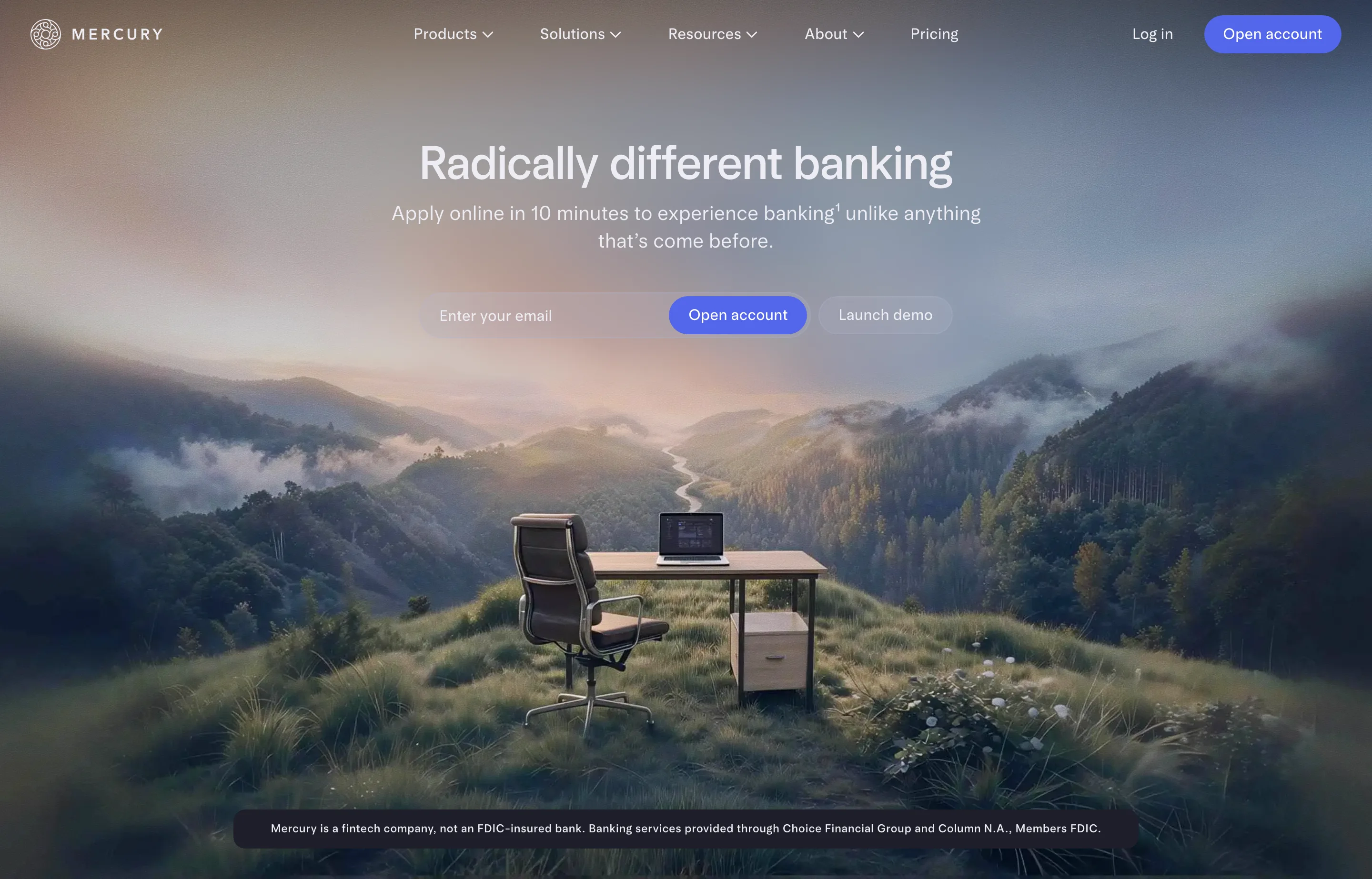
4. Mercury — best for startups going upmarket
Mercury built the startup-fintech standard: free accounts, free wires, free payment rails, deep accounting automation, and treasury products for parked cash. The 2025–26 tell is the roadmap — a $299/month Pro tier with relationship managers and Treasury gated behind $250K balances — Mercury is visibly steering upmarket, and free-tier users should know the roadmap isn't being built for them.
- Key features: virtual/physical debit and IO credit cards; invoicing; QuickBooks/Xero automation (NetSuite on paid); venture debt and working capital; analytics; API.
- Pricing: read from Mercury's own pricing page, as of September 2026: Core banking $0/month, no minimum balance, no overdraft or opening fees; free ACH, free domestic wires both directions, free real-time payments; 1% non-USD FX; Plus $29.90/month (recurring invoices, unlimited 1099s); Pro $299/month (relationship manager, NetSuite automation). Treasury and treasury-account management unlock at $250K+ balances.
- The catch: no cash deposits; no interest on free-tier checking (yield lives in savings/Treasury products); Trustpilot (3.9/5) is markedly weaker than its app-store scores, with transfer-delay and account-closure complaints.
- Insurance: banking through Choice Financial Group and Column N.A., Members FDIC — sweep placement agreements published at mercury.com/legal.
- Pros: the most complete free platform for tech and e-commerce; genuinely free payment rails; strong app ratings.
- Cons: upmarket drift; no cash; the Trustpilot split.
- Reviews: 4.9/5 on the App Store (~12,600 ratings) · 3.9/5 on Trustpilot (~2,600 reviews) — as of September 2026.
5. Found — best for freelancers and sole proprietors
Found is banking-plus-bookkeeping for the one-person business: Pockets for tax and profit, real-time quarterly tax estimates, contractor payments with W-9 collection and 1099 e-filing, and a Schedule C-ready export at year-end. It's what a freelancer actually needs from a bank account — the banking is almost the side feature.
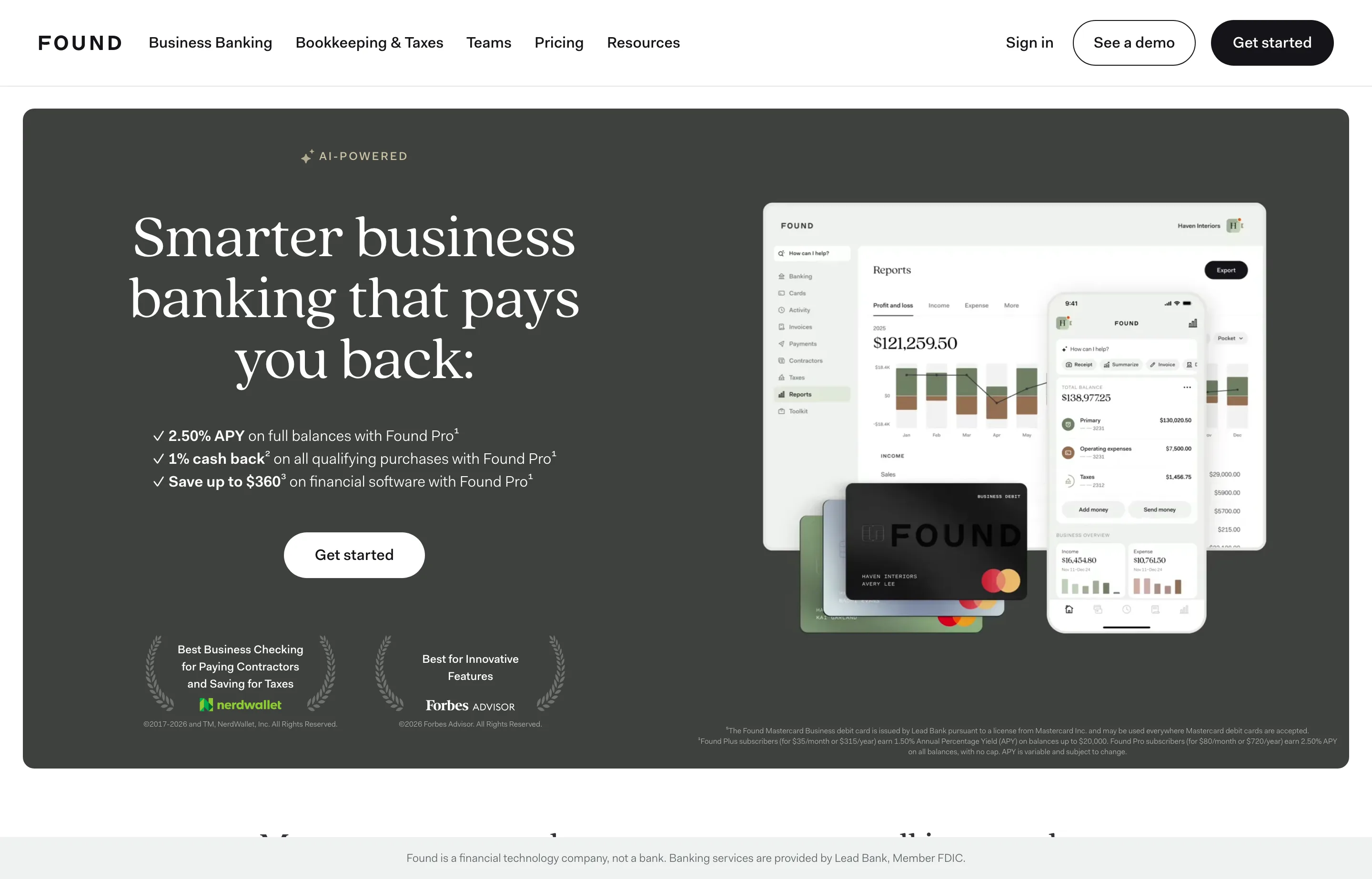
- Key features: up to 20 Pockets sub-accounts; unlimited invoicing and ACH; contractor payments with W-9/1099 handling; real-time tax estimates and auto-saving; P&L and expense reports; in-app quarterly federal tax payments (paid tiers).
- Pricing: read from Found's own pricing page, as of September 2026: Found $0/month, no minimum balance, no credit check; Plus $35/month ($315/year) for 1.5% APY on balances up to $20,000; Pro $80/month ($720/year) for 2.5% APY uncapped plus 1% cash back. Cash deposits supported at retail locations for $1.75 per deposit (per NerdWallet's current review).
- The catch: the yield and cash back sit behind $35–$80/month subscriptions — a steep price for a solo account; only $250K FDIC via a single partner bank (Lead Bank); support is chat-first.
- Insurance: $250,000 per depositor per ownership category via Lead Bank — no sweep network advertised.
- Pros: the strongest free tax/bookkeeping toolset in the category; no-credit-check onboarding; huge app-store ratings at volume.
- Cons: paid tiers for the features that justify it; $250K coverage; not built for multi-entity or high-volume operations.
- Reviews: 4.8/5 on the App Store (26,000+ ratings) · 4.6/5 on Trustpilot (1,000+ reviews) — as of September 2026.
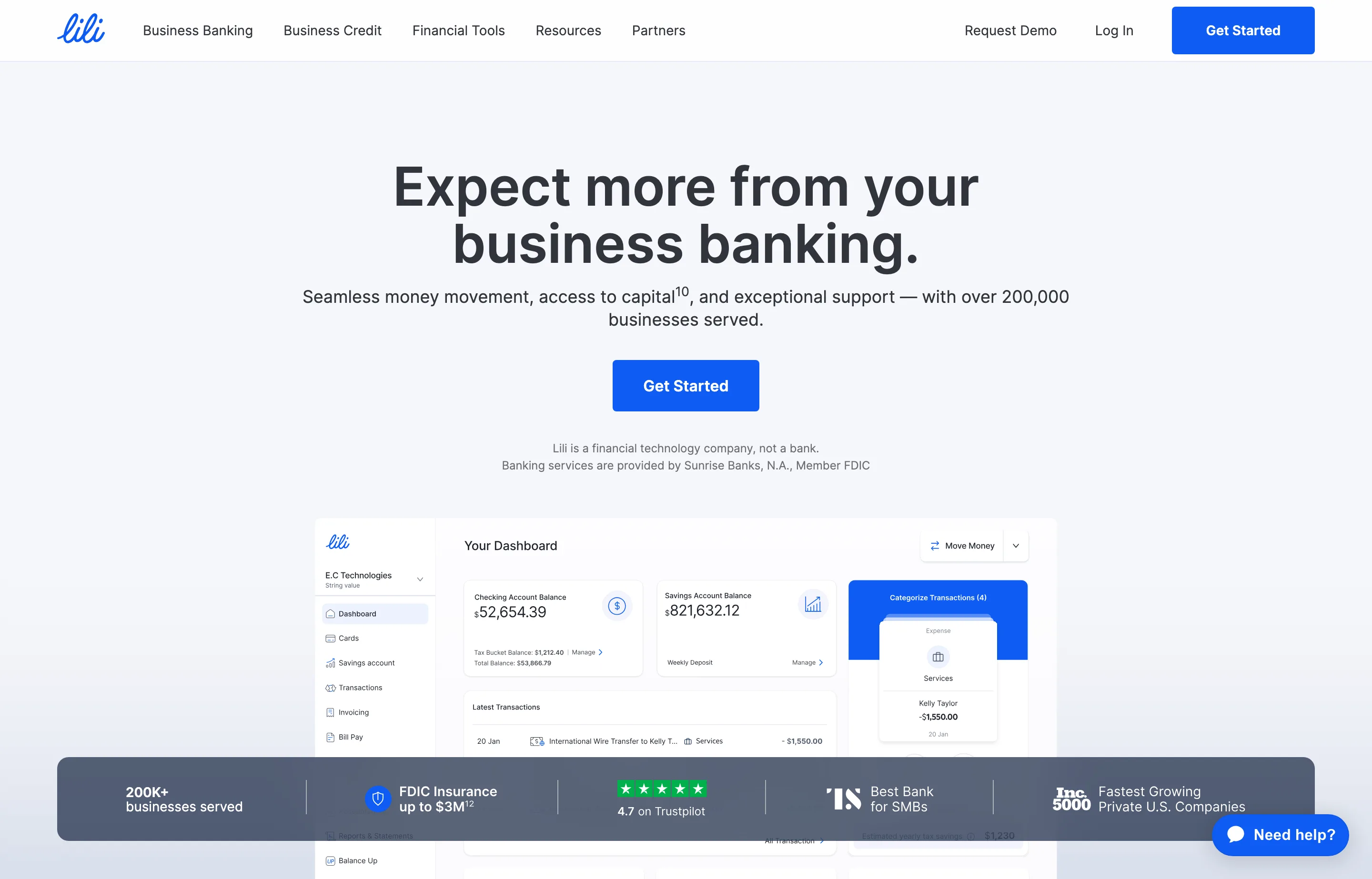
6. Lili — best checking-plus-savings combo
Lili pairs a free checking account with the highest savings yield here that isn't locked behind a subscription: 2.25% on savings balances up to $500,000 (effective January 2026), with 4.00% on the portion from $500K to $1M. For a business parking an emergency fund alongside operating cash, that structure beats the checking-APY fintechs above ~$50K.
- Key features: QuickBooks, Xero, Stripe, Shopify, and Gusto integrations; invoicing and bill pay; tax buckets; Express ACH; international wires in 130+ currencies; team roles; a credit-builder add-on reporting to Dun & Bradstreet.
- Pricing: per Lili's own banking page and fee disclosures (as of September 2026; wire schedule via DollarScout's July 2026 review of the disclosures): Core $0/month, no minimum balance; paid tool tiers Pro $15, Smart $35, Premium $55/month. Savings 2.25% up to $500K, 4.00% from $500K–$1M (nothing above $1M). Outgoing domestic wires $15; retail cash deposits with merchant fees up to $4.95.
- The catch: checking itself earns nothing; the plan ladder is complicated and the tax/accounting tools that make Lili distinctive require paid tiers; retail cash-deposit fees; app-store scores lag peers.
- Insurance: banking via Sunrise Banks, N.A., Member FDIC; up to $3M through Sunrise plus sweep program banks — the addendum is published in the account agreement.
- Pros: the highest meaningful savings yield on this list; $3M coverage; seven-day human support.
- Cons: paid plans for the tools; no interest on checking; cash-deposit fees.
- Reviews: 4.7/5 on Trustpilot (3,900+ reviews) — as of September 2026. App-store figures found in third-party roundups were undated; we won't reprint them as current.
7. Grasshopper — best chartered digital bank
Grasshopper Bank is what happens when a real chartered bank (Grasshopper Bank, N.A., Member FDIC) adopts fintech pricing: $0 fee, unlimited free ACH including same-day, interest on checking, and 1% debit cash back. The fintech-versus-bank distinction matters most at exactly the margins where Grasshopper sits.
- Key features: interest checking; 1% unlimited debit cash back; instant-issue virtual cards; MoneyPass + SUM ATMs; QuickBooks integration; SBA and term lending; AI account connector.
- Pricing: read from Grasshopper's own fee schedule, as of September 2026: $0/month, no minimum balance, $100 minimum opening deposit. Checking APY: 1.00% on $0–$24,999.99; 1.35% on $25K–$250K; 1.00% above (accurate as of 11/03/2025 per the bank). Cash back requires a $10,000 average monthly balance and no NSFs in the prior 12 months. One conflict we're reporting rather than resolving: the official fee schedule lists outgoing domestic wires at $10, while a promo footnote on the checking page says $5 — the fee schedule is the controlling document.
- The catch: the $100 opening deposit (fintech rivals are $0); cash back gated behind the $10K balance; no Zelle; reported longer check holds than traditional banks; modest Trustpilot volume with a 21% one-star share.
- Insurance: direct FDIC $250K as a chartered bank — plus IntraFi ICS sweep to $125M for large balances.
- Pros: chartered-bank insurance with fintech pricing; same-day ACH free; the ICS ceiling for parked cash.
- Cons: $100 to open; cash-back gating; no branches or Zelle.
- Reviews: 4.1/5 on Trustpilot (442 reviews — modest base) — as of September 2026.
8. Axos Business Interest Checking — best waivable-fee yield from an online bank
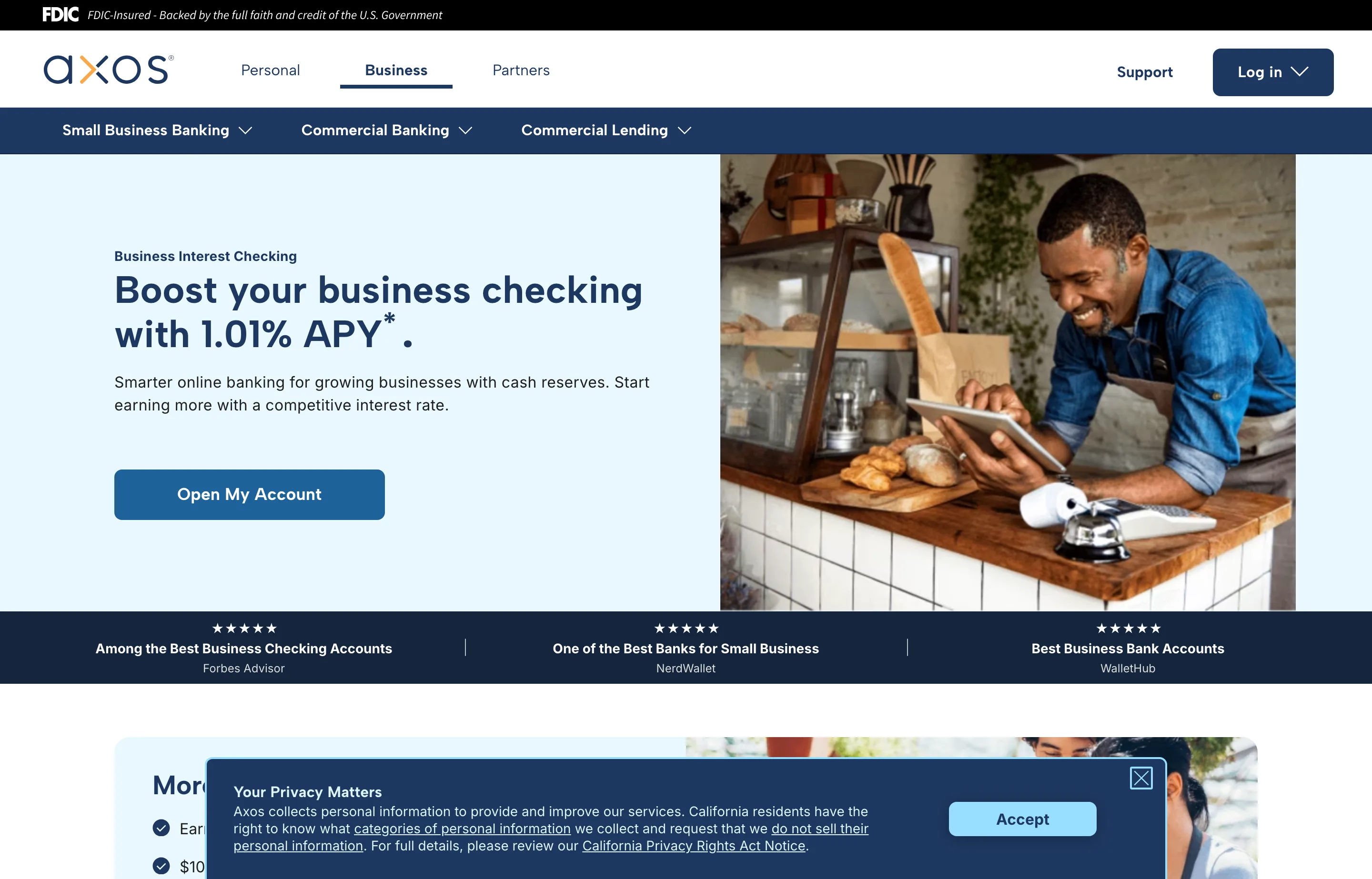
Axos is the chartered-online-bank version of a yield account: interest on checking itself, and unlimited domestic ATM fee reimbursements — an industry rarity. The $10 monthly fee waives at a $5,000 average balance, which makes it an account with a floor.
- Key features: QuickBooks/Quicken sync; treasury management and payroll via the bank's business services; a companion $0-fee Basic Business Checking; Business Premium Savings.
- Pricing: read from Axos's own product page (APY accurate as of 9/2/2026): $10/month, waived with $5,000 average daily balance; $100 minimum opening deposit. APY: 1.01% on $0–$49,999.99; 0.20% on $50K–$249.9K; 0.10% at $250K+ — the yield collapses above $50K. Transaction allowance: U.S. News reports 100 free per month then $0.50/item, while another source reports a deposit/non-deposit split — a conflict we're flagging; confirm in the account agreement.
- The catch: the $5K balance hurdle (the only waivable-fee structure among the online accounts here); the yield's cliff at $50K; and documented service friction — Trustpilot 3.9 and a BBB customer score of 1.0/5 (on 121 reviews) despite A+ accreditation.
- Insurance: direct FDIC as Axos Bank, Member FDIC; Insured Cash Sweep via IntraFi to $265M.
- Pros: chartered-bank safety with near-fintech economics; unlimited ATM refunds; yield on checking.
- Cons: the $5K balance or $10 fee; yield cliff at $50K; service reputation.
- Reviews: 4.7/5 on the App Store (~19,000 ratings) · 3.9/5 on Trustpilot (~680 reviews) — as of September 2026.
9. U.S. Bank Business Essentials — best free checking from a branch bank
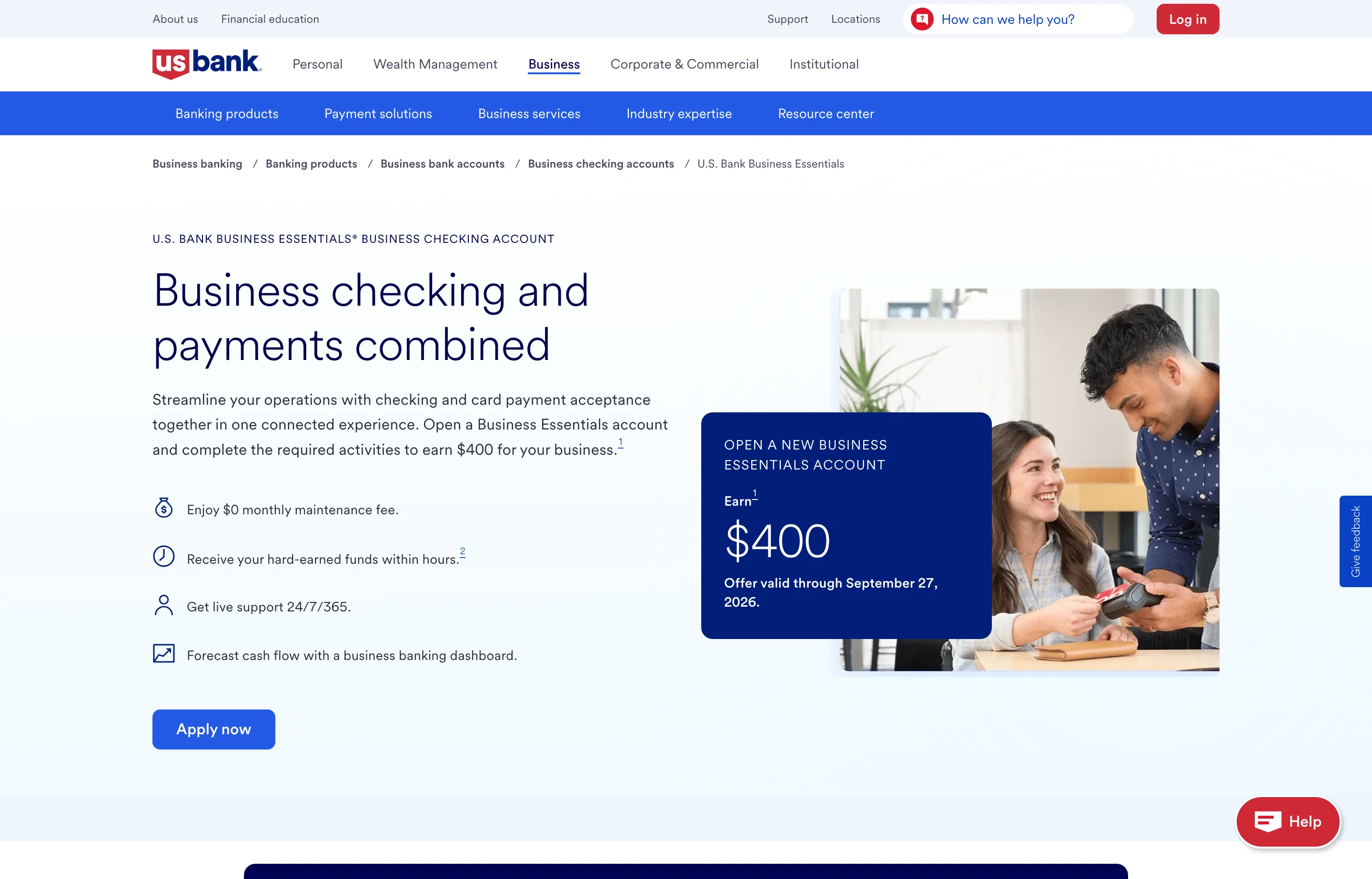
U.S. Bank is the only big-four entry account that is genuinely $0 with no balance hoops — and it restructured in April 2025 to unlimited free digital transactions (debit, ATM, mobile, ACH/Zelle) with 25 free teller/paper transactions per cycle. Elavon card processing bundles in at 2.60% + 10¢ with a free reader.
- Key features: unlimited digital transactions; 25 free teller/paper transactions; Zelle for Business; sub-accounts; embedded Gusto payroll; SBA lending depth; branches in 25+ states.
- Pricing: read from U.S. Bank's own page and pricing PDF (effective Aug 10, 2026): $0/month, no minimum balance, $25 minimum opening deposit; teller/paper transactions $0.50 each above 25; overdraft $36. Cash-deposit allowance: the vendor page doesn't state it — the pricing brochure and NerdWallet report $2,500/month free, then $0.30 per $100 (third-party-reported; flagged).
- The catch: that $2,500 cash cap is the stingiest of the four branch banks — a cash-heavy business blows through it in a week; branches cover only ~25 states with no East Coast presence; paper transactions cap at 25.
- Insurance: direct FDIC, U.S. Bank National Association.
- Pros: genuinely free big-four checking; unlimited digital transactions; processing bundled at signup (with a $400 promo at the time of writing).
- Cons: the $2,500 cash ceiling; regional footprint; $36 overdrafts.
- Reviews: left unrated — no reliable business-specific consumer rating base.
10. Chase Business Complete Banking — best branch bank for cash-heavy businesses
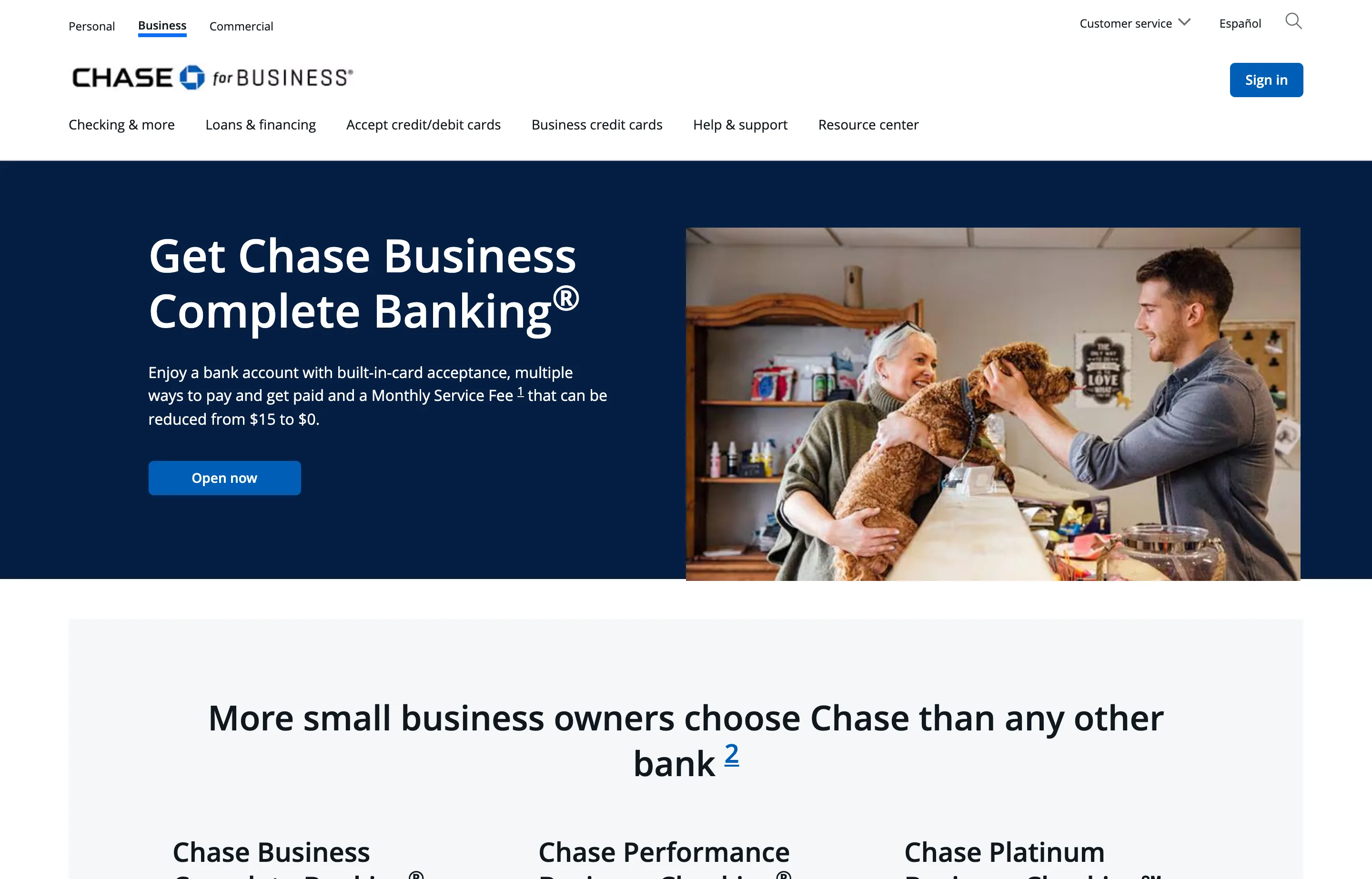
Chase wins on what fintechs can't do at all: ~5,000 branches, $5,000/month in free teller cash deposits, free Chase ATM deposits, and — the differentiator — card acceptance built into the checking account (QuickAccept, with same-day funding), whose deposits also waive the monthly fee.
- Key features: QuickAccept in-app card acceptance with same-day funding; invoicing; associate debit cards; business credit cards; savings-fee waiver when linked; the largest branch and ATM network in the country.
- Pricing: read from Chase's own page, as of September 2026: $15/month, waived with any one of: $2,000 minimum daily balance, Chase QuickAccept deposits, or Chase business credit card purchases. 20 free teller transactions/checks per cycle; $5,000/month free in-branch cash deposits, then per-item fees; unlimited electronic transactions; no interest; $34 overdraft.
- The catch: the $5K cash ceiling is still modest for a truly cash-heavy operation (Bank of America's Relationship tier allows $20K); 20 free teller transactions is tight; no interest at this tier.
- Insurance: direct FDIC, JPMorgan Chase Bank, N.A.
- Pros: branches everywhere; the easiest waiver paths of the big banks (processing deposits count, so a low-balance shop can still qualify); payments embedded in the account.
- Cons: $5K cash cap; teller-transaction cap; $15 if you miss every waiver path.
- Reviews: left unrated — no reliable business-account-specific rating base (Chase's consumer app ratings don't measure this product).
11. Bank of America Business Advantage — best for heavier cash and teller volume
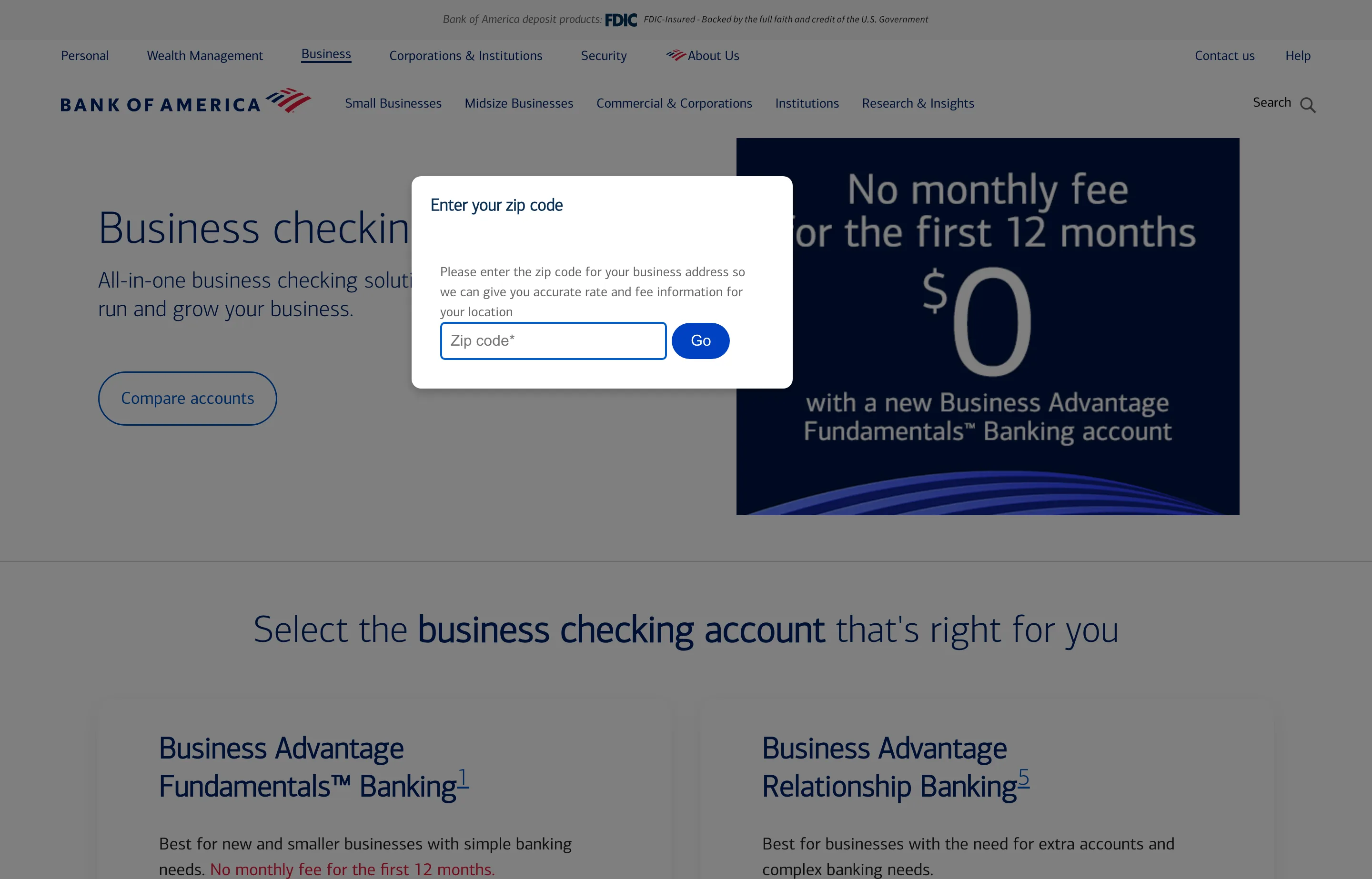
Bank of America plays the same structure as Chase with two twists: a 12-month fee holiday on the entry tier, and a Relationship tier ($29.95, waived at $15K) that unlocks $20,000/month in free cash deposits and 500 free transactions — the best cash-and-teller economics of any big bank's mid tier. Its $10 overdraft cap is also the lowest among the big four.
- Key features: Business Advantage 360 platform with cash-flow tools; Zelle for Business; digital debit cards; Preferred Rewards for Business; a Gusto partnership with payroll cash back.
- Pricing: read from Bank of America's own fee page, as of September 2026: Fundamentals $16/month — $0 for the first 12 months, then waived with any one of: $5,000 combined average balance, $500/month in net qualified debit purchases, or Preferred Rewards for Business. Relationship tier $29.95, waived at $15,000 combined — with 500 free transactions, $20,000 free cash deposits, and free incoming wires. Overdraft $10 (max 2/day). One conflict reported as found: the vendor page states 20 free transactions on Fundamentals then $0.45/item, while some third parties cite 200 — the vendor's own fee page is authoritative as fetched.
- The catch: the $16 fee with a $5K-or-spend hurdle after the holiday year; the Fundamentals tier's 20 physical transactions is low; Preferred Rewards program changes were announced for May 2026 — verify your waiver path still qualifies.
- Insurance: direct FDIC, Bank of America, N.A.
- Pros: the best cash/teller economics at the Relationship tier; the lowest overdraft fee at any major bank; a free first year.
- Cons: the entry-tier hurdles; transaction caps; ~3,900 financial centers (fewer than Chase).
- Reviews: left unrated on business accounts — consumer-app ratings don't measure this product.
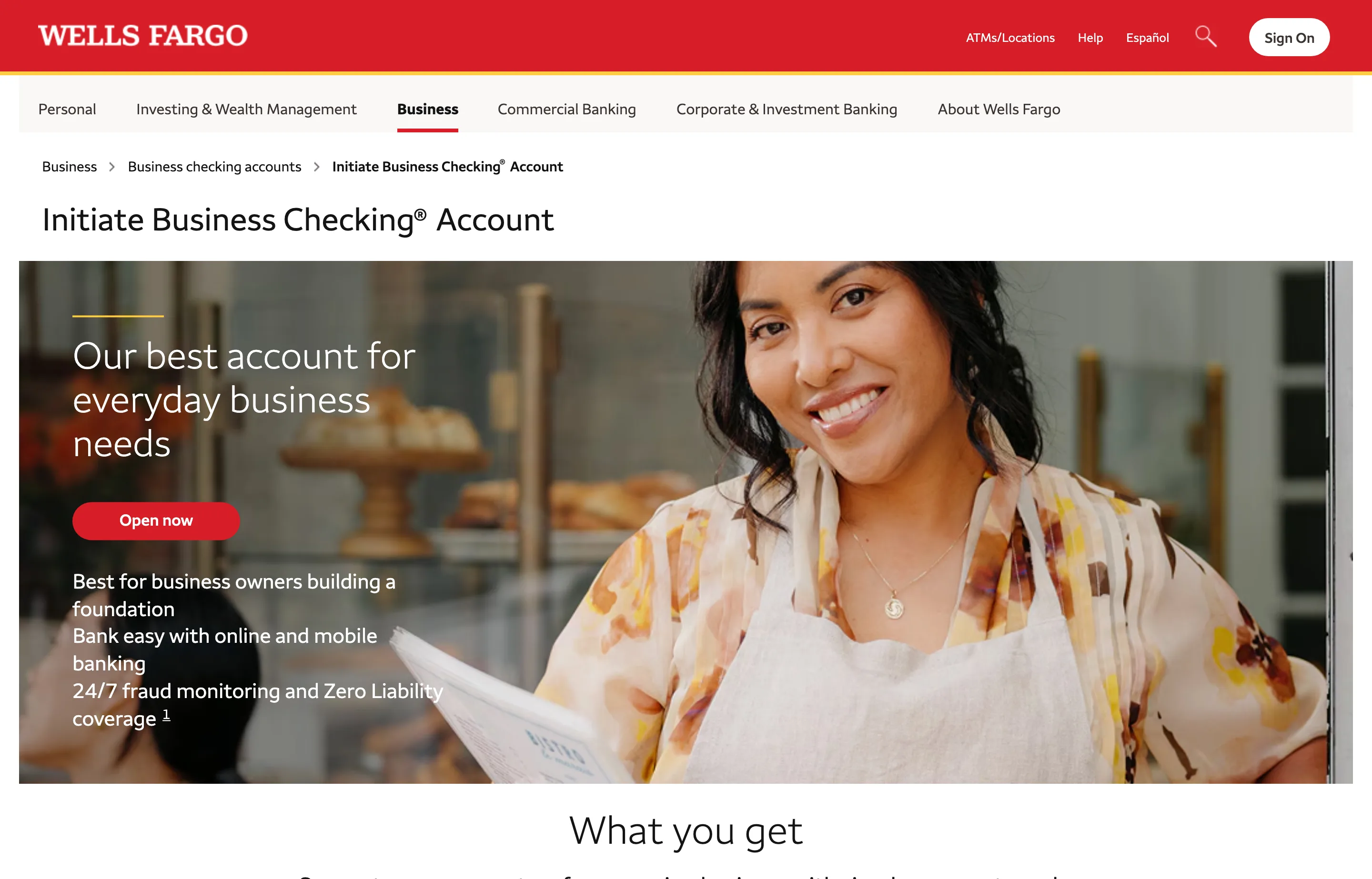
12. Wells Fargo Initiate Business Checking — the branch option that repriced itself last
Wells Fargo still has ~4,200 branches across 40 states, the best app of the big four (4.9 weighted per NerdWallet), and the deepest add-on service bundling. It also repriced its entry account in March 2026 — fee up 50%, waiver balance up 4× — which is why it ranks last among banks this year despite all of that.
- Key features: Business Bill Pay, mobile deposit, digital wires; the Vantage treasury platform (top tiers); Zelle for Business; bundled payroll, tax, and merchant services.
- Pricing: read from Wells Fargo's own fee schedule PDF (July 2026): $15/month (raised from $10 in March 2026), waived with any one of: $2,000 minimum daily balance (raised from $500), $5,000 average combined business deposits, or a personal Premier checking relationship. 100 free transactions per cycle then $0.50 — and Wells Fargo counts nearly everything as a transaction except debit-card purchases, the most restrictive counting of the four. $5,000 free cash deposits, then $0.30/$100. Incoming wires free; outgoing $25 digital/$40 in-branch.
- The catch: the March 2026 repricing made the entry tier the worst big-four value; the 100-transaction cap with near-universal counting; the bank's broader retail-banking issues color everything.
- Insurance: direct FDIC, Wells Fargo Bank, N.A.
- Pros: the broadest branch coverage in the West and Midwest; free incoming wires; the best-rated app; deep service bundling.
- Cons: the 2026 repricing; transaction counting; the entry tier is strictly worse than U.S. Bank's free account.
- Reviews: left unrated on business accounts — consumer-app ratings don't measure this product.
The paperwork the account assumes: free Small Business Tools
An account receives money; it doesn't ask for it correctly. These free tools handle the billing side that every business account depends on:
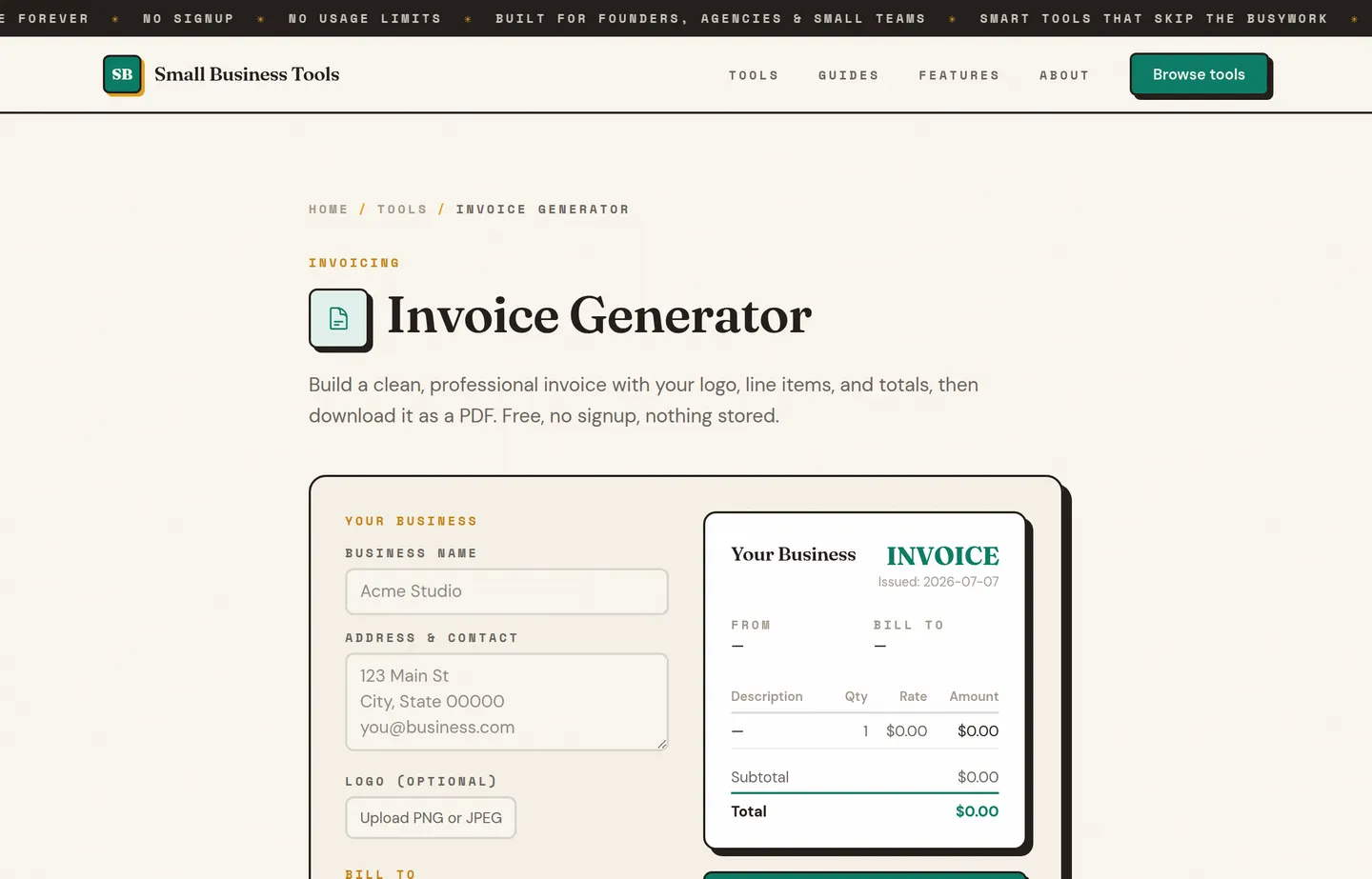
- Invoice Generator — clean, numbered invoices that make deposits traceable and reconcile cleanly against the account. No account, nothing stored.
- Estimate Generator — quote the job first, then convert the same line items to the invoice.
- Percentage Calculator — the fee math this guide keeps demanding: what $0.30 per $100 actually costs on your cash volume, what a waived-fee balance "costs" in idle cash, what 2.25% APY pays on your balance.
The free small business tools hub lists the rest by job. The account pairs with the money side of the business: payment terms for small business for how fast the money arrives once invoiced, the payment processors guide for what card acceptance costs, and the accounting software guide for the books it all posts into.
Which should you choose?
- You want the best free account and mostly move money digitally: Bluevine — activity-conditioned APY, $3M sweep, the biggest platform.
- You run Profit First or want labeled buckets: Relay — 20 accounts with auto-transfers on the free tier.
- Your business runs on Stripe/Shopify/QuickBooks: Novo for integrations, Mercury if you're startup-shaped and want free wires.
- You're a freelancer who wants taxes handled inside the bank: Found.
- You're parking a large emergency fund: Lili (2.25% savings to $500K) or Grasshopper/Axos with their IntraFi ceilings for serious balances.
- You deposit cash every week: skip the entire fintech section — Chase (easiest waivers, payments built in), Bank of America (best cash economics at the $29.95 Relationship tier), or U.S. Bank ($0 fee if $2,500/month of cash covers you). Wells Fargo only if its branch network is what's near you.
- You want a chartered bank without branches: Grasshopper ($0, interest, ICS) or Axos (yield with a $5K balance).
A worked example of the cash-deposit decoder: a restaurant depositing $12,000/month in cash pays $0 at Bank of America's Relationship tier ($20K allowance) versus roughly $23/month at U.S. Bank ($0.30 per $100 above $2,500 — $9,500 overage × 0.30%) — versus not being able to deposit the cash at all at Novo, Relay, or Mercury. The monthly fee is the decoy; the allowance is the decision.
FAQs
What is the best bank for a small business account?+
For an online-first small business, Bluevine is the best all-round free account ($0 fee, unlimited transactions, up to $3M FDIC via sweep). Relay is best for organizing cash across multiple sub-accounts, Novo for integrations, and Found for freelancers. For cash-heavy businesses, the answer changes entirely: Chase Business Complete (easiest fee waivers, built-in card acceptance) or Bank of America's Relationship tier ($20,000/month free cash deposits).
Can I open a business bank account for free?+
Yes — Bluevine, Relay, Novo, Mercury, Found, Lili, Grasshopper, and U.S. Bank's Business Essentials all have $0 monthly fees with no minimum balance (Grasshopper and U.S. Bank require $100 and $25 opening deposits respectively; Axos charges $10/month unless you keep $5,000). "Free" is real at the online banks; the cost lives elsewhere — cash-deposit fees, paid tiers for yield, and no branch access.
Are fintech business accounts FDIC insured?+
Yes, but differently than banks. Your money sits at a partner bank (Novo: Middlesex Federal Savings; Found: Lead Bank; Bluevine: Coastal Community Bank; Relay: Thread Bank; Lili: Sunrise Banks; Mercury: Choice Financial Group and Column N.A.), and FDIC coverage is either that bank's $250K directly or "pass-through" via a sweep network that spreads deposits across multiple program banks — Bluevine, Relay, and Lili publish up to $3M. The FDIC has proposed tightening the recordkeeping rules that pass-through insurance depends on — the structure is legitimate today, but verify the current disclosure on the fintech's legal page before relying on sweep limits.
How much cash can I deposit in a business checking account?+
At branch banks, the free allowances as of September 2026 are: U.S. Bank $2,500/month, Chase $5,000/month, Wells Fargo $5,000/month, Bank of America $5,000/month at Fundamentals ($20,000 at the Relationship tier) — above the allowance you pay roughly $0.30 per $100. The fintechs have no branch deposits at all: Bluevine and Found take retail-network cash deposits with fees and daily/monthly caps, and Novo, Relay, and Mercury take none. Large recurring cash deposits are also one of the behaviors that trigger account reviews — deposit consistently, and expect to explain your business to your bank.
Do business bank accounts pay interest?+
Some do. On checking: Bluevine 1.3% (with a $500/month card-spend or $2,500/month deposits activity condition), Grasshopper 1.00–1.35% by tier, Axos 1.01% on the first $50K. On savings products: Lili pays 2.25% up to $500K, Relay 1.11–3.00% by plan. The branch banks' entry tiers pay nothing. Yields move with the rate cycle — every figure here is as of September 2026.
Do I need a separate business bank account if I'm a sole proprietor?+
You're not legally required to have one (LLCs and corporations are, to preserve liability protection), but you should: commingled finances make your Schedule C an audit minefield, weaken your corporate veil if you form an entity later, and violate most processor and marketplace terms. A free account from Bluevine, Novo, or Found costs nothing to separate — and Found or Lili will even estimate your quarterly taxes on the money as it lands.
Final take
Pick by how money physically arrives. If it arrives digitally — cards, ACH, checks by photo — the free fintech accounts beat every branch bank on price and features: Bluevine as the default, Relay for cash-flow structure, Novo or Mercury for integration- or startup-shaped businesses. If it arrives in a drawer every night, only a branch bank works: Chase for the easiest all-round setup, Bank of America's Relationship tier when cash volume is real, U.S. Bank for the only big-four $0 entry account.
Then keep both sides of the ledger honest: bill with the free Invoice Generator, quote with the Estimate Generator, and run the fee-and-yield arithmetic with the Percentage Calculator — free, no signup, nothing stored.
Free tools to try
Keep reading
Guide
Payment Terms for Small Business (Net 15, Net 30, Late Fees)
What Net 30 really means, how to choose payment terms, what early-payment discounts actually cost you, and how to set a late fee that holds up.
Guide
Best Payment Processors for Small Business (2026)
11 payment processors compared for small businesses — real 2026 fees for Square, Stripe, PayPal, Helcim and more, plus when interchange-plus saves money.
Guide
Best Free Accounting Software for Small Business (2026)
12 accounting tools ranked for small businesses — real free-tier caps, current pricing, pros and cons for Wave, Zoho Books, GnuCash, QuickBooks, Xero and more.
Guide
Free Small Business Tools (No Signup): The Complete List
A directory of free small business tools — pricing calculators, invoicing, marketing, SEO, and writing. No signup, no paywall, and they explain the math.