How-to guide
How to Calculate Loan Payments (and What the Payment Hides)
A monthly loan payment is the most quoted and least informative number in small-business finance. Two offers can both be "$1,013 a month" and differ by tens of thousands of dollars in total cost, because the payment says nothing about the term, the fees folded into the principal, or how much of the early money goes to interest instead of the balance.
The Federal Reserve Banks' 2026 Report on Employer Firms — the 2025 Small Business Credit Survey — found that 60% of firms that borrowed from an online lender said their actual borrowing costs came in higher than they expected, against 37% at small banks and 32% at large banks. The gap is not usually a lie in the quote. It is that the quote is a payment, and the borrower never converted it into total cost.
This guide does that conversion. It gives you the amortization formula, walks a real $50,000 loan line by line, and shows the three levers — rate, term, and fees — that decide what you actually repay. The arithmetic matches our Loan Payment Calculator, and the lender-comparison side is covered in Best Small Business Loans.
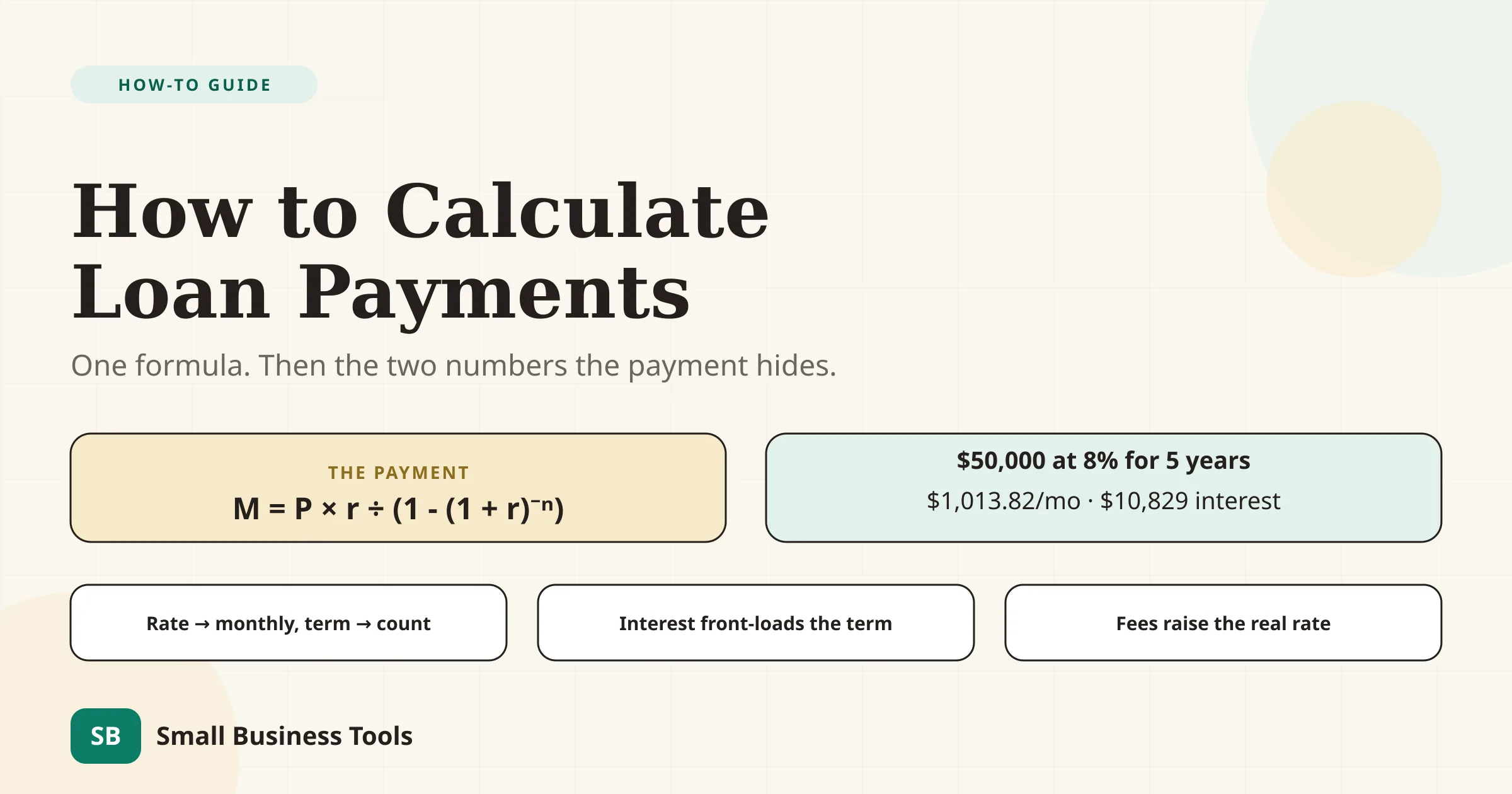
Quick answer: the formula
For a fixed-rate, fully amortizing loan, the monthly payment is:
M = P × r ÷ (1 − (1 + r)^−n)
Where:
- M is the monthly payment.
- P is the principal — the amount actually borrowed, net of any fees financed into the loan.
- r is the monthly interest rate: the annual rate divided by 12.
- n is the number of payments: the term in years × 12.
On a $50,000 loan at 8% for 5 years: r = 0.08 ÷ 12 = 0.006667, n = 60, and the payment is $1,013.82. Multiply by 60 and you repay $60,829.18 — $10,829.18 of which is interest.
Three numbers matter, and the formula only produces one of them:
| What to calculate | How | $50,000 at 8%, 5 years |
|---|---|---|
| Monthly payment | the formula above | $1,013.82 |
| Total repaid | payment × number of payments | $60,829.18 |
| Total interest | total repaid − principal | $10,829.18 |
If a lender quotes only the first number, you are missing the two that decide whether the loan is affordable.
What you need before you start
Five inputs. Get them in writing before you calculate anything, because the difference between a verbal quote and a loan agreement is where the surprises live.
1. Principal. The amount disbursed to you, not the amount you applied for. If a 2% origination fee is deducted from the proceeds, you borrow $50,000 but receive $49,000 — and the payment is calculated on the $50,000. That distinction is worth real money and is covered below.
2. Interest rate — and which rate it is. A note rate is the rate on the principal. An APR folds fees into a single annualized number. A factor rate is neither; it is a flat multiplier used by merchant cash advances. Quoting a factor as if it were an APR is the most expensive mistake in this category.
3. Term. The number of months or years over which the loan amortizes. A longer term lowers the payment and raises the total interest. That trade is the core of loan math, and it is not symmetrical.
4. Payment frequency. Monthly is standard. Biweekly and weekly schedules exist and change the arithmetic, because paying half a monthly payment every two weeks produces 26 half-payments a year — one extra monthly payment annually.
5. Fees. Origination, documentation, guarantee, and closing fees. Some are paid upfront, some are financed into the principal, and some are deducted from the proceeds. Each treatment changes the true cost differently.
Step by step: calculating the payment
Step 1: Convert the annual rate to a monthly rate
Divide the annual rate by 12. An 8% annual rate becomes 0.08 ÷ 12 = 0.006667 per month. Do not divide by 365 or use a daily rate unless the loan actually compounds daily; mixing conventions is how hand calculations drift from the lender's number.
Step 2: Count the payments
Multiply years by 12. A 5-year loan has 60 payments. A 7-year loan has 84. If the term is quoted in months, use it directly.
Step 3: Apply the formula
The expression (1 + r)^−n is the discount factor. On the $50,000 example: (1.006667)^−60 = 0.6712. So the denominator is 1 − 0.6712 = 0.3288, and the payment is $50,000 × 0.006667 ÷ 0.3288 = $1,013.82.
The intuition behind the formula: each payment has to cover the interest accrued that month plus enough principal to retire the balance by the final payment. Early payments are mostly interest because the balance is large; late payments are mostly principal because the balance is small.
Step 4: Build the first-row check
Before trusting the total, verify one month by hand. On $50,000 at 8%, the first month's interest is $50,000 × 0.006667 = $333.33. Subtract that from the $1,013.82 payment and $680.49 goes to principal. The new balance is $49,319.51. If your amortization table does not reproduce those numbers, something is off.
Step 5: Multiply out the total cost
Payment × number of payments gives total repaid. Subtract the principal for total interest. Add any upfront fees that were not financed to get the cash cost of the loan. That last addition is the one most borrowers skip.
Worked example: $50,000 at 8% over 5 years
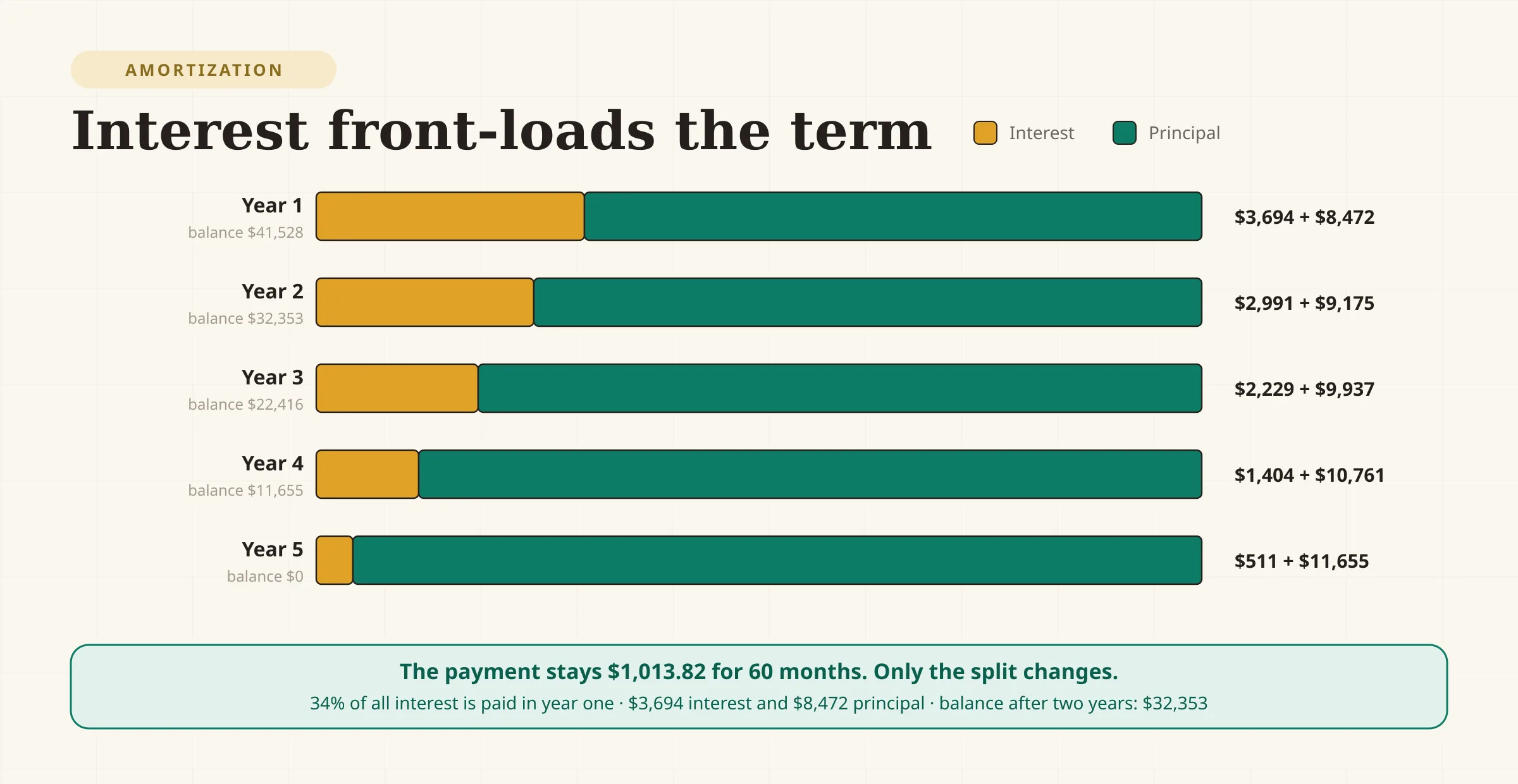
Here is the full amortization, rolled up by year. This is the shape every fixed-rate loan follows.
| Year | Interest paid | Principal paid | Balance at year end |
|---|---|---|---|
| 1 | $3,693.83 | $8,472.01 | $41,527.99 |
| 2 | $2,990.66 | $9,175.18 | $32,352.82 |
| 3 | $2,229.12 | $9,936.71 | $22,416.11 |
| 4 | $1,404.38 | $10,761.45 | $11,654.65 |
| 5 | $511.19 | $11,654.65 | $0.00 |
| Total | $10,829.18 | $50,000.00 | — |
Two things stand out. First, 34% of all the interest is paid in year one — $3,693.83 of $10,829.18. Second, the principal balance after two years is still $32,352.82, so a borrower who sells the asset or refinances at that point has repaid only about 35% of the loan. That is why "I've been paying for two years" is not the same as "I owe less than half."
The first payment is $333.33 interest and $680.49 principal. The last payment is $6.71 interest and $1,007.11 principal. The payment never changes; the split does.
The three levers: rate, term, and fees
Rate: smaller effect than most people expect
On a 5-year, $50,000 loan, each point of rate moves the payment by roughly $50 and the total interest by about $3,000:
| Annual rate | Monthly payment | Total interest |
|---|---|---|
| 6% | $966.64 | $7,998.40 |
| 8% | $1,013.82 | $10,829.18 |
| 10% | $1,062.35 | $13,741.13 |
| 12% | $1,112.22 | $16,733.34 |
| 15% | $1,189.50 | $21,369.79 |
The payment moves slowly because it is spread over 60 months. The total interest moves fast because it compounds on the declining balance for five years. A borrower comparing two offers on the monthly payment alone will see a $48 difference between 8% and 10% and may not bother — while signing up for $2,912 of extra interest.
Term: the biggest lever, and the most seductive
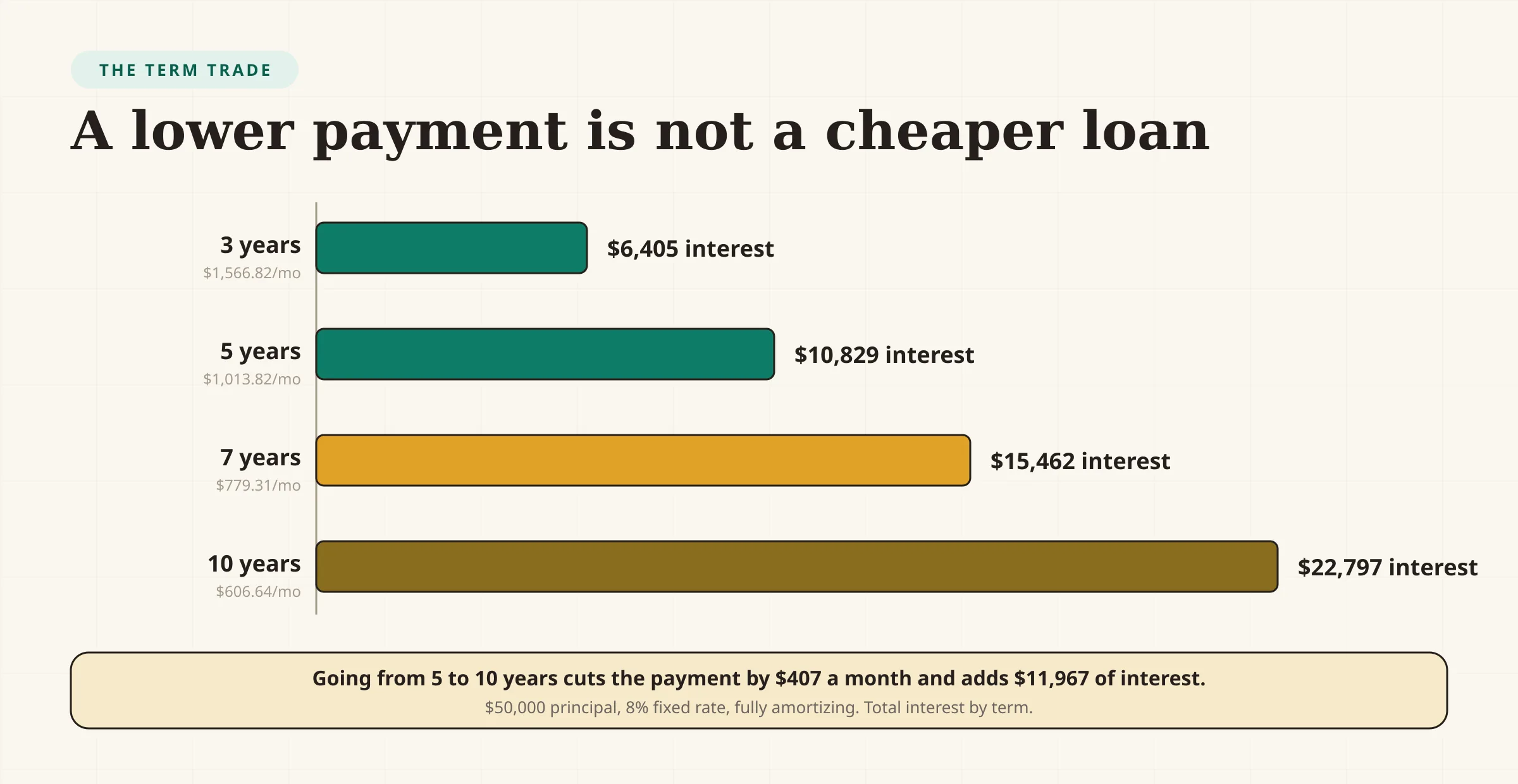
Stretching the term lowers the payment and raises the interest, and the ratio is worse than linear:
| Term at 8% | Monthly payment | Total interest |
|---|---|---|
| 3 years | $1,566.82 | $6,405.46 |
| 5 years | $1,013.82 | $10,829.18 |
| 7 years | $779.31 | $15,462.10 |
| 10 years | $606.64 | $22,796.56 |
Going from 5 to 10 years cuts the payment by $407 a month and adds $11,967 of interest. That can still be the right choice for a business that needs the cash flow, but it should be a choice, not an accident of "what's the lowest payment you can offer me."
Down payment and extra principal
A larger down payment reduces the principal, which reduces both the payment and the interest. On the same 8%/5-year loan, putting $5,000 down instead of financing the full $50,000 drops the payment to $912.44 and the interest to $9,746.26 — saving $1,083 of interest.
Extra principal payments have an outsized effect because every dollar of principal removed also removes all future interest on that dollar. Adding $100 a month to the $1,013.82 payment pays the loan off in 54 months instead of 60 and saves $1,213.72 of interest. The saving looks modest against the $6,000 of extra payments, but the loan ends six months earlier and the cash flow frees up sooner.
The biweekly version of the same idea is smaller than the internet claims. Paying half the monthly payment every two weeks ($506.91) produces 26 payments a year instead of 12, which is one extra monthly payment annually. On this loan it pays off in about 54.5 months and saves $1,151.41 — real, but not the "years off your mortgage" result people expect. The saving on a 30-year mortgage is large because the term is long; on a 5-year business loan it is a rounding error by comparison.
What the payment hides: fees and the APR gap
A loan's sticker rate is not its cost if you paid fees to get it. The cleanest way to see the gap is to compare the payment stream to the money you actually received.
Take the $50,000 loan at 8% with a 2% origination fee — $1,000, deducted from the proceeds. You receive $49,000 but make payments calculated on $50,000. Solve for the rate that makes a $1,013.82 payment stream worth $49,000 today and the answer is about 8.86%, not 8.0%:
| Origination fee | Net proceeds | Payment | Effective annual cost |
|---|---|---|---|
| $0 (0%) | $50,000 | $1,013.82 | 8.00% |
| $1,000 (2%) | $49,000 | $1,013.82 | 8.86% |
| $1,500 (3%) | $48,500 | $1,013.82 | 9.30% |
| $2,500 (5%) | $47,500 | $1,013.82 | 10.20% |
That calculation is a nominal annual rate derived from the actual cash flows, which is the honest way to compare offers. It is not a Regulation Z APR disclosure; business loans are often exempt from TILA, and the disclosure you receive may use a different convention. Use it as a comparison tool, not as a legal figure.
The same logic applies to financed fees. If the $1,000 fee is added to the principal instead of deducted, you borrow $51,000 and pay 8% on the whole amount. The payment rises to $1,034.10 and the total interest to $11,045.76 — you pay interest on the fee for five years. Deducted or financed, the fee costs money; the question is only whether it costs interest too.
The quote formats that are not interest rates
Three common small-business loan quotes do not use the amortization formula at all, and running them through it produces nonsense.
Factor rate. A merchant cash advance quoted at "1.30" means you repay $1.30 for every $1.00 advanced. On $50,000 that is $65,000 — a $15,000 cost, or 30% of the principal, for a term measured in months. It is not a 30% annual rate. Because the balance is repaid throughout the term, the effective annualized cost is far higher; on equal daily remittances over six months it runs into triple digits. The loans guide has the full conversion table.
Interest-only. A loan that charges interest but no principal for an initial period has a low "payment" that is not amortizing anything. When the interest-only period ends, the payment jumps to the fully amortizing amount — often 30–50% higher. Always ask what the payment becomes after the introductory period.
Weekly or daily remittance. Short-term online loans often collect a fixed daily or weekly amount rather than a monthly payment. The total is easy to see (daily amount × number of days); the annualized cost is not. Convert it to a single total cost first, then compare that total to the principal.
Common mistakes
- Comparing monthly payments instead of total cost. Two loans with the same payment can differ by five figures in interest.
- Treating a factor rate as an interest rate. A 1.30 factor over six months is not 30% a year; it is several times that.
- Ignoring the origination fee. A 2% fee on a 5-year loan adds roughly 0.86 points to the effective annual cost.
- Financing the fee and forgetting it. A financed fee accrues interest for the whole term.
- Assuming the balance falls evenly. After two years of a 5-year loan, about two-thirds of the principal is still outstanding.
- Choosing the longest term for the lowest payment. The payment falls slowly and the interest rises quickly.
- Missing a prepayment penalty. Some business loans charge a fee for paying early, which erases the benefit of extra principal.
- Using the note rate to compare offers with different fees. Convert both to the same cash-flow basis before deciding.
The loan-shopping checklist
[ ] Principal confirmed: amount disbursed, not amount applied for
[ ] Rate type identified: note rate, APR, or factor rate
[ ] Term in months confirmed
[ ] Payment frequency confirmed: monthly, biweekly, weekly, or daily
[ ] All fees listed: origination, documentation, guarantee, closing
[ ] Fee treatment confirmed: paid upfront, deducted, or financed
[ ] Monthly payment calculated
[ ] Total repaid calculated (payment × number of payments)
[ ] Total interest calculated (total repaid − principal)
[ ] Effective annual cost calculated from net proceeds
[ ] Prepayment penalty checked
[ ] Payment after any interest-only period checked
FAQs
What is the formula for a loan payment?+
M = P × r ÷ (1 − (1 + r)^−n), where P is principal, r is the monthly interest rate (annual rate ÷ 12), and n is the number of monthly payments. On $50,000 at 8% for 5 years, the payment is $1,013.82.
How much interest will I pay on a $50,000 loan?+
It depends on the rate and term. At 8% over 5 years, $10,829.18. At 10% over 10 years, $29,290.44. At 12% over 7 years, $48,282.96. The total is always payment × number of payments minus the principal.
Why is most of my early payment interest?+
Because interest is charged on the outstanding balance, and the balance is highest at the start. On a $50,000 8% loan, the first payment is $333.33 interest and $680.49 principal. By the final payment it is $6.71 interest and $1,007.11 principal. The split shifts every month even though the payment does not.
Does a longer term always cost more?+
Yes, for a fixed rate. A longer term lowers the monthly payment but increases the total interest, because you pay interest for more months on a balance that declines more slowly. At 8% on $50,000, a 10-year term costs $22,796.56 of interest versus $10,829.18 over 5 years.
How do I compare a loan with an origination fee to one without?+
Convert both to the same basis: the rate that makes the payment stream equal the net cash you actually receive. A 2% fee on a 5-year 8% loan raises the effective annual cost to about 8.86%. Compare that number, not the sticker rate.
What is a factor rate, and how do I convert it?+
A factor rate is a flat multiplier: 1.30 means you repay $1.30 per $1.00 borrowed. Convert it by totaling the repayment, subtracting the principal for the cost, and then annualizing based on the actual remittance schedule. Because principal is repaid throughout the term, the effective annual rate is much higher than the flat percentage suggests.
Do extra payments reduce interest?+
Yes. Extra principal reduces the balance, which reduces all future interest on that amount. Adding $100 a month to a $50,000 8% 5-year loan pays it off in 54 months and saves $1,213.72. Check for a prepayment penalty first.
What is amortization?+
Amortization is the schedule that splits each payment between interest and principal so the balance reaches zero at the end of the term. Early payments are interest-heavy; later payments are principal-heavy. The schedule is what turns a payment into a total cost.
What to do next
Run your actual numbers through the Loan Payment Calculator and read the total interest line before the monthly payment. Then compare the offer against the alternatives in Best Small Business Loans, which decodes factor rates, SBA guarantee fees, and the real cost of the small-ticket online products. If the loan is funding equipment or an acquisition, run the return against the cost with the ROI calculator — a loan that costs 9% is only worth taking if the money earns more than 9% — and check the break-even volume in Break-Even Analysis before committing to a fixed payment.
Free tools to try
Keep reading
Guide
Best Small Business Loans and Financing (2026)
15 small-business loan and financing options compared — real 2026 rates, SBA fees by loan size, and how to convert a factor rate into an APR.
Guide
How to Calculate ROI on a Small Business Investment
Calculate ROI on a small business investment: the formula, annualized ROI for fair comparisons, what makes a return good, and the traps that inflate it.
Guide
New SBA Rules for Buying a Business (SOP 50 10 8.1, Oct 2026)
SBA SOP 50 10 8.1 raises the cash-flow bar for 7(a) business acquisitions to 1.25x, drops projections, adds QoE reports, and caps debt at the valuation.
Guide
Break-Even Analysis: A Step-by-Step Guide
Break-even analysis explained step by step: the formula, fixed vs variable costs, contribution margin, and a worked example that finds the break-even point.