How-to guide
Quarterly Estimated Taxes: The 2026 Payment Schedule
The first year of self-employment usually ends the same way: a tax bill in April that nobody budgeted for, plus a letter explaining that the IRS also wanted the money in June, September, and January. The letter is not a penalty for being self-employed. It is a penalty for paying once a year when the system expects four payments.
The IRS is explicit about the trigger. Individuals — including sole proprietors, partners, and S-corp shareholders — generally must make estimated tax payments if they expect to owe $1,000 or more when the return is filed. Nothing is withheld from a 1099 payment, so a freelancer's entire tax bill is "estimated" by default. The only question is whether you send it in four installments or in one late lump.
This guide covers the 2026 dates, the arithmetic behind each payment, the safe harbor that legally protects you from the penalty, and the mistakes that turn a manageable quarterly habit into a 7% interest charge. The numbers come from the same 2026 engine as our Self-Employment Tax Calculator, and the underlying tax math is walked through in How Self-Employment Tax Works.
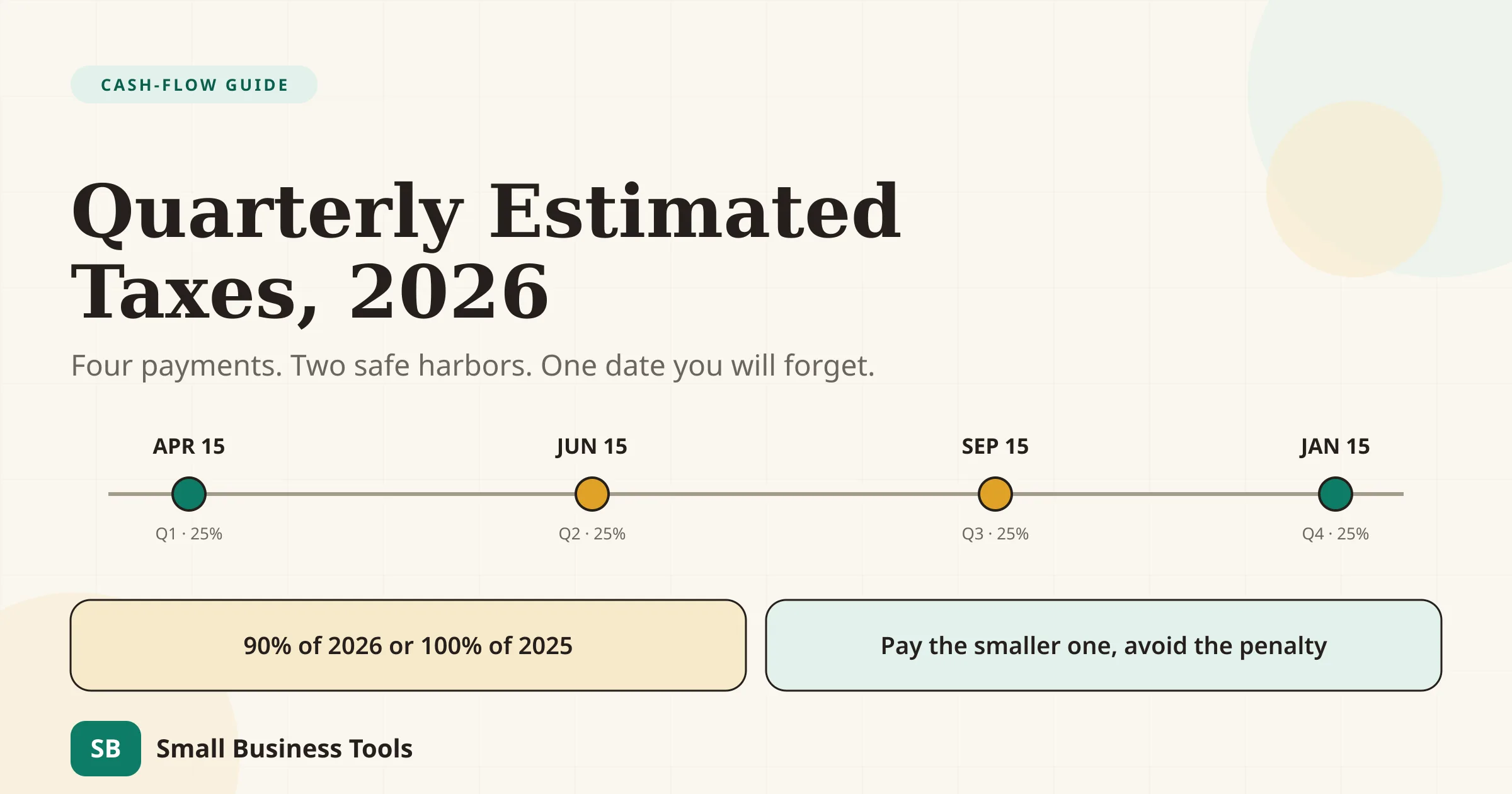
Quick answer: the 2026 dates and the $1,000 test
If you expect to owe at least $1,000 in federal tax after withholding and credits, pay estimated tax in four installments. For tax year 2026 the due dates are:
| Installment | Income period it covers | Due date | Share of the year |
|---|---|---|---|
| Q1 | January 1 – March 31 | April 15, 2026 | 25% |
| Q2 | April 1 – May 31 | June 15, 2026 | 25% |
| Q3 | June 1 – August 31 | September 15, 2026 | 25% |
| Q4 | September 1 – December 31 | January 15, 2027 | 25% |
The periods are not even calendar quarters, and that surprises people. Q2 is two months long and Q4 is four. The IRS divides the year this way so each payment lands roughly every three months, and it matters when you use the annualized income method below.
The amount is your expected total tax — income tax plus self-employment tax, minus withholding and credits — divided by four. The calculator does that arithmetic from net profit and state. A single filer in Texas with $100,000 of net profit owes about $22,365 for 2026, or $5,591 per installment.
Who has to pay, and the withholding shortcut
The $1,000 test is the headline, but there are three ways to satisfy it without writing a check to the IRS four times a year.
You are covered if you had no tax liability last year. If your 2025 return showed zero tax and you were a U.S. citizen or resident for the full year, you can skip 2026 estimated payments entirely — even if 2026 turns out to be a big year. The tax is still due in April 2027; there is just no penalty for not prepaying it.
You can increase W-2 withholding instead. If you have a job, file a new Form W-4 with your employer and ask for extra withholding. The IRS treats withholding as paid evenly through the year, regardless of when it was actually withheld. That is a meaningful advantage: a large bonus withheld in December is credited as if it had been paid in April, June, and September too. Estimated payments do not get that treatment — they are credited on the date you make them.
You can pay from a business account and skip the vouchers. Form 1040-ES comes with four payment vouchers, but if you pay electronically through IRS Direct Pay or EFTPS, you do not mail anything. The payment is tied to your Social Security number or EIN and the tax year, and it shows up on your IRS account the same day. Most people who get "lost" payments are people mailing paper vouchers.
You do not have to make estimated payments on wages where an employer already withholds. The system is designed so each dollar of tax is prepaid once. If your W-2 job covers most of your household tax, the side business only needs to cover the gap it creates.
How to calculate each payment
The calculation is less mysterious than the form suggests. Five steps, in order:
1. Estimate net profit, not revenue
Start with expected revenue and subtract ordinary and necessary business expenses: materials, subcontractors, software, mileage, insurance, home-office allocation, and the employer half of your own payroll tax if you are an S-corp. The result is the number that flows to Schedule C and the number the tax is built on. A consultant with $180,000 of revenue and $60,000 of expenses has $120,000 of profit, and that is the base.
2. Calculate self-employment tax
Multiply net profit by 92.35%, then by 15.3%. The 15.3% is 12.4% Social Security on net earnings up to the $184,500 wage base plus 2.9% Medicare on everything. Above $200,000 single or $250,000 joint, add the 0.9% Additional Medicare Tax. At $100,000 of profit that is $14,129.55.
3. Add income tax after the two deductions
Self-employment tax is only part of the bill. Deduct half of the SE tax ($7,064.78 at $100,000), apply the $16,100 standard deduction for a single filer in 2026, then take the QBI deduction — 20% of qualified business income, capped at 20% of taxable income before the deduction. At $100,000 of profit the federal income tax is $8,235.00. Combined federal tax: $22,364.55.
4. Subtract withholding and credits
If a W-2 job withheld $9,000 and you have a $2,000 child tax credit, subtract both. The remainder is what the quarterly payments need to cover. This is the step people skip, and it is why a side-business owner who copies a full-time freelancer's payment ends up overpaying all year.
5. Divide by four — or use the safe harbor
Divide the remainder by four for equal payments. If your income is uneven, the annualized income method (below) can lower the early installments. If you simply want protection from the penalty with the least arithmetic, use the safe harbor instead.
The safe harbor: the number that actually protects you
The underpayment penalty is not triggered by owing tax in April. It is triggered by prepaying too little during the year. The IRS gives you two ways to be "paid up" regardless of what the final return says:
- 90% of the tax shown on your 2026 return, or
- 100% of the tax shown on your 2025 return — 110% if your 2025 adjusted gross income was more than $150,000 ($75,000 if married filing separately).
Pay the smaller of those two numbers across the four dates and no underpayment penalty applies, even if you write a large check in April. That is the whole trick. It converts an estimate into a known quantity.
A worked example. Suppose your 2025 federal tax was $19,320 and your 2025 AGI was $140,000. Your 2026 income grows and the actual 2026 tax turns out to be $22,365.
| Safe-harbor test | Calculation | Amount |
|---|---|---|
| 90% of 2026 tax | 0.90 × $22,365 | $20,128.50 |
| 100% of 2025 tax | 1.00 × $19,320 | $19,320.00 |
| Required prepayment | the smaller | $19,320.00 |
| Per quarter | ÷ 4 | $4,830.00 |
You prepay $19,320, owe the remaining $3,045 in April, and owe no penalty — because you met the prior-year safe harbor. Had your 2025 AGI been $160,000, the second test would be 110% × $19,320 = $21,252, which is larger than the 90% figure, so the required prepayment would be $21,252.
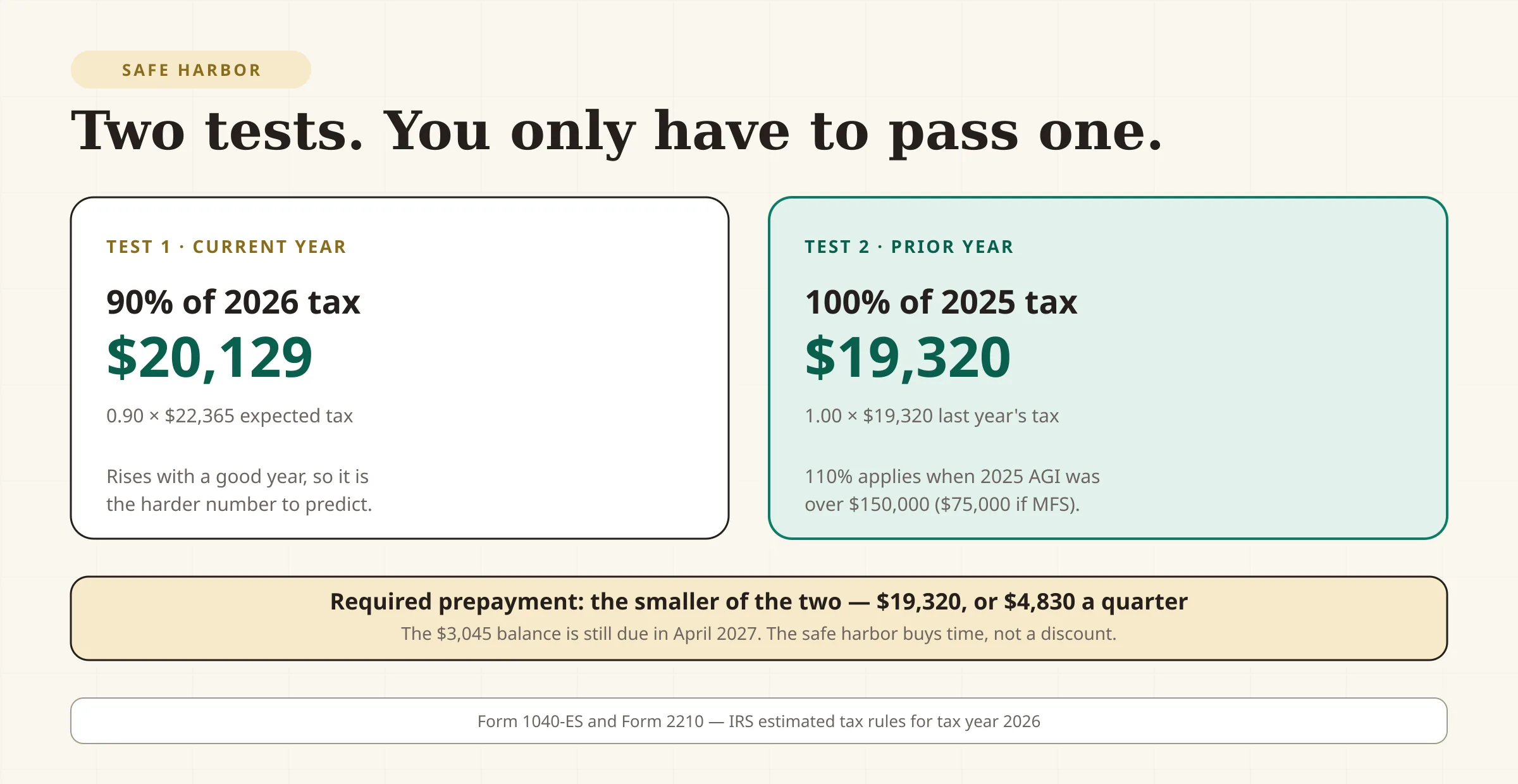
The prior-year safe harbor is the single most useful planning tool in this system. In a growth year it lets you pay last year's tax, keep the difference working in the business, and settle up in April without interest. In a declining year it can be the wrong choice — 90% of a smaller current-year tax may be less — so compare both numbers rather than defaulting to last year.
One catch: the safe harbor protects you from the penalty, not from the tax. If you prepay $19,320 and owe $22,365, the $3,045 balance is still due April 15, 2027. The safe harbor buys time, not a discount.
The underpayment penalty, honestly
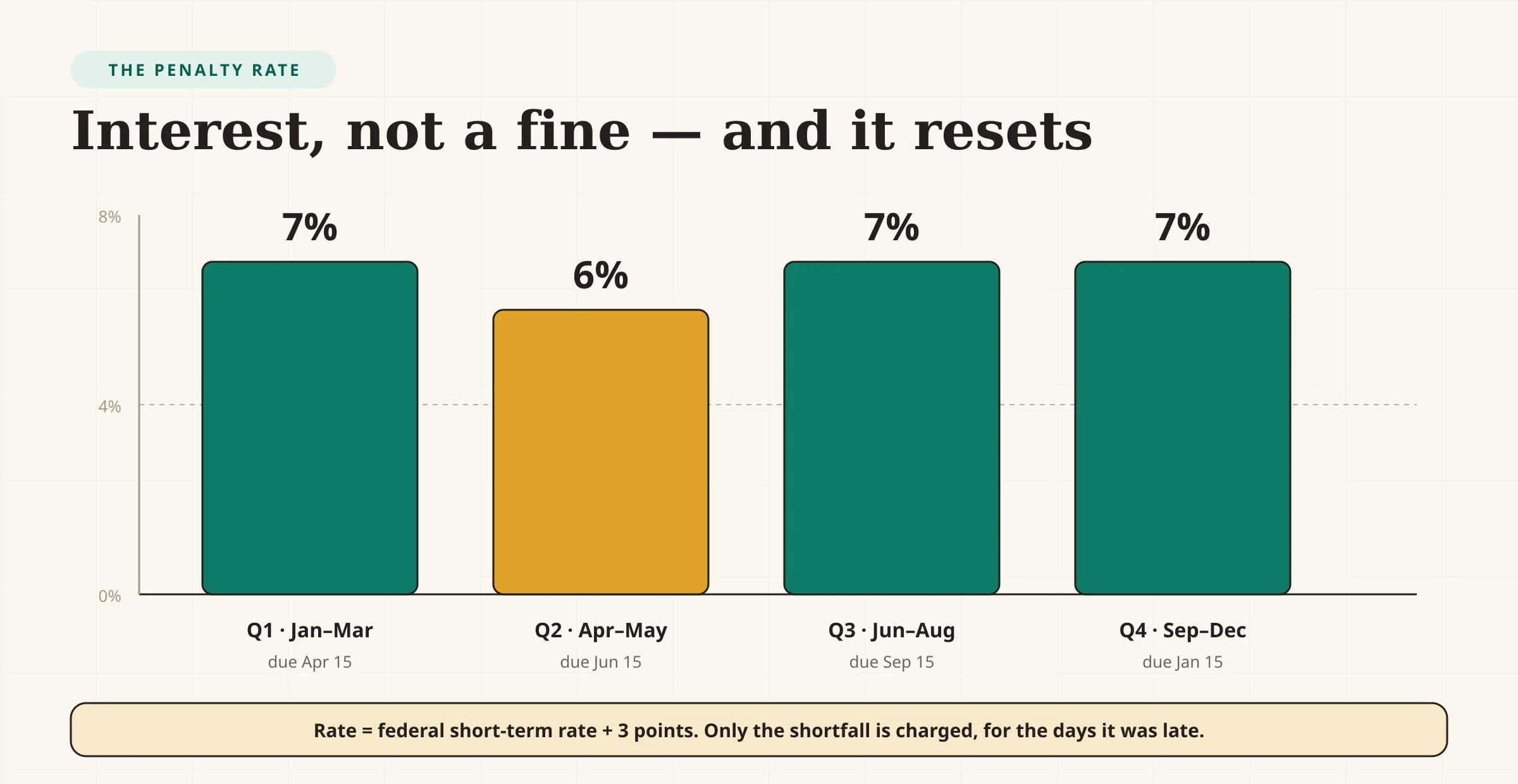
The penalty is widely misunderstood as a flat fine. It is closer to interest: the IRS charges it per installment, for the number of days the payment was short, at a rate that resets every quarter.
For 2026 the underpayment rate is 7% for the first quarter, 6% for the second, and 7% for the third and fourth, per the IRS quarterly interest rates. The rate is the federal short-term rate plus three percentage points, which is why it moves. It is not a catastrophic number, but it is real: a $5,000 shortfall that persists for six months costs roughly $175.
Three details make the penalty less scary than it sounds:
There is a de minimis threshold. If the total tax you owe after withholding is under $1,000, no penalty applies. That is the same $1,000 test that decides whether you have to make payments at all.
It is calculated per installment, on Form 2210. Each payment has its own due date and its own shortfall period. Paying Q1 late and Q2 on time does not create a single annual shortfall; it creates a Q1 shortfall that stops when you catch up. Form 2210 does that arithmetic, and most tax software fills it in automatically when you enter the payment dates.
You can ask the IRS to waive it. The penalty can be waived for a casualty, disaster, or other unusual circumstance that made a payment late, and for a taxpayer who retired at 62 or later or became disabled during the year. The waiver is requested on Form 2210; it is not automatic.
Worked example: a $100,000 freelancer in Texas
Take a single-member LLC taxed as a sole proprietorship, single filer, Texas (no state income tax), $100,000 of net profit, no W-2 income, no credits. The 2026 federal bill is:
| Component | Amount |
|---|---|
| Self-employment tax | $14,129.55 |
| Federal income tax | $8,235.00 |
| Total federal tax | $22,364.55 |
| Effective rate on profit | 22.4% |
| Equal quarterly payment | $5,591.14 |
Now suppose the owner's 2025 federal tax was $16,800 and 2025 AGI was $95,000. The prior-year safe harbor is 100% × $16,800 = $16,800, which is less than 90% of $22,365 ($20,129). So the owner can pay $4,200 per quarter, keep the $5,565 difference in the business through the year, and settle the remaining $5,565 in April 2027 without a penalty.
That is the practical value of the safe harbor: it turns a $5,591 quarterly obligation into a $4,200 one during the year. The trade is a larger April balance, which only works if the money is actually set aside rather than spent.
If the same owner lived in California, the federal numbers would be identical but state estimated tax would be a separate obligation. California requires payments once you expect to owe $500 or more, and its installments are front-loaded: 30% in April, 40% in June, nothing in September, and 30% in January. That asymmetry trips up people who assume every state uses 25% quarters. The per-state rules live in the state calculator pages and in the tax checklist.
Uneven income: the annualized income method
Equal quarterly payments assume equal income. Most freelancers and seasonal businesses do not have equal income. A wedding photographer earns most of the money between May and October; a retailer earns most of it in November and December; a consultant might have a huge Q1 and a quiet summer.
Form 1040-ES includes a worksheet called the Annualized Income Installment Method (Schedule AI on Form 2210) that recalculates each installment based on the income actually earned in that period. If you made $10,000 in the first two months and $60,000 in the last four, the method lets the early payments be small without triggering a penalty. It requires more recordkeeping — you annualize each period's income as if it continued for the full year — but it can be the difference between a legitimate low payment and a penalty on money you had not yet earned.
Two practical notes. First, the method only helps if your income is genuinely back-loaded; if income is steady, equal payments are simpler and produce the same result. Second, it must be elected on the return with Form 2210; you cannot retroactively claim it after the IRS assesses a penalty unless you file the form.
Farmers and fishermen get a separate rule: if at least two-thirds of gross income comes from farming or fishing, they can skip the first three installments and pay the whole estimate by January 15 of the following year. That is a narrow exception, but it is a real one for agricultural businesses.
State estimated taxes are a separate calendar
Federal estimated tax is the larger number for most owner-operators, but it is not the only one. Forty-one states and DC tax income, and most of them run their own estimated-payment system with its own form, threshold, and due dates.
The differences that matter:
- Thresholds vary. California triggers at $500; New York at $300; many states follow the federal $1,000. A state with a low threshold can require payments from a business that owes nothing federally.
- Shares vary. Most states use 25% quarters. California uses 30/40/0/30. A few states set no quarterly schedule at all.
- Forms vary. California uses Form 540-ES, New York Form IT-2105, and the rest use their own equivalents. Paying the federal voucher does not pay the state.
- Safe harbors vary. Many states mirror the federal 90%/100% rule, but the prior-year percentage and AGI trigger are not universal.
The per-state calculator pages show each state's estimate, form, dates, and shares next to the federal number, so you can see both obligations in one place rather than discovering the state one in April.
Common mistakes
- Setting aside a bracket percentage instead of the effective rate. A 22% bracket ignores the 15.3% SE tax; at $100,000 of profit the real federal rate is 22.4% *including* both taxes, not 22% plus 15.3%.
- Calculating on revenue. Expenses reduce both income tax and SE tax. Taxing gross revenue overstates the bill by thousands.
- Missing the January 15 payment. It is due in the *following* calendar year, and it is the installment people forget most often.
- Treating the safe harbor as optional. Paying 100% of last year's tax is the cheapest legal protection available. Skipping it to "pay what I think I'll owe" is how penalties start.
- Assuming withholding and estimated payments are credited the same way. Withholding is treated as paid evenly; estimated payments are credited when paid.
- Mailing paper vouchers and losing them. Electronic payment through IRS Direct Pay or EFTPS removes the lost-check failure mode.
- Forgetting state estimated tax entirely. A federal-only plan leaves a second, separate obligation unpaid.
- Overpaying all year and calling it discipline. A large refund is an interest-free loan to the government. The safe harbor is the better target.
The quarterly checklist
[ ] Net profit projected for 2026 (revenue minus business expenses)
[ ] SE tax calculated: profit × 92.35% × 15.3%, Social Security capped at $184,500
[ ] Federal income tax added after half-SE, standard deduction, and QBI
[ ] 2025 federal tax and AGI pulled from last year's return
[ ] Safe harbor compared: 90% of 2026 vs 100%/110% of 2025, pay the smaller
[ ] W-2 withholding and credits subtracted from the total
[ ] Four dates on the calendar: Apr 15, Jun 15, Sep 15, Jan 15
[ ] State estimated tax calculated separately (form, threshold, shares)
[ ] Payment method chosen: IRS Direct Pay, EFTPS, or W-4 withholding
[ ] Set-aside percentage moved to a separate account on every payment
[ ] Annualized income method considered if income is back-loaded
FAQs
Do I have to pay quarterly estimated taxes in my first year?+
Yes, if you expect to owe $1,000 or more. There is a first-year exception only if you had no tax liability for the prior year and meet the other conditions. Otherwise the four payments apply from the first year of self-employment. Many new freelancers miss this because no form arrives in the mail; the obligation is triggered by the profit, not by a notice.
What happens if I miss a quarterly payment?+
The IRS charges interest on the shortfall from the installment due date until you pay, at the quarterly underpayment rate — 7% for most of 2026. It is calculated on Form 2210 when you file. If the total underpayment is under $1,000, no penalty applies. You can also request a waiver for a casualty, disaster, or retirement/disability circumstance.
Can I pay the whole year at once in April?+
You can, but the IRS treats it as four late payments. A single April payment does not retroactively cover the April, June, and September installments. The penalty is computed per installment, so paying everything at the end costs more than paying on the four dates — even though the total is the same.
Is the safe harbor 90% or 100%?+
Both, and you use whichever is smaller. Pay at least 90% of the current year's tax **or** 100% of the prior year's tax (110% if prior-year AGI exceeded $150,000, or $75,000 if married filing separately). Meeting either test avoids the penalty.
Do estimated payments count for the self-employment tax too?+
Yes. Form 1040-ES covers your total expected tax, including income tax and self-employment tax, minus withholding and credits. There is no separate "SE tax payment." The quarterly amount from the [calculator](/tools/self-employment-tax-calculator) already includes both.
How do I pay?+
IRS Direct Pay (bank account, no fee), EFTPS (business accounts), a debit or credit card through an IRS payment processor (convenience fee applies), or the paper voucher from Form 1040-ES. Electronic payment is faster and leaves a record tied to the tax year.
Can I skip estimated taxes if I have a W-2 job?+
Not automatically. Your employer withholds on your wages, but the side business has no withholding. If the side profit creates $1,000 or more of additional tax, you either make estimated payments or increase W-4 withholding. Increasing withholding is often simpler because it is treated as paid evenly through the year.
Do states have the same due dates?+
Mostly, but not always with the same shares or thresholds. California, for example, front-loads its installments at 30/40/0/30 and triggers at $500 of expected tax. New York uses 25% quarters and triggers at $300. Check your state's form rather than assuming the federal schedule carries over.
What to do next
Open the Self-Employment Tax Calculator, enter your projected net profit and state, and read two numbers: the quarterly payment and the set-aside percentage. Put the four dates in your calendar with a reminder one week before each. Then pull last year's return and compare the safe-harbor figure — if 100% of last year's tax is lower than 90% of this year's estimate, that is your quarterly number.
If the arithmetic is the part you want explained rather than just calculated, How Self-Employment Tax Works walks the 92.35% base, the half-SE and QBI deductions, and the S-corp question. For the full year of deadlines by entity — payroll forms, pass-through returns, and the January 31 1099 date — the small business tax checklist puts them in one table. And if you would rather have software track the installments and generate the vouchers, the tax software roundup compares the options by price and Schedule C support.
Free tools to try
Self-Employment Tax Calculator
See how much of your 1099 income to set aside — federal, state, and quarterly payments.
Hourly Rate Calculator
Find the hourly rate freelancers and consultants must charge to hit their income goal.
Invoice Generator
Create a professional invoice and download it as a PDF in 30 seconds.
Keep reading
Guide
How Self-Employment Tax Works in 2026
How self-employment tax works in 2026: the 92.35% base, the $184,500 wage base, the half-SE deduction, QBI, and when an S-corp really saves money.
Guide
The Small Business Owner's Tax Checklist
A small business tax checklist by deadline: quarterly estimated taxes, filing dates by entity, payroll forms, recordkeeping rules, and 2026 figures.
Guide
Best Tax Software for Small Business (2026)
12 tax software options compared for small businesses — real 2026 prices for TurboTax, TaxAct, FreeTaxUSA and more, plus who files S corps and C corps.
Guide
How to Set Your Hourly Rate (What to Charge)
Work out what to charge per hour: target income, real expenses, self-employment tax, and billable hours — with a formula and a full worked example.