How-to guide
How Self-Employment Tax Works in 2026
Self-employment tax has a reputation for being simple: 15.3%, paid by freelancers instead of an employer. The rate is real, but almost everything else about that sentence is wrong in a way that costs money. You do not pay 15.3% of your profit. You pay 15.3% of 92.35% of it, then deduct half of what you pay, then run the remainder through the income-tax system and a 20% small-business deduction that most people calculate incorrectly. The difference between the sticker rate and the real bill is thousands of dollars a year at a modest profit.
The IRS sets the floor plainly: net earnings of $400 or more trigger self-employment tax, which funds Social Security and Medicare and is separate from income tax. What the one-line rule hides is the arithmetic between your profit and your bank balance. That arithmetic decides how much you set aside from every client payment, whether your quarterly payments are big enough, and whether an S-corp election is worth its paperwork.
This guide walks the whole calculation in order, using the same 2026 engine as our Self-Employment Tax Calculator. By the end you will know your real percentage, the two deductions that reduce it, and the profit level where an S-corp stops being a tax myth and starts being a decision.
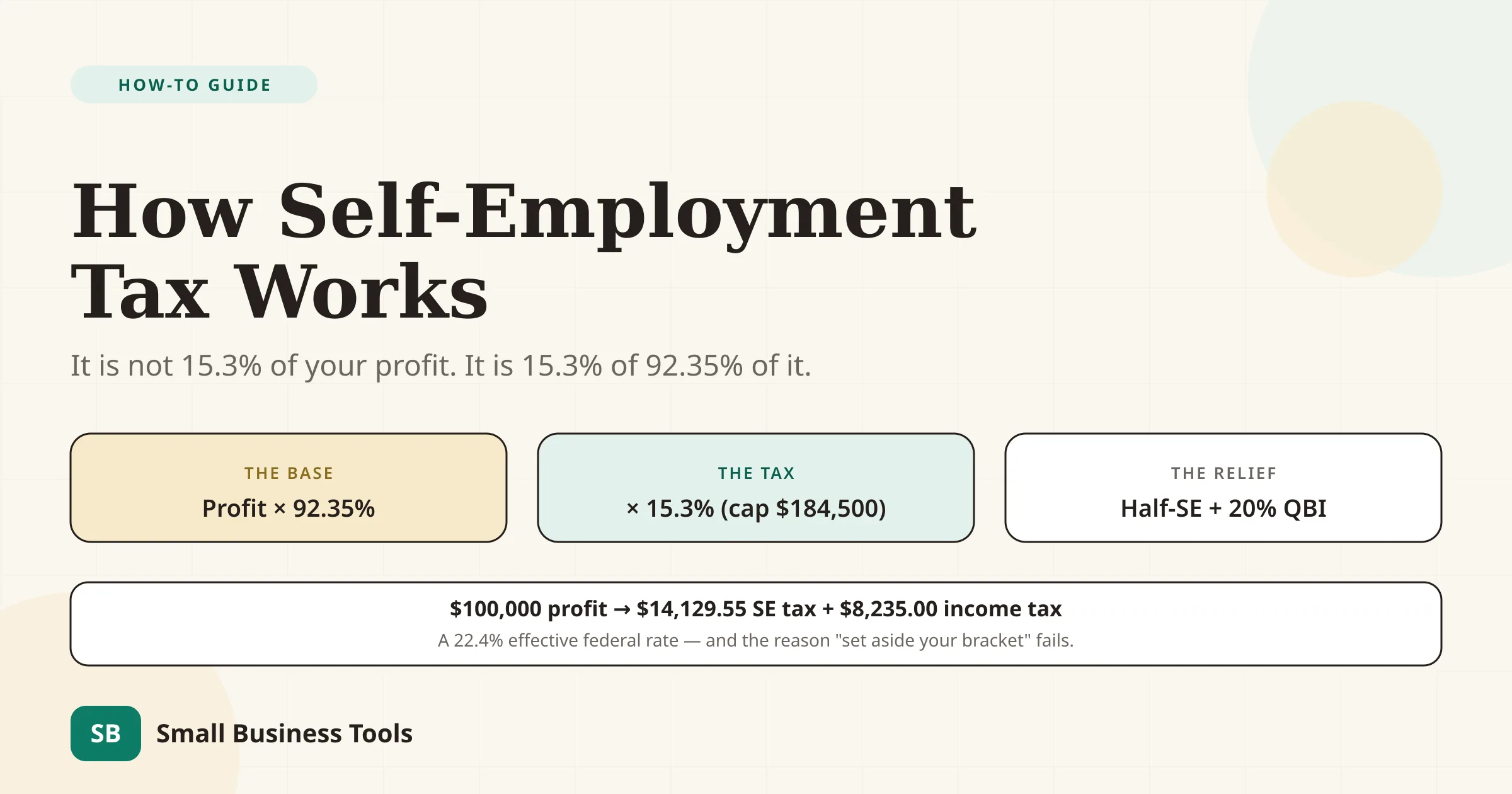
Quick answer: the formula and the 2026 numbers
Self-employment tax is net profit × 92.35% × 15.3%, split into 12.4% for Social Security on earnings up to the wage base and 2.9% for Medicare on everything. The 2026 wage base is $184,500. Half of the resulting tax is deductible against income tax, and the business profit also qualifies for the qualified business income (QBI) deduction.
| Number | 2026 value | What it does |
|---|---|---|
| Net-earnings factor | 92.35% | Stands in for the employer half of payroll tax |
| Self-employment tax rate | 15.3% | 12.4% Social Security + 2.9% Medicare |
| Social Security wage base | $184,500 | Above this, only the 2.9% Medicare portion continues |
| Additional Medicare tax | 0.9% | On earnings above $200,000 single / $250,000 joint |
| Filing threshold | $400 of net earnings | Below this, no SE tax |
| Half-SE deduction | 50% of SE tax | Above-the-line; reduces income tax, not SE tax |
| QBI deduction | Up to 20% of qualified business income | 2026 thresholds: $201,750 single / $403,500 joint |
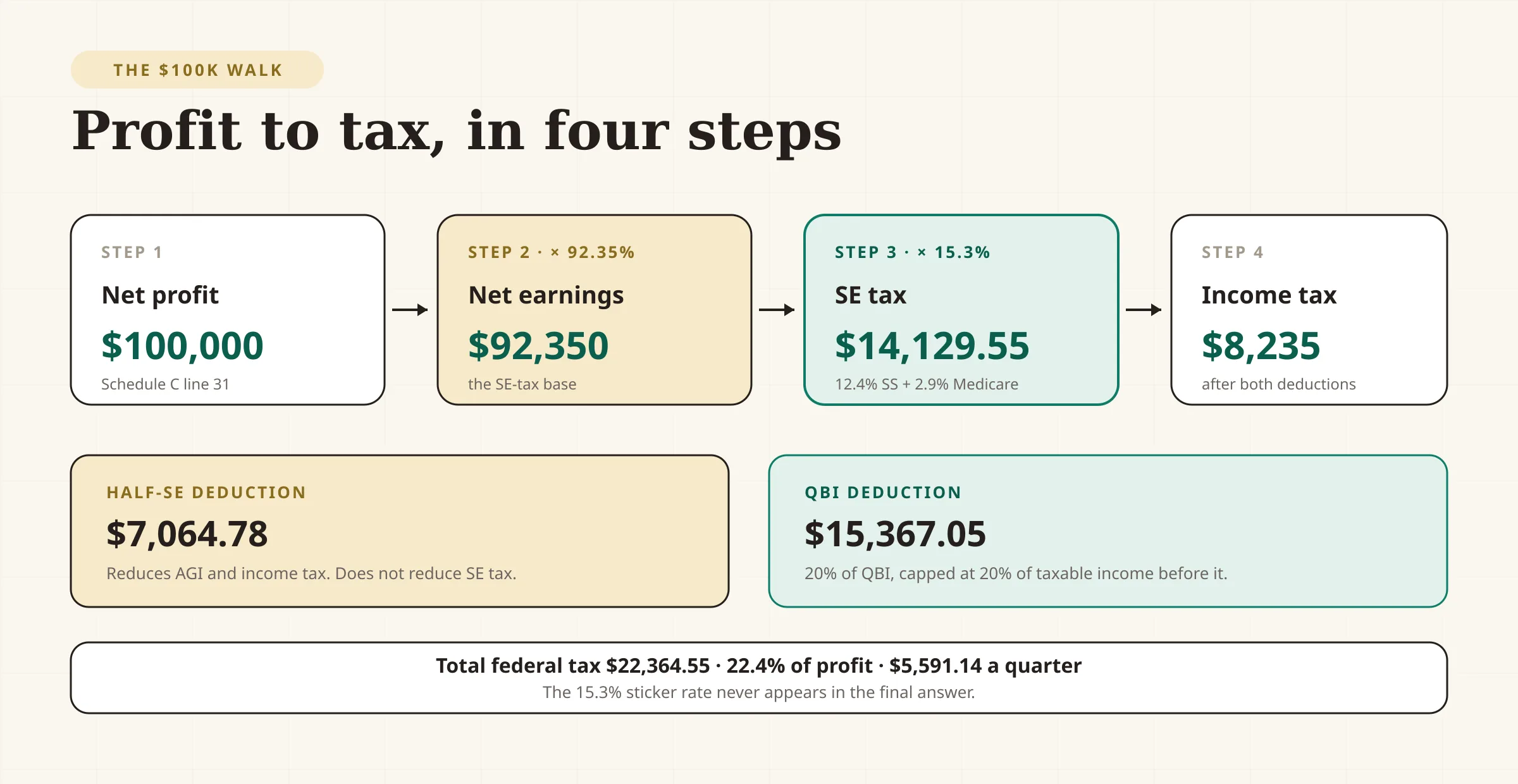
At $100,000 of net profit, the calculation is $100,000 × 92.35% = $92,350 of net earnings, then $92,350 × 15.3% = $14,129.55 of self-employment tax. That is 14.13% of profit, not 15.3%. The gap is not a loophole; it is the employer half you are treated as having already paid.
Who owes self-employment tax (and who does not)
You owe it if you carry on a trade or business as a sole proprietor, an independent contractor, a member of a partnership, or a single-member LLC that has not elected corporate status. Income reported on a 1099-NEC or 1099-K is the usual trigger, but the form is not what creates the tax. Net profit does. If you sold $80,000 of work and spent $30,000 on materials, software, mileage, and subcontractors, you owe tax on $50,000, not $80,000.
An LLC changes your liability shield, not your federal tax status. A single-member LLC is a disregarded entity: its profit goes on Schedule C and owes self-employment tax exactly like a sole proprietorship. A multi-member LLC is a partnership by default, and each partner owes SE tax on their share of ordinary business income. An LLC that elects S-corp status changes the picture, but not by making the tax disappear — more on that below.
You do not owe self-employment tax on wages where an employer already withholds Social Security and Medicare. That includes your own reasonable salary from an S-corp. Employees, including S-corp shareholder-employees, pay the employee half through payroll; the corporation pays the employer half. The 15.3% is still being paid on that salary — it is just split and reported differently.
Rental income is usually not self-employment income. Neither is investment income, a one-off sale of personal property, or profit from a hobby. The line is whether you are regularly carrying on a business, and the IRS looks at the facts, not the label on your bank account.
The 92.35% base: why you do not pay 15.3% of profit
A W-2 employee and their employer each pay 7.65% of wages: 6.2% Social Security and 1.45% Medicare. Together that is 15.3%. When you work for yourself, you are both parties, so you pay both halves — but the law does not apply the full 15.3% to your gross profit. It applies it to 92.35% of net earnings, which is designed to leave you in roughly the same position as an employee whose employer paid the other half.
The math on $100,000:
| Step | Amount |
|---|---|
| Net profit (Schedule C line 31) | $100,000.00 |
| Net earnings subject to SE tax (× 92.35%) | $92,350.00 |
| Social Security portion (12.4%) | $11,451.40 |
| Medicare portion (2.9%) | $2,678.15 |
| Self-employment tax | $14,129.55 |
| Effective rate on profit | 14.13% |
That 1.17-point gap between 15.3% and 14.13% is worth $1,170 on $100,000 of profit. It is also why the common advice to "set aside 15.3%" is simultaneously safe and imprecise: safe because it overestimates the SE tax, imprecise because it ignores income tax, which is usually the larger number at higher profits.
One more distinction that matters for planning: the 92.35% factor applies to net earnings from self-employment, not to revenue. A contractor with $250,000 of revenue and $180,000 of materials and labor has $70,000 of profit and pays SE tax on that. Calculating on gross revenue is the single most common — and most expensive — mistake in this corner of small-business finance.
The $184,500 wage base and the 0.9% Medicare surtax
The 12.4% Social Security portion has a ceiling. In 2026 it applies to the first $184,500 of net earnings, per the IRS's 2026 Publication 15. The 2.9% Medicare portion has no ceiling. So the shape of the tax changes as profit rises:
- Below $184,500: the full 15.3% applies to 92.35% of profit.
- Above $184,500: the Social Security portion stops; only the 2.9% Medicare portion applies to the excess.
- Above $200,000 single / $250,000 joint: an additional 0.9% Medicare tax applies to the excess, reported on Form 8959. It is not technically self-employment tax, but it is collected through the same return and belongs in the same set-aside.
If you also have a W-2 job, your wages count toward the wage base first. A side business that earns $120,000 on top of $80,000 of wages does not get a fresh $184,500 of Social Security room; the wages have already used $80,000 of it. Depending on the split, part or all of the side profit may be subject only to the 2.9% Medicare portion — or, if the wages alone exceed $184,500, to no Social Security portion at all. The calculator applies the full wage base to self-employment income as a conservative estimate, so if you have high W-2 wages, treat its SE-tax line as a ceiling rather than a precise number.
The side-business case is also where the withholding shortcut matters. Instead of sending quarterly payments, you can file a new Form W-4 with your employer and have extra tax withheld from your paycheck. The IRS treats withholding as paid evenly through the year, which can be simpler than four estimated payments — and it avoids the late-payment pattern that trips up people who start a side business mid-year.
The two deductions that cut the bill
Self-employment tax is only half the story. The same profit is also subject to federal income tax, and two deductions reduce that second bill.
1. The half-SE deduction
You can deduct half of your self-employment tax on Schedule 1 of Form 1040. At $100,000 of profit, that is $14,129.55 ÷ 2 = $7,064.78. It reduces your adjusted gross income, which reduces income tax. It does not reduce the SE tax itself — the IRS is not going to let you deduct the tax from the base that calculates the tax.
The deduction is easy to miss because it is not an itemized deduction and it does not appear on Schedule C. It flows from Schedule SE to Schedule 1 automatically in most tax software. If you are estimating by hand, forgetting it overstates your income tax by roughly your marginal rate times half the SE tax.
2. The QBI deduction
The qualified business income deduction lets most pass-through owners deduct up to 20% of qualified business income. For a sole proprietor, QBI starts as net profit minus the half-SE deduction. The deduction is then capped at 20% of taxable income before the QBI deduction, which is why it is often less than 20% of profit.
At $100,000 of profit, single filer:
| Step | Amount |
|---|---|
| Net profit | $100,000.00 |
| Less half-SE deduction | −$7,064.78 |
| QBI before the cap | $92,935.22 |
| Tentative 20% deduction | $18,587.04 |
| Taxable income before QBI ($92,935.22 − $16,100 standard deduction) | $76,835.22 |
| 20% of that taxable income | $15,367.04 |
| QBI deduction (the smaller number) | $15,367.04 |
The 2026 thresholds are $201,750 for single filers and $403,500 for married filing jointly, per Revenue Procedure 2025-32. Below them, the deduction is generally available in full. Above them, it phases out over $75,000/$150,000 of taxable income, and specified service businesses — consulting, law, health, accounting, financial services — lose it entirely at the top of the range. The One Big Beautiful Bill Act also added a $400 minimum deduction once you have at least $1,000 of active QBI, which matters at low profit levels.
Put the pieces together at $100,000:
| Component | Amount |
|---|---|
| Self-employment tax | $14,129.55 |
| Federal income tax after half-SE and QBI | $8,235.00 |
| Total federal tax | $22,364.55 |
| Effective rate on profit | 22.4% |
| Quarterly set-aside | $5,591.14 |
That is the number to plan around — not 15.3%, and not your income-tax bracket. The calculator adds state tax on top, which can move the total by several thousand dollars depending on where you live.
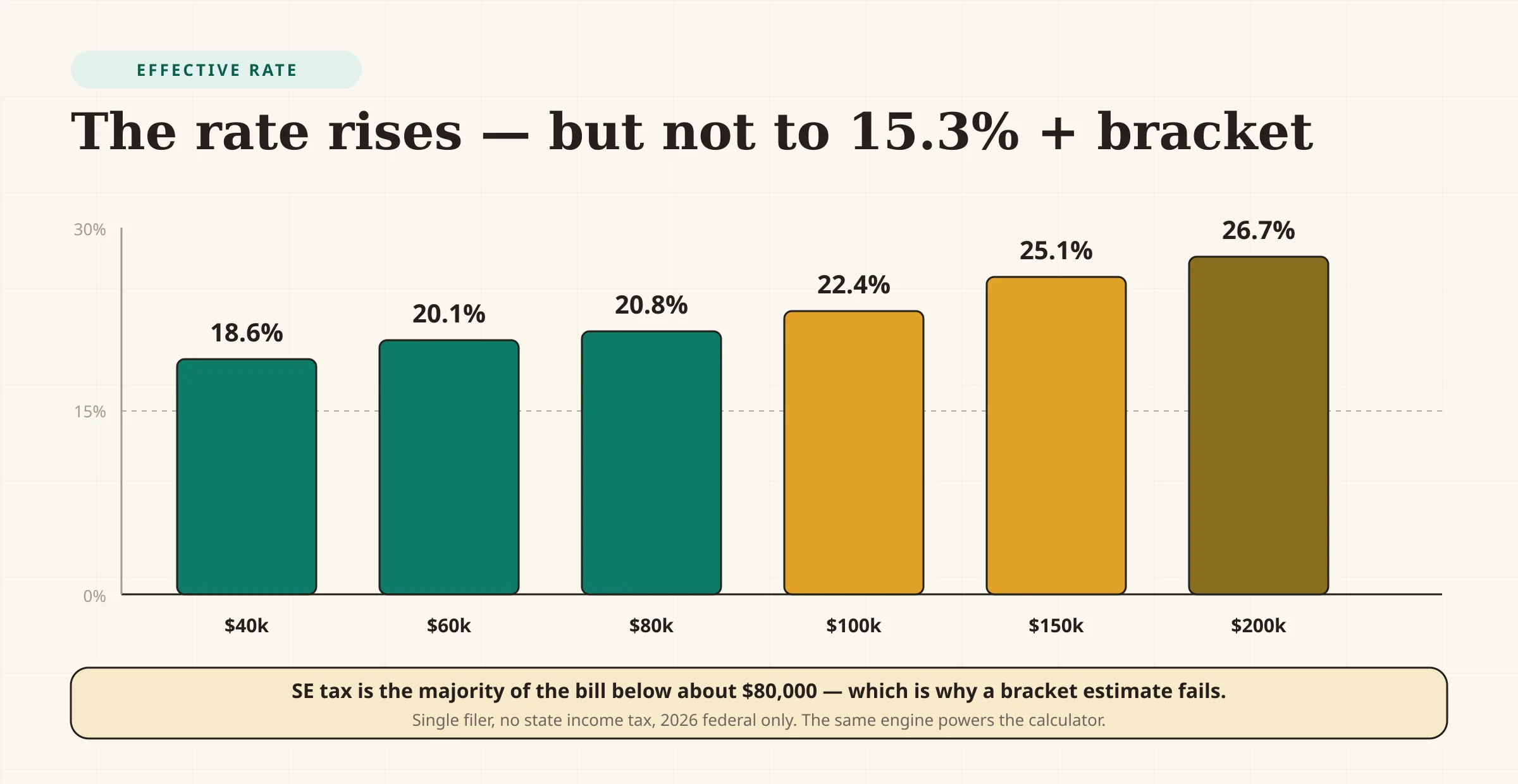
What it actually costs at six profit levels
The effective rate rises with profit, for two reasons: the income-tax brackets are progressive, and the QBI cap binds harder as the standard deduction becomes a smaller share of income. Here is the federal-only picture for a single filer in a no-income-tax state in 2026, using the same engine as the calculator:
| Net profit | SE tax | Federal income tax | Total federal | Effective rate | Quarterly |
|---|---|---|---|---|---|
| $40,000 | $5,651.82 | $1,775.11 | $7,426.93 | 18.6% | $1,856.73 |
| $60,000 | $8,477.73 | $3,559.47 | $12,037.20 | 20.1% | $3,009.30 |
| $80,000 | $11,303.64 | $5,343.83 | $16,647.47 | 20.8% | $4,161.87 |
| $100,000 | $14,129.55 | $8,235.00 | $22,364.55 | 22.4% | $5,591.14 |
| $150,000 | $21,194.32 | $16,413.30 | $37,607.62 | 25.1% | $9,401.91 |
| $200,000 | $28,234.30 | $25,196.31 | $53,430.61 | 26.7% | $13,357.65 |
Two things to notice. First, the SE tax is the majority of the bill below about $80,000, which is why "set aside your bracket" fails so badly for new freelancers. Second, the effective rate never reaches 15.3% + your bracket, because the half-SE and QBI deductions pull taxable income down. The real number is somewhere in between, and it is specific to your profit and state.
State tax is the wild card. On $100,000 of single-filer profit, the 2026 estimate is about $22,365 in Texas or Florida, roughly $26,600 in California or New Jersey, $26,800 in New York before New York City's own tax, and about $29,000 in Oregon or Maryland including Maryland's county tax. That is a $4,000–$7,000 annual swing from state tax alone. The per-state calculator pages show the full breakdown for each state.
The set-aside system that keeps you out of trouble
The percentage is more useful than the dollar amount because revenue arrives unevenly. The system that works for most owner-operators:
- Open a separate tax savings account. Not your operating account, not your personal savings. The separation is the whole trick.
- Move the set-aside percentage on every payment, not every quarter. If the calculator says 22.4%, move 22.4% of each client payment the day it lands. On a $5,000 invoice, that is $1,120.
- Pay quarterly from that account. The four federal dates are April 15, June 15, September 15, and January 15 of the following year. The quarterly estimated taxes guide covers the safe harbor and the penalty math in detail.
- True up in April. If you over-set-aside, the refund is yours. If you under-set-aside, you have a smaller problem than a surprise bill.
- Re-run the percentage when profit changes materially. A raise from $60,000 to $100,000 moves the effective rate from about 20% to 22.4%. The dollar amount matters less than keeping the percentage current.
The quarterly payment shown by the calculator is the tax your self-employment income adds divided by four. If you also have a W-2 job, your employer is already withholding for those wages, so the gap is what you need to cover — not the household's entire tax bill.
S-corp election: when the 15.3% saving is real
The pitch is everywhere: elect S-corp status, pay yourself a salary, take the rest as distributions, and skip the 15.3% on the distributions. The mechanics are real, but the saving is smaller than the pitch because the salary portion still carries payroll tax, and the election adds costs that a sole proprietor does not have.
Here is the honest arithmetic at $100,000 of profit, with a $60,000 salary and a $40,000 distribution:
| Item | Sole proprietor | S-corp |
|---|---|---|
| Tax on the owner's earnings | SE tax on $100,000: $14,129.55 | Payroll tax on $60,000 salary: $9,180 (employee + employer) |
| FUTA | — | About $42 on the first $7,000 of wages |
| Payroll service | — | $300–$1,200/yr |
| Form 1120-S preparation | — | $800–$2,500/yr |
| State annual report / franchise | Varies | $0–$800/yr |
| QBI base | Profit minus half-SE: $92,935 | Distribution after wages and payroll costs: roughly $33,000 |
The gross difference between SE tax on the whole profit and payroll tax on the salary is about $4,900. The administrative stack runs $1,200–$5,000. The QBI deduction also shrinks, because wages are not qualified business income; at this income, that can add roughly $1,000–$2,000 of income tax. The realistic net at $100,000 is somewhere between −$2,000 and +$2,700 — not the $5,652 the headline suggests.
That does not make S-corp elections useless. It makes them profit-dependent. At $60,000–$80,000, the fixed costs usually exceed the saving. At $150,000 and above, the gross saving grows while the fixed costs stay roughly flat, so the math starts to work — but it still depends on your state's treatment of S-corps, your professional fees, and how much salary the IRS would consider reasonable.
Reasonable compensation is not optional. The IRS requires S-corporations to pay a shareholder-employee reasonable compensation for services before making non-wage distributions, and it can reclassify distributions as wages if the salary is too low. The agency's S corporation compensation guidance lists the factors: training and experience, duties, time devoted, comparable pay, and the source of gross receipts. A one-person consulting business that pays itself $20,000 and distributes $80,000 is asking for an audit adjustment.
If you are considering the election, get two numbers before you file Form 2553: a quote from a payroll provider and a quote from the accountant who will prepare the 1120-S. Our payroll software roundup covers the first; the second is usually $800–$2,500 a year for a single-owner return. If the combined cost is close to the SE-tax saving, the election is paperwork for its own sake.
Common mistakes
- Setting aside your income-tax bracket. A 12% or 22% bracket ignores the 15.3% SE tax, which is usually the larger bill below $100,000 of profit.
- Calculating on revenue instead of profit. Every legitimate business expense lowers both SE tax and income tax. Revenue is not the base.
- Forgetting the half-SE deduction. It is automatic in software but easy to omit in a hand estimate, and it overstates income tax.
- Assuming the QBI deduction is 20% of profit. It is 20% of QBI, capped at 20% of taxable income. The cap binds for many sole proprietors.
- Treating an LLC as a separate taxpayer. A single-member LLC is taxed like a sole proprietorship unless it elects S or C status.
- Skipping the January 15 payment. The fourth-quarter payment is due in the following year and is the one people miss most.
- Assuming a loss year is tax-free everywhere. Some states tax gross receipts or charge LLC fees even with no profit — California's $800 minimum franchise tax is the classic example.
- Electing S-corp status before the profit justifies it. The fixed costs are real, and the QBI loss is easy to overlook.
The one-page checklist
[ ] Net profit confirmed from Schedule C (revenue minus business expenses)
[ ] SE tax calculated: profit × 92.35% × 15.3%
[ ] Social Security portion capped at $184,500 of net earnings
[ ] Additional 0.9% Medicare checked above $200,000 single / $250,000 joint
[ ] Half-SE deduction taken on Schedule 1
[ ] QBI deduction calculated and capped at 20% of taxable income
[ ] State income tax added (or state-specific business tax checked)
[ ] Set-aside percentage moved to a separate account on every payment
[ ] Four quarterly dates on the calendar: Apr 15, Jun 15, Sep 15, Jan 15
[ ] S-corp election modeled with payroll + 1120-S costs before filing Form 2553
FAQs
Is self-employment tax the same as income tax?+
No. Self-employment tax is the Social Security and Medicare contribution for people who work for themselves: 15.3% of 92.35% of net profit. Federal income tax is a separate tax on taxable income, calculated after the standard deduction, the half-SE deduction, and the QBI deduction. You can owe SE tax while owing no income tax, and you can owe income tax on profit that is below the SE-tax threshold only in unusual cases.
How is self-employment tax calculated in 2026?+
Net profit × 92.35% × 15.3%. The 15.3% is 12.4% Social Security on net earnings up to $184,500 plus 2.9% Medicare on all net earnings. Above $200,000 single or $250,000 joint, an additional 0.9% Medicare tax applies. The result is reported on Schedule SE.
Do I owe self-employment tax if I have an LLC?+
A single-member LLC that has not elected corporate status is a disregarded entity: its profit goes on Schedule C and owes self-employment tax like a sole proprietorship. A multi-member LLC is a partnership by default, and partners owe SE tax on their share. An LLC that elects S-corp status pays payroll tax on the owner's reasonable salary and avoids SE tax on distributions, but it does not eliminate the payroll tax on the salary.
Does an S-corp eliminate self-employment tax?+
No. It converts part of the tax into payroll tax on a reasonable salary and leaves the remaining distribution free of SE tax. At $100,000 of profit with a $60,000 salary, the gross difference is about $4,900 before payroll, accounting, state fees, and the smaller QBI deduction. For many owners at that level, the net saving is small or negative.
What if I have a W-2 job and a side business?+
Your W-2 wages count toward the $184,500 Social Security wage base first. Depending on the split, your side profit may be subject only to the 2.9% Medicare portion, or to no Social Security portion at all. You can also avoid quarterly payments by increasing withholding on your W-4, because the IRS treats withholding as paid evenly through the year.
Can I deduct half of my self-employment tax?+
Yes. The half-SE deduction is an above-the-line deduction on Schedule 1. It reduces adjusted gross income and therefore income tax, but it does not reduce the SE tax itself. At $100,000 of profit, the deduction is $7,064.78.
Do I pay self-employment tax on 1099-K income?+
You pay it on the **net profit** of the business, regardless of whether the income arrived on a 1099-NEC, a 1099-K, or no form at all. The 1099-K is a reporting form, not a separate tax. Add the income to your business records, subtract legitimate expenses, and tax the profit.
What happens if my business loses money?+
There is no self-employment tax on a net loss, because the tax applies to net earnings of $400 or more. Some states still charge entity-level fees or gross-receipts taxes — California's $800 minimum franchise tax and Washington's B&O tax are the common examples — so a loss year is not automatically a no-tax year.
How do I pay self-employment tax?+
Through quarterly estimated payments on Form 1040-ES or IRS Direct Pay, or through additional withholding on a W-2 job. The four federal dates are April 15, June 15, September 15, and January 15 of the following year. The tax is reconciled on your annual return.
What to do next
Enter your actual net profit and state into the Self-Employment Tax Calculator and read the set-aside percentage first. That is the number to apply to every client payment. Then check the quarterly amount against the safe harbor in the quarterly estimated taxes guide — paying last year's tax is often cheaper and simpler than chasing this year's estimate. If your profit is above roughly $100,000 and you are considering an S-corp, price the payroll and 1120-S work before you file the election; the tax checklist has the entity and deadline map, and the payroll software roundup covers the operating cost.
Free tools to try
Self-Employment Tax Calculator
See how much of your 1099 income to set aside — federal, state, and quarterly payments.
Hourly Rate Calculator
Find the hourly rate freelancers and consultants must charge to hit their income goal.
Invoice Generator
Create a professional invoice and download it as a PDF in 30 seconds.
Keep reading
Guide
The Small Business Owner's Tax Checklist
A small business tax checklist by deadline: quarterly estimated taxes, filing dates by entity, payroll forms, recordkeeping rules, and 2026 figures.
Guide
How to Set Your Hourly Rate (What to Charge)
Work out what to charge per hour: target income, real expenses, self-employment tax, and billable hours — with a formula and a full worked example.
Guide
Best Tax Software for Small Business (2026)
12 tax software options compared for small businesses — real 2026 prices for TurboTax, TaxAct, FreeTaxUSA and more, plus who files S corps and C corps.
Guide
Best Payroll Software for Small Business (2026)
12 payroll options compared for small businesses — real 2026 pricing for Gusto, OnPay, QuickBooks, ADP and more, plus the fees that hide at year-end.