No-Code App Builders
Adalo
Adalo is a no-code app builder for web and native mobile apps. You describe the app in a sentence, and its AI builder, Ada, generates screens, a database, and logic; you then refine it on a visual canvas or by asking for changes. When you are ready, Adalo signs and submits native builds to the App Store and Google Play, and publishes a web version.
The pricing split is the part most people miss: building and testing is free, but publishing to an app store starts at $65/month on the Builder plan. That is the real entry price for a business app, before Apple's $99/year developer fee and Google's one-time $25 registration.
This profile is based on Adalo's site and pricing page, read in November 2026, not on hands-on testing. Adalo is an established platform with a long template and tutorial library — the durability question is about the app you build, not the vendor disappearing.
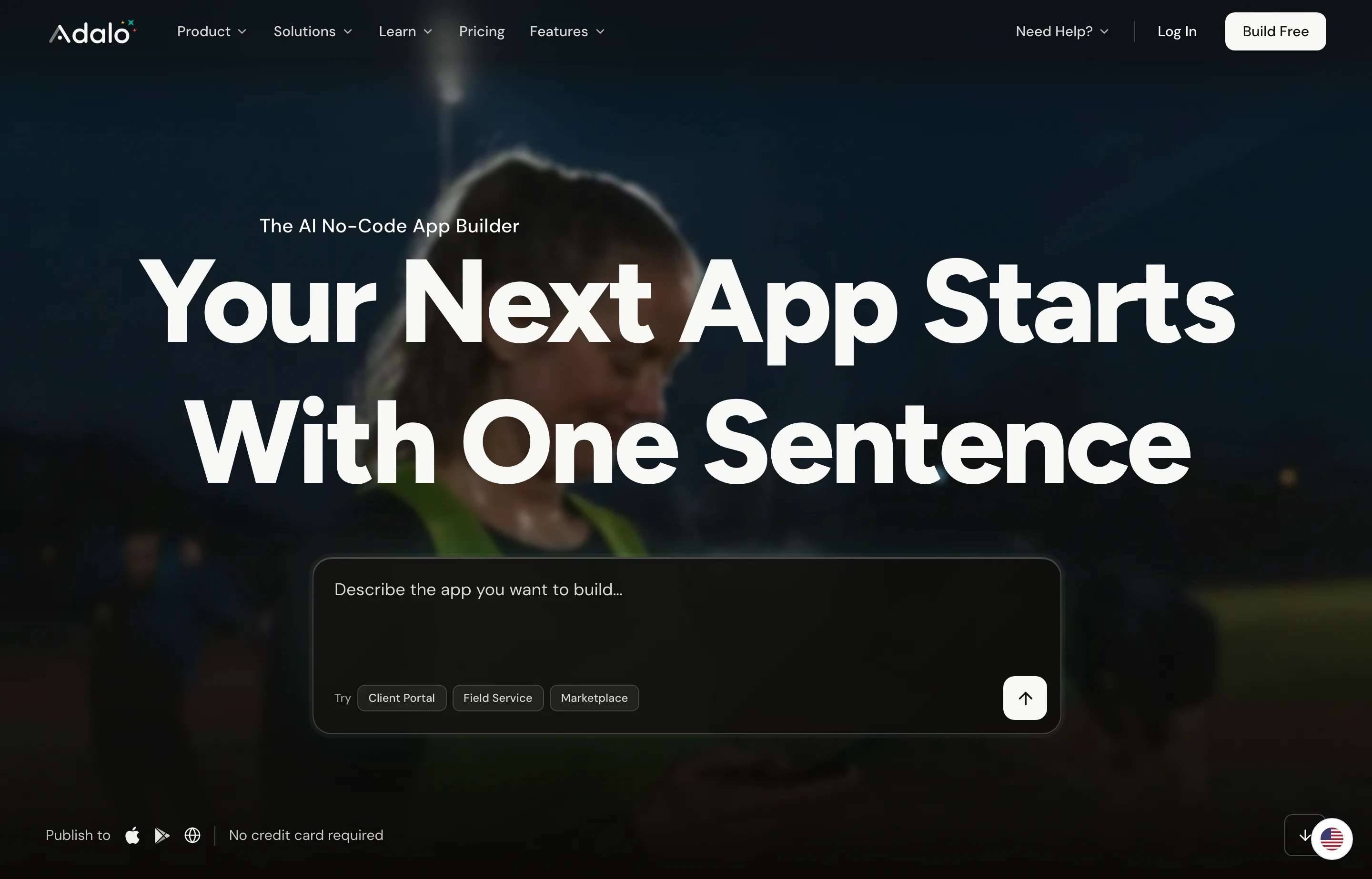
- Website
- adalo.com
- Category
- No-Code App Builders
- Pricing
- Free plan + paid tiers
- Starts at
- Free to build and test; publishing from $65/month
- Best for
- Founders and small agencies shipping a first app — internal tool, client portal, or marketplace — without hiring developers.
- Profile updated
- November 12, 2026
Independent profile — no affiliate links or sponsored placement.
Key features
- AI app generation from a plain-English description, producing screens, database tables, and basic logic
- Visual editor for screens, relationships, actions, and conditional visibility
- Native iOS and Android builds plus a responsive web app from one project
- App Store and Google Play submission handled by Adalo, with over-the-air updates for most changes
- Data sources include Adalo's own database, Google Sheets, Excel, Airtable, External Collections, and Xano
- Prebuilt app patterns for booking, chat, marketplaces, CRM, inventory, delivery, and internal tools
- Zapier and IAPHub integrations for automation and in-app purchases
- Component marketplace and feature templates, plus a free App Academy course library
Pricing
Read from Adalo's pricing page on 12 November 2026 (verify current):
- Free — $0. Build and test a complete app with up to 500 records; no publishing.
- Builder — $65/month, $175.50 per quarter (10% off), or $624/year (20% off). Includes AI building each month, two published apps, five app editors, and publishing to the App Store, Google Play, and web.
- Business — $200/month, $540 per quarter, or $1,920/year. Includes more AI building, five published apps, ten editors, and production features.
- Enterprise — custom pricing.
There are no usage caps on records for paid plans, but localization, crash monitoring, and analytics are sold as paid add-ons. Store fees are separate.
Pros and cons
Pros
- Real native builds and store submission, not just a web wrapper
- Free tier is enough to validate an idea with 500 records before paying
- One project covers iOS, Android, and web
- Large template and tutorial library shortens the first build
Cons
- $65/month before you can put an app in front of a customer — the highest entry price in this category
- Store fees add roughly $124 in the first year (Apple $99/year, Google $25 once)
- Complex logic and large datasets hit platform limits; this is not a substitute for custom code at scale
- Analytics, crash monitoring, and localization are extra-cost add-ons
Who should use Adalo?
Adalo fits a founder validating a mobile product, a small agency building client portals, or an owner replacing a spreadsheet with an internal app — booking apps, field-service tools, member directories, simple marketplaces. The free tier is a genuine prototype path; the $65/month decision comes when you have something worth publishing.
Do not choose it if you need heavy offline support, complex real-time collaboration, or deep custom integrations. x1 is a more guided iPhone-first path for a solo founder; Bubble and FlutterFlow give more control at the cost of a steeper learning curve.
Evidence, for context: Adalo says more than 2 million builders have made apps on the platform, and its site shows a long public gallery (vendor claim, read November 2026). We did not read a G2 or Capterra rating this run.
FAQs
Can I publish to the App Store with Adalo?+
Yes. The Builder plan ($65/month) includes two published apps with native iOS and Android builds that Adalo signs and submits, plus over-the-air updates for most changes. You still need your own Apple and Google developer accounts.
Is Adalo free?+
Building and testing is free with up to 500 records. Publishing is not — it starts at $65/month on Builder, or $200/month on Business for five published apps and ten editors.
Do I need to write code for Adalo?+
No. You build on a visual canvas, and Ada can generate screens, database structure, and logic from a description. You may want a developer later for performance tuning or unusual integrations, but the first version does not require one.
Adalo or x1?+
Adalo for web plus native apps, multiple published apps, and a mature template library. x1 for a guided iPhone-only MVP with a lower entry price. If you are testing one iPhone idea, x1 is cheaper; if you are building client apps or a web-and-mobile product, Adalo is the fuller platform.
Similar tools in the directory
No-Code App Builders
x1
Non-technical founders who want a guided path from iPhone app idea to App Store submission
Website Builders
Framer
Design-led founders, creators, and small agencies that want to publish polished marketing sites without a developer handoff.
Website Builders
Webflow
Freelancers and digital agencies building structured, custom client sites without maintaining a conventional codebase.
Free tools to try
Keep reading
Guide
Best AI Website Builders for Small Business (2026)
The best AI website builders for small businesses, compared by launch speed, editing control, SEO basics, booking and commerce fit, and real entry pricing.
Guide
The Small Business AI Stack: Tools for Every Job in 2026
A practical AI stack for small businesses — the tools that actually save time on marketing, content, SEO, and admin, organized by the job they do. Free where it counts.