Guide
Best AI SEO Tools for Ecommerce in 2026
Ecommerce SEO is a different job from blog SEO, because the pages that rank are products and categories, not articles. A Shopify store's organic traffic mostly comes from product pages competing against other stores' product pages — and, increasingly, against Amazon. A Jungle Scout survey cited by Practical Ecommerce found that 56% of online shoppers began a product search on Amazon's marketplace versus 42% on a traditional search engine — which means a store owner is really optimizing for two search engines at once: Google (their own store) and Amazon (if they sell there).
This guide is deliberately narrower than our general AI SEO tools roundup. It ranks the tools that do ecommerce-specific work: product and category-page optimization, the Shopify/BigCommerce/WooCommerce apps that fix on-page issues in bulk, product structured data, and Amazon/marketplace SEO. Prices are US figures checked against provider pages on October 28, 2026 — verify the current number before you subscribe.
Quick comparison
| Tool | Best for | Entry point | Ecommerce focus |
|---|---|---|---|
| Semrush | All-in-one with an ecommerce solution | SEO $139/mo | Keyword + AI visibility |
| CrawlRaven | AI-prioritized plan for a catalog | Starter $29/mo | Content + technical audit plan |
| Ahrefs | Deepest keyword/competitor data | Starter $29/mo | Product keyword research |
| SE Ranking | Budget all-in-one | Core $103.20/mo | Audit + rank tracking |
| Surfer SEO | Product/category copy optimization | Discovery $49/mo | Content scoring + AI visibility |
| Plug in SEO | Shopify bulk audit & fix | Starter $4.99/mo | Bulk on-page + schema |
| Avada SEO Suite | Shopify image + speed + SEO | Free; Pro ≈$35/mo | Speed + structured data |
| SEO King | Shopify breadth at low cost | 500 pages $9.99/mo | 50+ tools + llms.txt |
| Yoast | Product schema for Woo/Shopify | From $118.80/yr | Product rich results |
| Rank Math | WooCommerce schema depth | PRO €7.99/mo | 840+ schema types |
| Screaming Frog | Technical crawl of a catalog | Free to 500 URLs | Duplicate/schema audit |
| Helium 10 | Amazon listing & keyword SEO | Platinum $129/mo | Amazon search |
| Jungle Scout | Amazon keyword research | Catalyst Starter $49/mo | Amazon search |
What we looked for
We weighted each tool on ecommerce-specific leverage: does it improve product and category pages, handle a large catalog, generate or validate product structured data, or optimize for Amazon's separate search algorithm? We checked live pricing pages and public review listings, and we are explicit where a price is demo-gated or geolocated rather than inventing a number. Ratings below come from the Shopify App Store where verified, or are labeled as vendor-displayed.
All-in-one SEO suites
1. Semrush — best all-in-one with an ecommerce solution
Semrush has the broadest toolset here and a dedicated Retail & Ecommerce solution page: product keyword research, daily rank tracking, competitor and keyword-gap benchmarking, site audits, and AI-visibility tracking. It is the right pick when you want one subscription to cover SEO, competitor research, and AI search.
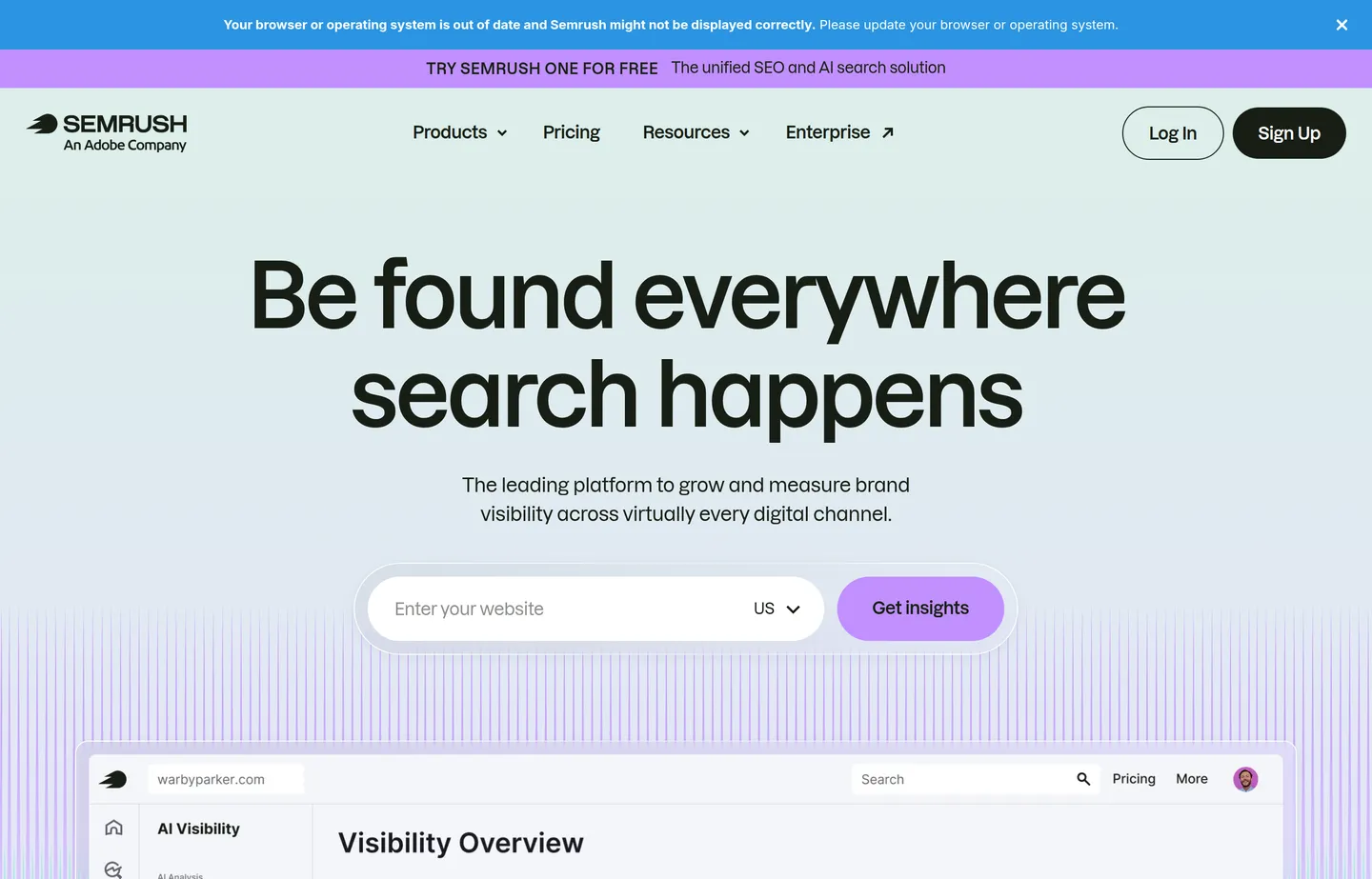
- Key ecommerce features: product keyword research (Keyword Magic), daily rank tracking across devices and markets, competitor/keyword-gap benchmarking, Site Audit crawl, and AI visibility tracking.
- Pricing: read from Semrush's pricing page on October 28, 2026: SEO $139/mo ($117.33/mo billed annually), Starter $199/mo, Pro+ $299/mo, Advanced custom, plus a free tier. 7-day free trial.
- Pros: the most complete toolset; strong tutorials; the ecommerce solution is well-documented.
- Cons: pricier than SE Ranking at entry; feature sprawl can overwhelm a solo owner.
- Reviews: Capterra shows 4.6/5 across 2,328 Semrush reviews as of September 2026 in our other guides (suite-wide).
2. CrawlRaven — best AI-prioritized plan for a large catalog
CrawlRaven joins your Google Search Console and GA4 data, your imported Ahrefs or Semrush keyword lists, and a 200-point technical crawl into one ranked to-do list. For a store with hundreds of product and category pages, that prioritization is the product: a crawl of a big catalog finds thousands of issues, and CrawlRaven sorts them by severity and the search traffic behind each page, so you fix the ten that matter this week instead of triaging a spreadsheet. It has a dedicated ecommerce SEO audit, and its own FAQ confirms Shopify and ecommerce support.
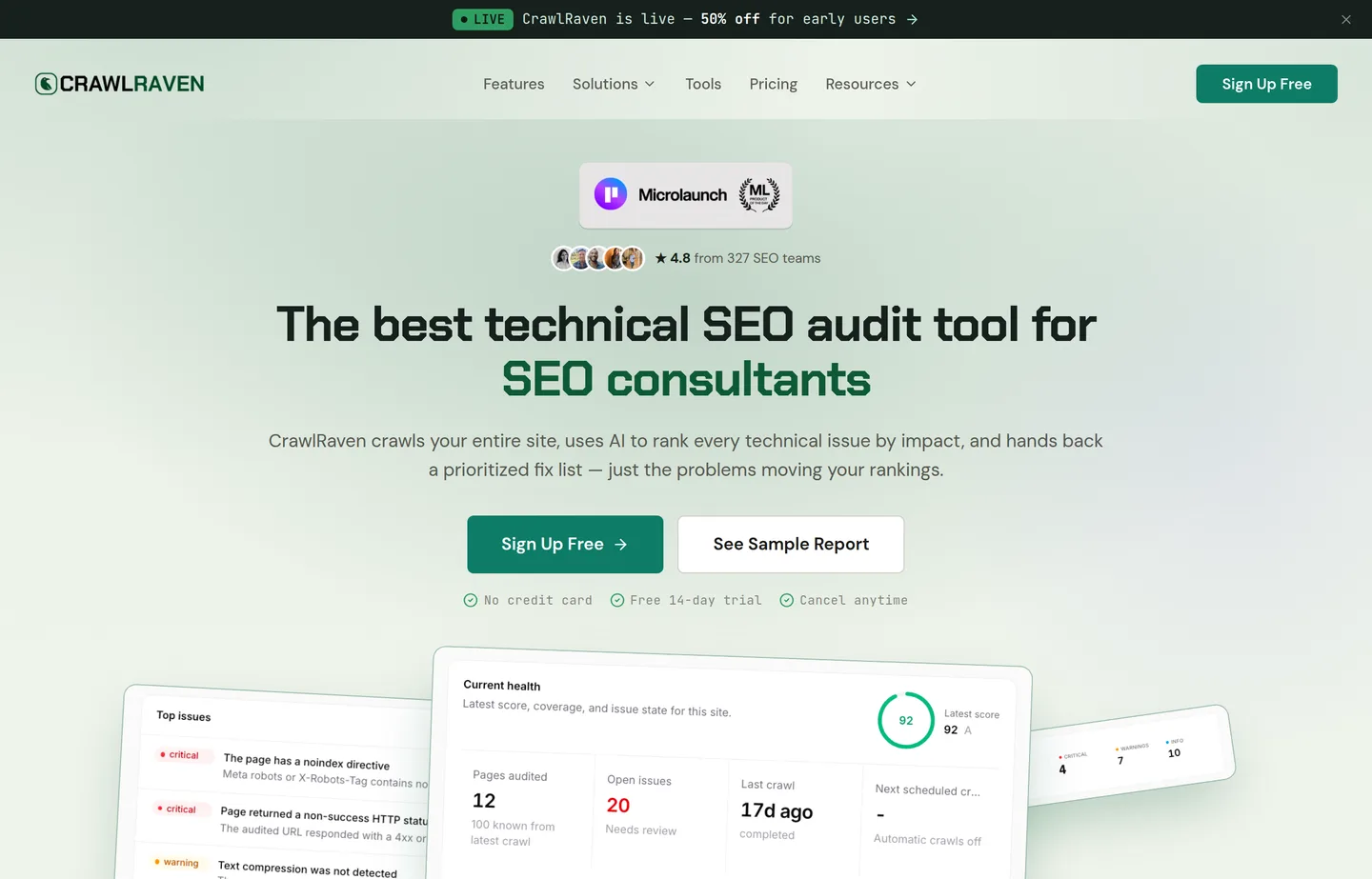
- Key ecommerce features: GSC query/page/position analysis, GA4 traffic and engagement context, imported Ahrefs/Semrush keyword lists, a 200-point technical crawl (Core Web Vitals, schema, redirects), cannibalization and decay flags, content gaps, and a read-only MCP server for AI assistants.
- Pricing: read from CrawlRaven's site on October 28, 2026: 7-day free trial (1 site, no card), Starter $29/mo (1 site), Pro $39/mo (3 sites; $390 one-time lifetime), Agency from $199/mo (20 sites; $1,990 one-time lifetime). Extra sites are $10/mo each.
- Pros: the only tool here that turns your *own* store data into a weekly plan; a free trial that needs no card; lifetime options on Pro and Agency can beat a recurring bill.
- Cons: it complements rather than replaces a keyword/backlink database (that is Ahrefs or Semrush); a younger product with a shorter independent-review history; lifetime/batch pricing has changed before — confirm the current number.
3. Ahrefs — best for product-keyword and competitor research
Ahrefs has the deepest keyword, backlink, and competitor data. For a store, that means finding the product and comparison keywords your category actually searches, seeing which product and category pages win for them, and crawling a large catalog for technical issues. It has no Amazon module — Amazon search is a separate engine — but for Google SEO on your own domain it is the data benchmark.
- Key ecommerce features: Keywords Explorer (keyword difficulty and intent), Site Explorer (competitor pages and backlinks), Site Audit (100k–1.5M+ crawl credits), Rank Tracker, and AI features.
- Pricing: read from Ahrefs' pricing page on October 28, 2026: Starter $29/mo, Lite $129/mo, Standard $249/mo, Advanced $449/mo, Enterprise $1,499/mo, plus a limited free plan. Annual billing saves up to 17%.
- Pros: best-in-class backlink and keyword data; strong competitor research; generous free tools.
- Cons: no ecommerce/Amazon-specific module; no free trial (only a limited free plan); the paid entry tier is steep for a small store.
- Reviews: G2 lists Ahrefs at 4.5/5 across 714 reviews as checked in September 2026 (suite-wide).
4. SE Ranking — best value all-in-one
SE Ranking is the budget-friendly all-in-one: rank tracking, website audit, an on-page checker, a SERP analyzer, backlink monitoring, and local marketing. It is the best price-to-capacity option for auditing an ecommerce catalog and tracking product-page keywords without Ahrefs or Semrush pricing.
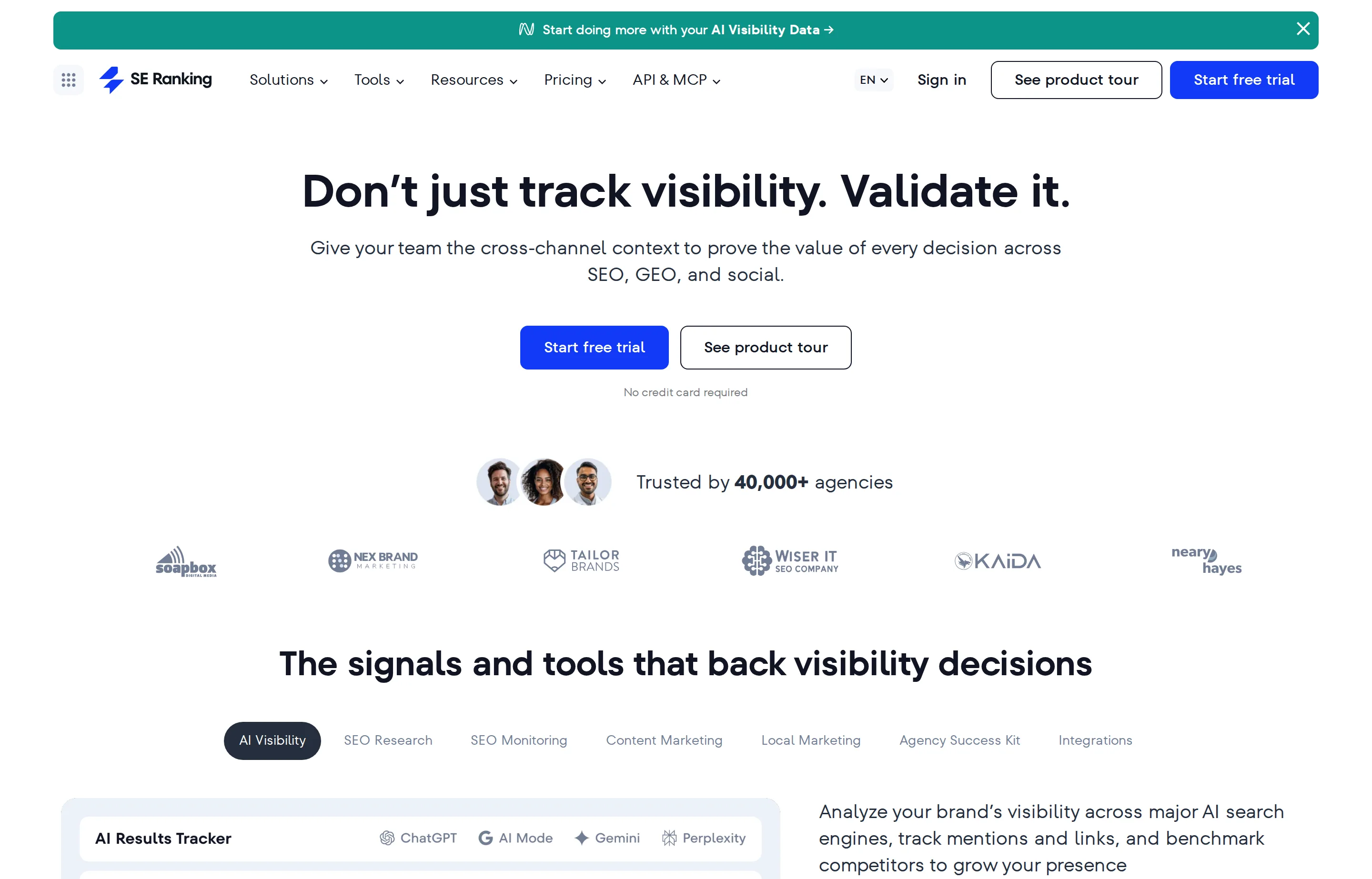
- Key ecommerce features: website audit (250k–2M pages/month), on-page checker and SERP analyzer, rank tracking, content marketing tools, and local marketing.
- Pricing: read from SE Ranking's pricing page on October 28, 2026: Core $103.20/mo billed annually ($129 monthly), Growth $223.20/mo annually ($279 monthly), Enterprise custom. 14-day free trial (no card). Add-ons: Agency Pack +$69/mo, AI Search +$71.20/mo.
- Pros: strong value; clean UI; high audit capacity per dollar.
- Cons: smaller link/keyword index than Ahrefs or Semrush; no marketplace/Amazon tools; AI-search features cost extra.
Content and product-page optimization
5. Surfer SEO — best for scoring product and category copy
Surfer SEO scores your content against the pages already ranking and now tracks AI-search visibility across ChatGPT, Gemini, and AI Overviews. It has a dedicated eCommerce solution page, and for a store it is most useful for product and category-page copy that is written to rank — not just to describe the item.
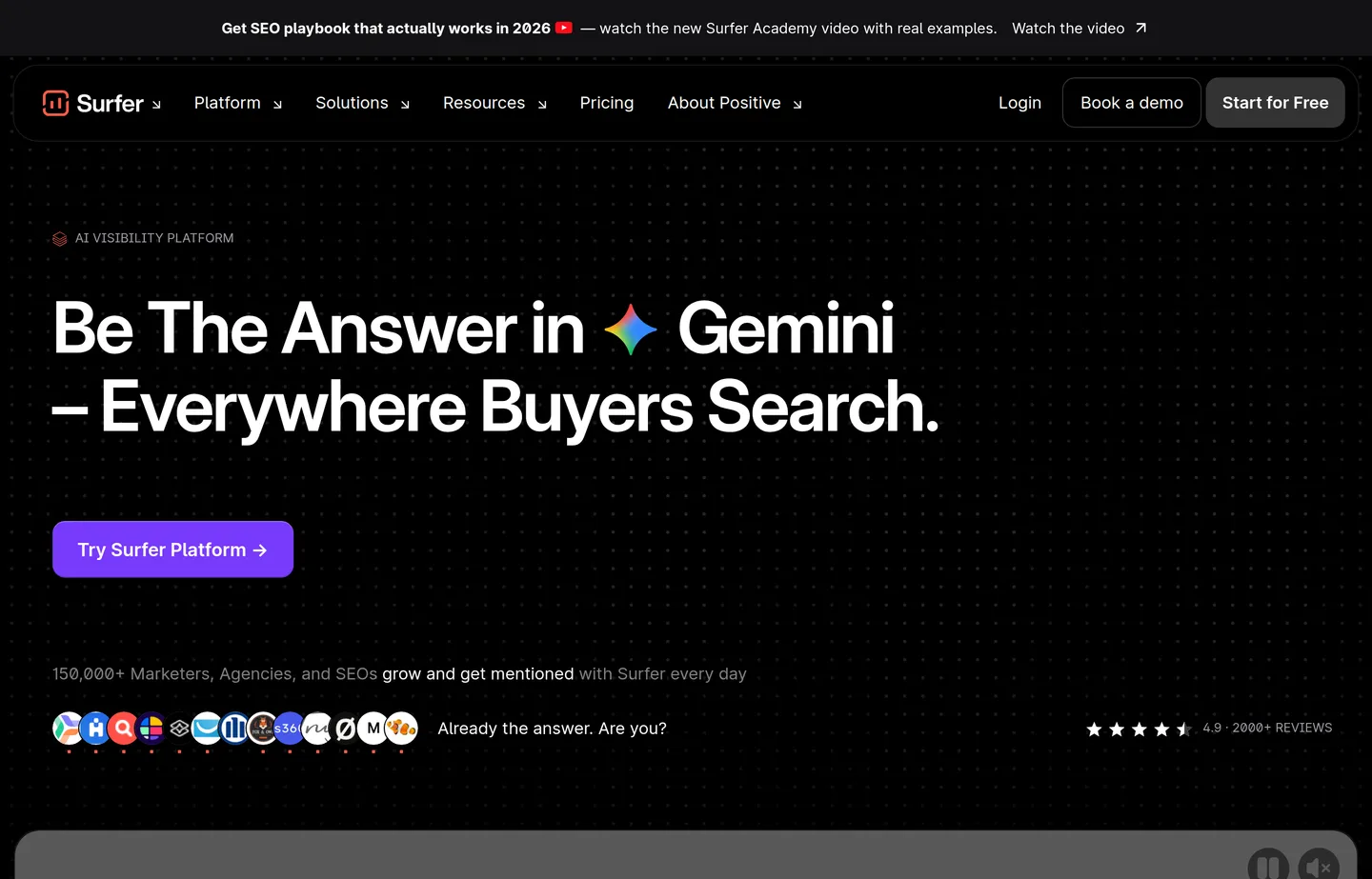
- Key ecommerce features: Content Editor with a real-time content score, Topical Map, AI Visibility tracking, AI SEO optimization, and 1-click internal linking plus a cannibalization report.
- Pricing: read from Surfer's pricing page on October 28, 2026 (billed yearly): Discovery $49/mo, Standard $99/mo, Pro $182/mo, Peace of Mind $299/mo, AI Search Analytics $82/mo, Enterprise custom.
- Pros: fast, actionable content scores; strong AI-search features; Shopify/WordPress/Google Docs integrations.
- Cons: no keyword/backlink research depth; article-centric — product-page schema and speed are not its focus; credit-based "documents."
- Reviews: Surfer's own footer displays G2 4.8/5 (500+ reviews) and Capterra 4.9/5 (400+ reviews) — vendor-displayed figures we did not independently re-verify in October 2026.
Shopify & WooCommerce SEO apps
6. Plug in SEO — best Shopify bulk audit and fix
Plug in SEO scans every page of a Shopify store and lets you bulk-fix alt text, file names, URLs, and meta tags, and add schema/JSON-LD and AI-written titles and descriptions. Its pitch is explicit about the reason: get cited in AI search, not just ranked on Google.
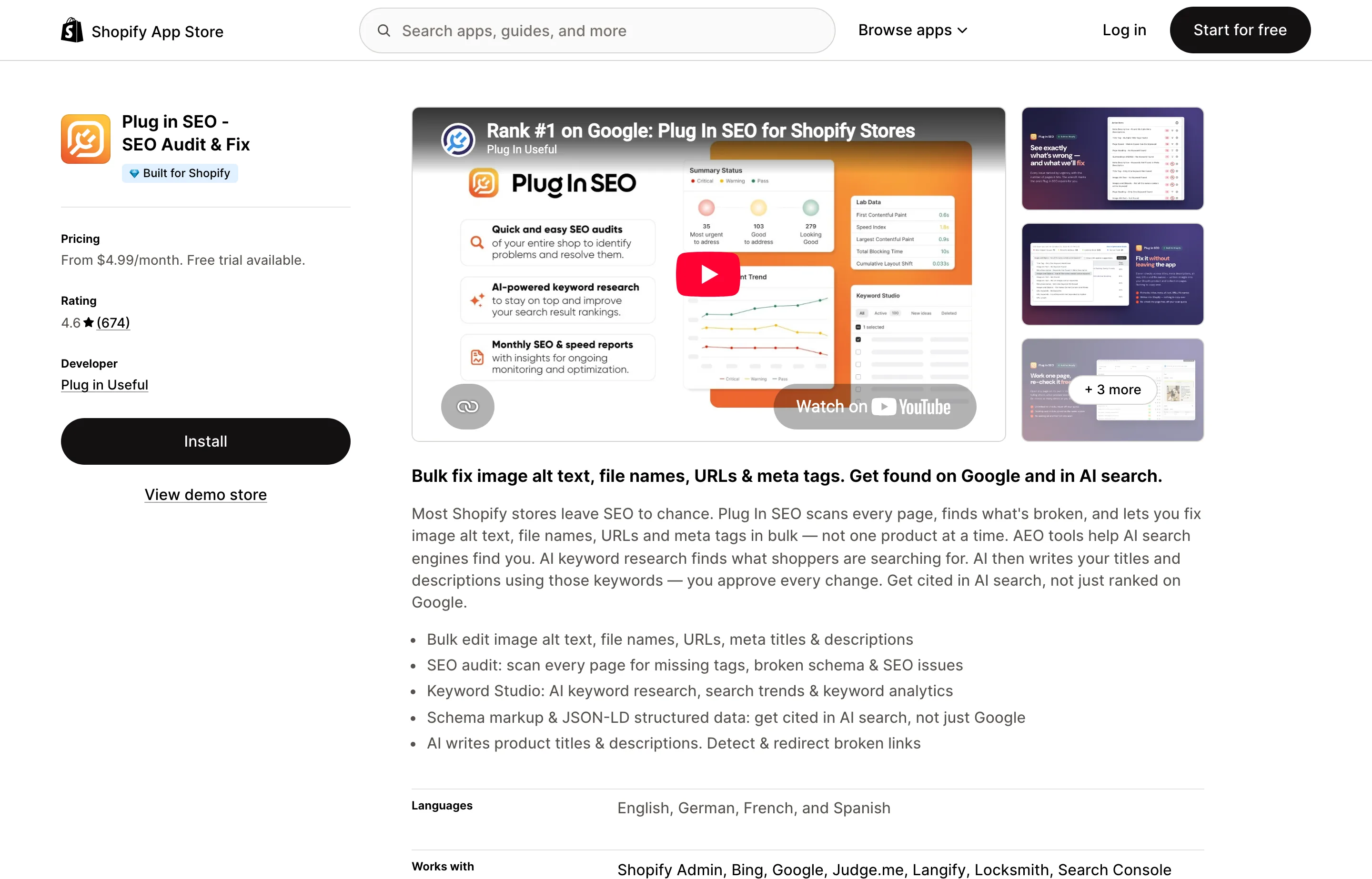
- Key ecommerce features: bulk alt text/file names/URLs/meta edits, SEO audit, Keyword Studio (AI keyword research), schema/JSON-LD, AI titles and descriptions, and broken-link redirects.
- Pricing: read from the Shopify App Store listing on October 28, 2026: Starter $4.99/mo (30 pages), Lite $29.99/mo (200), Standard $49.99/mo (2,000), Premium $79.99/mo (unlimited). Free trial available.
- Pros: true bulk editing; strong value at $4.99–$49.99; long track record.
- Cons: AI/audit tiers are capped by page count; some reviewers report leftover code on uninstall.
- Reviews: 4.6 stars (674 reviews) on the Shopify App Store, verified October 2026.
7. Avada SEO Suite — best Shopify image + speed + SEO in one
Avada SEO Suite combines an AI SEO audit with image compression, alt-text automation, page-speed optimization, and structured data for Shopify. Its huge review base reflects that it bundles several jobs a Shopify owner would otherwise buy separately.
- Key ecommerce features: AI SEO Audit Agent (one-click fixes), image compression and alt text, page-speed/LCP optimization, structured data/sitemap/redirects, and an SEO checklist with answer-engine optimization.
- Pricing: read from the Shopify App Store listing on October 28, 2026: Free, Pro ≈$34.93/mo, Enterprise ≈$98.94/mo (the App Store served prices in INR; USD figures computed from the vendor's stated 1 INR = 0.0105 USD rate). 7-day free trial.
- Pros: a very large, high-rated review base; combines speed and SEO; free tier available.
- Cons: paid pricing is geolocated (INR); heavier on image/speed than keyword research.
- Reviews: 4.9 stars (4,681 reviews) on the Shopify App Store, verified October 2026.
8. SEO King — best Shopify breadth at a low flat price
SEO King packs 50+ tools into a low flat monthly price: SERP audits, image optimization, JSON-LD and llms.txt, backlink and broken-link tools, image sitemaps, Core Web Vitals, and GSC analytics, with bulk AI content via MCP. Note that its premium AI services are billed separately through an in-app credit balance.
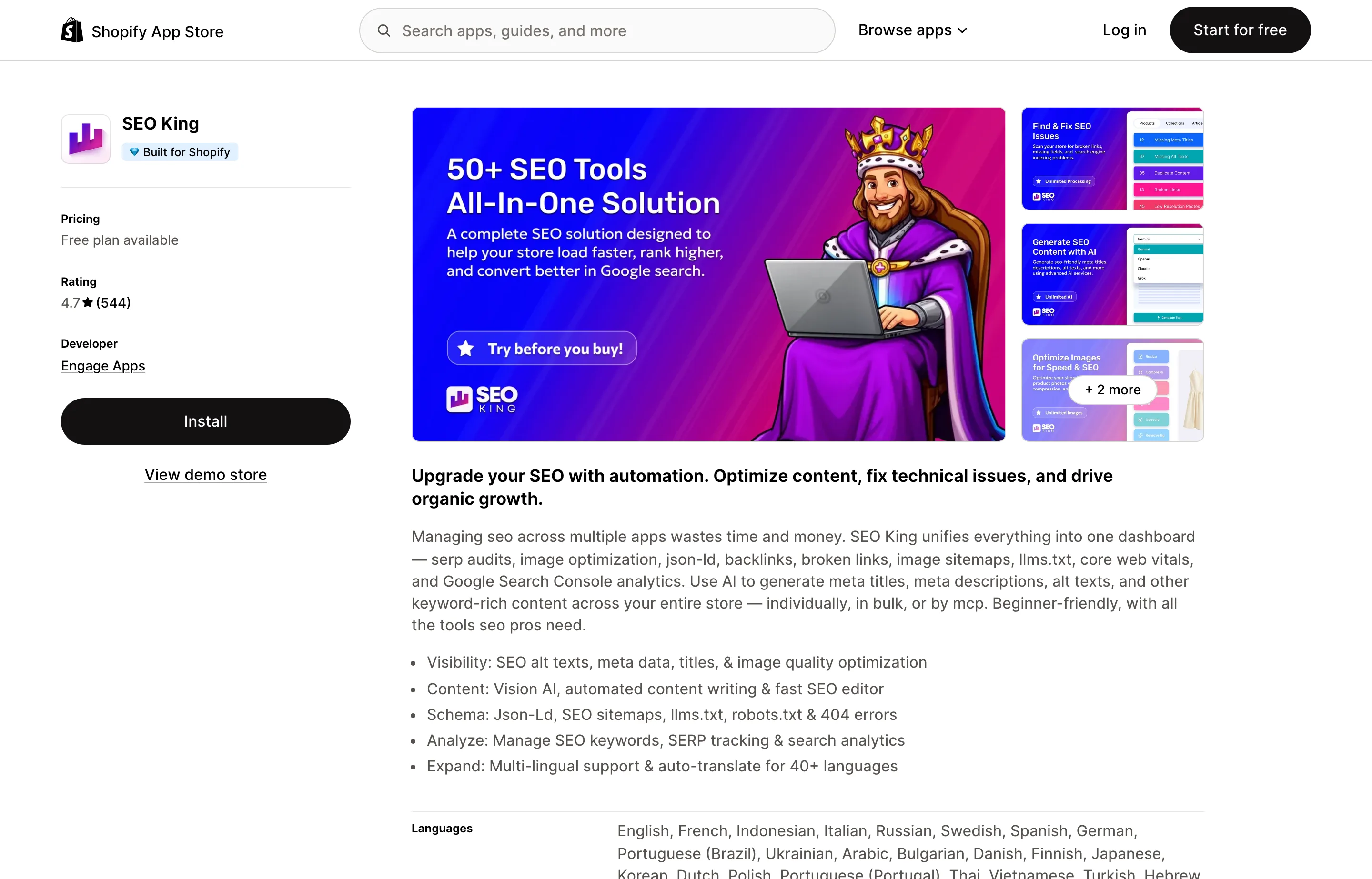
- Key ecommerce features: JSON-LD and llms.txt, image optimization (alt text, compression, upscale), bulk AI meta/alt content, SERP/keyword tracking, and 40+ languages with auto-translate.
- Pricing: read from the Shopify App Store listing on October 28, 2026: Free, 500 Pages $9.99/mo ($69.99/yr), 5,000 Pages $13.99/mo ($79.99/yr), 20,000 Pages $16.99/mo ($99.99/yr). Premium AI services are billed separately.
- Pros: very low cost for the feature breadth; bulk and MCP workflows; strong multilingual.
- Cons: some AI features cost extra credits (flagged in reviews); page-count tiers.
- Reviews: 4.7 stars (544 reviews) on the Shopify App Store, verified October 2026.
9. Yoast — best product schema for WooCommerce and Shopify
Yoast is the most-installed WordPress SEO plugin, and its WooCommerce and Shopify products are built around product structured data: price, availability, ratings, and identifiers that make products eligible for rich results. It also generates optimized product sitemaps that skip cart, checkout, and filter pages.
- Key ecommerce features: product schema (price, stock, ratings, identifiers), optimized product sitemaps, AI titles/descriptions/alt text, breadcrumbs and canonicals, and llms.txt.
- Pricing: read from Yoast's product pages on October 28, 2026: Yoast SEO Premium $118.80/yr (ex VAT), Yoast WooCommerce SEO $178.80/yr (ex VAT), and Yoast SEO for Shopify from $19 USD/30 days (AI+ for Shopify $45/mo). 14-day free trial on Shopify.
- Pros: a trusted brand; genuinely product-aware schema and sitemaps; covers both WooCommerce and Shopify.
- Cons: the Shopify app is shallower than WooCommerce; per-site/year pricing adds up; AI features are an upsell.
- Reviews: 4.3 (175 reviews) for Yoast SEO for Shopify on the Shopify App Store, verified October 2026.
10. Rank Math — best WooCommerce schema depth
Rank Math is the WordPress/WooCommerce SEO plugin with the deepest schema support — a dedicated WooCommerce SEO PRO module plus 840+ schema types and a custom schema builder. For a WooCommerce store, it is the cheapest way to get rich product, review, and offer markup right in the dashboard.
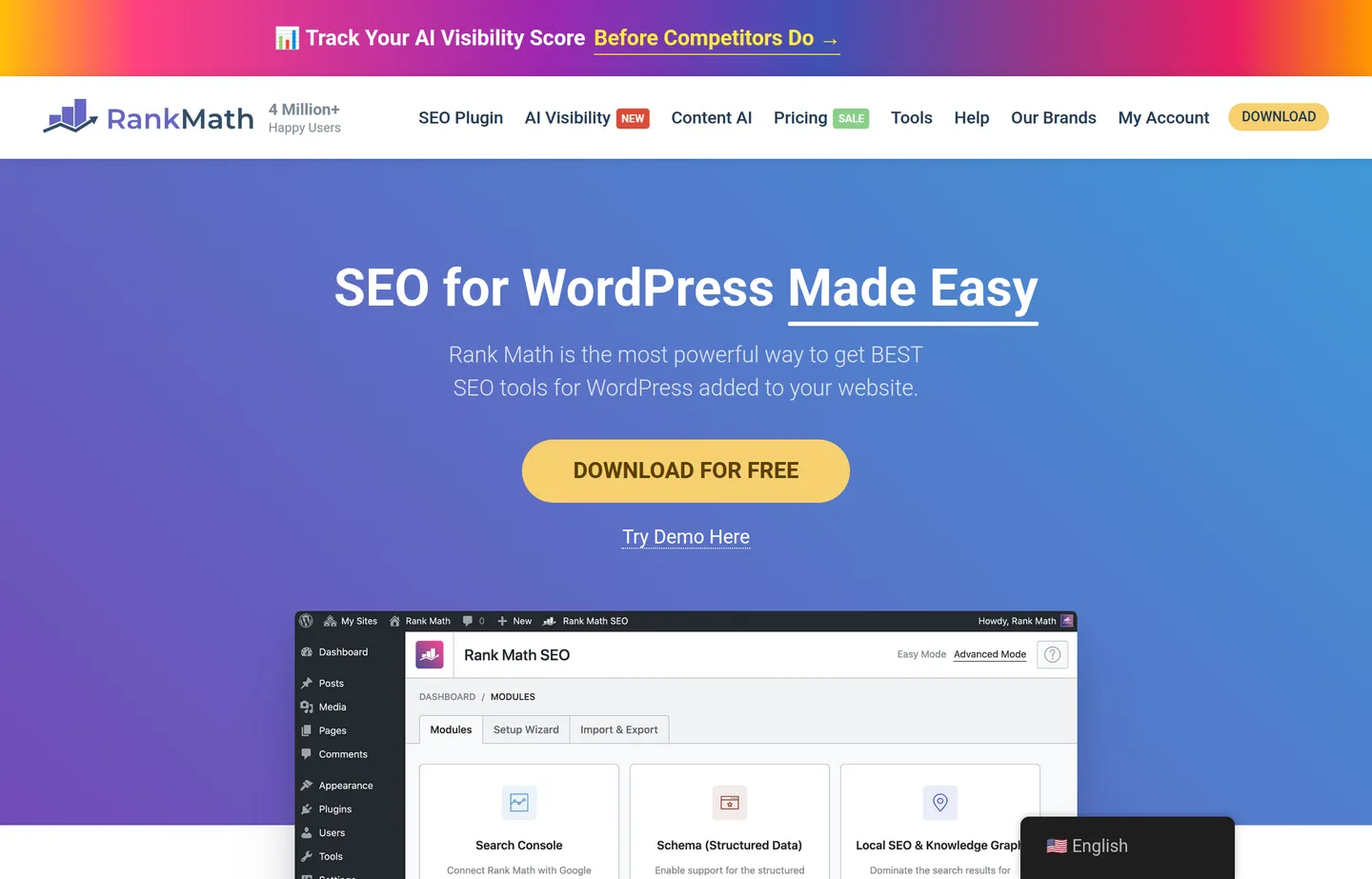
- Key ecommerce features: WooCommerce SEO PRO (included in paid plans), Product/Review/Offer schema, 840+ schema types, local SEO, and AI content features.
- Pricing: read from Rank Math's pricing page on October 28, 2026 (EUR, billed annually, ex VAT): Free, PRO €7.99/mo, Business €24.99/mo, Agency €54.99/mo.
- Pros: very affordable; unmatched schema depth for the price; a capable free tier.
- Cons: WordPress/WooCommerce only (not Shopify); prices quoted in EUR; AI is a separate add-on.
Technical crawling
11. Screaming Frog — best technical crawl of a catalog
Screaming Frog SEO Spider is the de-facto standard for ecommerce technical audits. It crawls every URL in a store and flags duplicate product pages, broken links, missing titles, redirect chains, and validates product structured data — the issues that silently eat a catalog's crawl budget.
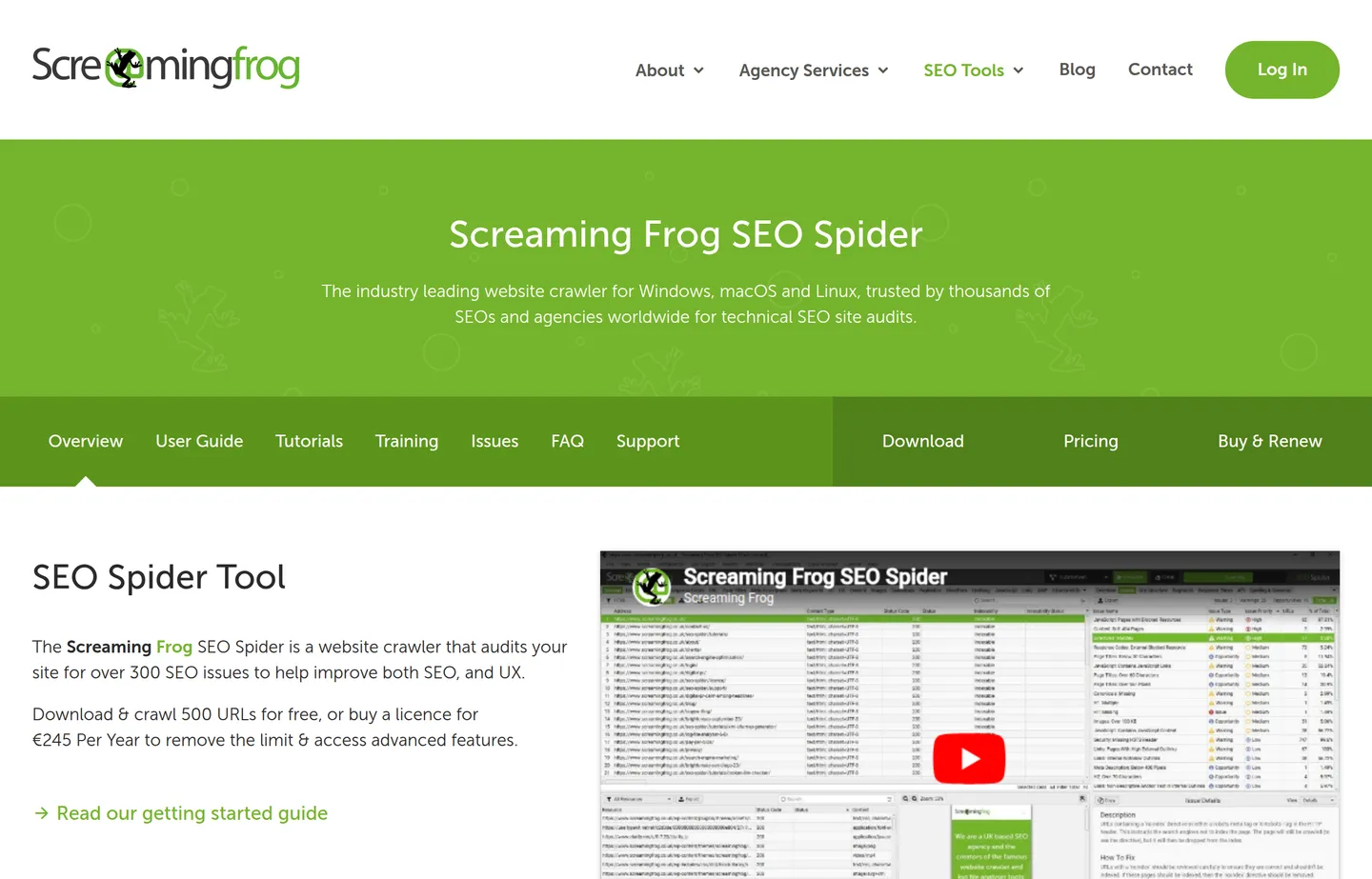
- Key ecommerce features: structured-data validation, exact/near-duplicate content detection, XML sitemap generation, hreflang audit, JavaScript rendering, and AI-assisted crawl analysis.
- Pricing: read from Screaming Frog's pricing page on October 28, 2026: free up to 500 URLs; a paid licence is £199/year per user (volume discounts for 5+ licences). The vendor displays GBP with a currency toggle we did not capture.
- Pros: one flat price, no monthly cap; extremely thorough; a genuinely useful free tier.
- Cons: a desktop app (not cloud); a steeper learning curve; no rank or backlink data.
Amazon & marketplace SEO
12. Helium 10 — best Amazon listing and keyword SEO
Helium 10 is the leading all-in-one Amazon seller suite, and its "SEO" is for Amazon's search algorithm: reverse-ASIN keyword research (Cerebro), keyword research (Magnet), listing building and analysis, and rank tracking. If you sell on Amazon, this is the equivalent of Ahrefs for that marketplace.
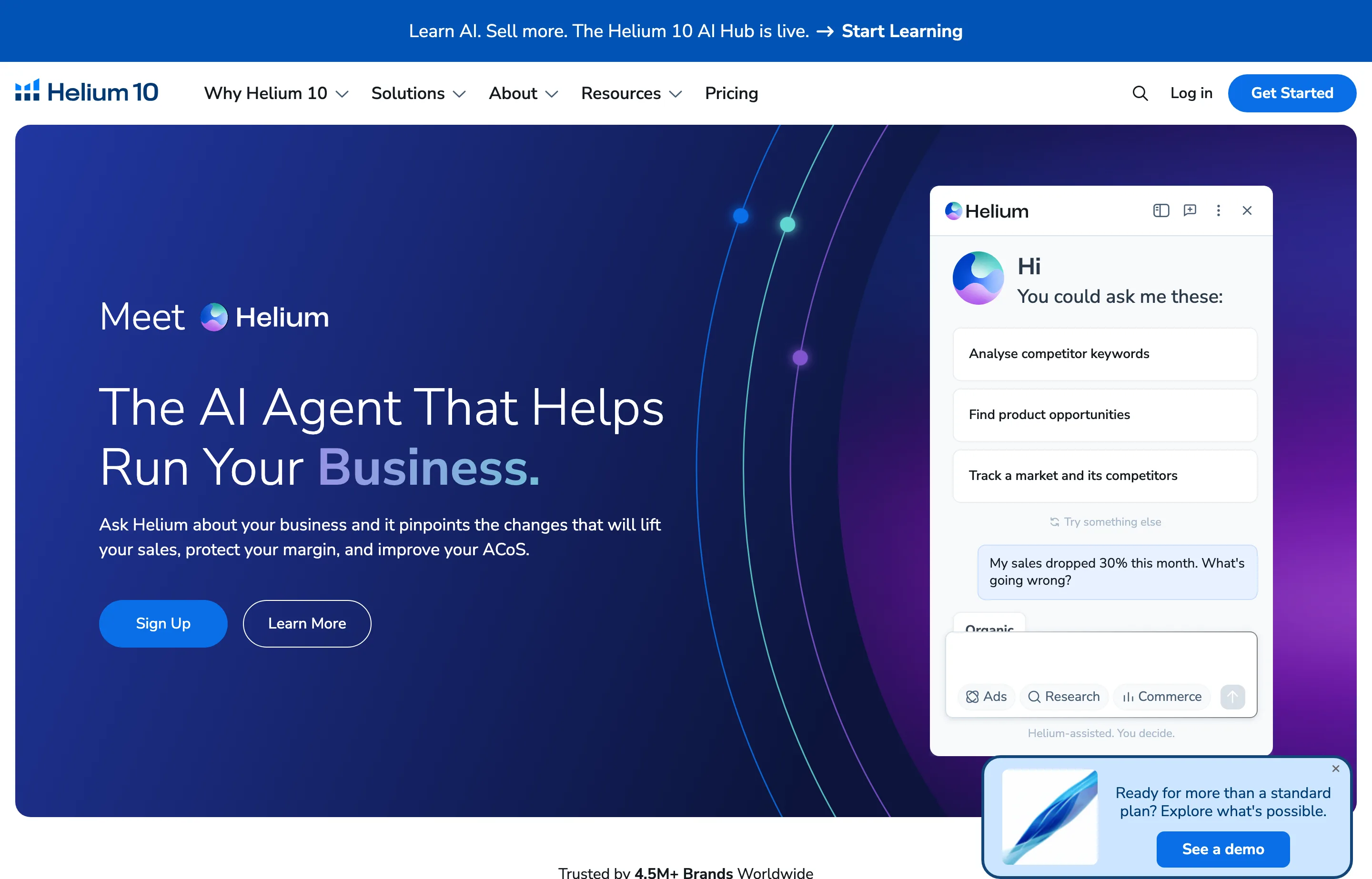
- Key ecommerce features: Cerebro (reverse-ASIN keywords) and Magnet (keyword research), Listing Builder/Analyzer, Keyword Tracker, product research (Black Box/Xray), and Helium AI Agent with MCP.
- Pricing: read from Helium 10's pricing page on October 28, 2026: Platinum $129/mo ($99/mo billed yearly), Diamond $359/mo ($279/mo yearly), Enterprise $1,499/mo (annual). A free plan exists; yearly saves up to 20%.
- Pros: the deepest Amazon-specific SEO toolset; huge marketplace coverage; strong AI features.
- Cons: pricey at Diamond; Amazon-focused (no Google SEO); steep for casual sellers.
13. Jungle Scout — best Amazon keyword research for smaller sellers
Jungle Scout is the other big Amazon research suite, now split into Catalyst for small and growing sellers and Cobalt for enterprise brands. Its Keyword Scout and listing tools cover the same Amazon-SEO job as Helium 10 at a friendlier entry price.
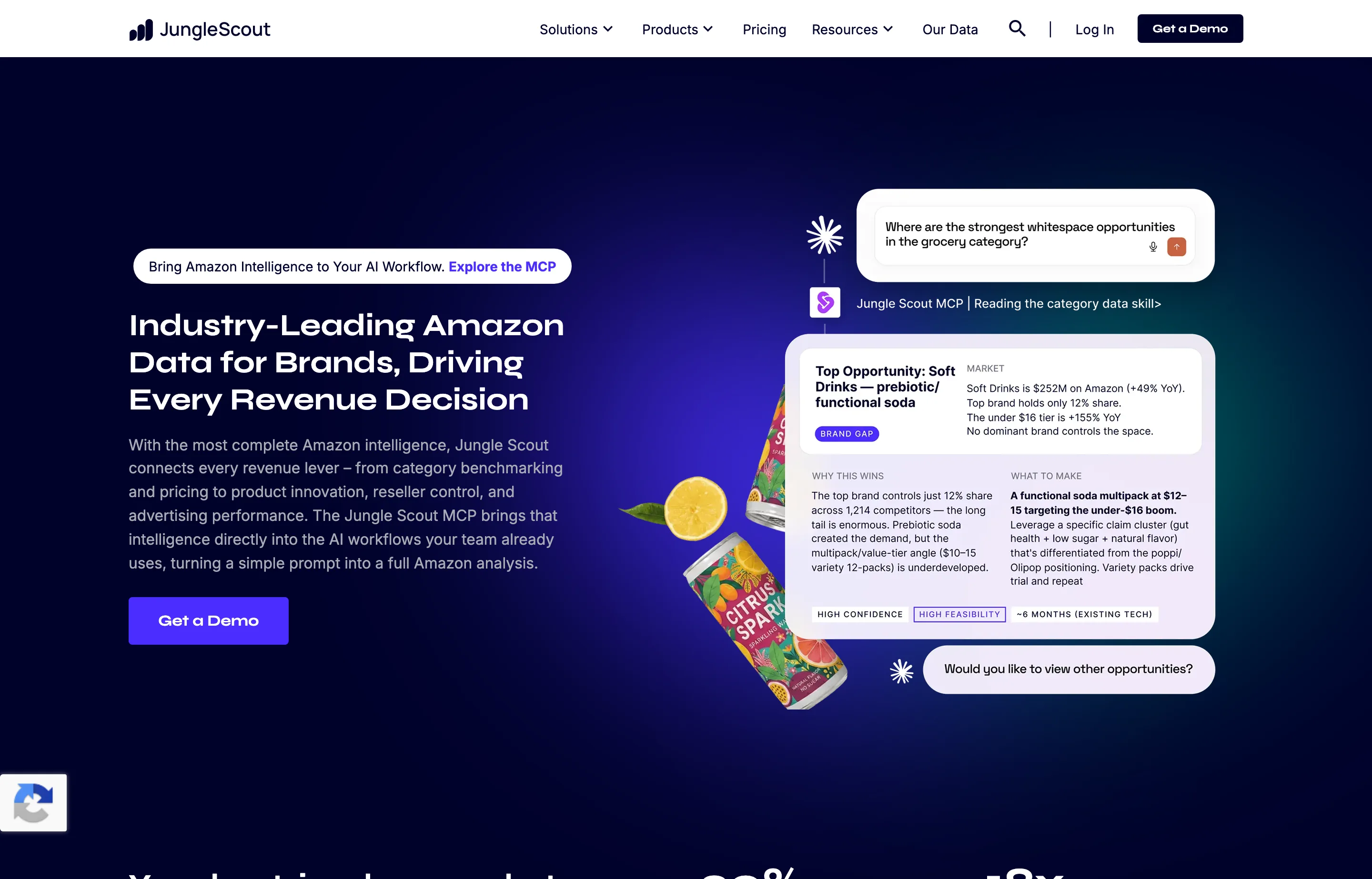
- Key ecommerce features: Keyword Scout, product database and Opportunity Finder, Listing Builder/Analyzer, rank tracking, and competitive intelligence (Brand Owner tier).
- Pricing: read from Jungle Scout's Catalyst plans on October 28, 2026: Starter $49/mo ($348/yr), Growth Accelerator $79/mo ($588/yr), Brand Owner + CI $149/mo ($1,548/yr). Cobalt is demo/custom. No free trial (7-day money-back).
- Pros: trusted data (the vendor cites 1M+ customers); clear tiering by revenue; strong tutorials.
- Cons: no free trial (money-back only); Cobalt pricing is opaque; Amazon-only.
Which should you choose?
- You sell only on your own Shopify/BigCommerce/WooCommerce store: start with Semrush or Ahrefs for keyword and competitor data, and add Surfer SEO for product and category copy. If you are on Shopify, Plug in SEO or Avada SEO Suite handle the bulk on-page and schema work inside the platform.
- You are budget-constrained: SE Ranking for the all-in-one, and SEO King at $9.99/mo if you are on Shopify.
- You sell on Amazon too: Helium 10 (depth) or Jungle Scout (entry price) for Amazon SEO — it is a separate search algorithm and none of the Google tools above cover it.
- You need a technical audit of a large catalog: CrawlRaven for the AI-prioritized to-do list, or Screaming Frog for a hands-on crawl — free to 500 URLs, one flat fee after that.
- Everyone, first: generate product schema with our free Schema Markup Generator, write accurate product titles and descriptions with the Product Description Generator, and check pages with the Website SEO Checker.
A note on the demo-gated enterprise tools we left out of the ranking: MarketMuse, Lumar (formerly DeepCrawl), OnCrawl, and Sitebulb all do real ecommerce SEO work but hide pricing behind "book a demo," so we cannot honestly rank their value for a small business. They are worth a look at mid-market scale, not at the entry tier this list is aimed at.
Free on-page tools from Small Business Tools
Product pages win rich results when the structured data is correct, the titles fit Google's display limits, and the descriptions match what shoppers actually search. Our free, no-signup tools handle exactly that, alongside whichever paid tool you pick.
- Generate product and review schema — the Schema Markup Generator outputs valid JSON-LD for Product, Offer, Review, and FAQ, which is what gets price, availability, and star ratings into search results.
- Write titles and descriptions that fit — the Meta Tags Generator builds title and description tags within length limits, and the SERP Snippet Preview shows how the result will look.
- Draft product copy — the Product Description Generator turns a short spec into listing copy you can edit for accuracy.
- Audit a page fast — the Website SEO Checker runs a 20-point on-page check, and the Image Alt Text Checker flags weak or missing alt text on your product images.
For the platform decision behind all of this, see best ecommerce platforms for small business.
FAQs
What is the best SEO tool for a Shopify store?+
For on-page work inside Shopify, Plug in SEO (bulk audit and fix, from $4.99/mo), Avada SEO Suite (image + speed + SEO, ≈$35/mo), or SEO King (50+ tools from $9.99/mo) are the strongest reviewed options. Pair one of them with a keyword-research suite like Semrush or Ahrefs if you are doing competitive research, and add Surfer SEO if you are optimizing product and category copy.
Do I need different SEO tools for Amazon?+
Yes. Amazon's search algorithm is separate from Google's, and none of the Google SEO suites cover it. Helium 10 and Jungle Scout are the two big Amazon keyword-research and listing-optimization suites; if you sell on Amazon and your own site, budget for both jobs.
What is product structured data, and why does it matter for ecommerce?+
Product structured data (schema.org Product, Offer, Review, and AggregateRating) tells Google your price, availability, and ratings in a format it can read directly, which is what makes products eligible for rich results like star ratings and price in the search results. Tools that generate it include Yoast, Rank Math, Plug in SEO, and our free Schema Markup Generator.
Are these AI tools actually necessary, or can I do ecommerce SEO manually?+
You can do the basics manually, but for a catalog of more than a handful of products the math favors tools: bulk alt-text and meta fixes, duplicate-page detection, and schema validation are all things a tool does across hundreds of URLs in minutes that would take days by hand. The AI layer mostly turns a wall of audit warnings into a short, prioritized to-do list.
How much should a small ecommerce store spend on SEO tools?+
Enough to cover the specific job you are weak at, and no more. A Shopify store might spend $30–50/mo on a good app plus one keyword-research suite when competitive research starts to matter; an Amazon seller adds $49–129/mo for a marketplace suite. Avoid stacking overlapping all-in-one subscriptions — one suite plus one platform app usually beats two suites.
Do these tools work for WooCommerce?+
Several do. Rank Math and Yoast are the two WordPress/WooCommerce SEO plugins with deep product-schema support. The all-in-one suites (Semrush, Ahrefs, SE Ranking) and technical crawlers (Screaming Frog) work across any platform, including WooCommerce.
Final take
Ecommerce SEO is won on the pages shoppers actually land on — products and categories — not on a blog. The highest-leverage stack is one keyword-research suite (Semrush, Ahrefs, or SE Ranking), one platform app that fixes on-page issues in bulk (Plug in SEO, Avada, or SEO King on Shopify; Yoast or Rank Math on WooCommerce), and product schema done right, whether that is a paid tool or our free Schema Markup Generator. If you sell on Amazon, treat it as a second search engine and add Helium 10 or Jungle Scout. Start with the free on-page basics and one app that fits your platform, then graduate into a paid suite only when competitive research starts paying for itself.
Free tools to try
Schema Markup Generator
Generate FAQ, Local Business, and Product JSON-LD you can paste into any page.
Meta Tags Generator
Title, description, Open Graph, and Twitter tags as one copy-paste snippet.
Product Description Generator
2 benefit-led descriptions with scannable bullets — sized for your site, Etsy, or Amazon.
Website SEO Checker
A 20-point technical SEO check of any page — clear pass/fix results, honest limits.
SERP Snippet Preview
See your title and description exactly as Google shows them — before you publish.
Keep reading
Guide
Best Ecommerce Platforms for Small Business (2026)
13 store platforms plus Etsy and Amazon, ranked by real year-one cost — subscription + fees + apps — with the total-cost-of-ownership decoder.
Guide
Best AI SEO Tools for Small Businesses in 2026
The SEO tools that give small businesses a real edge in AI search — paid data suites, AI audits like CrawlRaven, PikaSEO's free suite, and the free essentials.
Guide
Best SEO Tools for Small Business (2026)
The SEO tools small businesses should actually use: free Search Console and Bing data, paid research suites, crawlers, WordPress plugins, and fast on-page fixes.