Guide
Best AI SEO Tools for Brand Monitoring in 2026
Your pages can rank well in Google and still be missing when someone asks ChatGPT, Gemini, or Perplexity for a recommendation. In a Pew Research Center study of Google browsing behavior, people clicked a traditional result on 8% of visits when an AI summary appeared, compared with 15% when it did not. That finding covers Google AI summaries, not every AI assistant, but it shows why a ranking alone gives an incomplete view of discovery. AI search monitoring tools answer a different question: when relevant questions are asked, does an AI answer mention your brand, cite your site, describe you accurately, and recommend a competitor instead?
For most small teams, OtterlyAI is the easiest paid starting point because its entry plan tracks a focused prompt set at a relatively low price. Semrush AI Visibility is stronger when you want brand perception, competitor research, and SEO work in the same ecosystem. Ahrefs Brand Radar is the research choice when you need to discover mentions beyond the prompts you thought to enter. The right purchase depends on the question you need answered, not the largest visibility score.
Quick comparison
| Tool | Best for | Entry point | Main tradeoff |
|---|---|---|---|
| OtterlyAI | A small, repeatable prompt watchlist | Lite: $29/month, 15 prompts | Some engines cost extra |
| Semrush AI Visibility | Brand narrative and SEO reporting together | Base: $99/month per domain, billed annually | Domain and prompt limits |
| Ahrefs Brand Radar | Finding unplanned mentions and citation opportunities | Custom prompt tracking from $50/month; AI indexes extra | Full index access is expensive |
| Peec AI | A team sharing daily AI visibility reports | Starter: $95/month, 50 prompts, three models | Price jumps as projects grow |
| Profound | Deep brand perception and answer accuracy analysis | Free seven-day trial; paid pricing is custom | No published self-serve paid price |
Free first look: Semrush's AI Search Visibility Checker can show a domain-level snapshot before you commit to recurring monitoring. A snapshot cannot tell you whether a change persists week after week.
What we looked for
We prioritized tools that show the *actual AI answer* behind a metric and let a team compare a stable set of relevant prompts over time. We also looked for competitor context, cited-source analysis, useful geographic controls, exportable reports, and a clear entry point for a small business. We checked live provider pricing pages and public user reviews. This is a documented feature-and-pricing comparison, not a claim that we ran identical field tests across every platform.
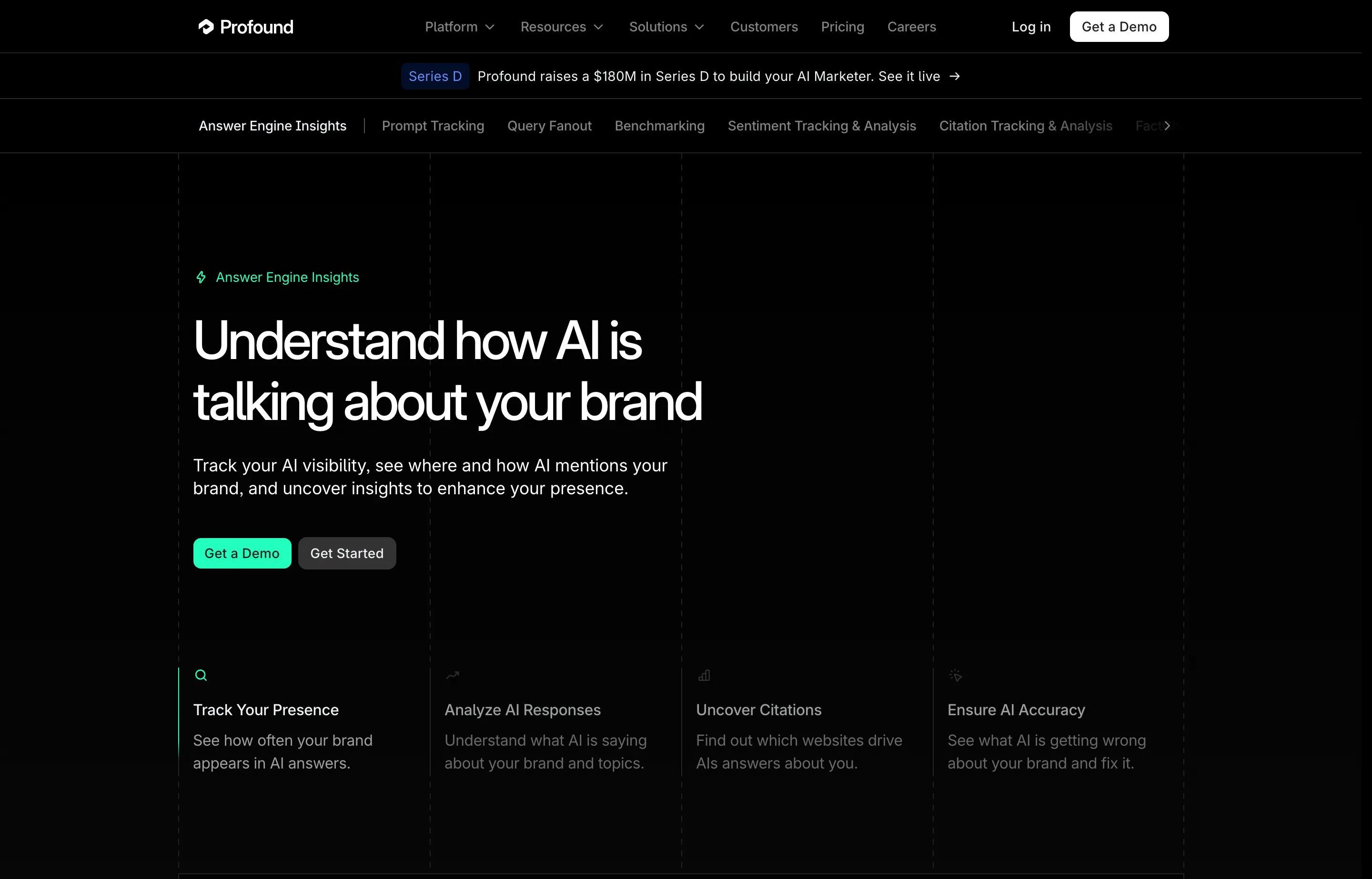
The screenshots below show public product pages, not authenticated dashboards. Review comments are paraphrased and linked. Ratings for Ahrefs and Semrush cover their whole SEO suites, so they should not be read as separate ratings for Brand Radar or AI Visibility. Small review samples and incentivized reviews deserve extra caution.
Keep three measurements separate. A brand mention means the name appears in the answer. A citation is a link or source reference, which may point to your site or to a third party. Sentiment or narrative describes what the answer says about you. A brand can be mentioned favorably without receiving a link, or cited while the answer recommends someone else.
1. OtterlyAI — best low-cost prompt monitoring
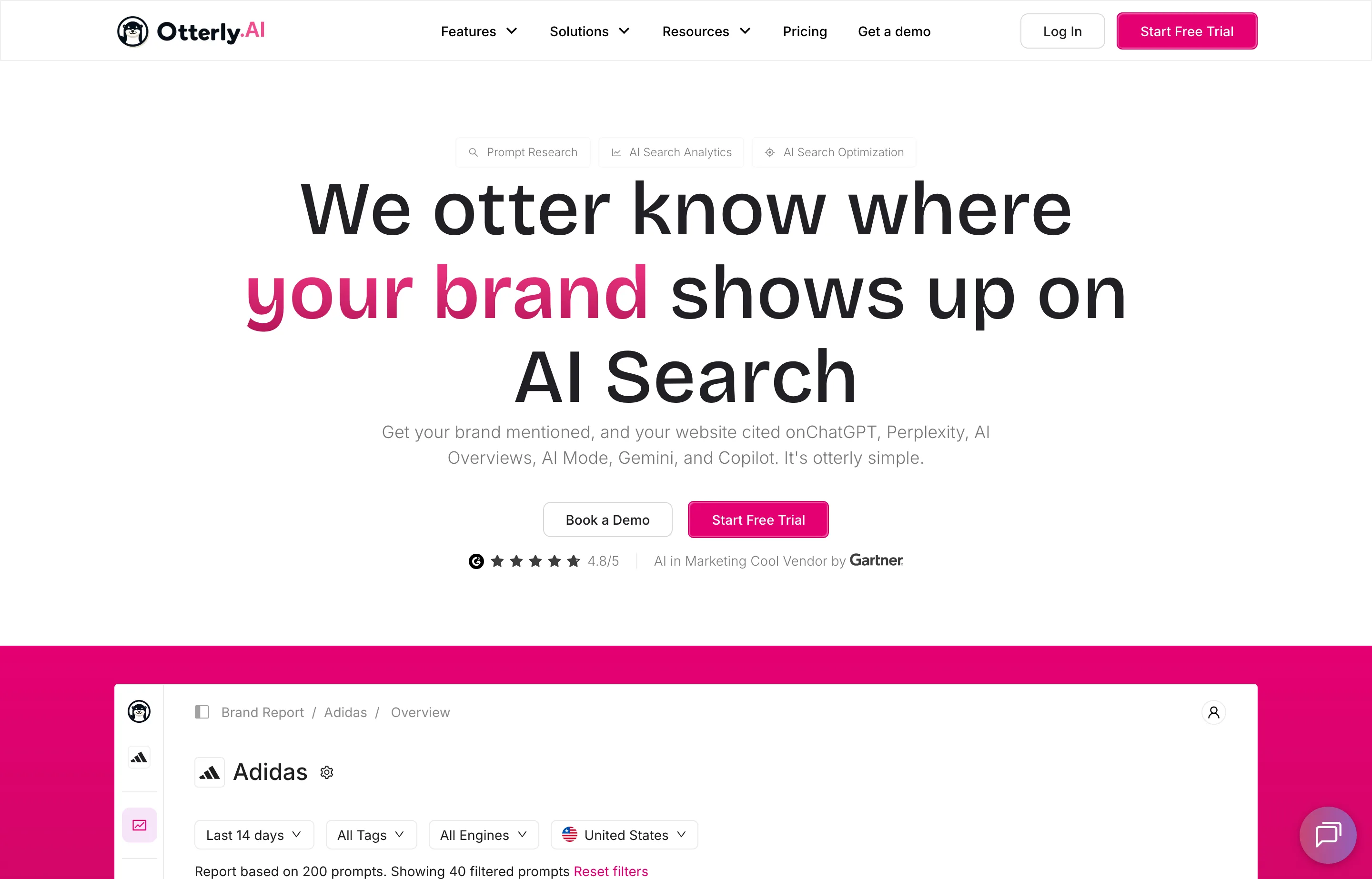
OtterlyAI is the practical starting point for a business that already knows which buyer questions matter. Enter a prompt such as “best payroll software for a five-person shop,” then watch how the answer changes across supported engines: whether your brand appears, which competitor is recommended, and whether your own site or another source is cited. Its dashboards emphasize prompt trends, share of voice, and citation opportunities rather than a traditional Google rank position.
Best for
A solo marketer, local service business, or small SaaS team with 10–15 high-intent prompts to review each week. Keep branded questions (“Is Acme Payroll reliable?”) separate from non-branded discovery questions (“best payroll software for restaurants”) so a rise in existing-brand awareness does not look like new discovery.
Key features
Scheduled prompt checks, brand and competitor mentions, citations, share-of-voice reporting, and prompt research. The product page describes a broader optimization workflow, but the first value to test is whether its answer history helps you decide which page or third-party source to improve.
Pricing
The current pricing page lists Lite at $29/month for 15 prompts, Standard at $189/month for 100, and Premium at $489/month for 400. Lite includes daily tracking on ChatGPT, Google AI Overviews, Perplexity, and Microsoft Copilot. Gemini, Google AI Mode, and Claude are add-ons. The jump from 15 to 100 prompts is large, so map your required prompts and engines before choosing a tier.
Pros
Low starting price; easy-to-scan reports; enough coverage for a focused watchlist; competitors and cited URLs appear alongside your own mentions.
Cons
Lite is tight for multiple locations or products; extra engines raise the real price; monitoring data alone does not establish whether a mention led to a visit or lead.
Public reviews
G2 lists 4.7/5 from 54 OtterlyAI reviews as checked in September 2026. Reviewers repeatedly praise the clear dashboard and prompt insights. In individual reviews, some ask for more filtering and historical detail, while one small-agency user specifically flags the cost jump to Standard. Those comments fit the main buying decision: Lite is attractive if the prompt set stays small.
2. Semrush AI Visibility — best for brand perception plus SEO context
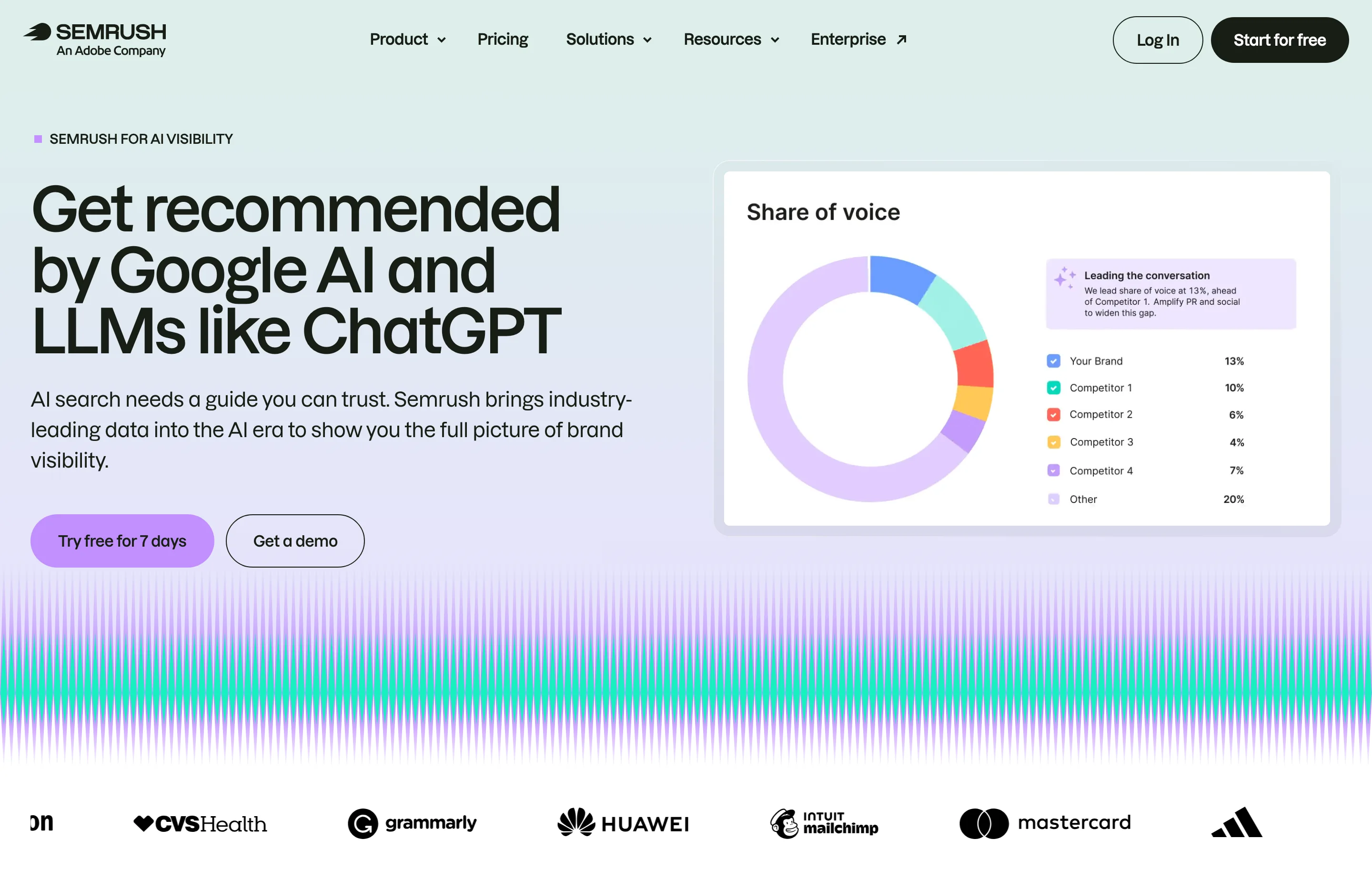
Semrush AI Visibility combines a large prompt database with a smaller custom watchlist. Use its overview to find category topics where competitors appear, then track your own high-value prompts daily. Its Brand Performance reports focus on share of voice, sentiment, and the narratives AI systems associate with a domain. An AI search site audit gives the SEO team technical issues to investigate when content is hard to crawl or cite.
Best for
A business already using Semrush, or an SEO team that needs to explain *how* AI describes its brand as well as *whether* it appears. If an answer repeats an old service area or price, inspect the cited sources before changing a page. A perception chart points to a problem; the underlying answer and source determine the fix.
Key features
Visibility overview, competitor and prompt research, Brand Performance sentiment and narrative analysis, daily custom prompt tracking, report exports, and AI crawler checks. Semrush documents different refresh schedules: broad analysis updates daily, Brand Performance weekly, and selected prompts daily. Do not treat all charts as though they are measuring the same day.
Pricing
The Base plan is shown at $99/month per domain billed annually, with 25 custom prompts and one Brand Performance domain. Semrush's plan documentation lists 50 additional prompts for $60/month and extra Brand Performance domains for $99/month each. The free checker gives a limited first look, but recurring tracking requires a paid plan.
Pros
Broad discovery and focused monitoring in one place; brand narrative is more useful than a bare mention count; links naturally to existing SEO research and audits.
Cons
Domain and prompt limits can make multi-brand work expensive; its proprietary score is a directional benchmark; the number of reports can be overwhelming without a defined review routine.
Public reviews
Capterra shows 4.6/5 across 2,328 Semrush reviews as of September 2026. Reviewers praise the breadth of research and reporting, while commonly calling out price and the learning curve. That rating covers the overall Semrush suite, not this AI toolkit alone; weigh the toolkit's stated limits separately.
3. Ahrefs Brand Radar — best for discovering where a brand appears
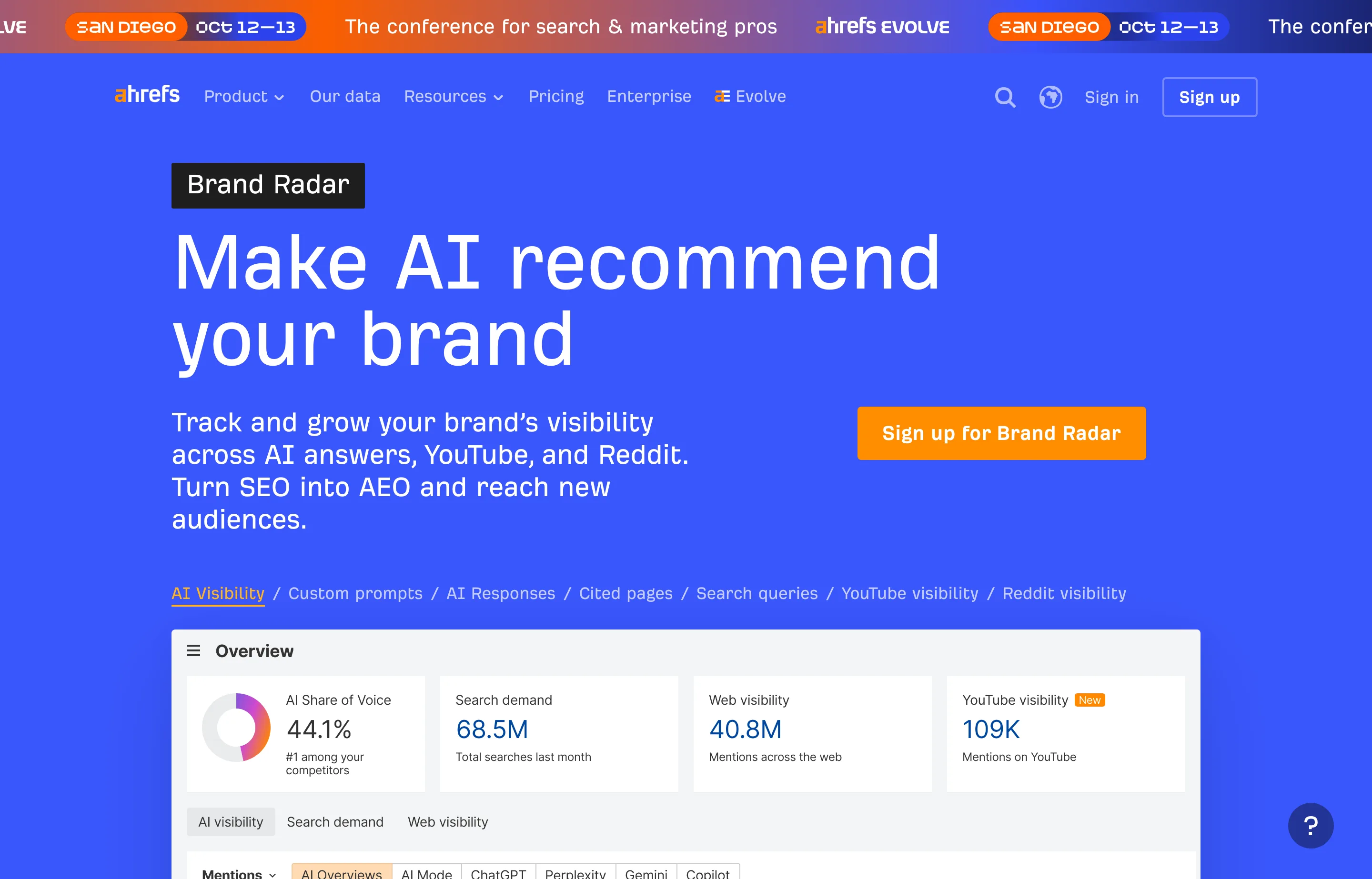
Ahrefs Brand Radar is built for exploration. Its search-backed prompt index can surface brand mentions, cited pages, and competitor appearances without requiring you to predict every question first. Save a report to revisit a brand and add custom prompts when an opportunity needs closer monitoring. Ahrefs also connects AI answers with web mentions and search demand, which helps explain where an answer's source material may come from.
Best for
An SEO consultant or research-heavy team asking “where are we already appearing, and what is getting cited?” A retailer, for example, might discover that comparison answers cite an independent review page much more often than its own product page. That finding changes the outreach or content plan more than another rank keyword would.
Key features
Indexed AI responses across supported platforms, AI share of voice, cited-page and domain analysis, competitor comparisons, saved reports, and recurring custom prompt checks. Ahrefs' documentation distinguishes its broad AI indexes from the separately metered custom-prompt product.
Pricing
Ahrefs lists custom prompt tracking from $50/month for 2,500 checks, a single AI platform index at $199/month, and all-platform index access at $699/month. Eligible Ahrefs subscriptions include some custom checks. The $50 entry does not mean unrestricted access to Brand Radar's indexed AI-response database.
Pros
Discovers questions you did not add to a watchlist; strong connection between answer citations and broader web research; useful competitive views for content planning.
Cons
Index access is expensive for a small business; different access levels are easy to confuse; the size of an index does not guarantee your niche or location has enough useful answers.
Public reviews
G2 lists Ahrefs at 4.5/5 across 714 reviews as checked in September 2026. Recent reviewers praise competitor-gap research and the breadth of the SEO/AEO suite. Those are Ahrefs-wide reviews, not a standalone Brand Radar verdict. The price and coverage decision should be made from Brand Radar's own plan terms and a sample of your market's results.
4. Peec AI — best for a shared daily visibility workflow
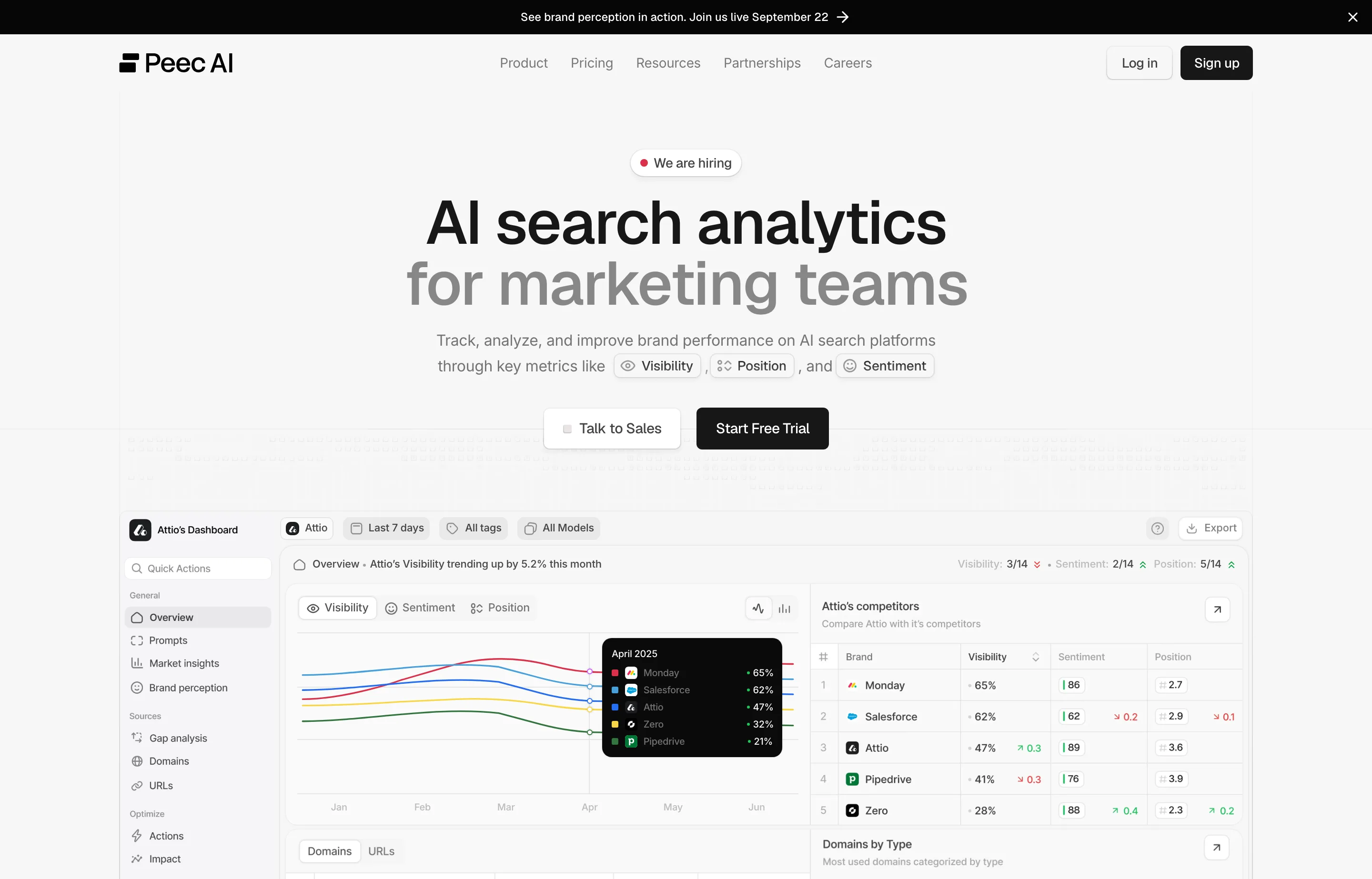
Peec AI is oriented around a team's chosen prompt set: visibility, position, and sentiment over time, with competitor and source views to investigate a change. Its public product page shows an example dashboard with those measures side by side. This is a better fit for repeat reporting than a one-off question like “has AI ever mentioned us?”
Best for
An in-house content or SEO team that has already mapped its category prompts and wants colleagues to use the same dashboard. Give one person ownership of the prompt list; otherwise teams can fill their allowance with overlapping questions that do not answer a buyer decision.
Key features
Daily prompt checks, brand visibility, position and sentiment trends, competitor comparisons, source and citation analysis, projects, and shared access. Compare the exact model mix and region coverage against your customers' behavior rather than buying solely on the prompt count.
Pricing
The live pricing page shows Starter at $95/month for 50 prompts, three chosen models, unlimited users and one project; Pro at $245/month for 150 prompts and two projects; Advanced at $495/month for 350 prompts and five projects. Enterprise is custom. These are the monthly prices displayed on September 23, 2026; confirm billing settings at checkout.
Pros
Useful entry allowance for a real topic map; daily updates; unlimited team members on listed plans; reports make it easier to divide research and follow-up work.
Cons
Three-model selection can hide changes on other engines; scaling prompts or projects raises the price sharply; sentiment and position need a human reading of the answer before action.
Public reviews
G2 showed 4.9/5 from 11 Peec AI reviews in the available listing. Reviewers praise clear visualizations and competitor visibility; one says useful work still requires export filtering, and another wishes the product cost less. The sample is small, so use those reports as questions for a trial rather than as proof of typical results.
5. Profound — best for detailed answer and accuracy analysis
Profound Answer Engine Insights measures visibility, share of voice, citations, sentiment, and competitor position across AI answers. Its FactCheck documentation describes an accuracy workflow that compares factual claims with a brand's source of truth and identifies cited sources behind errors. This goes beyond counting recommendations: it gives a team a way to investigate *why* an answer is wrong.
Best for
A larger brand or agency where an incorrect feature, policy, eligibility, or product-safety claim has a material cost. A multi-product business can separate topics, regions, and competitors, then give each claim an owner. A one-location service firm with a dozen prompts is unlikely to need this depth first.
Key features
Daily answer collection, visibility and share-of-voice trends, citation-source analysis, sentiment, competitor benchmarks, and FactCheck. Profound's documentation defines visibility as the share of sampled responses containing a brand; that is a property of the prompts and answers collected, not a census of all AI users.
Pricing
The rendered pricing page, checked September 23, 2026, now shows a free seven-day trial with 50 prompts run daily on ChatGPT, Gemini, and Google AI Overviews, followed by custom Enterprise pricing for the paid plan shown. Older indexed snippets still describe $99 and $399 self-serve tiers; those are not on the current rendered page, so request a quote rather than budgeting from an old number.
Pros
Detailed answer and citation investigation; explicit accuracy workflow; useful segmentation for teams managing several products or markets.
Cons
No published self-serve paid price on the current page; learning curve; the trial covers fewer engines and less time than a full monitoring program.
Public reviews
G2 lists Profound at 4.5/5 from 1,129 reviews as checked in September 2026. Reviewers value visibility into prompts and citations, while individual reviews mention cost and the time needed to learn the reporting. Some displayed reviews are seller-invited or incentivized, which is another reason to test your own accuracy workflow during the trial.
How to set up brand monitoring that leads to action
- Write 15 to 30 real buyer questions. Include category, comparison, problem, and location questions. Keep prompts conversational; a list of SEO keywords is not the same thing.
- Separate discovery from reputation. Track unbranded prompts to measure discovery and branded prompts to catch factual errors. Report them separately so a rise in branded mentions does not masquerade as new demand.
- Record the whole answer. For every important miss or negative description, save the prompt, platform, date, cited URLs, competitor names, and exact claim. AI answers vary between runs, so look for repeated patterns before declaring a win or loss.
- Fix the source, then recheck. Update your own relevant page when it lacks a clear answer; correct outdated directory or review information when a third-party source is responsible. Use the website SEO checker to catch basic page issues and the guide to getting recommended by AI search for the broader content work.
- Review monthly against business outcomes. Compare mention and citation trends with referral traffic, qualified leads, and sales conversations. An AI visibility score is a diagnostic measure, not proof of revenue.
FAQs
What is the best free AI brand monitoring tool?+
Semrush's free AI visibility checker is a useful first snapshot. For ongoing monitoring without a subscription, keep a small prompt sheet and manually check the same questions on a fixed schedule. Record the answer and date; one-off checks are too noisy to show a trend.
Is AI brand monitoring the same as social listening?+
No. Social listening finds posts and conversations on social networks and the web. These tools inspect the answers AI search systems produce for selected questions, including mentions, links, and how they describe your brand. You may need both if customer conversations and AI recommendations are important.
Can an AI visibility score tell me whether I am getting customers?+
No. It summarizes appearances in a provider's sampled prompts or index. Pair it with analytics, lead sources, and sales feedback. Compare scores only within the same tool and a stable prompt set because providers use different samples and formulas.
How many prompts should a small business track?+
Start with 10 to 20 questions tied to your main products, locations, and comparisons. Add prompts when they represent a distinct buyer decision. A smaller list that you review and act on is more useful than hundreds of generic checks.
Final take
Start with a free snapshot, then choose one paid tool around your main question. Use OtterlyAI for an affordable prompt watchlist, Semrush for brand narratives and SEO context, Ahrefs for broad discovery, Peec AI for team reporting, or Profound for deeper answer accuracy work. The useful result is a repeatable list of claims and citation gaps you can address, followed by evidence that those answers changed.
Free tools to try
Keep reading
Guide
How to Get Recommended by ChatGPT & AI Search
What makes AI assistants recommend your business: which crawlers to allow, what the evidence says about schema and llms.txt, and how to measure it.
Guide
Best AI SEO Tools for Small Businesses in 2026
The SEO tools that give small businesses a real edge in AI search — paid data suites, AI audits like CrawlRaven, PikaSEO's free suite, and the free essentials.
Guide
Best SEO Tools for Small Business (2026)
The SEO tools small businesses should actually use: free Search Console and Bing data, paid research suites, crawlers, WordPress plugins, and fast on-page fixes.