Guide
What Outbid.lol Teaches Small Businesses About Viral Growth
Outbid.lol is the kind of story that makes a tiny business owner sit up: a reportedly three-hour side project became a public attention event, with $178,000 reported in 77 hours. That is roughly $180,000 in just over three days. The number comes from founder updates and is not an audited revenue statement—but the mechanism is worth studying. Superframeworks' launch breakdown documents the timeline, the public leaderboard, and the flood of follow-on projects it inspired.
The useful lesson is not that every small business should build an auction board. It is that a one-person or tiny-team business can make luck more likely when it keeps shipping, participates in conversations while they are happening, and creates something people have a reason to show other people. Virality is not a plan you can schedule. Surface area is.

Quick answer
Small businesses can improve their odds of social-media virality by making a product or launch easy to explain, easy to participate in, and worth sharing. Keep shipping small experiments, attach a clear public signal to participation, and measure what happens after the attention arrives.
Outbid.lol's reported result came from a specific moment and audience. It does not prove that simple products automatically grow or that revenue spikes last. The repeatable part is the operating habit: make more credible attempts, share them where the conversation already exists, learn quickly, and keep enough capacity to act when one catches.
What happened with Outbid.lol
Outbid.lol made promotion into a public game. A business could pay for a position on a leaderboard; higher bids ranked higher. That decision bundled three actions together:
- A buyer paid the product.
- The buyer filled the product with a new listing.
- The buyer gained a public position worth posting about.
The board itself became the marketing. The original Superframeworks article reports more than 200,000 first-day visitors, a $21.5k first-day milestone, and $178k at hour 77, alongside more than 170 tracked clone boards. Those are reported launch figures, not a promise of retention, profit, or customer quality.
The story kept spreading because the mechanic fits in a sentence: pay more, rank higher, get seen. A founder did not need a tour, a sales call, or a long thread to explain it. A spectator could understand the stakes on the page itself.
Why the format traveled
| Ingredient | What it did | A small-business version |
|---|---|---|
| One-sentence mechanic | Made the idea retellable | “Nominate a local maker; the most shared entry wins a free feature.” |
| Participation creates distribution | Gave users a reason to post | A client shares their published case study or referral result. |
| Visible movement | Turned use into an unfolding story | A live challenge counter, limited cohort, or public before-and-after board. |
| A moment already in motion | Put the launch in an active conversation | Ship a useful response when your audience is already discussing a change. |
None of those requires a huge budget. They do require clarity. If a customer cannot tell a friend what they did and why it mattered in a few seconds, the social loop has too much friction.
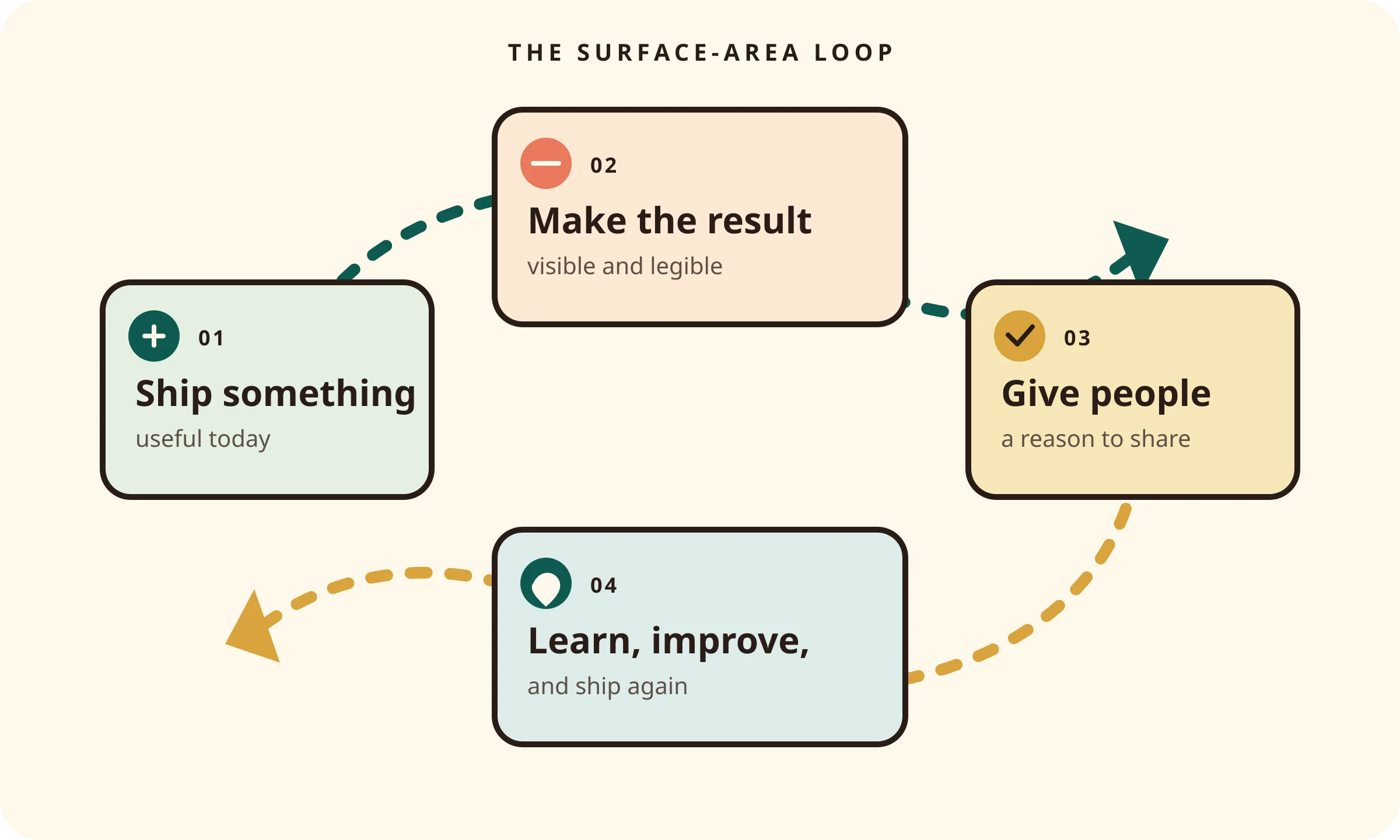
The 1% business advantage: more attempts, not magical ideas
For a small, owner-operated business—what we mean here by a “1% business”—the advantage is not a massive media budget. It is the ability to decide, build, publish, and revise without a committee.
That speed is valuable only when it produces real attempts. One polished launch a year gives luck one doorway. A steady stream of small products, tools, offers, case studies, and public experiments gives it many. Most will be quiet. That is normal. The point is not to make every post go viral; it is to make enough useful, visible work that one of them can meet the right audience at the right time.
Think of the work as a portfolio:
- A florist publishes a five-minute “wedding bouquet budget” calculator before spring booking season.
- A two-person agency turns a common client question into a public teardown and invites others to submit examples.
- A creator publishes a small template each week and shows one real use case in a short video.
- A local accountant comments clearly on a tax deadline change, then links to a plain-English checklist rather than a generic sales page.
The lucky event may be an algorithmic lift, a repost from someone trusted, a community thread, a press mention, or a search result. You cannot choose which one. You can choose whether there is something useful and timely for it to discover.
Copy the architecture, not the pixels
Outbid inspired a fast wave of clones because builders could recognize the product grammar. The strongest response to a viral format is not copy-pasting its interface or pretending it has no origin. It is asking: what is the underlying social loop, and what meaningful constraint can I change for my audience?
billbored.lol is one example of a meaningful change: it uses 100 fixed slots at a flat $10, where each new claim moves to the top. That replaces escalating bids with a known cost, finite capacity, and recency. Its creator-supplied directory entry discloses that relationship.
Changing the audience, economics, time window, or reward can turn a borrowed format into a real experiment. Copying visual details without changing the value is usually just a slower route to being ignored.
A practical viral-growth loop for a small business
1. Ship something people can use today
Choose the smallest useful artifact: a calculator, audit, template, scorecard, challenge, short guide, or limited offer. Do not wait until it can serve every customer segment. A narrow tool for one recurring question is easier to explain and much easier to revise.
2. Give the user a reason to share
The share cannot be a favor to you alone. It should help the user demonstrate taste, status, progress, support for a community, or a useful result. For example, a web designer's free homepage score could create a report the owner wants to forward internally; a café's local-vote board gives regulars a reason to rally others.
3. Put it where the conversation already is
Do not manufacture a trend from an empty room. Watch for questions, seasonal decisions, platform changes, and industry moments your customers are already discussing. Then contribute the useful artifact—not just a link. A thoughtful post, demo, or reply gives the launch context; the product gives it somewhere to go.
4. Track the business outcome, not applause
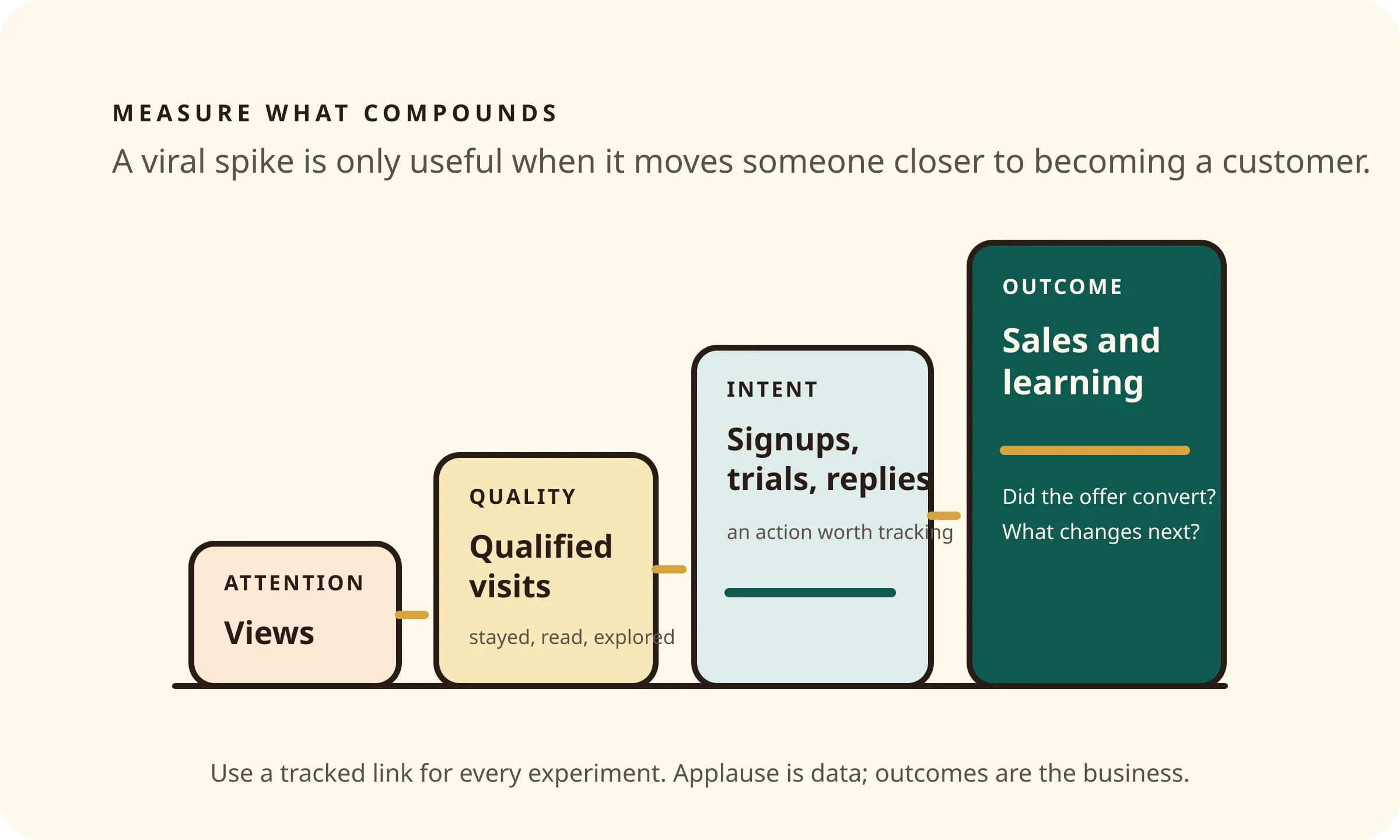
Set up a unique link with the UTM Link Builder before sharing. Track visits, signups, qualified replies, booked calls, sales, and repeat use. A post with 50,000 views that produces no target-customer action may still teach you something, but it is not growth.
5. Reuse the signal
When an experiment works, turn it into a series: a follow-up, a customer story, a template, a video, an email, or a better version of the tool. When it does not work, retain the learning and ship the next attempt. The compounding asset is not one viral post; it is the body of evidence about what your customers respond to.
A 30-day surface-area plan
| Week | Ship | Share | Measure |
|---|---|---|---|
| 1 | One tiny tool or template for a repeated customer question | Show the before/after in one social post | Clicks and completed uses |
| 2 | One opinionated teardown or checklist | Reply where that question is already being discussed | Saves, qualified replies, email signups |
| 3 | One customer-facing challenge, referral hook, or public result | Ask participants to share a useful outcome | Shares, referred visits, leads |
| 4 | Improve the strongest item and retire the weakest assumption | Repackage the winner for a second platform | Cost per lead or sale |
The plan deliberately makes room for misses. If every item must succeed, you will avoid the small, odd experiments that sometimes create the biggest upside. Keep the financial risk capped, the value to the user real, and the feedback loop short.
What not to learn from this story
- Do not confuse revenue with profit. Payment fees, refunds, taxes, and the value of a buyer's future attention all matter.
- Do not buy empty engagement. A share loop works only if there is a real reason for the participant and the audience to care.
- Do not make an unmeasurable bet. Use a landing page, one clear action, and tracked links.
- Do not turn a trend into a mandate. A viral mechanic that fits indie products might be wrong for a local service business, a trust-sensitive practice, or a long sales cycle.
- Do not stop shipping after a quiet result. The lesson is a higher volume of thoughtful attempts, not a demand for instant validation.
Join the discussion
The launch has an active r/Superframeworks discussion about Outbid.lol's $178k-in-77-hours story. The useful question there is the right one for any small business: have you built a product where participating or buying also creates its own distribution?
Before you answer it, write down one recurring customer question you could turn into a small public artifact this week. Then make it useful enough to share, instrument the link, and ship it while the idea is still fresh.
FAQs
Did Outbid.lol make $180,000 in 80 hours?+
The closest documented milestone is $178,000 in 77 hours—approximately $180,000 in about 80 hours. It was a founder-reported live figure, not an audited final-revenue statement. See the [Superframeworks report](https://superframeworks.com/articles/outbid-lol-viral-launch) for the source and caveats.
Can a small business plan to go viral?+
No. You can plan the conditions that make a viral outcome more possible: a clear idea, genuine usefulness, a social reason to share, timely distribution, and measurement. The outcome itself remains uncertain.
How often should a small business ship experiments?+
Choose a cadence you can sustain without lowering the value to customers. One useful small experiment a week is more valuable than a frantic burst followed by months of silence.
Should I copy Outbid.lol for my business?+
Copy the underlying design principle only if it fits your customers: participation should create a real benefit and be easy to explain. Change a meaningful constraint, audience, or reward, and be transparent about inspiration.
What should I measure after a social-media spike?+
Measure qualified visits, email signups, trials, inquiries, sales, and cost per useful outcome. Views and likes describe attention; they do not by themselves show business growth.
Free tools to try
Keep reading
Guide
14 Best Social Media Scheduling Tools for Small Business (2026)
14 social media schedulers ranked for small businesses — real 2026 pricing, free-plan caps, and X support for PosterMyWall, Buffer, Statusbrew, Metricool and more.
Guide
Best Small Business Ideas for Solopreneurs in 2026
27 realistic small business ideas for solopreneurs, sorted by startup cost and how fast you can land the first paying customer. No fluff, no get-rich-quick.
Guide
How to Get Recommended by ChatGPT & AI Search
What makes AI assistants recommend your business: which crawlers to allow, what the evidence says about schema and llms.txt, and how to measure it.