Creator Commerce
Minicart
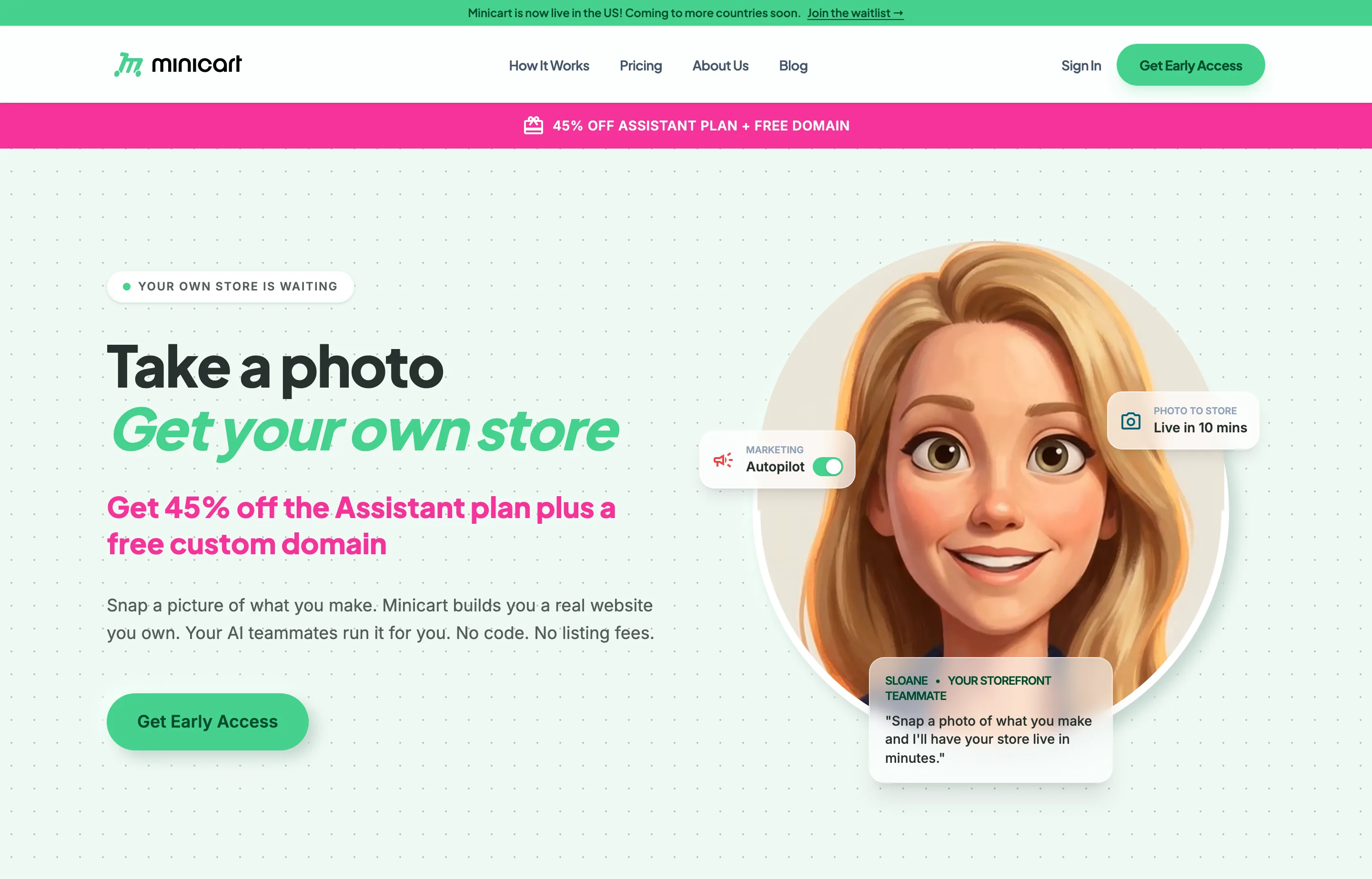
Minicart lets a maker, creator, or reseller build an independent online store by describing products and tasks to AI teammates. They can draft listings, design store pages, prepare promotions, and help with orders; the owner reviews changes before they are saved. It launched on Product Hunt on September 20, 2026, ranking #2 with 240 points. That is a measure of launch-day interest, not a review score. Its help center was already publishing operational guidance before launch, but the product is still young and its plans may change.
The key limit is geographic: Minicart currently accepts stores based in the United States. It is your own branded site, not a marketplace that sends shoppers to you. You still have to bring traffic through social posts, email, search, or another channel. The free store is real, but its transaction fee is higher than the paid-plan card rates, so an active seller should calculate the crossover rather than choose on monthly price alone. Although the marketing site still uses “Get Early Access” wording, the documented start link opened the live store-building chat in this research run; payment approval was not tested.
- Website
- minicart.com
- Category
- Creator Commerce
- Pricing
- Free plan + paid tiers
- Starts at
- Free plan; 6% + $0.30 per standard card sale
- Best for
- US-based makers and small sellers who want their own storefront without learning a complex ecommerce dashboard.
- Profile updated
- September 27, 2026
Independent profile — no affiliate links or sponsored placement.
Key features
- Photo-to-listing setup: Add a product photo and details; the assistant can draft the listing text and store presentation.
- Independent storefront: Products, collections, pages, checkout, and orders live under the seller's brand rather than in a shared marketplace catalog.
- Marketing assistance: Draft social posts, discounts, campaigns, and store pages from the product catalog.
- Order operations: Review inventory, shipping, customer questions, and refunds from the connected store workflow.
- Owner approval: AI teammates prepare work for review; the vendor says they do not save it without approval.
- Store imports: The site describes moving products from an existing Shopify store, reducing re-entry for a seller who wants to trial the platform.
- Payment and sales-tax workflow: Minicart's help center describes card fees and sales-tax collection for supported US transactions.
Pricing
Read from Minicart's live pricing page, billing guide, and per-sale fee guide on September 27, 2026 (verify current). Free has no monthly subscription and supports a live store; standard online cards cost 6% + 30¢ per sale. The pricing page currently displays Assistant at $10/month for the first year against a $19 regular price, Manager at $49/month, and Director at $199/month on its monthly view. Standard-card rates fall to 2.9% + 30¢, 2.7% + 30¢, and 2.5% + 30¢, respectively. Premium cards have higher rates and international cards add 1%. A separate Milo marketing add-on is displayed at $39/month. Check the live billing toggle and promotion terms before buying.
Minicart says the fee applies to the whole order, including shipping and tax. The original card fee is not returned after a refund; a disputed charge may incur a separate fee. On the free plan, a payout below $50 can incur a $1 bank-transfer fee. Check the live plan selector before upgrading and compare monthly subscription plus card fees at your expected sales volume.
Pros and cons
Pros
- A real free storefront lets an occasional seller start without a subscription.
- AI drafts connect to actual products, orders, and marketing tasks rather than a generic chatbot.
- Seller keeps an independent brand and direct customer relationship.
Cons
- Only US-based stores can sell today.
- Free-plan card fees are high for frequent sales; lower rates require a subscription whose promotion can change.
- Minicart brings no marketplace audience; you must earn your own traffic.
Who should use Minicart?
Try Minicart if you sell handmade goods, prints, apparel, collectibles, or downloads from a US business and want a guided route to your own store. Its fit is strongest when you would use the AI help for listings and routine operations, not just checkout. Compare Fourthwall if merchandise fulfillment or creator memberships dominate, and Gumroad if downloads and an established creator marketplace matter more.
The September Product Hunt result shows an encouraging launch, but it is too early to treat it as evidence of long-term reliability. Confirm the paid-plan subscription and tax treatment for your store before moving an established business.
FAQs
Can I run a Minicart store for free?+
Yes. The vendor says Free includes a live storefront, products, orders, checkout, and access to its AI teammates, with no monthly subscription. Standard US card sales cost 6% + 30¢ as of September 2026.
Is Minicart available outside the United States?+
Not for selling yet. Its current help center says stores must be based in the US.
Does Minicart bring me customers?+
No. It gives you your own store, not a shopping marketplace. You are responsible for attracting visitors.
What changes on a paid plan?+
Paid tiers lower the card rate and add capabilities such as custom domains and higher limits. Check the current subscription price in Minicart before deciding whether the lower fee offsets it.
Similar tools in the directory
Creator Commerce
Fourthwall
Audience-led creators that want merchandise, downloads, memberships, donations, and a branded storefront in one service.
Creator Commerce
Gumroad
Creators who value the fastest route to selling downloads, courses, memberships, or small software products over the lowest transaction fee.
Creator Commerce
Lemon Squeezy
Indie software founders and digital creators that want subscriptions, license keys, checkout, and global tax handled together.
Free tools to try
Product Description Generator
2 benefit-led descriptions with scannable bullets — sized for your site, Etsy, or Amazon.
Profit Margin Calculator
Find your margin, markup, and profit from cost and revenue — instantly.
Sales Tax Calculator
Add or remove sales tax at any rate — get the net, tax, and gross totals.
Keep reading
Guide
What Outbid.lol Teaches Small Businesses About Viral Growth
Outbid.lol's reported $178k-in-77-hours launch shows small businesses how to create viral opportunities without mistaking one spike for a strategy.
Guide
Small Business Pricing Strategies: The Complete Guide
The pricing strategies that work for small businesses — cost-plus, value-based, tiered, and premium — how to choose one, and how to raise prices without losing customers.
Guide
Best Payment Processors for Small Business (2026)
11 payment processors compared for small businesses — real 2026 fees for Square, Stripe, PayPal, Helcim and more, plus when interchange-plus saves money.