Comparison
Markup vs Margin: The Difference That Costs Money
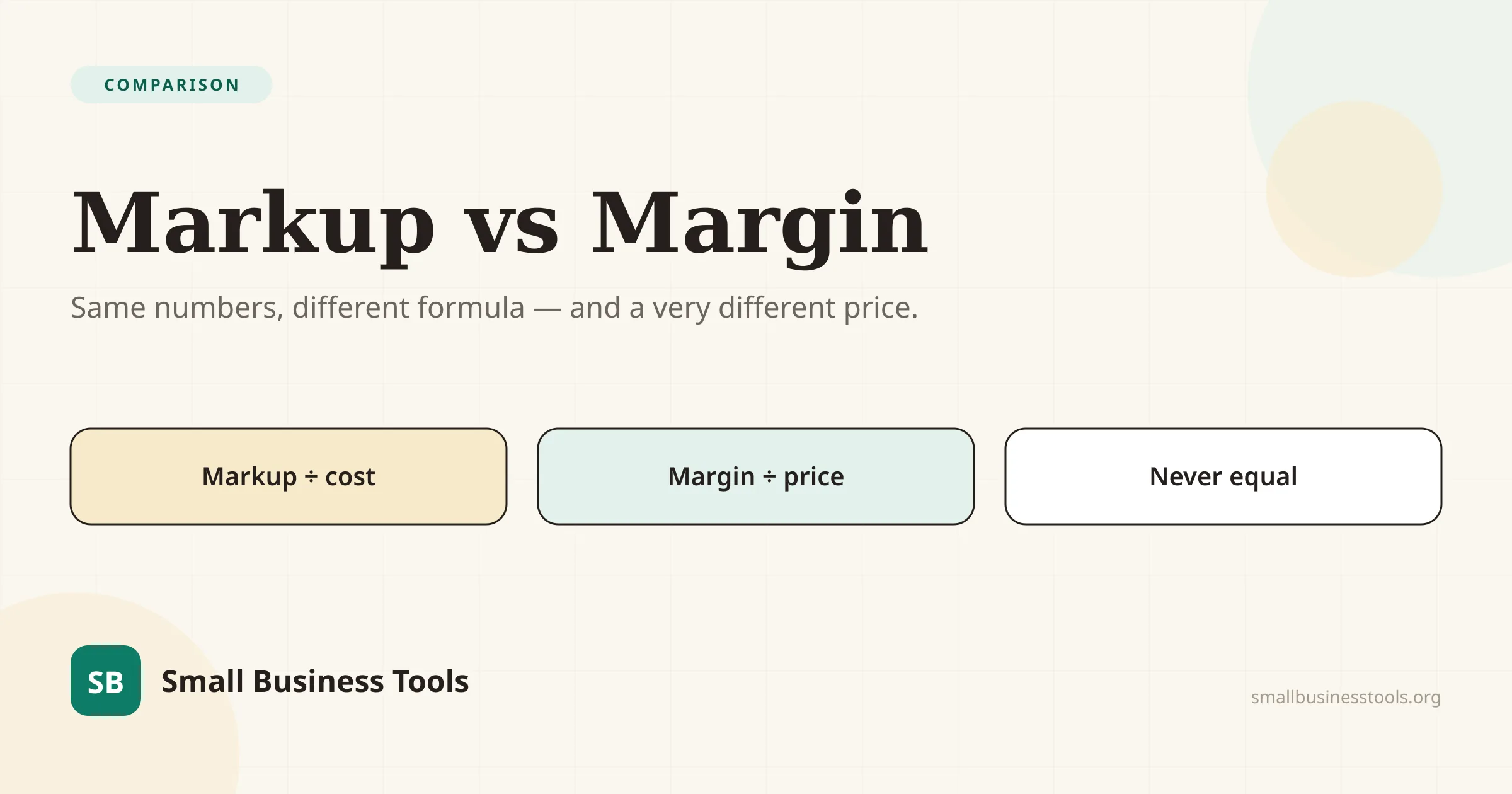
Markup and margin describe the same sale using the same two numbers — cost and price — but they divide them differently, so they're never equal. A 50% markup is only a 33% margin. Confuse the two and you'll set prices that look healthy and quietly earn far less than you think. This is one of the most common and most expensive mistakes small businesses make, and it takes about five minutes to fix for good. The distinction is standard retail accounting — the Corporate Finance Institute lays out the markup formula and exactly how it differs from margin.
Here's the short version: markup is profit as a percentage of what the item cost you. Margin is profit as a percentage of what you sold it for. Same profit on top, different number on the bottom. This guide shows the difference with real numbers, tells you when to use each, and gives you a conversion table so you're never caught out again.
Quick answer
| Markup | Margin | |
|---|---|---|
| Formula | Profit ÷ Cost × 100 | Profit ÷ Price × 100 |
| Measures against | What you paid | What you charged |
| Which is bigger | Always the larger % | Always the smaller % |
| Best for | Setting a price from cost | Judging profitability |
| Example ($60 → $100) | 66.7% | 40% |
Both start from the same $40 of profit on an item that cost $60 and sold for $100. Markup divides by the cost ($60), margin divides by the price ($100). Because the price is always bigger than the cost, the margin percentage is always smaller than the markup percentage for the same sale.
What is markup?
Markup is how much you add on top of your cost, expressed as a percentage of that cost.
If a hardware store buys a drill for $60 and sells it for $100, the $40 added on is a 40 ÷ 60 × 100 = 66.7% markup. Markup answers "how much did I add to my cost?" — which is why it's the natural tool when you're *building* a price. You know what something cost you; you apply a markup to reach a selling price.
Retailers and wholesalers often think in markup because they buy at a cost and mark it up. "Keystone pricing" — doubling the cost — is simply a 100% markup.
What is margin?
Margin (profit margin) is how much of the *selling price* you keep as profit, expressed as a percentage of that price.
Same drill: 40 ÷ 100 × 100 = 40% margin. Margin answers "of the money that came in, how much did I keep?" — which is why it's the right tool for judging whether a business is healthy. It's directly comparable across products and against your overheads, because everything is measured against revenue. Our profit margin guide goes deeper on the three margin types.
Side by side: same sale, two percentages
The whole confusion lives in one picture. One sale, $40 of profit, two different denominators:
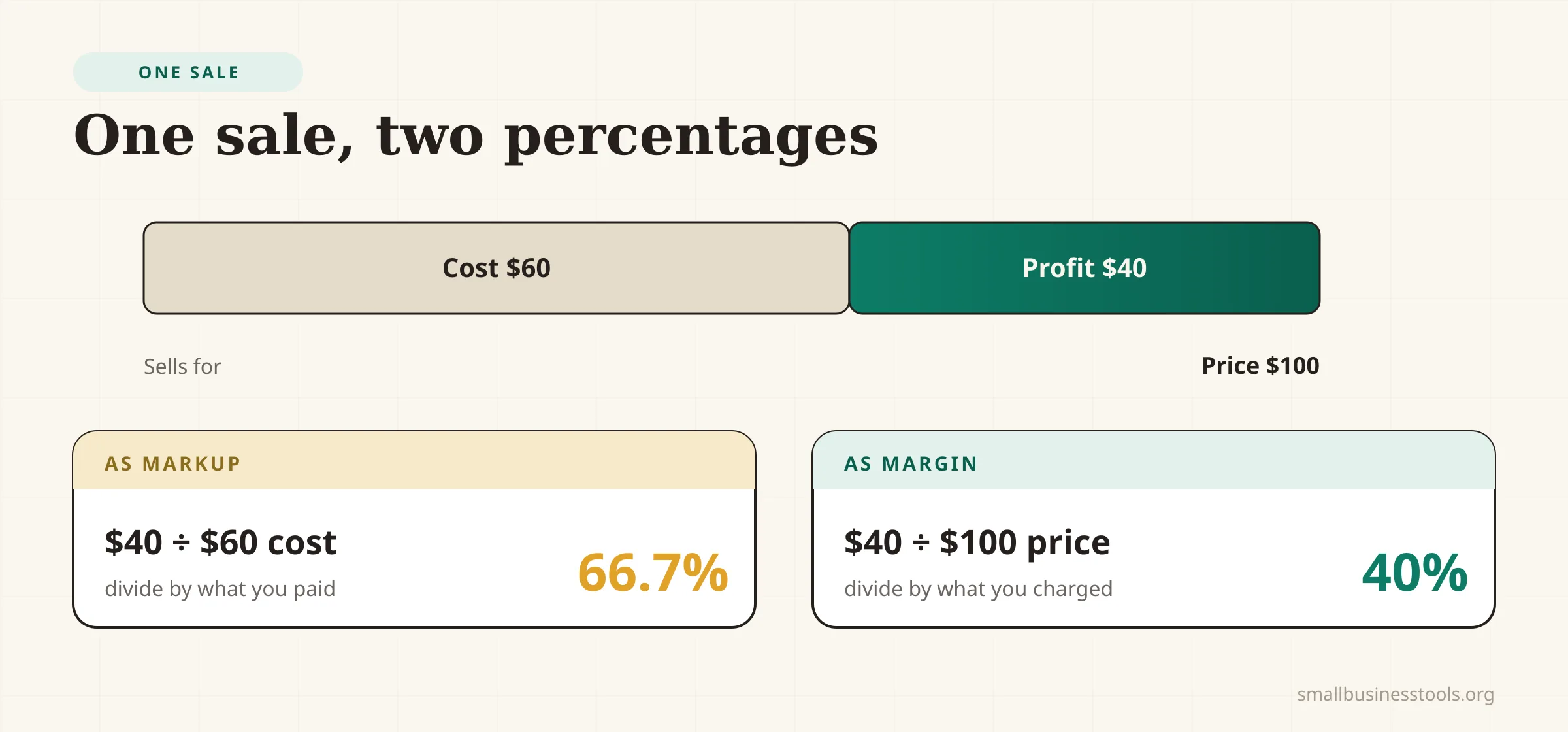
The profit didn't change. The item still cost $60 and still sold for $100. Only the number you divide by changed — and that's enough to turn "66.7%" into "40%". Neither is wrong; they're answers to different questions.
When to use markup
Reach for markup when you're setting a price from a known cost:
- You buy inventory at wholesale and need a shelf price. Apply your markup to the cost.
- You're quoting a job where materials have a clear cost and you add a standard uplift.
- You want a fast, repeatable pricing rule across many products ("everything is cost + 60%").
Markup is builder-friendly because you start with the cost you already know and add to it. The Markup Calculator turns a cost and a markup percentage straight into a selling price.
When to use margin
Reach for margin when you're judging profitability or comparing:
- Checking whether a product, service, or the whole business is healthy.
- Comparing profitability across items that have different costs.
- Setting a target you can hold against overheads ("I need to keep 45% of revenue to cover rent and pay myself").
Margin is the language of profit-and-loss statements and the number to quote when someone asks "how profitable is it?" Because it's measured against revenue, it's directly comparable everywhere. The Profit Margin Calculator reports margin, markup, and profit together so you can flip between the two views.
The conversion: markup ↔ margin
Because they share the same profit, you can convert between them. The formulas:
(Use the decimals — a 50% markup is 0.5, so margin = 0.5 ÷ 1.5 = 0.333 = 33.3%.)
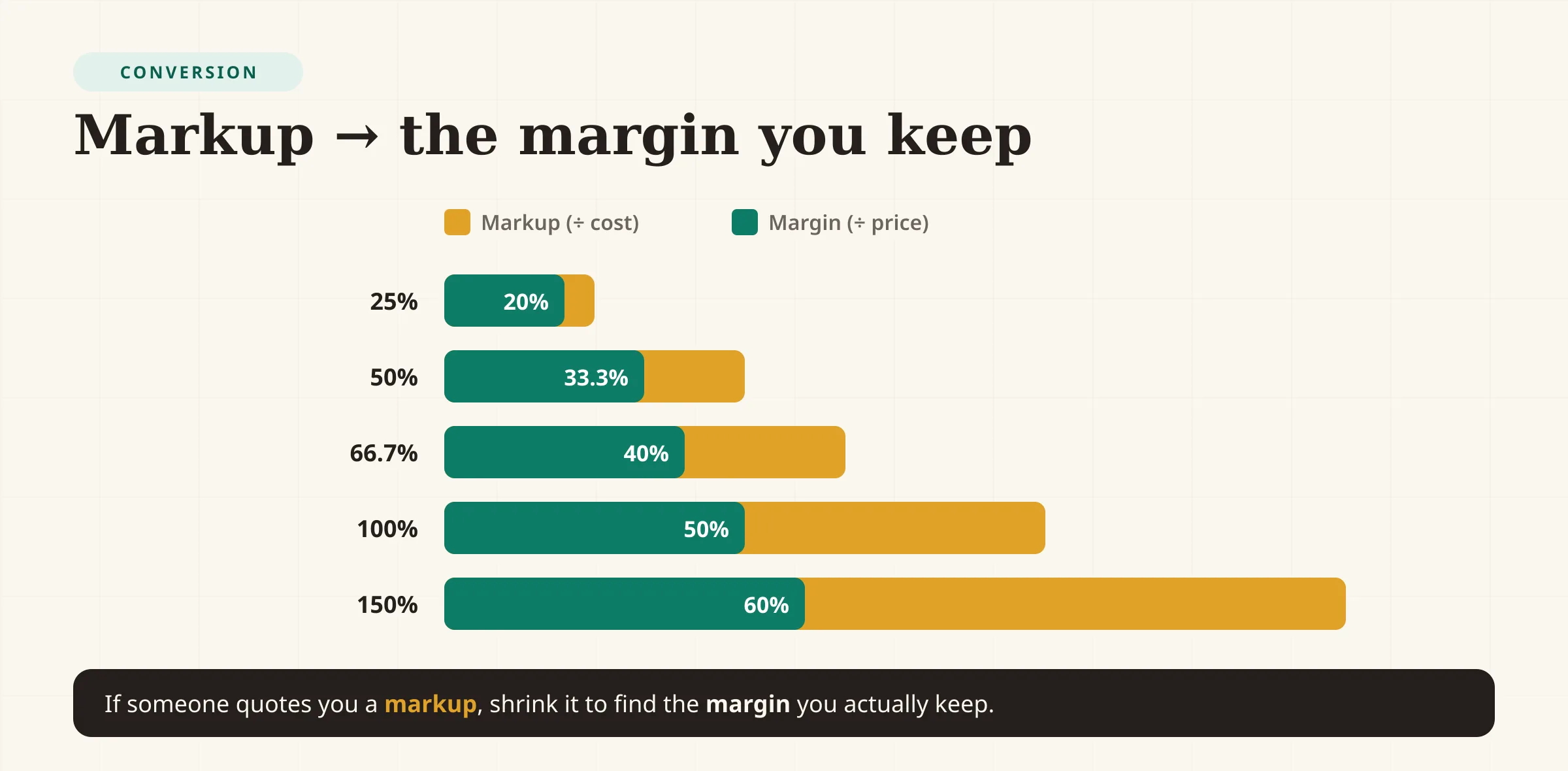
You rarely need to do it by hand, though. Keep this table handy:
| Markup | Margin |
|---|---|
| 20% | 16.7% |
| 25% | 20% |
| 50% | 33.3% |
| 66.7% | 40% |
| 100% | 50% |
| 150% | 60% |
| 200% | 66.7% |
The pattern to memorize: markup is always the bigger number. So if a supplier or a pricing "rule of thumb" quotes you a markup, mentally shrink it to find the margin you'll actually keep.
The mistake that costs money
Here's how the confusion bites. Say you want to "make 40%" on a product that costs you $60.
- If you *mean* a 40% margin, the price should be
60 ÷ (1 − 0.40) = $100. You keep $40 of every $100. - If you mistakenly apply a 40% markup instead, the price is
60 × 1.40 = $84. Your actual margin is only24 ÷ 84 = 28.6%.
That's an $16 lower price and an 11-point lower margin on every single unit, all from mixing up two words. Across a year of sales, that's the difference between a comfortable business and a struggling one. Sort out which one you mean *before* you set the price, not after.
Discounting has the same trap in reverse — a "20% off" sale cuts more margin than owners expect. The Discount Calculator shows the real profit impact before you run a promotion.
Common mistakes
- Assuming they're the same. They never are. Markup always exceeds margin for the same sale.
- Quoting markup when someone means margin. In a conversation about profitability, "40%" almost always means margin. In a conversation about pricing from cost, it usually means markup. Confirm which.
- Setting a target margin by applying it as a markup. As shown above, this underprices you every time. Convert first, or use a tool that prices to a target margin.
- Comparing your markup to someone else's margin. Apples to oranges. Convert both to the same measure before you compare.
FAQs
Is markup or margin better?+
Neither is better — they're tools for different jobs. Use markup to build a price up from a known cost, and margin to judge how profitable that price actually is. Good pricing uses both: markup to set the number, margin to sanity-check it.
Why is markup always higher than margin?+
Because markup divides profit by the (smaller) cost, while margin divides the same profit by the (larger) selling price. A smaller denominator produces a larger percentage, so markup always comes out higher for the same sale.
How do I convert markup to margin?+
Divide the markup by one plus the markup, using decimals. A 50% markup is `0.5 ÷ 1.5 = 0.333`, or a 33.3% margin. To go the other way, divide the margin by one minus the margin. The conversion table above covers the common values.
What is a 50% markup as a margin?+
A 50% markup equals a 33.3% margin. If an item costs $100, a 50% markup makes the price $150, and the $50 profit is 33.3% of that $150 selling price.
Does keystone pricing mean 100% margin?+
No — keystone pricing (doubling the cost) is a 100% *markup*, which is a 50% margin. Buy for $50, sell for $100: the $50 profit is 100% of the cost but only 50% of the price.
Which one should I put on my price list?+
Set the price with whichever is easier for your workflow, but track margin for the business. Margin is what tells you if you can cover overhead and pay yourself, so it's the number worth reviewing month to month.
Final take
Markup and margin come from the same profit but divide it differently — markup by cost, margin by price — so markup is always the larger percentage and the two are never interchangeable. Use markup to set prices from cost and margin to measure profitability, convert between them with the table above, and never apply a target margin as if it were a markup. Price with the Markup Calculator, check the result with the Profit Margin Calculator, and you'll never leave money on the table to a vocabulary mix-up again.
Free tools to try
Markup Calculator
Turn cost into a selling price at the markup you want — and see the margin.
Profit Margin Calculator
Find your margin, markup, and profit from cost and revenue — instantly.
Discount Calculator
Calculate sale price after discount or find the discount percentage from original and final price.
Keep reading
Guide
Small Business Pricing Strategies: The Complete Guide
The pricing strategies that work for small businesses — cost-plus, value-based, tiered, and premium — how to choose one, and how to raise prices without losing customers.
Guide
How to Calculate Profit Margin (Formula + Examples)
How to calculate profit margin step by step — the formula, the difference between gross, operating, and net margin, and worked examples with real numbers.
Guide
How to Price a Product for Retail (Step by Step)
How to price a product for retail: total your true costs, pick a pricing method, and set a price that hits a real profit margin. With a worked example.
Guide
How to Calculate a Discount (And What It Really Costs)
How to calculate a discount: the formula, percent off, stacked discounts, and the volume you need to sell to break even on the margin you gave away.