How-to guide
How to Price a Product for Retail (Step by Step)
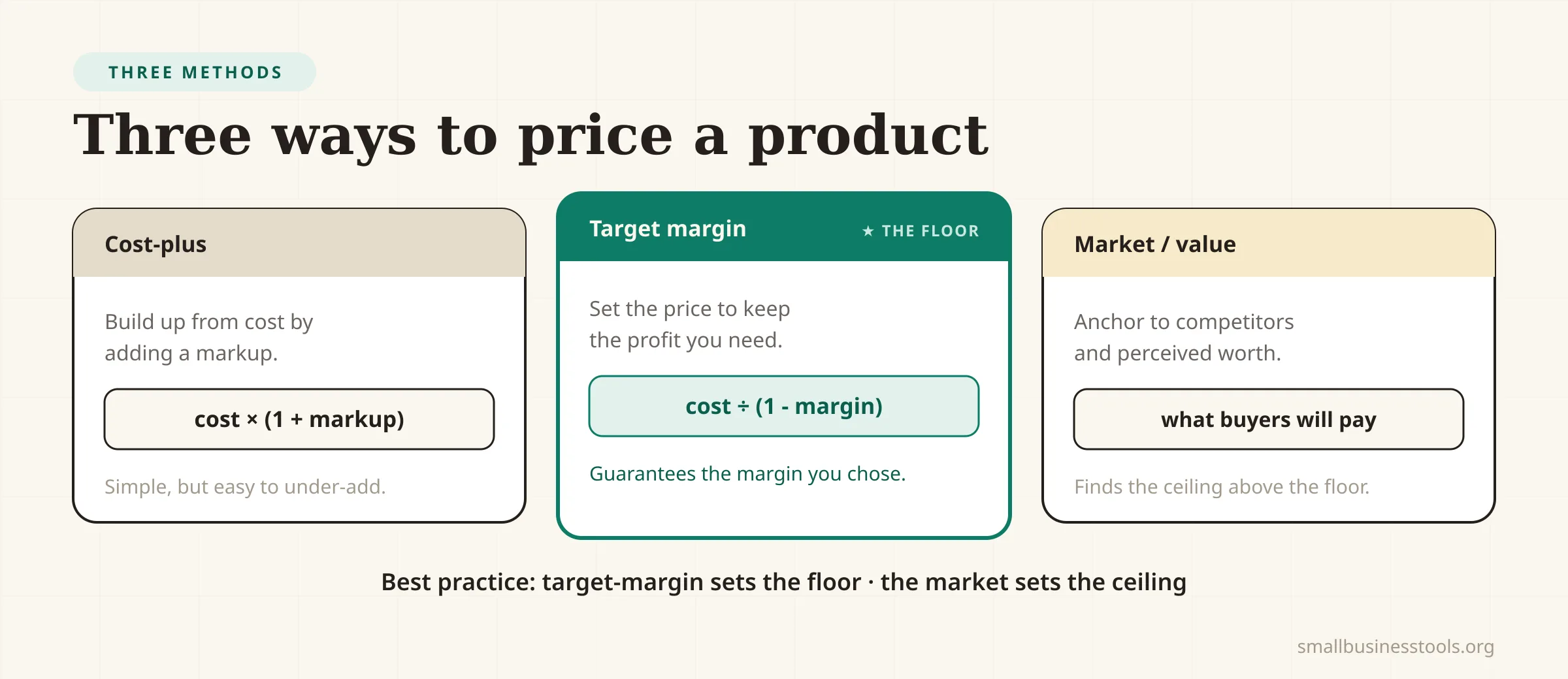
Pricing a product is the decision that quietly determines whether your business survives. Price too low and you work yourself into the ground for pennies; price without knowing your real costs and you can lose money on every sale while feeling busy and successful. Yet most small makers and shops set prices by copying a competitor or doubling the material cost and hoping — which is how so many end up with a "sold out" product that never actually paid them. Pricing is its own discipline: in-depth guides like Shopify's on how to price a product walk through the same cost-plus and value-based methods retailers rely on.
There's a better way, and it's not complicated. Good retail pricing works in three moves: know your true cost, price to the profit margin you need, then sanity-check against the market. This guide walks through each step with a real worked example, so you can price your next product with numbers instead of hope.
Quick answer: the pricing build-up
The reliable method has three stages:
- Total your true cost per unit — materials, your labor, and a share of overhead. Not just materials.
- Price to a target margin — divide the cost by (1 − your target margin) to get a price that keeps the profit you need.
- Check the market — make sure the number is credible against competitors and what customers will pay, then adjust.
Price = True unit cost ÷ (1 − target margin)
That single formula is the heart of it. If a product truly costs you $4 and you want to keep a 60% margin, the price is 4 ÷ (1 − 0.60) = $10. Everything else is making sure the $4 and the 60% are honest.
Step 1: Total your true cost per unit
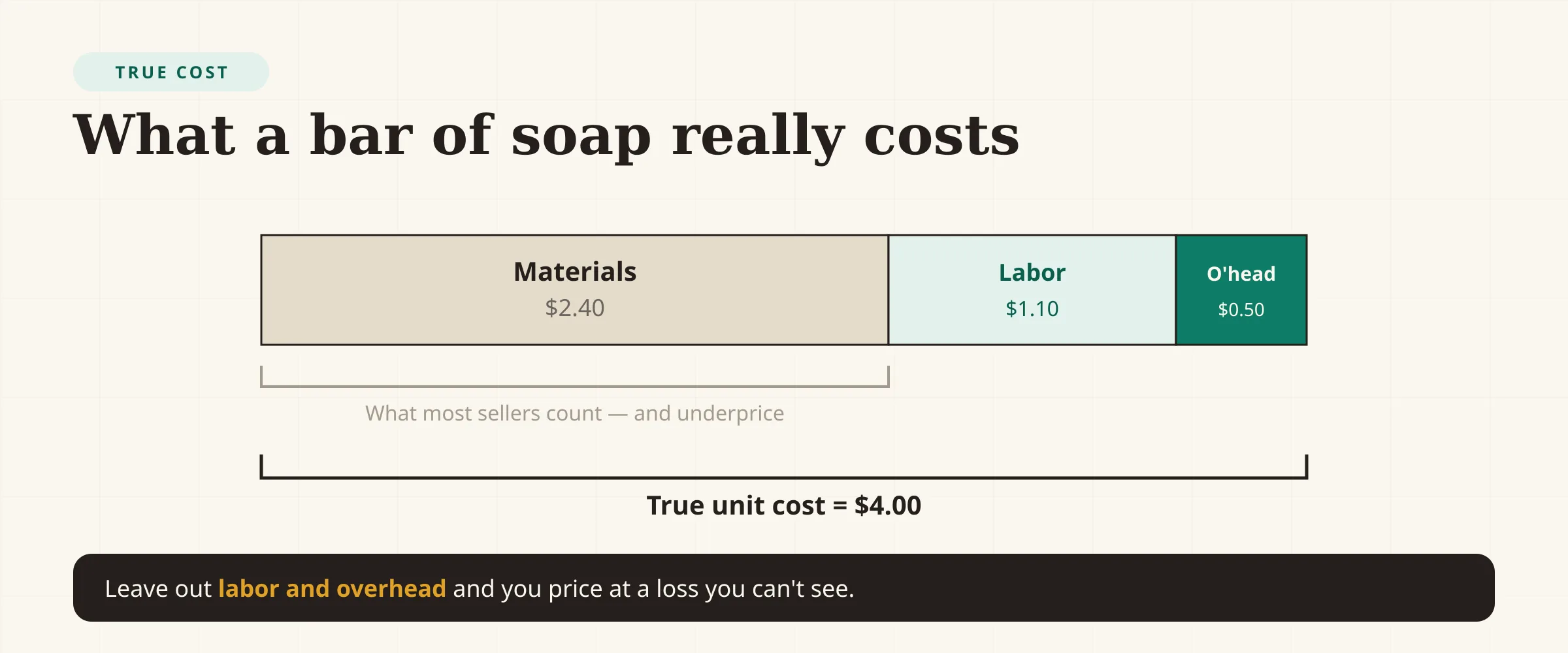
The number one pricing mistake is counting only materials. Your true cost has three parts, and skipping any of them means pricing at a loss you can't see.
- Direct materials — everything physically in the product. For a candle: wax, wick, jar, label, box.
- Your labor — the time to make and pack one unit, priced at a real hourly rate. Your time is not free; if you don't pay yourself in the cost, your "profit" is really just your unpaid wages. The Hourly Rate Calculator helps you set that rate honestly.
- Overhead per unit — a slice of the costs that keep you running: rent or workspace, tools, software, insurance, and selling fees (market stall, Etsy, Shopify, card processing). Total your monthly overhead, divide by the units you realistically sell in a month, and add that per unit.
Add the three together for the number that actually matters: your true unit cost. Almost everyone is surprised it's higher than they thought — and that surprise is exactly why they were underpricing.
Step 2: Price to the margin you need
Once you know the true cost, don't just "add a bit." Decide what margin you need to keep — the share of each sale that's left after that cost — and let it set the price.
Why divide instead of just adding a markup? Because a target *margin* and a target *markup* are different numbers, and adding a markup that looks like your margin will underprice you every time. (A 60% margin needs a 150% markup, not a 60% one — see markup vs margin.) Dividing by (1 − margin) gets you to the price that truly keeps that margin.
For our $4 soap at a 60% target margin: 4 ÷ 0.40 = $10.00. At $10, the $6 of profit is genuinely 60% of the selling price. The Markup Calculator will take your cost and a target and hand you the price directly, and the Profit Margin Calculator confirms the margin once you've picked a number.
What margin should you target? Enough to cover the overhead you *couldn't* fully allocate, absorb discounts and returns, and leave real profit. Physical products generally need a healthy gross margin (often 50%+) because retail involves fees, markdowns, and the occasional dud. Set it deliberately, not by accident.
Step 3: Check the price against the market
A formula can hand you a price the market will reject — or one that leaves money on the table. So pressure-test it:
- Competitor prices. Where does your number sit against similar products? Being the cheapest is rarely a winning position for a small business — it just trains customers to expect low prices and starves your margin.
- Perceived value. Handmade, local, premium materials, or a strong brand can command more than the cost-plus number suggests. If customers value it at $14, don't sell it at $10 out of shyness.
- Price psychology. Rounding to $9.99 versus $10 versus $12 sends a signal. Test what fits your positioning.
If the market says your $10 soap could sell at $12, raise it — that's an extra $2 of pure margin. If the market caps it at $8, you either cut true cost, accept a lower margin, or reconsider the product. The formula gives you the floor; the market sets the ceiling.
Worked example: pricing a bar of soap
A soap maker wants to price a new bar for their market stall and online shop.
Step 1 — true cost. Materials (oils, lye, fragrance, packaging) come to $2.40. Making and wrapping a bar takes about 2 minutes; at a $33/hour working rate that's $1.10 of labor. Monthly overhead (stall fees, insurance, supplies, a share of the soap equipment) is $500, and they sell about 1,000 bars a month, so $0.50 per bar. True unit cost = 2.40 + 1.10 + 0.50 = $4.00.
Step 2 — price to margin. They want a 60% margin: 4.00 ÷ (1 − 0.60) = $10.00. At $10, each bar keeps $6.
Step 3 — market check. Comparable artisan soaps sell for $8–$14. At $10 they're mid-range, with a story (handmade, local) that supports it. They set the shelf price at $11 — the market supports a premium, lifting the margin to 63.6% and adding $1 of pure profit per bar. On 1,000 bars a month, that market check alone is worth an extra $1,000.
Notice what happened: the formula set a confident floor at $10, and the market check *raised* it. Without the true-cost step they might have priced at $6 (double the materials) and lost money on every bar after labor and overhead.
Common pricing mistakes
- Pricing on materials alone. The most common and most damaging error. Labor and overhead are real costs — leave them out and you're paying customers to take your product.
- Copying a competitor's price blindly. Their costs, volume, and margins aren't yours. Use competitors as a sanity check, not a source of truth.
- Confusing markup and margin. Applying a "60%" as a markup when you meant a 60% margin underprices you badly. Convert first — markup vs margin shows how.
- Racing to the bottom. Competing on being cheapest destroys the margin that keeps you alive. Compete on quality, story, and service instead.
- Never revisiting prices. Material costs and fees rise. A price you set two years ago may now be a loss. Recheck at least annually, and whenever costs jump.
- Forgetting discounts and returns. If you regularly run 20% off, your everyday price has to be high enough to survive it. The Discount Calculator shows what a promotion really does to your margin.
Checklist
- Add up materials, your labor, and overhead per unit
- Confirm that's your *true* cost, not just materials
- Choose a target margin deliberately
- Price = cost ÷ (1 − target margin)
- Check against competitors and perceived value
- Adjust up if the market supports it; never reflexively down
- Confirm the price still profits after typical discounts
- Diarize a price review at least once a year
FAQs
How do I price a product for retail?+
Total your true cost per unit (materials + labor + overhead), divide by one minus your target margin to get a price that keeps that margin, then check it against competitor prices and perceived value and adjust. The formula sets your floor; the market sets your ceiling.
What is a good profit margin on a retail product?+
Physical products usually need a healthy gross margin — often 50% or more — because retail carries fees, markdowns, returns, and unsold stock. There's no universal figure; set the margin high enough to cover the overhead you couldn't fully allocate and still leave real profit after discounts.
Should I just double my cost to set the price?+
Doubling cost (a 100% markup, i.e. a 50% margin) is a rough starting point, but only if "cost" includes labor and overhead — not just materials. Most people double *materials*, which ignores their biggest costs and prices at a loss. Total the true cost first, then decide the margin.
How do I price to hit a specific margin?+
Divide your true unit cost by one minus the target margin as a decimal. For a 40% margin on a $30 cost: `30 ÷ (1 − 0.40) = $50`. The [Markup Calculator](/tools/markup-calculator) does this for you and shows the resulting markup too.
How often should I change my prices?+
Review prices at least once a year, and immediately whenever a major cost (materials, shipping, platform fees) rises noticeably. Prices set once and forgotten slowly turn into losses as costs creep up around them.
Should I use prices ending in .99?+
Charm pricing like $9.99 can lift conversions in value-driven markets, while round numbers like $10 or $12 can signal quality and simplicity in premium ones. It's a positioning choice — test what fits your brand rather than following a rule.
Final take
Retail pricing isn't guesswork once you follow the three moves: total your true cost including labor and overhead, price to the margin you actually need with cost ÷ (1 − margin), then check the number against the market and adjust — usually upward. Set your price with the Markup Calculator, verify the margin with the Profit Margin Calculator, and confirm you'll still break even on volume with the Break-Even Calculator. Price with numbers, not hope, and every sale will actually pay you.
To capture all of it in one place, fill in the copy-paste pricing worksheet — it walks the same build-up line by line, including the card fees this guide doesn't cover.
Free tools to try
Keep reading
Guide
Small Business Pricing Strategies: The Complete Guide
The pricing strategies that work for small businesses — cost-plus, value-based, tiered, and premium — how to choose one, and how to raise prices without losing customers.
Guide
Markup vs Margin: The Difference That Costs Money
Markup vs margin explained: same numbers, different formula, very different price. See the difference with real examples and a quick conversion table.
Guide
How to Calculate Profit Margin (Formula + Examples)
How to calculate profit margin step by step — the formula, the difference between gross, operating, and net margin, and worked examples with real numbers.
Guide
Small Business Pricing Worksheet (Free, Copy-Paste)
A free copy-paste pricing worksheet for products and services: cost build-up, overhead, card fees, and the margin math, with worked examples.
Guide
How to Calculate a Discount (And What It Really Costs)
How to calculate a discount: the formula, percent off, stacked discounts, and the volume you need to sell to break even on the margin you gave away.