Guide
Untapped Small Business Niches: 18 Underserved Markets
An untapped niche is not a market nobody wants — it is a market plenty of people want served, but nobody good is serving well. Those two things get confused constantly. A truly empty market is usually empty for a reason. An *underserved* market has real, paying demand and weak, generic, or overpriced supply. That gap is where a solopreneur or small team can win. And the appetite to start is there: the U.S. Census Bureau's Business Formation Statistics have tracked new-business applications at historically elevated levels in recent years.
This guide covers how to recognize an underserved niche, 18 examples that fit the pattern right now, and a one-week test to confirm demand before you commit.
How to spot an underserved market
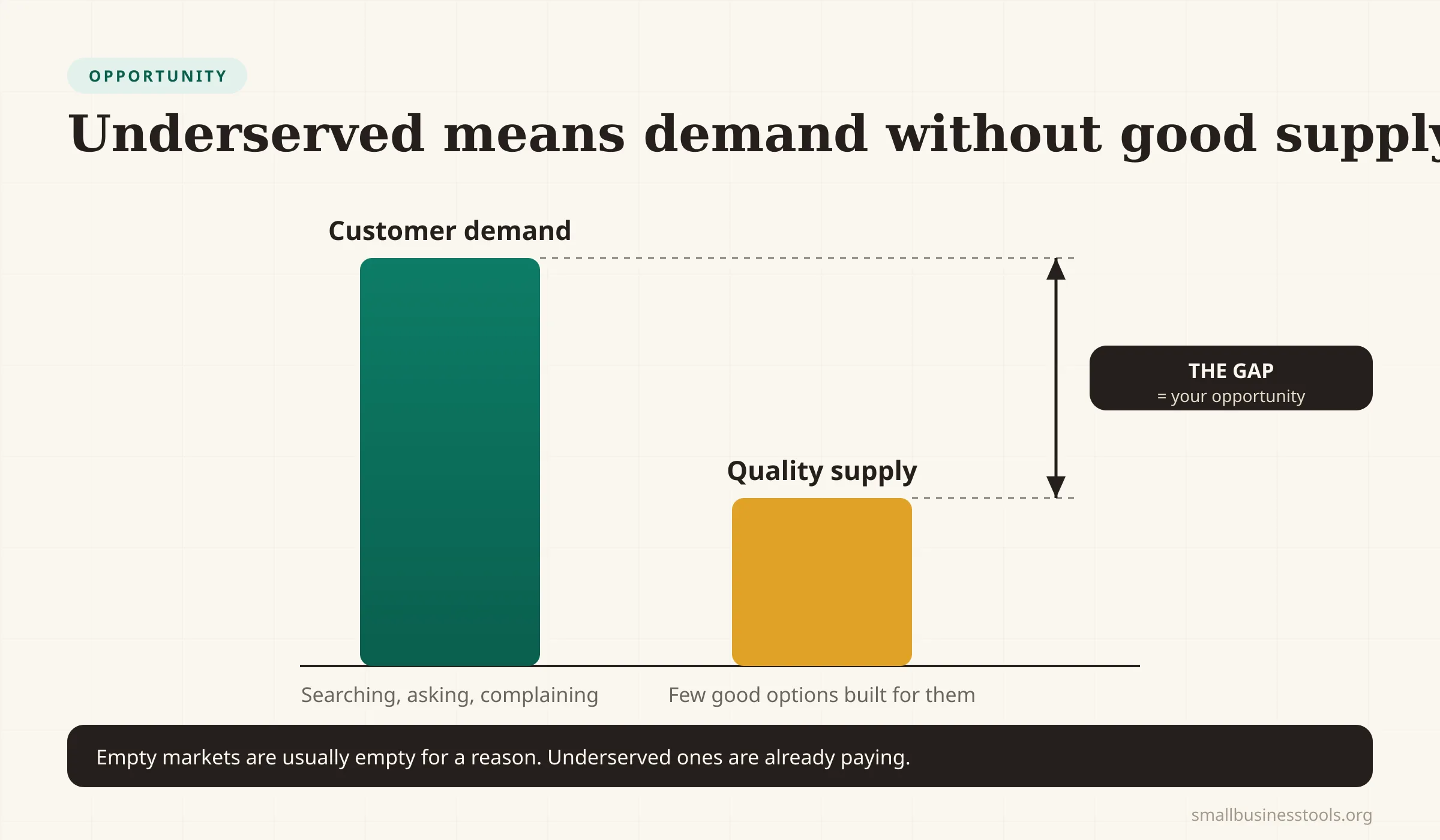
You are looking for a mismatch between demand and quality of supply. The strongest signals:
- Angry reviews on the incumbents. Read one- and two-star reviews of the biggest players in a category. Recurring complaints ("nobody returns my calls," "the software is bloated," "they don't understand my industry") are a map of unmet demand.
- "Small business" treated as an afterthought. Huge tools and agencies chase enterprise budgets and bolt on a thin small-business tier. The owner who serves only the small end, properly, wins the whole segment.
- A trade that's still on paper, phone, and spreadsheets. Whole industries run on manual work because the "solutions" were built for someone else. Digitizing one narrow trade is a durable niche.
- Language nobody markets in. A service delivered in a specific community's language, or tuned to a specific region's rules, is often wide open.
If reading reviews sounds slow, the Business Niche Finder generates niche candidates with a first offer and a validation test for each, which is a faster way to build a list to investigate. Just remember the tool gives you *candidates* — the validation still has to happen in the real market.
18 untapped small business niches
Grouped by the type of gap they exploit. None of these are secrets — the point is that they are underserved, not undiscovered.
Services for a single trade
| Niche | The gap it fills |
|---|---|
| Bookkeeping for a single trade (electricians, salons) | Generic bookkeepers don't know trade-specific costs and taxes |
| Marketing for a specific profession (dentists, lawyers) | Big agencies are too expensive; freelancers lack the vertical knowledge |
| Websites for one industry only | Templated, fast, and priced right — no custom-project overhead |
| Scheduling & admin for solo medical practices | Small clinics can't afford enterprise practice-management software |
Depth beats breadth here. When you serve only plumbers, every plumber you help becomes a referral engine to the next, because the community is tight and the specialist reputation compounds.
Underserved local demand
- Elder tech help — patient, in-home tech support for older adults and their families.
- Post-construction and move-out deep cleaning — a premium slice above routine cleaning.
- Small-business IT for shops with no IT person — the "someone to call" that big MSPs won't bother with.
- Bilingual services in a growing local community — accounting, real estate help, notary, translation.
- Accessibility retrofits for small storefronts trying to meet requirements.
Local niches are underrated because they don't scale to millions — which is exactly why the big players ignore them and leave the field open for someone reliable.
Boring-but-essential B2B
- Compliance and licensing help for a specific regulated trade.
- Invoicing and AR follow-up as a service for tiny businesses that hate chasing payments.
- Data cleanup and migration for shops switching software.
- Safety and OSHA documentation for small contractors.
- Email deliverability tune-ups for small e-commerce senders.
"Boring" is a feature. These niches have low competition precisely because they aren't glamorous, and the customers feel the pain sharply enough to pay to make it go away.
Digital gaps
- Micro-tools for one workflow in an industry that still uses spreadsheets.
- Niche newsletters for a profession with no good trade publication.
- Templates and SOPs for a specific business type (food trucks, Airbnb hosts, dog groomers).
- Done-for-you AI setup for small businesses that want the productivity but not the learning curve.
Validate a niche in one week
Never commit to a niche on a hunch. Run this cheap, fast test before you build anything:
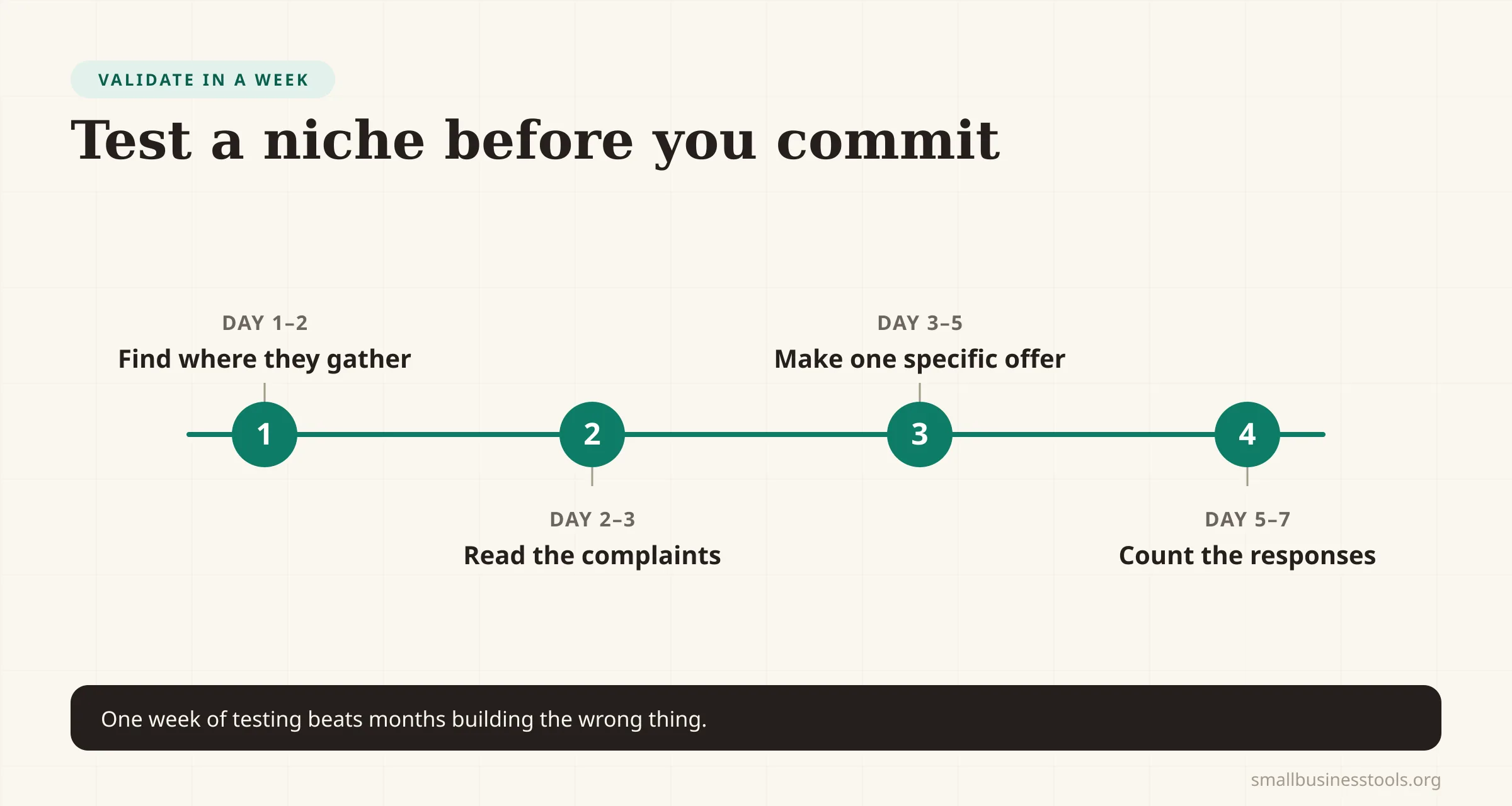
- Day 1–2: Find where they gather. Locate the Facebook groups, subreddits, trade forums, or local associations for the customer. If you can't find where they congregate, that's a warning sign about reachability.
- Day 2–3: Read the complaints. Collect the recurring frustrations in their own words. This is both your validation and your future marketing copy.
- Day 3–5: Make one offer. Write a single, specific offer and put it in front of 20–30 real people — a DM, a post, a local flyer, a quick landing page. You are testing whether anyone raises their hand.
- Day 5–7: Count the responses. You are not looking for a sale yet, just genuine interest — replies, questions, "how much?" A few strong signals from a small test is enough to justify a real attempt.
Then do the math before you go all-in. Estimate what it costs to acquire and serve one customer, what they pay, and how long they stay, and run it through the ROI Calculator. A niche with enthusiastic demand but no room for profit is a hobby, not a business — the most profitable niches guide goes deeper on getting that math right.
Common mistakes hunting for a niche
- Confusing "no competition" with "no market." If truly nobody is doing it, ask why. Often the answer is that customers won't pay. Underserved is good; empty is usually a trap.
- Picking a niche you can't reach. A perfect customer you have no way to contact is worthless. Reachability matters as much as demand.
- Going too broad to feel safe. "Small businesses" is not a niche. The narrower you go, the less competition you face and the easier your marketing gets.
- Skipping validation because you're impatient. One week of testing saves months of building the wrong thing. It is the cheapest insurance in business.
FAQs
What does "untapped niche" actually mean?+
It means a market with real, paying demand that current providers serve poorly — because they're too generic, too expensive, or too focused on bigger customers. It rarely means a market with literally no competitors, which is usually a sign customers won't pay.
How do I know if a niche is profitable before starting?+
Estimate the cost to acquire and serve one customer, what they pay, and how long they stay, then run those numbers through an [ROI Calculator](/tools/roi-calculator). Enthusiasm isn't profit — you need the unit economics to work before you commit.
Is a smaller niche riskier?+
Usually the opposite. A narrow niche has less competition, cheaper marketing, and faster word-of-mouth because the community is tight. The risk of going broad is that you compete with everyone and stand out to no one.
How many niches should I test at once?+
One or two at a time. The one-week validation test is cheap, but splitting your attention across many niches means you validate none of them properly. Test, decide, then move on.
Can I use a tool to find niches?+
A tool like the [Business Niche Finder](/tools/business-niche-finder) is great for generating candidates and first offers quickly, which beats staring at a blank page. But it can only suggest — the real validation always happens by talking to actual customers.
Final take
Underserved beats undiscovered. The best niches for a small business are ones where people are already frustrated and already paying — they just don't have anyone good to pay. Find the gap by reading complaints, test it in a week with one specific offer, and confirm the unit economics before you build. Start your list with the Business Niche Finder and the Business Ideas Generator, then pressure-test the winners against real demand.
Free tools to try
Business Niche Finder
5 specific niches matched to your skills — with the first offer and a cheap way to validate each.
Business Ideas Generator
8 realistic business ideas matched to your skills, budget, and time — with a first step for each.
ROI Calculator
See your return on investment as a percentage — plus annualized ROI over time.
Keep reading
Guide
Best Small Business Ideas for Solopreneurs in 2026
27 realistic small business ideas for solopreneurs, sorted by startup cost and how fast you can land the first paying customer. No fluff, no get-rich-quick.
Guide
Most Profitable Small Business Niches (And the Math Behind Them)
The most profitable small business niches for solopreneurs and small teams — ranked by real margin, not revenue. Plus how to check the profitability of any idea.